Reddit Crypto Discussion: Tech Stocks Surge for 8 Months, Is the Crypto Community Starting to 'Accept Fate'?

marsbitОпубліковано о 2026-06-02Востаннє оновлено о 2026-06-02

Анотація

Reddit Crypto Discussion: Has the Community 'Given Up' as Tech Stocks Soar? A recent post on Reddit's r/CryptoMarkets asking if the crypto market feels "dead" compared to surging tech stocks has sparked intense debate. The discussion highlights a community grappling with underperformance: Bitcoin is down ~44% from its October 2025 high and ~20% YTD in 2026, while the S&P 500 and Nasdaq 100 have gained significantly. The debate features classic opposing views. Some users, citing Bitcoin's history, are "cycle believers" who anticipate a return to form, arguing it has "died" many times before. Others counter that crypto's narratives keep shifting without delivering a stable, compelling real-world use case beyond speculation. A prevalent third view pinpoints AI as the core issue: the tech sector's transformative boom is absorbing all attention and capital, while crypto lacks a comparable, impactful utility. Data supports the pessimistic mood. Bitcoin spot ETFs saw their largest monthly net outflow in May 2026 (~$2.3B), indicating institutional de-risking. The Crypto Fear & Greed Index has fallen to "Fear" levels. When asked about the timing of a potential market rotation back to crypto, answers are uncertain. A key practical point raised is the current high-interest-rate environment, which makes stable yields from cash and bonds attractive, reducing incentive to move into volatile assets like crypto. The underlying anxiety, as one user summarized, is "opportunity cost"—the w...

Recently, a post on the Reddit subreddit r/CryptoMarkets quietly gained popularity. The poster, harukasweet, asked only one question:

"The crypto market feels lifeless. Compared to tech stocks, the crypto market has been dormant over the past year. Will the capital rotation happen again? Or have people given up on crypto?"

This post, tinged with expectation and pathos, sparked over a hundred replies. It becomes clear that not only is the Chinese crypto community discussing this issue; the reality that only crypto isn't rising is now stimulating the sentiment of the entire crypto community indiscriminately, regardless of language.

The intensity of the debate isn't due to someone presenting new evidence, but because each side is using the other's failure to prove their own correctness. This atmosphere of mutual criticism in the discussion is itself a microcosm of the current crypto community's sentiment.

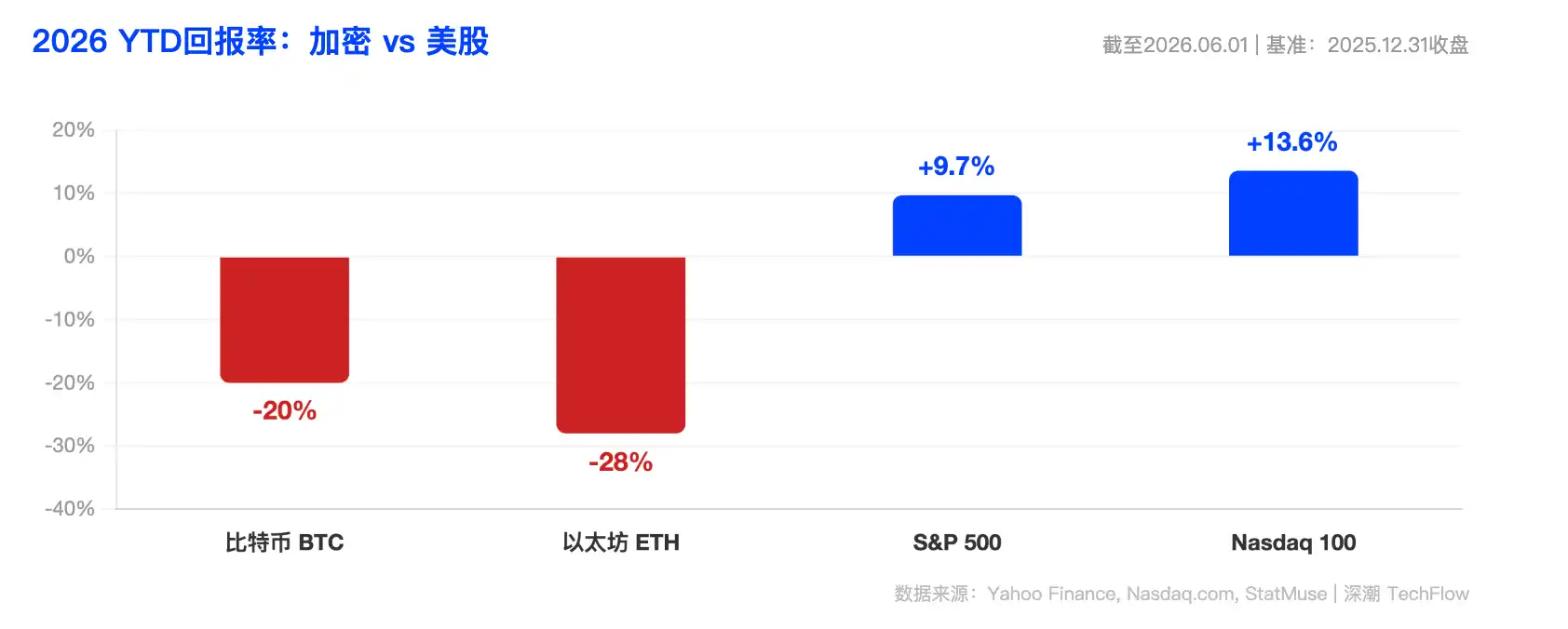
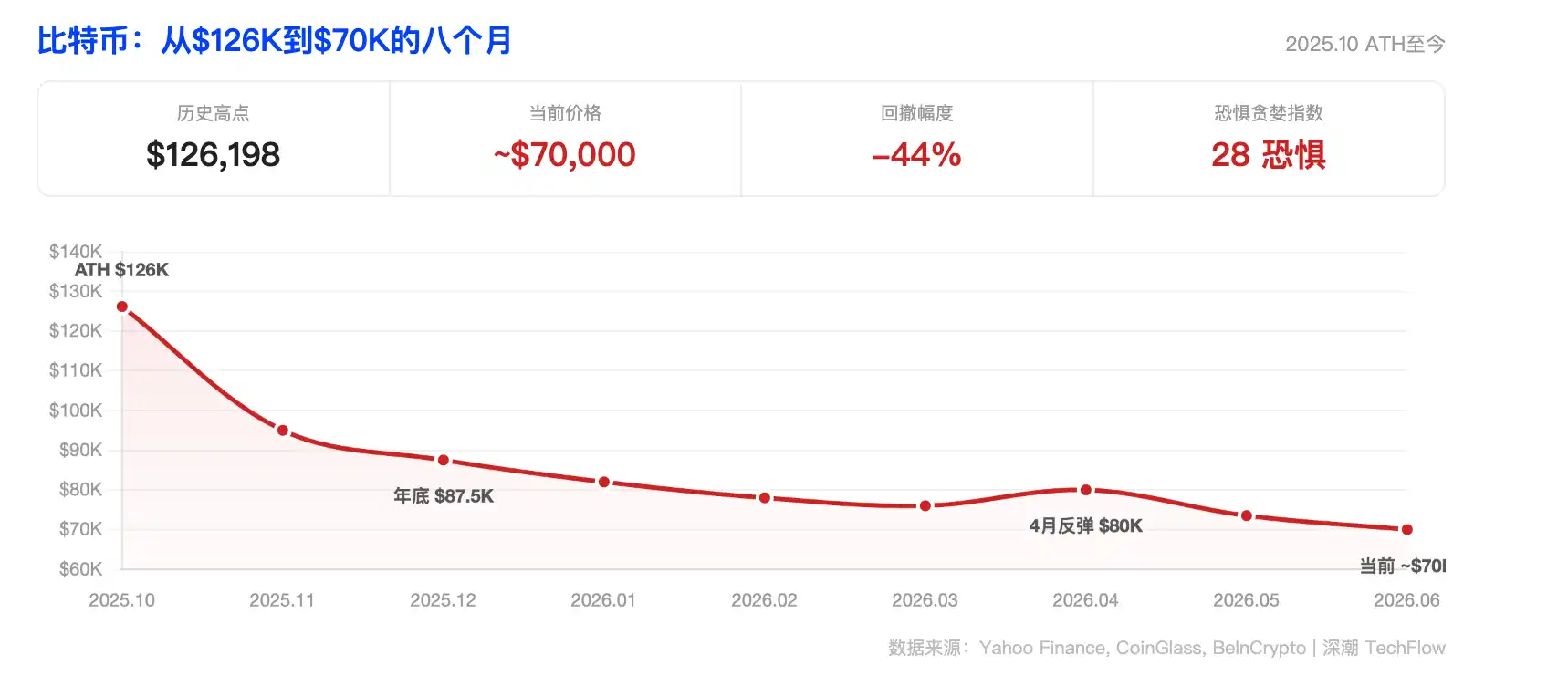
Bitcoin has retreated from its October 2025 all-time high of $126,198 to around $70,000 currently, a drop of about 44%; its Year-to-Date (YTD) decline for 2026 is about 20%. During the same period, the S&P 500 is up about 9.7% YTD. The Nasdaq 100 is up about 13.6%.

With one line rising and the other falling, the gap between them can no longer be described as merely "underperforming."
"Bitcoin Has Died Over 800 Times" vs "The Narrative Really Can't Hold Up This Time"

The most tense exchange in the Reddit discussion occurred between users Giordano86 and think_harder_plz.

Giordano86 is a classic cycle believer: "Be greedy when others are fearful. Markets have cycles. People will soon rotate back into Bitcoin." When someone rebutted, he directly threw out data: "Go look at Bitcoin's 17-year history and tell me you haven't seen cycles. Bitcoin has 'died' over 800 times, it's fine."

Another user, Powerful_Respect_400, was more direct: "I've been here since 2017. The 2017 bull run, the 2021 bull run, 2025... every four years. We might have to wait until 2029."

think_harder_plz's counterattack was equally sharp: Bitcoin's narrative has been constantly "upgrading," from peer-to-peer electronic cash, to digital gold, to an inflation hedge, to an institutional reserve asset. "Every time an old narrative fails, a new one is swapped in." His conclusion: "Cryptocurrency hasn't existed long enough to make such confident assertions. This is the beginning of the end."

Interestingly, another user, keepitcasualbrah, accurately pinpointed the self-contradiction in this statement:

You say in the first part "hasn't existed long enough to conclude," and in the latter part conclude "this is the beginning of the end." This rebuttal gained considerable agreement.
AI Stole the Attention, But What Crypto Truly Lost Was 'Use Cases'

If it were just the old tunes of cycle theory versus end-of-theory, this post wouldn't have triggered so many replies. What truly hit the nerve was the third type of voice: the crypto market is losing not to a bear market, but to AI.

The comment by user optifree1 was heavily cited: "The tech industry is experiencing a once-in-decades productivity revolution, AI is genuinely changing how people work and live. This wave of enthusiasm has sucked away attention from all other markets, and cryptocurrency hasn't yet found any use case with influence close to that of the AI boom."

Crypto's structural issues are indeed evident. Several users corroborated the same judgment from different angles:

The crypto market lacks real use cases for support. User i_am_13th_panic pointed out that despite crypto companies' efforts to expand applications, the only solid use for most cryptocurrencies is "to speculate with it, use it to speculate, or stake it."

User Usually_Sunny raised a sharper paradox: For a currency to be "useful," its value must be relatively stable, but Bitcoin's core investment logic is precisely built on price volatility.

The poster harukasweet also admitted: "Yes, only stablecoins are somewhat useful, DeFi maybe has some use, but too many hacks."

Data Perspective: Institutions Are Pulling Out, Not Just Retail

The Reddit discussion is emotional, but capital flows provide colder validation.

According to BeInCrypto data, Bitcoin spot ETFs recorded approximately $2.3 billion in net outflows in May 2026, the largest monthly outflow for the year and the largest since November 2025. The preceding April and March saw net inflows of about $1.97 billion and $1.32 billion, respectively. Cumulative net ETF inflows have dropped from $58.09 billion in April to $55.79 billion.
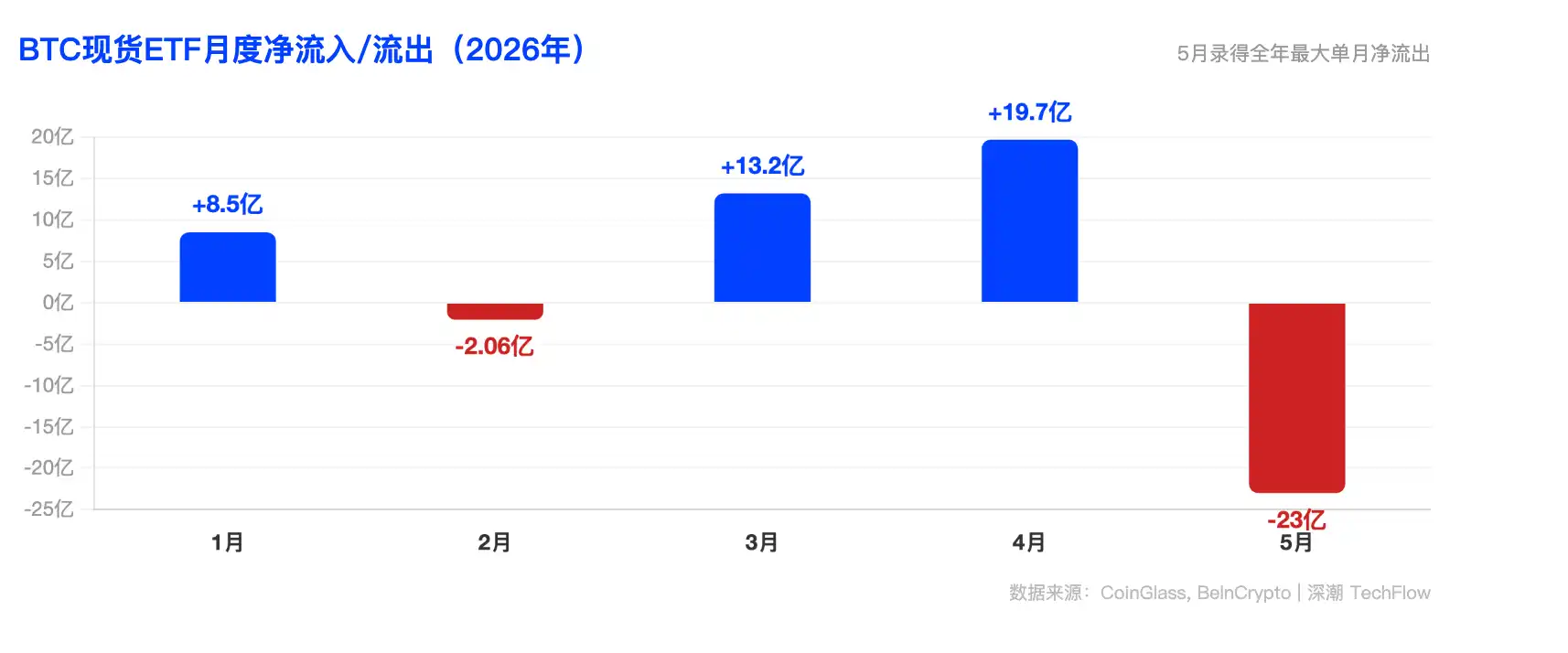
In May, BTC fell only about 3.7%, but the ETF outflow scale was over 10 times the $206 million net redemption in February. Institutions' speed of de-risking is noticeably faster than what the price decline itself suggests.

Meanwhile, the Fear & Greed Index dropped to 28 (Fear), with market sentiment at its lowest level in 2026.

So When Is the Next Rotation Coming?

This is the question the poster harukasweet repeatedly pressed. The answers varied widely, but the honesty was surprisingly high.

User only_linear_joseph's analysis was more pragmatic: Cash and bond yields are now very competitive, which was rare before. As long as the high-interest-rate environment persists, capital has no incentive to flow from fixed income to high-volatility assets. After discussing with the poster, he even self-corrected a contradiction: If inflation remains high, the Fed won't cut rates, and crypto will continue to be left out in the cold.

No one gave a definitive answer. But one comment in the thread perhaps summarizes most people's true state of mind: When asked "what's the hurry," user harukasweet replied with two words: "Opportunity cost."

Every day money isn't in the crypto market is money making gains elsewhere. This is the real source of anxiety in the current crypto community—not "will it come back," but "what am I missing while waiting for it to come back."

Data as of June 2, 2026. This article is an observation of sentiment and does not constitute investment advice.


Пов'язані питання

QWhat are the two main opposing viewpoints regarding Bitcoin's future as discussed in the Reddit thread?

AThe two main opposing viewpoints are the cyclical believers and the 'endgame' believers. Cyclical believers, like user Giordano86, argue that Bitcoin operates on predictable multi-year cycles and will recover as it has in the past. 'Endgame' believers, like user think_harder_plz, argue that Bitcoin's narrative keeps shifting as old use cases fail and that this period might mark the beginning of its decline, citing its relatively short history.

QAccording to the article, what major technological trend is currently diverting attention and capital away from the cryptocurrency market?

AAccording to the article and user comments, the major trend is the Artificial Intelligence (AI) revolution. Users like optifree1 argue that AI is a once-in-a-decades productivity revolution with real-world impact, drawing attention and capital away from cryptocurrencies, which are seen as lacking comparable widespread, practical use cases.

QWhat key structural problem with cryptocurrencies is highlighted by the Reddit users?

AThe key structural problem highlighted is the lack of real-world, practical use cases. Users point out that most cryptocurrencies primarily serve purposes like speculation, trading, or staking. A paradox is noted: for a currency to be broadly 'useful,' it needs price stability, but Bitcoin's core investment thesis is built on price volatility. Only stablecoins are acknowledged as having consistent utility.

QWhat does the data on Bitcoin ETF flows in May 2026 indicate about institutional sentiment?

AThe data indicates a significant shift to negative institutional sentiment. In May 2026, Bitcoin spot ETFs recorded approximately $2.3 billion in net outflows, the largest single-month outflow for the year and the largest since November 2025. This outflow was over 10 times larger than the net redemptions in February, suggesting institutions are de-risking at a pace faster than the modest 3.7% price decline that month would imply.

QWhat does the user 'harukasweet' identify as the true source of anxiety for the current crypto community?

AUser harukasweet identifies 'opportunity cost' as the true source of anxiety. The concern is not just whether cryptocurrency prices will recover, but what potential gains in other markets (like the surging tech stocks) are being missed while waiting for a crypto market revival. This fear of missing out on better-performing assets is the core driver of current community frustration.

Пов'язані матеріали

After Marvell's 32% Surge, the Chinese Chip Family Behind It Emerges

The stock price of Marvell Technology surged 32.5% on June 2nd, driven by NVIDIA CEO Jensen Huang highlighting its custom ASICs and optical interconnects as core to AI data center architecture. This event brought attention to the Chinese semiconductor family behind Marvell: the Dai siblings. The story centers on three siblings, all UC Berkeley graduates, whose three-decade entrepreneurial journey aligns with major semiconductor industry shifts. In 1995, youngest sister Dai Wei Li co-founded Marvell with her husband Sehat Sutardja and his brother, focusing on storage controllers. Eldest brother Dai Wei Min founded EDA company Ultima, later sold to Cadence, and later founded VeriSilicon (芯原) in China, becoming a leading semiconductor IP provider. Second brother Dai Wei Jin co-founded EDA firm Silicon Perspective (sold to Cadence) and GPU IP company Vivante, later acquired by VeriSilicon. The combined "Dai-Sutardja" family network extends beyond Marvell. Their ventures and investments form a comprehensive ecosystem for the post-Moore's Law, chiplet era. Key holdings include: Dream Big Semiconductor (AI SuperNICs, acquired by Arm), Alphawave (high-speed SerDes IP, acquired by Qualcomm), and Silicon Box (a chiplet advanced packaging foundry). VeriSilicon itself thrives on the AI ASIC and IP boom in China. Collectively, the family's AI infrastructure-related portfolio is estimated at over $22 billion. Their strategy represents a distinct path: building critical components for open standards and key manufacturing capacity in the chiplet era, rather than pursuing standalone AI chip dominance. While this path may not create the next NVIDIA, it has enabled repeated successful exits and sustained influence within the global semiconductor industry.

marsbit49 хв тому

After Marvell's 32% Surge, the Chinese Chip Family Behind It Emerges

marsbit49 хв тому

Microsoft is Afraid of Being Marginalized by AI Giants

Microsoft, once the defining force of the PC era, now faces a familiar challenge in the AI age: the risk of being relegated to a profitable but invisible infrastructure provider. This anxiety was laid bare at Build 2026, where CEO Satya Nadella unveiled a major strategic pivot. The catalyst was a quiet April agreement that dissolved Microsoft's exclusive licensing and cloud-hosting deal with OpenAI, its once-vital partner. This erased Microsoft's key AI moat. With OpenAI and Anthropic defining AI applications and gaining enterprise traction—even within Microsoft's own ranks—Nadella had to answer: without exclusivity, what is Microsoft's role? The answer was a suite of seven in-house AI models, a developer-focused AI workstation (Surface RTX Spark Dev Box), and, most crucially, the Agent 365 platform for enterprise AI governance. The models, notably targeting Anthropic's strengths in coding and enterprise, signal a defensive move. However, the broader strategy is to make the models themselves less decisive. Financially, Microsoft's AI revenue is strong, driven largely by Azure running others' models. Yet its user-facing products like Copilot show weak penetration and engagement. Microsoft earns infrastructure money but lacks direct user mindshare. Nadella's core fear is being "hollowed out." As OpenAI and Anthropic prepare for IPOs and gain financial independence, they may build their own infrastructure, threatening Azure's lucrative AI revenue stream. Microsoft's window is to entrench itself deeper: not as the model creator, but as the indispensable platform for securely deploying, managing, and governing all AI models within the enterprise through Agent 365. Build 2026 revealed Microsoft's bet: in the AI era, the ultimate power lies not in any single model, but in the enterprise "operating system" that controls them. Nadella is determined to ensure Microsoft is the driver of this new era, not just a passenger.

marsbit1 год тому

Microsoft is Afraid of Being Marginalized by AI Giants

marsbit1 год тому

CPU, Quietly Returning to the Center of the AI Computing Power Stage

Over the past three years, AI computing power narratives have been dominated by GPUs. However, starting in 2026, this story began to shift. While training large models remains GPU-intensive, the rapid growth of inference and AI agent workloads, which require high levels of task orchestration, concurrency, and data flow management, has highlighted a renewed critical role for CPUs. These are tasks GPUs are not designed to handle. Intel's recent launch of the Xeon 6+ processor, built on its Intel 18A process and featuring up to 288 efficiency cores (E-cores), exemplifies this strategic pivot. It is positioned not as a mere companion to GPUs but as the essential "control plane" for AI infrastructure, optimized for high-density, energy-efficient, and high-throughput workloads characteristic of AI agents and inference. This "CPU resurgence" is not about CPUs outperforming GPUs in raw computation. It reflects a systemic bottleneck: as AI scales from training single models to deploying countless intelligent agents, the demand for coordination and data handling surges. Major cloud providers are also developing their own high-density ARM-based server CPUs for similar workloads. However, Intel's success with this strategy faces significant challenges. Competition includes NVIDIA's integrated CPU-GPU solutions, the expanding adoption of cloud vendors' in-house ARM CPUs, and the crucial market test of Intel's 18A manufacturing process against rivals like TSMC's N2. In conclusion, CPUs are indeed reclaiming a central, though redefined, role in AI compute—managing the complex orchestration that enables massive-scale AI deployment. While the trend is clear, which company will ultimately lead this CPU resurgence remains an open question to be decided in the data centers of 2027 and beyond.

marsbit1 год тому

CPU, Quietly Returning to the Center of the AI Computing Power Stage

marsbit1 год тому

Торгівля

Спот
Ф'ючерси
活动图片




