Rare Annualized Rate of 400%: Is TradeXYZ Handing Out Money to Oil Bulls?

marsbitОпубліковано о 2026-04-10Востаннє оновлено о 2026-04-10

Анотація

Amidst volatile oil markets due to geopolitical tensions, Trade.xyz’s WTIOIL-USDC perpetual contract exhibited an unusually negative annualized funding rate of -300% to -400%. This meant long positions received approximately 1% of their position value daily from shorts. The anomaly stemmed from the structure of WTI futures curves in extreme backwardation, where near-month (May) contracts traded at a significant premium to far-month (June) contracts. Trade.xyz’s oracle gradually shifts price weighting from near-month to far-month over five trading days during rollover. Anticipating this decline, traders heavily shorted the perpetual, driving the funding rate deeply negative. Three strategies were discussed: 1. Shorting Trade.xyz’s contract while going long on CME’s far-month futures—initially profitable but later eroded by high funding costs. 2. Shorting far-month futures and longing Trade.xyz’s near-month contract before rollover, which gained traction as arbitrage opportunities emerged. 3. Betting against funding rates via Boros, a rate-trading platform, though limited by low leverage and high slippage. The situation highlights how DeFi traders are adapting to traditional futures mechanics and advanced instruments like rate markets, reflecting the evolving infrastructure of crypto-native trading platforms.

Amid the uncertain situation of the Iran war, the crude oil market is experiencing significant volatility.

At the same time, a rare phenomenon has appeared on Trade.xyz's WTIOIL-USDC crude oil perpetual contract: the annualized funding rate has stabilized between -300% and -400%. This means that any trader willing to go long at this moment can receive profits equivalent to 1% of their principal daily from the shorts.

The market doesn't give away money for no reason. To understand this反常的 negative funding rate, we need to start with the basics of futures trading.

Rollover

Crude oil futures are a series of contracts arranged by delivery month. Contracts for May delivery, June delivery, July delivery, each with its own price. When the front month is about to expire, the market must switch from the old contract to the new contract; this action is called rollover.

Under normal circumstances, back-month contracts imply that oil merchants will store the oil for several additional months, incurring extra storage costs. Therefore, the delivery price should logically be higher. The market phenomenon where future contracts are more expensive than the near month is called Contango. Conversely, the situation where the near month is more expensive than the far month is called backwardation. This usually occurs when there is a current shortage, and everyone wants to get the oil immediately.
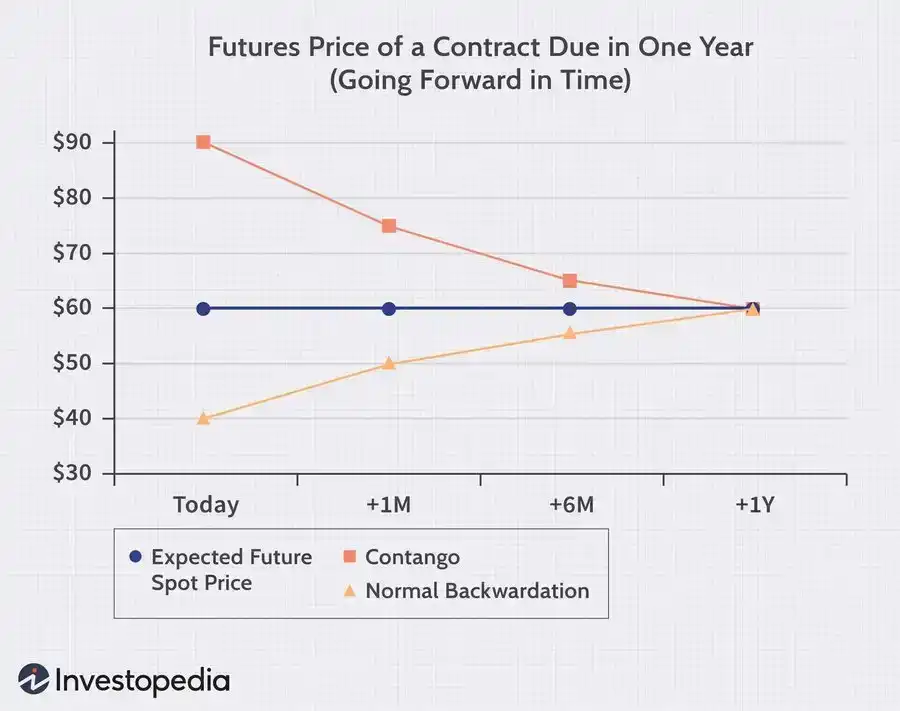
During this rollover period for Trade.xyz's crude oil, the crude oil futures market was in this near-high, far-low structure.
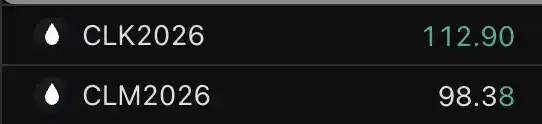
From late March to early April 2026, the WTI crude oil curve was in an extreme state of backwardation. As shown in the chart above, the price of the May contract (front month) remained consistently higher than the June contract (back month), with the spread widening to over $14 at one point.

The WTIOIL-USDC perpetual contract on Trade.xyz has its oracle pegged to this front-month May contract.

But we won't be trading this May contract forever. It must be rolled over to the next June contract. So how is the rollover accomplished?

According to the Tradexyz documentation, the oracle will take 5 trading days to gradually shift the price weighting from 100% front-month contract to 100% back-month contract.
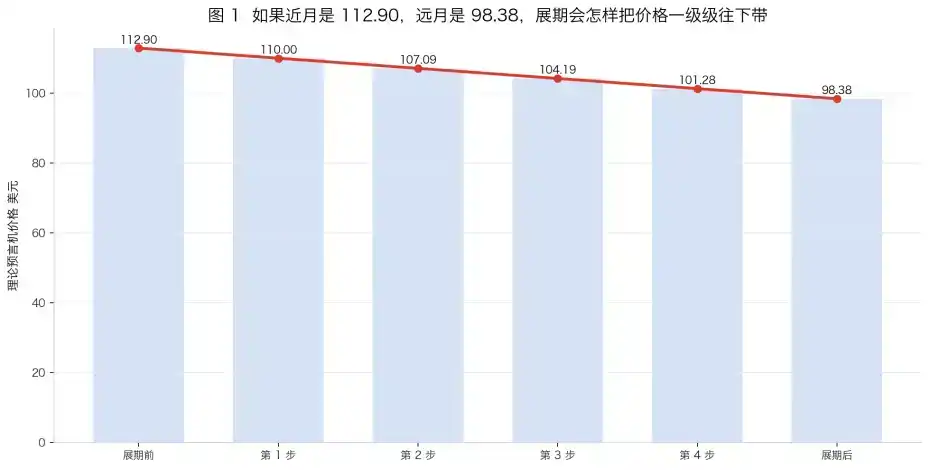
Against the backdrop of "backwardation," this means the oracle price on Tradexyz will drop from the front-month price to the back-month price over 5 trading days.
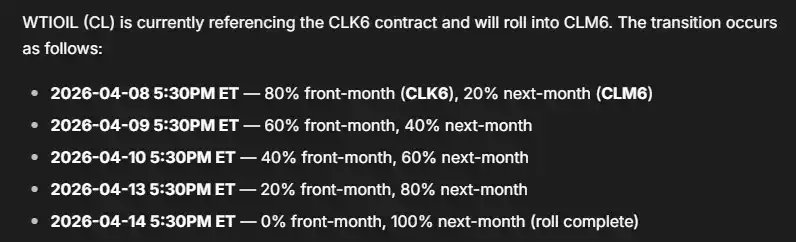
Market participants familiar with this mechanism have a clear expectation of the contract price after the rollover. Everyone knows it will fall, so they naturally rush to short. Shorts accumulate, the funding rate turns negative, and shorts start paying longs.
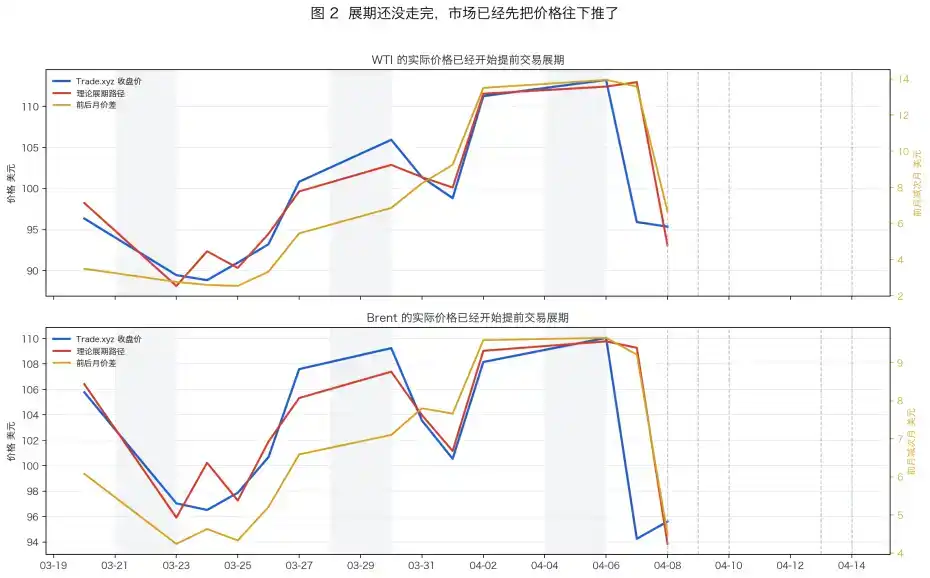
From an arbitrage-free principle perspective, this is normal. The spread between the front and back month gives short sellers a profit. The funding rate will reduce this profit. The larger the spread, the higher the negative funding rate the market charges.

Once the negative funding rate reaches a certain level, this seemingly obvious arbitrage opportunity will be eroded. The cost for short sellers will completely cover the profit.

Strategies

How to make money in such a market context? Here are three common strategies.

1. Short the crude oil contract on Tradexyz at the current price, while simultaneously going long the back-month contract on CME.

This seems like a risk-neutral strategy to stably earn the spread, but it fails to consider several factors.

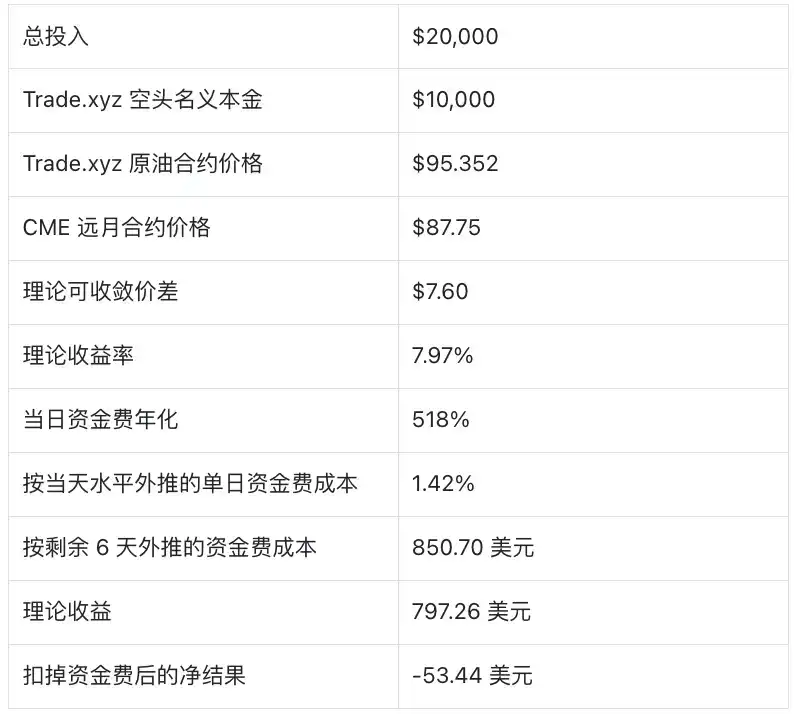
Suppose you short Trade.xyz's WTI contract at $95.352 on April 8th, while going long the June futures contract at $87.75, each with a notional principal of $10,000. If both sides eventually converge, you could theoretically get a spread of $7.60, about $797 in profit. But on April 8th, the daily funding rate for the short position was already 1.42%. Based on the remaining 6 days until rollover completion, the funding fee would cost $851. At this point, the net profit is only -$53. This doesn't even include transaction fees and slippage.
Abraxas capital implemented this strategy starting on March 19th, after the last rollover was completed. Their Brent crude oil position on tradexyz accounted for 20% of the open interest in that market and yielded huge profits early on when the funding rate remained relatively neutral. However, as more arbitrageurs flooded in, the funding fee has devoured 80% of their arbitrage profits.

The massive position also means they find it difficult to exit and are forced to pay passively.

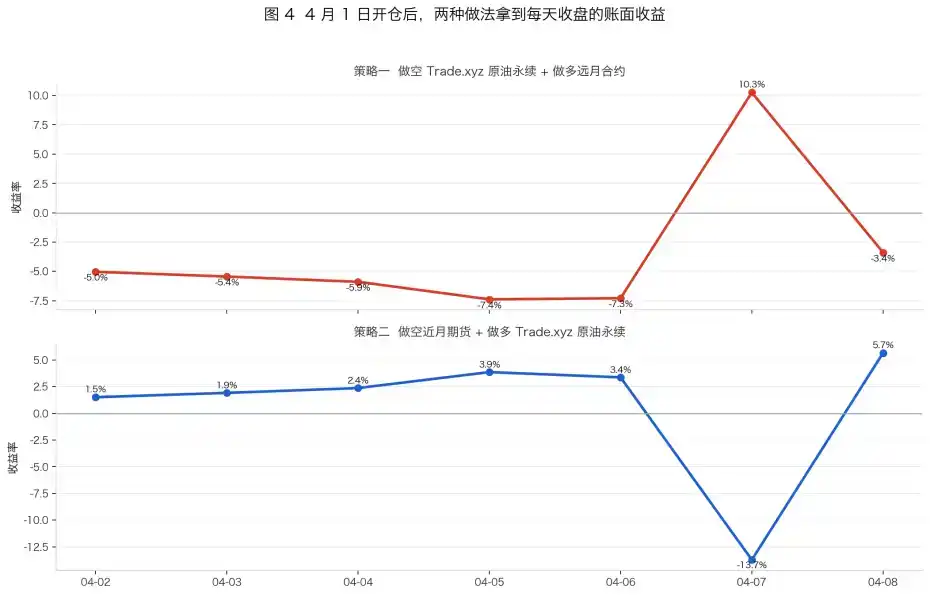
2. Short the back-month futures contract, go long the xyz front-month contract, and close the position before the rollover begins.

This trade is almost the counterparty to Strategy 1, betting that the market is over-arbitraged. After April 1st, this strategy could indeed yield profits.
3. Short the funding rate for the xyz contract on Boros before the rollover begins.

Boros is a market developed by the Pendle team specifically for trading rates (funding rates). In Boros's crude oil contract market, what is traded is the market's expectation of the funding rate for Trade.xyz's crude oil contract over the coming period. If users believe the negative funding rate will deepen further, they can short the market's funding rate contract.
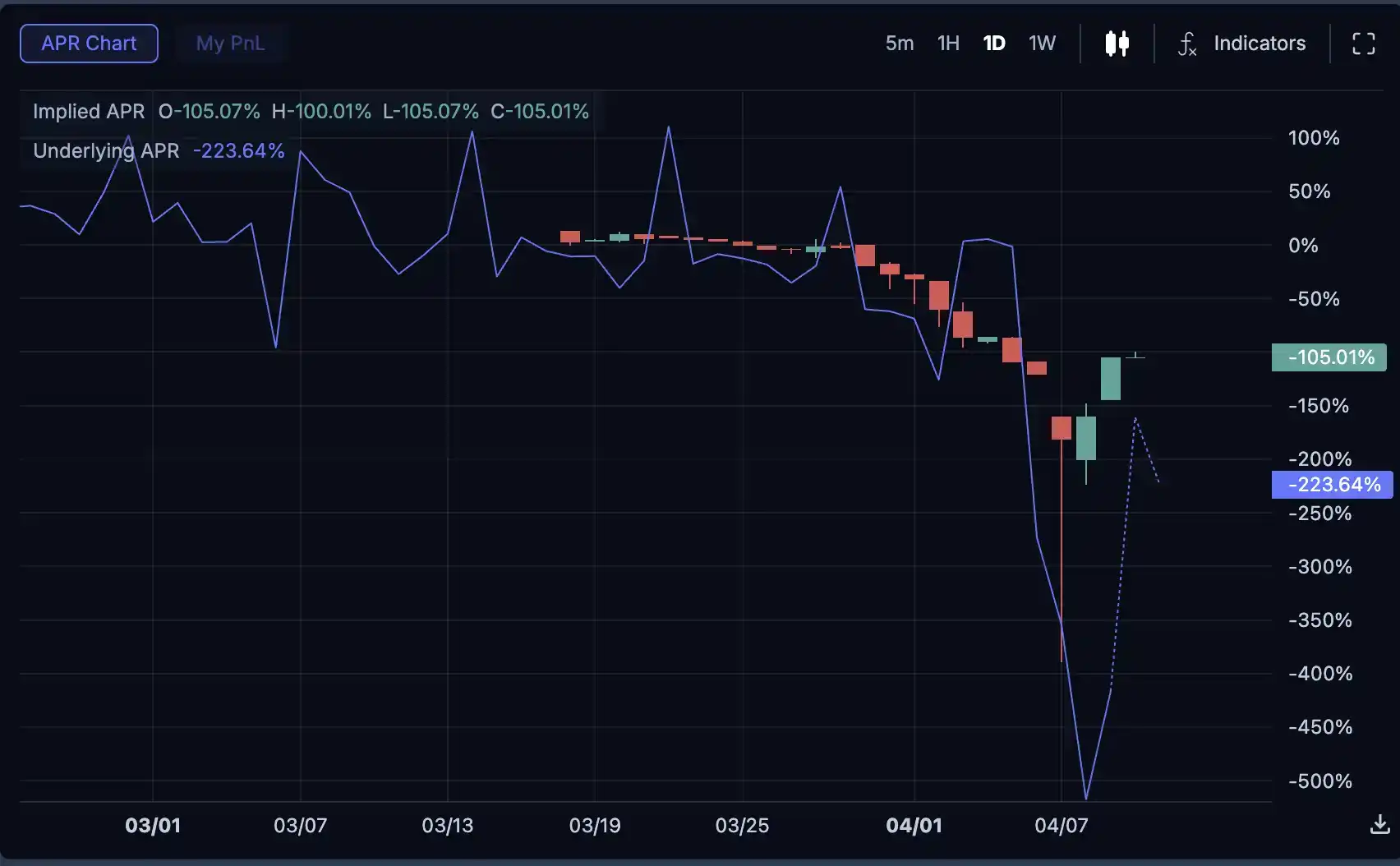
However, limited by slippage costs, position limits, transaction fees, and extremely low capital efficiency (only supporting 0.2x leverage), this trade also struggles to achieve the ideal high returns.

Conclusion

The rise of RWA trading platforms like Trade.xyz is forcing a group of "crypto traders" to become "futures traders." DeFi players are also starting to learn the CME rollover calendar, calculate front-back month spreads, and make decisions based on the funding rate curve on Boros.

Trading platforms are continuously iterating, and market participants are also adapting to new infrastructure.


Трендові криптовалюти

Пов'язані питання

QWhat is the annualized funding rate for the WTIOIL-USDC perpetual contract on Trade.xyz, and what does it imply for traders?

AThe annualized funding rate for the WTIOIL-USDC perpetual contract on Trade.xyz is between -300% and -400%. This means that traders who take a long position at this time can receive a profit equivalent to approximately 1% of their principal daily, paid by the short sellers.

QWhat market structure is causing the extreme negative funding rate on Trade.xyz's crude oil perpetual contract?

AThe extreme negative funding rate is caused by a market structure called backwardation, where the near-month futures contract (May) is trading at a higher price than the far-month contract (June). This creates an expectation that the price will drop during the rollover period, leading to a surge in short positions and negative funding rates.

QHow does the rollover mechanism work for the WTIOIL-USDC perpetual contract on Trade.xyz?

AAccording to Trade.xyz's documentation, the oracle takes five trading days to gradually shift the price weighting from 100% of the near-month contract to 100% of the far-month contract. During this rollover period in a backwardated market, the oracle price is expected to drop from the higher near-month price to the lower far-month price.

QWhat was one of the strategies mentioned for profiting in this market, and what was its drawback?

AOne strategy was to short the crude oil contract on Trade.xyz while simultaneously going long on the far-month futures contract on CME. The drawback is that the high negative funding rate can consume most of the potential profits from the price difference. For example, a calculation showed that funding fees could cost $851 over six days, nearly erasing the $797 theoretical gain from the price spread, not including transaction costs and slippage.

QWhat is Boros, and how can it be used to trade in this context?

ABoros is a market developed by the Pendle team专门 for trading rates (funding rates). On Boros's crude oil contract market, traders can speculate on the expected funding rate for Trade.xyz's crude oil contract. If a trader believes the negative funding rate will deepen, they can short the funding rate合约 on Boros. However, this strategy is limited by slippage, position caps, trading fees, and low capital efficiency (only supporting 0.2x leverage).

Пов'язані матеріали

Annual Salary of Millions Competing for Electricians, Meta Rushes to Open Its Own Technical School

The AI boom is facing an unexpected bottleneck: a severe shortage of skilled construction workers and electricians. As tech giants like Meta, OpenAI, and Alphabet race to build massive data centers—such as OpenAI's $16 billion "Stargate" project—they are hitting a critical labor wall. The U.S. needs an estimated 130,000 more electricians, 240,000 construction workers, and 150,000 supervisors by 2030 for AI infrastructure alone, but tens of thousands of electrician jobs go unfilled each year. While AI companies offer high premiums, with electricians earning up to $280,000 annually, worker scarcity still causes massive losses—delays on a single project can cost $14.2 million per month. The complexity of building AI data centers, which require immense power (equivalent to powering hundreds of thousands of homes), sophisticated electrical systems, and advanced liquid cooling solutions, demands highly skilled technicians who are in short supply. To combat this, companies are investing heavily in training. Meta has committed $115 million to a free training school offering tuition, housing, and stipends, targeting 5,000 new workers. OpenAI is partnering with unions to secure skilled labor. These efforts are paying off, with a significant rise in Gen Z interest in trade schools over college. However, the power demands are staggering. AI data centers are driving a rapid surge in electricity consumption, projected to account for up to 12% of U.S. power use by 2028 and raising costs for consumers. Furthermore, the construction boom is project-based, leading to a potential future glut of trained workers once building peaks, which could depress wages industry-wide. The race for AI supremacy now depends as much on skilled hands as on advanced chips.

marsbit1 год тому

Annual Salary of Millions Competing for Electricians, Meta Rushes to Open Its Own Technical School

marsbit1 год тому

OpenAI No Longer Sells Its Most Expensive Model for Profit

OpenAI is shifting its business strategy away from promoting its most expensive, flagship models for every task. Recent price cuts—80% for GPT-5.6 Luna and 20% for Terra—signal a deeper change: the company now actively advises users that many tasks don't require the most powerful model. Instead, OpenAI recommends a tiered approach: use the high-end GPT-5.6 Sol for complex planning and analysis, then delegate execution to cheaper models like Luna. This mirrors moves by Anthropic, which recently launched Claude Opus 5 at half the price of its top model, Fable 5. Both companies are de-emphasizing flagship models as primary revenue drivers, using them instead for brand prestige and technological showcases. The industry is entering a "mass-market" phase, similar to automotive, where high-volume, cost-effective models handle daily operations and drive scale. OpenAI's price reductions are partly enabled by AI models themselves optimizing underlying code and infrastructure, creating a self-reinforcing cycle of efficiency gains and cost reduction. Competition is shifting from "who is smartest" to "who offers the best value." The goal is no longer selling individual models but fostering widespread API adoption and ecosystem lock-in. By making AI calls cheap and ubiquitous, companies like OpenAI aim to become the indispensable, utility-like infrastructure powering automated workflows—the "water and electricity" of software, quietly embedded everywhere.

marsbit1 год тому

OpenAI No Longer Sells Its Most Expensive Model for Profit

marsbit1 год тому

Торгівля

Спот

Популярні статті

Як купити WAR

Ласкаво просимо до HTX.com! Ми зробили покупку WAR (WAR) простою та зручною. Дотримуйтесь нашої покрокової інструкції, щоб розпочати свою криптовалютну подорож.Крок 1: Створіть обліковий запис на HTXВикористовуйте свою електронну пошту або номер телефону, щоб зареєструвати обліковий запис на HTX безплатно. Пройдіть безпроблемну реєстрацію й отримайте доступ до всіх функцій.ЗареєструватисьКрок 2: Перейдіть до розділу Купити крипту і виберіть спосіб оплатиКредитна/дебетова картка: використовуйте вашу картку Visa або Mastercard, щоб миттєво купити WAR (WAR).Баланс: використовуйте кошти з балансу вашого рахунку HTX для безперешкодної торгівлі.Треті особи: ми додали популярні способи оплати, такі як Google Pay та Apple Pay, щоб підвищити зручність.P2P: Торгуйте безпосередньо з іншими користувачами на HTX.Позабіржова торгівля (OTC): ми пропонуємо індивідуальні послуги та конкурентні обмінні курси для трейдерів.Крок 3: Зберігайте свої WAR (WAR)Після придбання WAR (WAR) збережіть його у своєму обліковому записі на HTX. Крім того, ви можете відправити його в інше місце за допомогою блокчейн-переказу або використовувати його для торгівлі іншими криптовалютами.Крок 4: Торгівля WAR (WAR)Легко торгуйте WAR (WAR) на спотовому ринку HTX. Просто увійдіть до свого облікового запису, виберіть торгову пару, укладайте угоди та спостерігайте за ними в режимі реального часу. Ми пропонуємо зручний досвід як для початківців, так і для досвідчених трейдерів.

304 переглядів усьогоОпубліковано 2024.12.11Оновлено 2026.06.02

Як купити WAR

Обговорення

Ласкаво просимо до спільноти HTX. Тут ви можете бути в курсі останніх подій розвитку платформи та отримати доступ до професійної ринкової інформації. Нижче представлені думки користувачів щодо ціни WAR (WAR).

活动图片












