Ranger Public Offering Introduces New Features, Can a Grassroots Team Win Market Trust?

marsbitОпубліковано о 2026-01-08Востаннє оновлено о 2026-01-08

Анотація

On January 6th, Ranger Finance, a DEX aggregator on Solana, launched its ICO for the RNGR token via the MetaDAO platform to raise funds and accelerate development. The project aims to address fragmented liquidity and poor execution quality in the derivatives market by using an intelligent order routing system that scans multiple venues for optimal trade execution. It also offers a unified interface for managing diverse trading positions and plans to introduce cross-margin support. The public sale, running until January 10th, has a minimum fundraising target of $6 million. If exceeded, Ranger will initiate a buyback plan to repurchase and burn tokens at the difference between the ICO and listing price. The total token supply is 25,625,000, with 10 million allocated to the ICO. Team tokens (29.6% of supply) are subject to performance-based vesting, unlocking at multiples of the ICO price (2x to 32x). Ranger raised $1.9 million in December 2024 from investors like RockawayX and Asymmetric. The team, including co-founders with backgrounds at SolanaFM and mtnCapital, is partially anonymous, which may pose trust issues despite alignment incentives. Currently, the ICO has raised $2.9 million from nearly 1,800 investors, with market predictions suggesting a high probability of exceeding $30 million.

On January 6th, the public offering (ICO) for Ranger Finance, a DEX aggregator on the Solana blockchain, officially launched. This public offering is conducted through the MetaDAO platform to raise funds for Ranger's token, RNGR, aiming to expand the team's capabilities and accelerate development.

Currently, the daily derivatives trading volume on Solana, Arbitrum, and Hyperliquid reaches approximately $50 billion. However, most trading platforms still lock each order to a single trading venue, leading to fragmented liquidity, reduced execution quality, and ultimately a worse experience for traders. Ranger's core intelligent order routing system scans integrated trading venues in real-time, assesses liquidity depth, intelligently splits large orders, and executes trades at the optimal price.
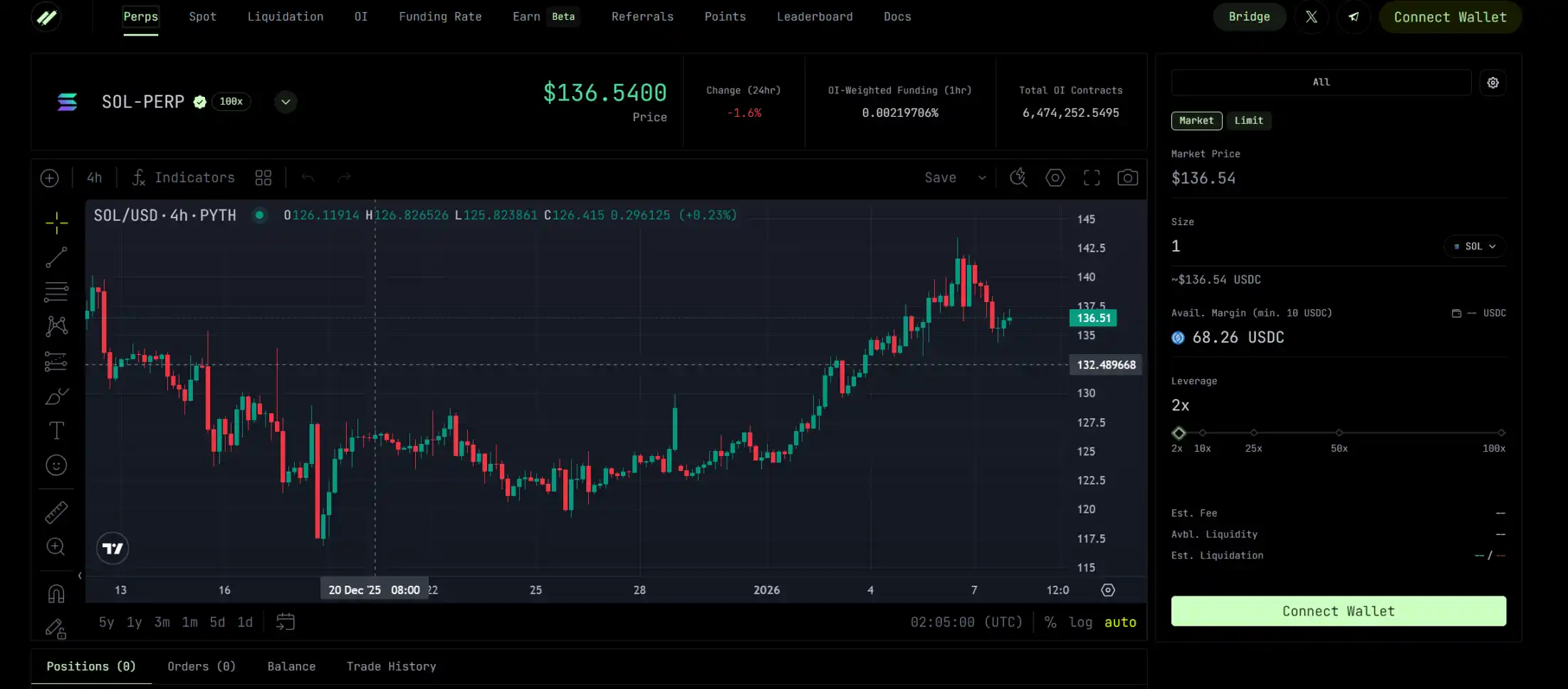
Ranger Finance also provides an intuitive interface for managing diverse trading positions, all operable on a single platform. The cross-margin support system (coming soon) allows the use of multiple assets in a single wallet as collateral, enabling greater flexibility and capital efficiency.

Public Offering Minimum Target $6 Million, Team Sets Performance-Based Unlock

The public offering runs until January 10th, with the officially announced minimum fundraising target of $6 million and a monthly spending limit of $250,000 (project founders can use this amount at their discretion each month without submitting a DAO proposal. The DAO reserves the right to adjust this amount in the future). Ranger point holders have priority in committing funds to the ICO. This priority is allocated proportionally among all point holders, with the remaining portion then allocated proportionally among non-point committers.

If the fundraising exceeds the minimum target ($6 million), Ranger will initiate a buyback plan, repurchasing tokens within 90 days based on the difference between the ICO price and the post-listing price. The repurchased tokens will be burned.

Ranger's total token supply is 25,625,000. The ICO token pool consists of 10 million tokens. Existing investors are allocated a total of 4,356,250 tokens (with a 24-month linear vesting period).

Notably, the project has specifically set up performance rewards. Team performance reward package: 7,600,000 tokens (18-month lock-up period, then unlocked based on price, using a 3-month TWAP as a benchmark, unlocking at 2x, 4x, 8x, 16x, and 32x the ICO price).

Ambassadors and ecosystem partners: 768,750 tokens (25% unlocked immediately, remaining 25% vested linearly over 6 months).

The remaining supply is for providing liquidity, with 20% of the raised funds plus 2 million tokens to be deposited into FutarchyAMM, and 900,000 tokens to be deposited unilaterally into Meteora's liquidity pool.

Previously Raised Funding at a $30 Million Valuation

In December 2024, during a period of excitement in the crypto market, Ranger completed a $1.9 million funding round led by RockawayX, with participation from Asymmetric, Big Brain Holdings, RISE Capital, and Anagram, among others.

This year, Ranger not only launched tokenized stocks based on xStocks but also acquired the strategy protocol Voltr in November.

Public information about the Ranger team is relatively limited. Its co-founder, Fathurrahman Faizal, graduated from Singapore Management University and previously served as COO at SolanaFM. Another co-founder, Barrett Williams, is also a co-founder of mtnCapital and has invested in the on-chain order book trading protocol BULK and MetaDAO.

The team allocation accounts for 29.6% of the total supply, unlocking only upon reaching ICO price milestones (e.g., 2x, 4x, 8x, 16x, 32x FDV). This incentive mechanism aligns with investor interests and is one of the few highlights. The team emphasizes "no pre-mining" and transparent governance but lacks specific links for verification, which may raise trust issues. The project claims to be built on TechFlow but does not disclose core developer experience.

Overall, the team's anonymity aligns with DeFi culture, but for a project seeking to raise millions in a public offering, this could be a potential risk point.
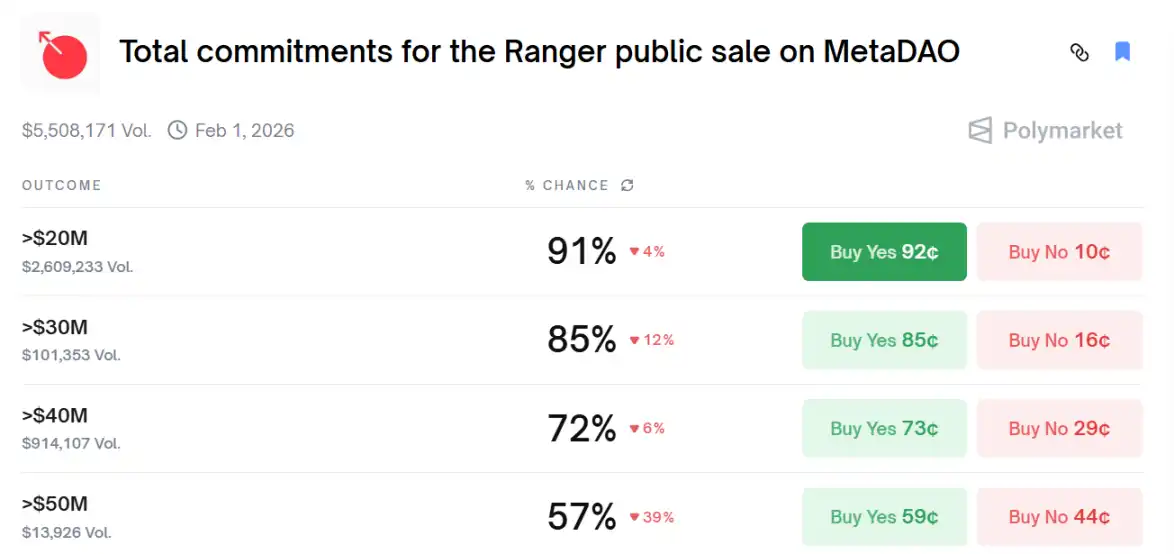
As of now, the official website shows that fundraising has reached $2.9 million, with nearly 1,800 investors participating. Polymarket data indicates an 85% probability that the market is betting on the public offering subscription amount exceeding $30 million.


Трендові криптовалюти

Пов'язані питання

QWhat is the main purpose of Ranger Finance's ICO and on which platform is it being conducted?

AThe ICO aims to raise funds for Ranger Finance's RNGR token to expand team capabilities and accelerate development. It is being conducted on the MetaDAO platform.

QWhat is the core technological solution that Ranger Finance provides to address liquidity fragmentation in decentralized exchanges?

ARanger Finance's core solution is its smart order routing system, which scans integrated trading venues in real-time, assesses liquidity depth, intelligently splits large orders, and executes trades at the best available price.

QWhat is the minimum fundraising target for the Ranger ICO and what happens if this target is exceeded?

AThe minimum fundraising target is $6 million. If this target is exceeded, Ranger will initiate a buyback plan within 90 days to repurchase tokens at the difference between the ICO price and the post-listing price, with the repurchased tokens being burned.

QHow is the team's token allocation structured to align their incentives and investor interests?

AThe team's allocation of 7,600,000 tokens has an 18-month lockup period, followed by unlocks based on price milestones. These unlocks occur when the token's 3-month TWAP reaches 2x, 4x, 8x, 16x, and 32x the ICO price.

QWhat are some of the potential trust issues or risks associated with the Ranger Finance project mentioned in the article?

APotential risks include the team's relatively anonymous nature, which is common in DeFi but a concern for a project seeking a public sale. The article also notes a lack of specific links to substantiate claims of 'no pre-mining' and transparent governance, as well as undisclosed core developer experience.

Пов'язані матеріали

Analyzing the Impact of AI on Economic Growth and Productivity

**Title: Analyzing AI's Impact on Economic Growth and Productivity** This article examines three contrasting views on AI's influence on economic growth and productivity. **The Optimistic View** posits that AI, especially through automating R&D ("recursive self-improvement"), could dramatically accelerate growth, even triggering a technological "singularity" with explosive, potentially infinite, economic expansion. **The Moderate/Mainstream View** acknowledges AI's productivity benefits but emphasizes significant real-world constraints that could limit its impact. These include: limited cost savings per task, structural ceilings on which jobs and industries are "exposed" to AI, adoption bottlenecks (e.g., compute, energy, regulatory hurdles), and the "weak link" effect where non-automatable tasks cap overall gains. Consequently, the realized AI dividend may be far lower than optimistic projections, with estimates typically ranging from 0.1% to 1.3% annual productivity growth. **The Pessimistic View** stems from two strands. The first aligns with the moderate view but applies extremely conservative assumptions about task exposure and efficiency gains, yielding minimal projected impact. The second introduces a demand-side critique: if AI primarily replaces rather than augments labor, it could depress labor's share of income, weaken consumer demand, and create a "demand trap" that ultimately stifles growth, unless offset by redistribution policies. **The authors' assessment** is nuanced: * **Short-term (1-2 years):** AI will support growth primarily through investment spending, not significant productivity gains. * **Medium-term (3-5 years):** Three potential paths emerge based on AI demand and bottleneck severity: 1. **"Optimistic Path":** High demand, few bottlenecks. Rapid productivity gains but risk of major job displacement and social conflict without redistribution. 2. **"Moderate Path" (most likely):** High demand but significant, surmountable bottlenecks. Leads to moderate productivity gains, financial market volatility (K-shaped returns), and sectoral job losses. 3. **"Pessimistic Path":** Low demand or severe bottlenecks. Minimal productivity and growth impact, triggering financial market corrections but allowing a smoother societal transition with less labor disruption. * **Long-term:** AI holds potential for a major productivity revolution and prosperity. The conclusion stresses that no path is smooth. Technologically "optimistic" outcomes could be socially detrimental, while "pessimistic" technological diffusion might be more socially stable. Policymakers must monitor developments and prepare balanced responses to manage economic, financial, and social sustainability.

marsbit5 хв тому

Analyzing the Impact of AI on Economic Growth and Productivity

marsbit5 хв тому

The New Cold War is a Tech Stock War

The New Cold War is a Tech Stock War The article argues that the contemporary geopolitical and economic rivalry between the US and China represents a "New Cold War," but one fundamentally fought through technology and financial markets, not physical barriers or conventional trade. Historically, US dominance was secured through financial systems. The Soviet Union, reliant on the rigid "Transferable Ruble," was ultimately undermined by its dependency on the US dollar for oil trade. Later, Japan's semiconductor challenge was countered not just by tariffs (e.g., Plaza Accord, 301 investigations) but by binding it to US Treasury bonds. China presents a more complex, "embedded" challenger. While it holds vast dollar reserves and US debt like Japan, its industrial base is stronger and more diversified than the Soviet Union's. Surviving the initial 2018 trade war phase, the conflict has evolved into a "tech-financial war." The core battlefield is now the stock market. US tech stocks (AI, semiconductors) are treated as sovereign assets, buoyed by bipartisan national will. China is pushing to strengthen its own financial markets to convert industrial strength into financial power and fund its tech ambitions. Companies like ChangXin (semiconductors), Moonshot AI, and DJI compete not just for market share but as financial proxies for their respective systems. The new paradigm is moving from globally efficient monopolies (Apple, Google) towards companies that achieve monopolistic profits within their respective geopolitical spheres. This competition over "pricing power" and financial valuation in segmented markets defines the current era, making the stock market the primary arena for this tech-centric struggle.

marsbit15 хв тому

The New Cold War is a Tech Stock War

marsbit15 хв тому

RWA Weekly: Ten European Financial Institutions Establish Tokenized Asset Cooperative; Ondo Launches New Execution Network Ondo Network

RWA Weekly: European Banks Form Tokenized Asset Cooperative; Ondo Launches New Execution Network Ondo Network Covering July 24-31, 2026, the RWA sector saw a steady on-chain total value locked (TVL) of $36.8 billion, with holder count hitting a record high. However, stablecoin transfer volumes fell sharply (~30%), indicating low on-chain settlement demand. Key regulatory moves include South Korea advancing stablecoin legislation and a push to scrap crypto taxes, Kenya lowering capital requirements for stablecoin issuers, and Zimbabwe approving seven projects for its crypto sandbox. In project developments, BIS-led Project Agorá successfully tested cross-border payments with tokenized funds across six currencies. Ten major European financial institutions formed the RL1 blockchain cooperative to build tokenized asset infrastructure. Other notable updates: Aviva launched a tokenized dollar liquidity fund on XRPL, POSCO International tokenized commercial invoices on Injective, and a Brazilian farmer used tokenized cattle as collateral for a loan. Additional progress includes BNY Mellon migrating its core transfer agent operations to blockchain, Securitize gaining SEC investment advisor registration, and Tether’s compliant stablecoin USA₮ launching on Celo. Ondo Finance introduced Ondo Network, a new execution layer focused on speed and privacy, moving away from its initial chain plans. An analysis highlights that despite the growing scale of on-chain RWAs (~$32B), approximately 90% remain underutilized in DeFi, pointing to a critical challenge in unlocking liquidity and fostering real-world application beyond mere issuance.

marsbit15 хв тому

RWA Weekly: Ten European Financial Institutions Establish Tokenized Asset Cooperative; Ondo Launches New Execution Network Ondo Network

marsbit15 хв тому

South Korean Stock Market Sees Sharp Rebound After Forceful De-leveraging, SK Hynix Rises 30%

On July 31, South Korean stocks staged a historic rebound. The benchmark KOSPI index surged 18.27%, with chipmaker SK Hynix hitting a 30% gain limit. This followed a brutal, near-40% decline in the KOSPI over the previous month, driven largely by a deleveraging spiral involving leveraged ETFs. Analysts attributed the sharp sell-off to structural liquidity issues rather than deteriorating corporate fundamentals. The rally was triggered by a confluence of positive catalysts. Firstly, strong earnings from U.S. cloud giants Microsoft and Amazon alleviated fears of an "AI bubble burst," boosting global tech sentiment. Secondly, SK Group Chairman Chey Tae-won made a rare personal purchase of SK Hynix shares, seen as a strong vote of confidence. Thirdly, the South Korean government announced a 20 trillion won ($139 billion) AI investment fund. In response to the market turmoil, South Korean regulators are tightening controls on leveraged ETFs, admitting oversight shortcomings. Measures include raising minimum cash保证金 requirements for散户 investors and suspending new product launches. While the rebound signals eased liquidity pressure, analysts note deep structural issues remain. The market's future stability is seen as dependent on global tech capital expenditure trends and memory chip price cycles, with some viewing the surge as a technical correction rather than a definitive trend reversal.

marsbit35 хв тому

South Korean Stock Market Sees Sharp Rebound After Forceful De-leveraging, SK Hynix Rises 30%

marsbit35 хв тому

Торгівля

Спот

Популярні статті

Як купити WIN

Ласкаво просимо до HTX.com! Ми зробили покупку WINkLink (WIN) простою та зручною. Дотримуйтесь нашої покрокової інструкції, щоб розпочати свою криптовалютну подорож.Крок 1: Створіть обліковий запис на HTXВикористовуйте свою електронну пошту або номер телефону, щоб зареєструвати обліковий запис на HTX безплатно. Пройдіть безпроблемну реєстрацію й отримайте доступ до всіх функцій.ЗареєструватисьКрок 2: Перейдіть до розділу Купити крипту і виберіть спосіб оплатиКредитна/дебетова картка: використовуйте вашу картку Visa або Mastercard, щоб миттєво купити WINkLink (WIN).Баланс: використовуйте кошти з балансу вашого рахунку HTX для безперешкодної торгівлі.Треті особи: ми додали популярні способи оплати, такі як Google Pay та Apple Pay, щоб підвищити зручність.P2P: Торгуйте безпосередньо з іншими користувачами на HTX.Позабіржова торгівля (OTC): ми пропонуємо індивідуальні послуги та конкурентні обмінні курси для трейдерів.Крок 3: Зберігайте свої WINkLink (WIN)Після придбання WINkLink (WIN) збережіть його у своєму обліковому записі на HTX. Крім того, ви можете відправити його в інше місце за допомогою блокчейн-переказу або використовувати його для торгівлі іншими криптовалютами.Крок 4: Торгівля WINkLink (WIN)Легко торгуйте WINkLink (WIN) на спотовому ринку HTX. Просто увійдіть до свого облікового запису, виберіть торгову пару, укладайте угоди та спостерігайте за ними в режимі реального часу. Ми пропонуємо зручний досвід як для початківців, так і для досвідчених трейдерів.

352 переглядів усьогоОпубліковано 2024.12.11Оновлено 2025.03.21

Як купити WIN

Обговорення

Ласкаво просимо до спільноти HTX. Тут ви можете бути в курсі останніх подій розвитку платформи та отримати доступ до професійної ринкової інформації. Нижче представлені думки користувачів щодо ціни WIN (WIN).

活动图片