Qubic Unveils 3-Phase Rollout For Dogecoin Mining Attack

bitcoinistОпубліковано о 2026-03-25Востаннє оновлено о 2026-03-25

Анотація

Qubic has announced a three-phase plan to transition its mining operations from Monero (XMR) to Dogecoin (DOGE), starting on April 1. The shift is designed to be deliberate and methodical rather than instantaneous. Phase 1 (beginning April 1) serves as a testing period where Monero mining remains active 50% of the time, while Dogecoin runs at 100% in "test mode." Computor revenue during this phase remains in XMR only. Phase 2 allows computors to choose between XMR and DOGE revenue, with XMR gradually phased out. Those opting for DOGE will no longer receive XMR. Phase 3 completes the transition, with revenue switching entirely to DOGE, XMR mining disabled, and both DOGE mining and AI training running at full capacity. Qubic claims its network is now three times faster after recent optimizations, which it says will help handle the increased load. The team cited Dogecoin’s significantly larger daily emission value—approximately $1.44 million compared to Monero’s—as the key economic incentive for the switch.

Qubic will begin its staged transition from Monero to Dogecoin mining on April 1. Via X, the Qubic team layed out a three-phase rollout that it says is designed to move deliberately rather than flip the network over in a single step.

In a post published Tuesday, the project said “the transition from Monero to Dogecoin doesn’t happen overnight” and that its core team had designed a three-phase process in which “each phase is evaluated before moving forward.” The framing is notable given Qubic’s increasingly explicit language around its mining strategy. The headline objective, as the team describes it, is to reach a final state where “DOGE + AI” run “simultaneously, full time.”

3-Phase Rollout For Dogecoin Mining Shift

The first phase begins April 1 and is positioned as a testing period lasting one to two epochs. During that stage, computor revenue remains denominated in XMR only, Monero mining remains active 50% of the time, and Dogecoin enters what Qubic calls “test mode” while running on mainnet at 100%. AI training continues alongside it. In other words, Qubic is not immediately removing the existing Monero-based incentive structure, but introducing DOGE at full operational intensity before revenue is switched over.

The second phase is the actual migration. For one to two epochs, computors will be able to choose between XMR and DOGE revenue, with XMR beginning to phase out and DOGE phasing in with a top-up applied. Qubic also said that computors who opt to bring DOGE “are no longer eligible for XMR.”

By the third and final phase, Qubic says computor revenue will be DOGE only. The XMR dispatcher will be turned off completely, DOGE will remain active 100% of the time, and AI training will also run at 100%. “No rushing. No shortcuts. Just disciplined execution,” the team wrote.
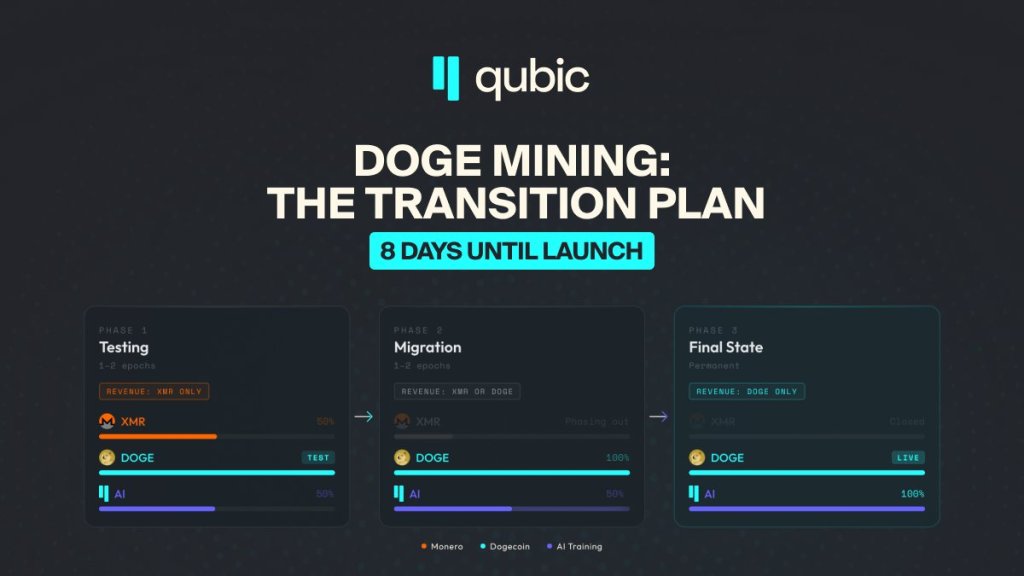
Source: X @_Qubic_

Qubic paired that roadmap with a performance claim aimed directly at the April 1 launch window. On March 23, the project said its network had become “3x faster” on live mainnet, with tick times reduced from 2 seconds a year ago to 1 second and now 0.6 seconds after the latest core optimization.

“Every share a miner submits gets validated through Oracle Machines in a single tick,” Qubic wrote. “Faster ticks mean faster confirmations, a more efficient pipeline, and a network that can handle the load when April 1st hits. The network got faster right before it needed to be.”

The economic case for targeting Dogecoin is straightforward in Qubic’s telling. In a March 20 post, the team pointed to its earlier Monero campaign, saying it went from less than 2% of Monero’s hashrate to “51%+ dominance in a live takeover event,” while generating more than $3.5 million in mining revenue and finding over 26,000 XMR blocks.

Dogecoin, it argued, is a much larger prize. “DOGE produces roughly 14.4 million coins per day. At current prices, that’s approximately $1.44M in daily emission, roughly 10x what Monero was producing,” the team wrote. “The same playbook. A much bigger target.”

At press time, DOGE traded at $0.09752.
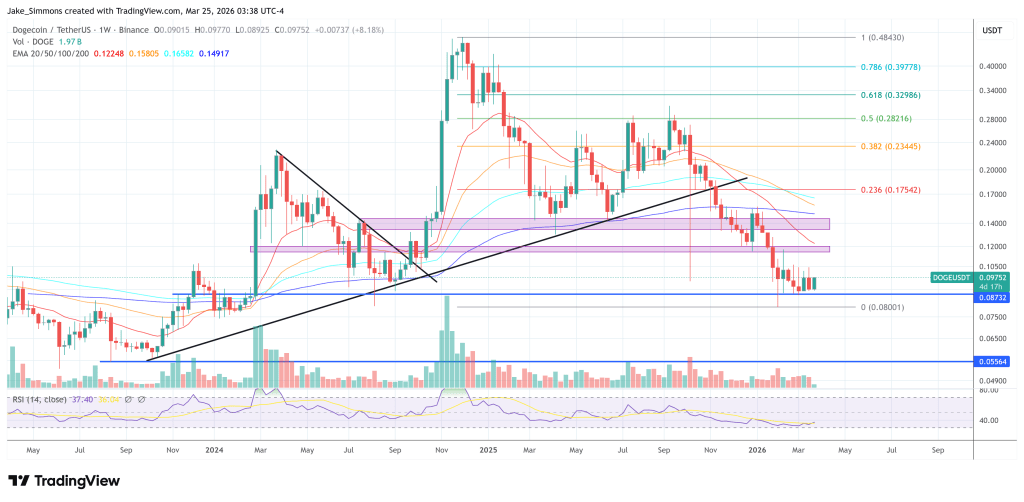
DOGE holds above key support, 1-week chart | Source: DOGEUSDT on TradingView.com

Пов'язані питання

QWhat is the start date for Qubic's transition from Monero to Dogecoin mining?

AApril 1.

QHow many phases are in Qubic's rollout plan for the Dogecoin mining shift?

AThree phases.

QIn the final phase, what will be the only form of computor revenue?

ADOGE only.

QWhat performance improvement did Qubic claim its network achieved on March 23?

AIt became 3x faster on live mainnet, with tick times reduced to 0.6 seconds.

QWhat economic reason did Qubic give for targeting Dogecoin instead of Monero?

ADogecoin produces approximately $1.44M in daily emission, which is roughly 10x what Monero was producing.

Пов'язані матеріали

Who Funds the Agents?

**Summary: Who Funds AI Agents?** OpenAI recently shut down a feature allowing AI agents to shop for users, highlighting the challenge of creating a secure and regulated environment for agent-driven transactions. While payment infrastructure exists, a crucial governance layer—defining spending limits, fraud detection, tax handling, and return policies—is largely missing. The potential is enormous: AI agents already processed $73M across 176M transactions last year, with McKinsey forecasting this could grow to $3-5T in global consumer commerce by 2030. The core competition isn't just about processing payments, which can be very cheap (especially with crypto-based settlement), but about controlling the rules that govern agent spending. Key players like Stripe and Coinbase are racing to dominate this governance layer. Stripe's acquisition of wallet provider Privy allows it to set spending policies, identity checks, and human-in-the-loop approvals directly at the wallet level. Similarly, Coinbase's stack, including its x402 protocol and AgentKit, embeds governance rules. This vertical integration across settlement, wallet, and governance layers is becoming the dominant strategy. Control over the governance layer is where significant future value lies. If agents handle trillions in transactions, even a small fee for managing compliance, fraud prevention, and policy enforcement could generate billions in annual revenue. The companies that successfully integrate across the payment stack will capture value from idle agent balances, transaction fees, and governance services, positioning themselves as the foundational banks of the AI agent economy.

marsbit2 хв тому

Who Funds the Agents?

marsbit2 хв тому

A Nation Blocks Chips, a Giant Buys a Nuclear Power Plant: Why It's Time to Seriously Consider DeAI

**Title: Great Powers Blockade Chips, Giants Buy Nuclear Plants: Why It's Time to Seriously Consider DeAI** In May 2026, the US closed loopholes for Chinese firms to acquire advanced NVIDIA chips via overseas subsidiaries. That same month, Kenya halted a $1B geothermal data center project involving Microsoft, fearing its immense energy consumption. Meanwhile, Huawei announced mass production of its Ascend AI chip. These disparate events underscore a new reality: the competition for computing power ("compute") has escalated beyond the tech industry, becoming a geopolitical and infrastructural battleground. A new era of oligopoly is forming, with control over the AI stack—from GPU chips (NVIDIA) and cloud platforms (AWS, Azure, Google Cloud) to foundational models (OpenAI, Anthropic)—concentrating in a few Western "AI Octopus" corporations. This centralization creates systemic risks: pricing power and platform lock-in for users, infrastructure fragility, and a widening "compute divide" that threatens to marginalize nations without independent AI capacity. An "AI Iron Curtain" is deepening through export controls. In response, some nations like Saudi Arabia and the UAE are investing heavily to buy compute power, aiming to transition from oil to AI economies. The EU seeks to triple its compute capacity by 2030 to reduce dependency. However, the spending gap is vast, with four US tech giants alone planning ~$750B in AI capex for 2026. The race is increasingly constrained by energy, with AI tasks consuming up to 1000x more power than web searches, pushing firms to even acquire nuclear plants. This landscape is fueling interest in Decentralized AI (DeAI). It proposes a third way: using open protocols to coordinate a global network of idle GPUs, independent developers, and data centers, creating an AI infrastructure without a single controlling entity. Leveraging blockchain and cryptographic verification, DeAI aims to break market concentration, disperse energy demands, reduce geopolitical dependencies, and enhance transparency. While still nascent in performance and stability, DeAI's core promise is not immediate superiority but providing a crucial alternative architecture to resist monopoly, censorship, and centralized power. As specialized AI hardware costs fall and open-source models flourish, the window to build this foundation is open. The very existence of such competition serves as a vital check against the inevitable abuse of concentrated power.

marsbit57 хв тому

A Nation Blocks Chips, a Giant Buys a Nuclear Power Plant: Why It's Time to Seriously Consider DeAI

marsbit57 хв тому

Outpoll Review: A Prediction Market Platform Built for Active Traders

Outpoll Review: A Prediction Market Platform Built for Active Traders In recent years, prediction markets have grown from a niche sector to a mainstream arena, attracting billions in trading volume and institutional capital. However, the user experience and tools for traders have not kept pace. Outpoll, a new global prediction market platform, aims to fill this gap by providing enhanced trading infrastructure for active and professional traders. Built on standard prediction market principles, Outpoll allows users to trade on the outcome of specific events. It uses fully collateralized contracts with USDC settlement, charges a competitive 0.1% fee per trade, and provides clear settlement rules upfront to minimize disputes. A key focus for Outpoll is its professional-grade trading tools. The platform supports limit and market orders, as well as take-profit and stop-loss orders for open positions—features uncommon in prediction markets. For automated trading, Outpoll offers comprehensive REST and WebSocket APIs, enabling portfolio management, price arbitrage, and integration with existing tools. The platform also features a creator-led market model, where approved experts and community leaders can create and manage markets for niche topics under platform supervision. Its integrated interface combines news feeds directly with trading functions, allowing users to monitor events and manage positions seamlessly. Outpoll launched with a native Android app (available on Google Play) and plans an iOS version later this year. In summary, Outpoll distinguishes itself with trader-focused tools, practical APIs, transparent and collateralized markets, integrated news, and an expanding creator program. For active traders, its advanced order types and API access alone make it a platform worth watching. Outpoll is now globally accessible via outpoll.com and Google Play.

marsbit1 год тому

Outpoll Review: A Prediction Market Platform Built for Active Traders

marsbit1 год тому

Торгівля

Спот
Ф'ючерси
活动图片