PwC Drops Guard On Crypto After US Digital Asset Rule Changes

bitcoinistОпубліковано о 2026-01-06Востаннє оновлено о 2026-01-06

Анотація

PwC, one of the Big Four accounting firms, has reversed its cautious approach toward cryptocurrency following new U.S. regulatory developments, including the Genius Act which regulates stablecoins. The firm is now actively promoting the use of digital asset technology, particularly stablecoins, to improve payment efficiency. This shift reflects growing institutional acceptance of crypto assets, especially stablecoins, which have seen increased adoption globally—including in Hong Kong, Japan, and Europe. Despite recent market consolidation, the stablecoin market cap remains strong near its all-time high at $307 billion. Meanwhile, Bitcoin is trading around $92,900, up 6% over the past week.

Big Four accounting firm PwC has reversed its cautious stance on crypto after regulatory developments related to the space in the United States.

PwC Has Softened Its Stance On Crypto

According to a report from the Financial Times, PwC has changed its strategy around digital assets following the new laws passed by Donald Trump’s administration. PricewaterhouseCoopers, PwC in short, is a multinational professional services network headquartered in London. It provides services such as audits, tax planning, and business consulting to companies worldwide.

PwC is the second-largest firm of its kind and part of the Big Four accounting firms. Previously, the British company steered clear of crypto-related work in the US like other Big Four firms, but it seems that stance has now changed. The shift has come as the US has made advancements in its crypto regulatory framework. Among the new laws is the Genius Act, which regulates stablecoins, digital assets pegged to a fiat currency like the US Dollar (USD).

“The Genius Act and the regulatory rulemaking around stablecoin, I expect, will create more conviction around leaning into that product and that asset class,” said Paul Griggs, senior partner at PwC US, in an interview with FT.

Griggs added that PwC has been pitching companies on how they can use digital asset technology, with stablecoins as a means of improving payment systems’ efficiency, cited as one example.

PwC and other Big Four firms budging on crypto showcases the legislative momentum that the industry has had recently, with traditional finance increasingly unable to ignore the sector. Stablecoins, in particular, have been witnessing growing adoption. Beyond the American Genius Act, this class of digital assets also attracted regulatory attention in other parts of the world.

Hong Kong introduced a stablecoin issuer licensing framework last year, while Japan observed the launch of its first yen-based token. In Europe, major banks have come together to work on a euro-pegged coin, aiming to challenge the sector’s USD dominance. The positive regulation in 2025 meant that the space witnessed some sharp growth, with the market cap exploring new records, as data from DefiLlama shows.
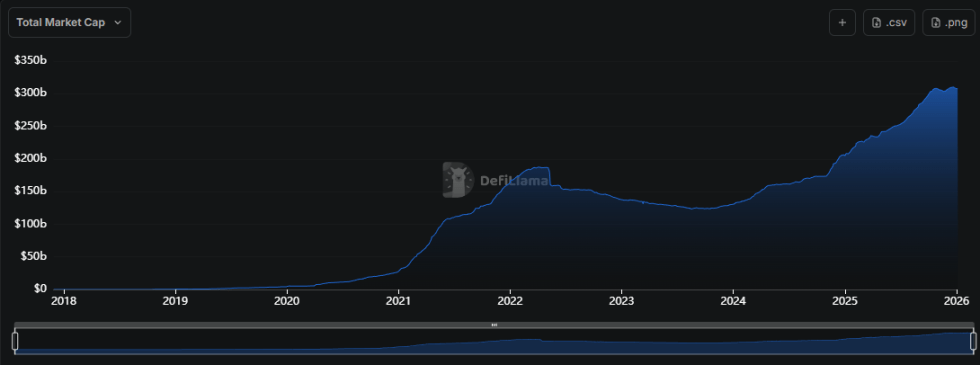
The trend in the market cap of all stablecoins over the last several years | Source: DefiLlama

The sector hasn’t been unaffected by the wider slowdown in crypto since October, however. From the above chart, it’s visible that the stablecoin market cap has seen consolidation in the last few months.

Nonetheless, while other parts of the market have shrunken, these fiat-tied tokens still have their combined market cap sitting at $307 billion today, which is very close to the all-time high (ATH).

Bitcoin Price

At the time of writing, Bitcoin is trading around $92,900, up nearly 6% over the last week.

Looks like the price of the coin has shot up over the last few days | Source: BTCUSDT on TradingView


Пов'язані питання

QWhy has PwC reversed its cautious stance on crypto in the US?

APwC reversed its cautious stance on crypto due to new regulatory developments in the United States, including the Genius Act which regulates stablecoins, providing more clarity and conviction for the asset class.

QWhat is the Genius Act mentioned in the article?

AThe Genius Act is a new US law that regulates stablecoins, which are digital assets pegged to a fiat currency like the US Dollar.

QHow does PwC plan to help companies with digital asset technology?

APwC has been pitching companies on how they can use digital asset technology, with stablecoins cited as a means to improve payment systems' efficiency.

QWhat is the current market cap of all stablecoins according to the article?

AThe combined market cap of all stablecoins is $307 billion, which is very close to the all-time high.

QWhat was the price of Bitcoin at the time of writing the article?

AAt the time of writing, Bitcoin was trading around $92,900, up nearly 6% over the last week.

Пов'язані матеріали

Report Interpretation: J.P. Morgan Details Micron's Pre-Earnings Sentiment, Current Hardware Sector Dynamics

Morgan Stanley analyst Joshua Meyers' report (June 21, 2026) highlights key trends in the hardware and semiconductor sector ahead of Micron's earnings. The core takeaways are: 1. **Micron & Memory:** Memory remains a high-conviction long theme, driven by strong AI demand and rising ASPs. However, investor focus is shifting to the sustainability of Micron's >80% gross margins and the specifics of potential new long-term supply agreements (SCAs). 2. **Hardware Supply Chain:** AI-related demand for servers, networking, and storage remains robust, but company performance is diverging. Celestica (CLS) shows improved margin confidence, Western Digital and Seagate benefit from pricing, Fabrinet (FN) sees predictable AI optics growth, and Teradyne (TER) anticipates a new Google customer. 3. **AI Capex & WFE Forecasts:** JPMorgan increased its Wafer Fab Equipment (WFE) market growth forecasts to 28% in 2026 and 29% in 2027. AI infrastructure financing is evolving, with higher project-level debt reducing constraints on capex expansion. The report signals that while the AI-driven hardware cycle is strong, the market is entering a phase focused on execution verification (e.g., Micron's SCA details, Fabrinet's ramp with Amazon) and valuation sustainability. Key near-term signals include Micron's guidance, Arista Networks' outlook, and the pace of demand normalization post potential tariff-related pull-ins.

marsbit8 год тому

Report Interpretation: J.P. Morgan Details Micron's Pre-Earnings Sentiment, Current Hardware Sector Dynamics

marsbit8 год тому

Research Report Analysis: The Fed's New Chair's Debut – New Leader, But Same Script?

Report Analysis: Federal Reserve's New Chair Debut – A New Captain, But the Same Script? Morgan Stanley's chief global economist Seth B. Carpenter analyzes the first FOMC meeting under new Fed Chair Kevin Warsh in a June 21 report. Warsh deliberately avoided providing forward guidance on interest rates, aligning with his philosophy. However, market expectations for a rate hike this year were reinforced. Key signals lie elsewhere: inflation may fall more than expected, and quantitative tightening (QT) could be more aggressive than anticipated. The FOMC's "dot plot" suggests only one rate hike in 2026. Carpenter argues that if inflation undershoots forecasts, the logic for even a single hike weakens, especially as projections indicate potential rate cuts in 2027. On QT, Warsh's stance is clear. Carpenter notes that measures like halving the Treasury's account balance could shrink the Fed's balance sheet by around $500 billion with minimal market impact. Combined with adjustments to reserve interest and liquidity rules, the ultimate QT scale may exceed expectations, though its market effect might be less disruptive unless the Fed actively sells Mortgage-Backed Securities (MBS). While Warsh initiated a review of the Fed's policy framework, the 2% inflation target remains intact for now. The report concludes that the market may be overestimating the significance of reduced forward guidance and the near-term rate hike risk, while potentially underestimating the scope and manageable nature of the coming balance sheet reduction. The key debates will hinge on upcoming core PCE data, the specifics of the QT path, and the framework review's findings.

marsbit8 год тому

Research Report Analysis: The Fed's New Chair's Debut – New Leader, But Same Script?

marsbit8 год тому

Critical Game Week: BTC Retracement Confirmation vs. HYPE Support Battle | Guest Analysis

This weekly analysis outlines a critical juncture for BTC and HYPE markets, focusing on key price level confirmations. **BTC Analysis:** BTC is at a pivotal point after a five-wave rally from the June 5th low of $59,100. The price has broken below a short-term rising channel's lower boundary, with the current move seen as a pullback to test this breakdown. Failure to reclaim this level could lead to a retest of the $59,000-$60,000 support zone. The core scenario hinges on this channel retest outcome. * **Key Levels:** Resistance at $64,500-$65,000 (channel boundary) and $69,500-$70,500. Support at $59,000-$60,000 and $55,000. * **Strategy:** A core bearish stance is maintained (20% short from last week), with short-term plans for tactical trades. Three detailed contingency plans (A/B/C) are provided for short positions on resistance tests or breakdowns, emphasizing strict stop-loss discipline. **HYPE Analysis:** HYPE shows strong momentum but is currently in a corrective phase after hitting a new high of $76.94. The price is retesting the crucial $64-$66 support area. * **Key Levels:** Resistance near $77 and $80-$82. Support at $64-$66 and $52-$54. * **Strategy:** The short-term approach is "buy on dips, avoid chasing rallies." A long position is considered only if clear stabilization signals appear at the $64-$66 or deeper $52-$54 support zones, with tight risk controls. **General Risk Management:** A standardized trailing stop-loss protocol is emphasized: set initial stop, breakeven at +1% profit, then trail stops upward to lock in gains. *Disclaimer: All analysis is presented as a personal trading framework, not investment advice. Market conditions are complex and require dynamic adjustment.*

marsbit8 год тому

Critical Game Week: BTC Retracement Confirmation vs. HYPE Support Battle | Guest Analysis

marsbit8 год тому

Торгівля

Спот
Ф'ючерси
活动图片