Pundit Says Current Altcoin Trend “Feels” Like January 2019, Here’s What Happened Back Then

bitcoinistОпубліковано о 2026-01-12Востаннє оновлено о 2026-01-12

Анотація

A crypto analyst, Chad Steingraber, has drawn parallels between the current altcoin market trend and January 2019, a period marked by extreme negative sentiment that preceded a significant market turnaround. Back then, Bitcoin was trading near $3,000 and Ethereum around $100, but the market eventually rebounded strongly. By mid-2019, Bitcoin surged past $13,000, finishing the year 95% higher, which fueled a broader crypto rally. The total market cap grew over 44%, peaking at $350 billion, with trading volume surging 600%. While some altcoins like Ethereum and Litecoin gained over 40%, others like XRP underperformed. Currently, another analyst, @brain2jene, highlights a Falling Wedge breakout in the altcoin market cap (excluding top 10 coins). The key resistance level is $221.87 billion; a break above this could add $50-$60 billion to the market, targeting the upper trend line. The RSI breakout from a downtrend suggests strong momentum, potentially igniting a broader altcoin rally, with coins like VET, SUI, ICP, and IMO poised for gains. Traders are watching closely to see if history repeats.

Talks of an impending altcoin season are once again gaining traction in the market as major cryptocurrencies saw a fresh rebound at the start of this year. A crypto analyst has likened the current altcoin market trend to that seen in January 2019—a period that marked the early stages of a major market turn. The comparison now has many traders watching closely to see whether the market could be setting up for a similar move.

Current Altcoin Market Echoes Trend From January 2019

Crypto pundit Chad Steingraber said in a recent X post that today’s market feels a lot like January 2019, when investor sentiment was extremely negative. At the time, Bitcoin was trading near $3,000, and Ethereum’s price was around $100, when most believed the market was over. Yet despite the downtrend, the analyst revealed that he had invested heavily in both cryptocurrencies.

Although the market was recovering from a bear market, Steingraber revealed that things began to turn around in April of that year, leading to the strong long-term results that are now widely known. Notably, during that time, the crypto market saw a strong breakout that changed sentiment across the space.

According to CoinGecko’s yearly report for 2019, Bitcoin’s price surged over $13,000 in June and ended the year 95% higher than where it started. This price jump helped drive a broader market rally and marked a key transition from bear market lows earlier in the year. Altcoins also reacted to this surge in market momentum, as traders and investors sought growth beyond Bitcoin and diversified into lower-cap cryptocurrencies.

While some altcoins, including Ethereum, Litecoin, and Bitcoin Cash, climbed by more than 40% in 2019, other large-cap tokens, such as XRP, performed poorly, finishing the year significantly weaker despite earlier strength in 2018. Excluding individual altcoin gains, the total cryptocurrency market capitalization grew by more than 44% in 2019, peaking at $350 billion in late June. The market also experienced a surge in trading volume of over 600%, along with renewed enthusiasm among investors who had stayed on the sidelines during the prior downturn.

Altcoin Market Eyes Breakout As Analyst Flags 221B Level

In a separate post, crypto analyst @brain2jene shared a chart tracking the total altcoin market capitalization, excluding the top 10 coins. He explained that a Falling Wedge breakout has already set the stage for the market’s next move. The analyst noted that the wedge pattern has been forming for weeks and emphasized that altcoins typically begin to move once the price breaks above the wedge lines shown on the chart.
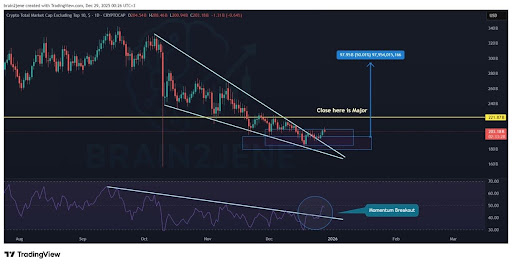
Source: Chart from @brain2jene on X

The chart also shows a clear pullback after the price hit the 221.87B resistance, which @brain2jene identified as the key level to watch. He explained that a clean break above 221.87B is critical and could add another $50-$60 billion to the market, with the target zone near the upper trend line.

Related Reading: Altcoin Season Index Crashes To Low 17 As Bitcoin Price Struggles, What This Means

Supporting this outlook, momentum appears strong, as the RSI on the chart has broken out of a downtrend. The analyst noted that this could signal the start of a broader altcoin rally, potentially boosting the price of coins like VeChain (VET), SUI, Internet Computer (ICP), and IMO.

Overall market cap excluding BTC at $1.25 trillion on the 1D chart | Source: TOTAL2 on Tradingview.com

Пов'язані питання

QWhat does crypto pundit Chad Steingraber compare the current altcoin market trend to, and why?

AChad Steingraber compares the current altcoin market trend to January 2019 because the current market sentiment feels similar, with extreme negativity among investors at that time, yet it marked the early stages of a major market turnaround.

QWhat were the prices of Bitcoin and Ethereum in January 2019, as mentioned in the article?

AIn January 2019, Bitcoin was trading near $3,000 and Ethereum's price was around $100.

QAccording to CoinGecko's 2019 report, how much did Bitcoin's price surge by June 2019, and what was its yearly gain?

ABitcoin's price surged over $13,000 by June 2019 and ended the year 95% higher than where it started.

QWhat key resistance level does analyst @brain2jene identify for the altcoin market capitalization, and what could a break above it lead to?

AAnalyst @brain2jene identifies the 221.87B level as key resistance, and a clean break above it could add another $50-$60 billion to the market, targeting the upper trend line.

QWhich altcoins does the analyst suggest could potentially be boosted by a broader altcoin rally based on the chart analysis?

AThe analyst suggests that coins like VeChain (VET), SUI, Internet Computer (ICP), and IMO could potentially be boosted by a broader altcoin rally.

Пов'язані матеріали

Bitcoin Mining Farms Are Becoming AI Factories

Bitcoin mines are transforming into AI factories. This shift is driven by the convergence of three key assets from the previous crypto cycle: infrastructure, talent, and capital. Crypto mining companies like Crusoe, CoreWeave, and Bitdeer are repurposing their core competency—securing power, land, and grid connections in remote locations—to build data centers for AI clients. These firms are signing multi-billion dollar, long-term contracts with companies like Anthropic, AWS, and Microsoft, as AI's demand for reliable, high-capacity compute surpasses the profitability of Bitcoin mining. Simultaneously, crypto entrepreneurs and engineers are applying their skills to new AI ventures. Examples include OpenSea's co-founder launching OpenRouter (an AI model aggregator), and former Coinbase engineers building Fal.ai (a generative media infrastructure platform). Their experience in building scalable, global software networks translates effectively to the AI space. Furthermore, capital accumulated during the crypto boom is now fueling AI. Figures like Jed McCaleb (co-founder of Ripple) funded Voltage Park, a large-scale GPU cloud provider. Notably, some crypto investments, like FTX's early bets on Anthropic and Cursor, have generated astronomical paper returns, demonstrating how high-risk crypto capital flowed into AI before it became mainstream. The transition is not just about repurposing hardware, but about redirecting critical resources—power infrastructure, distributed systems expertise, and venture funding—to the next technological frontier: artificial intelligence.

链捕手38 хв тому

Bitcoin Mining Farms Are Becoming AI Factories

链捕手38 хв тому

Morpho Launches Fixed-Rate Product Midnight: Lenders and Borrowers Set Their Own Rates, Ending the Era of Interest Rate Models

Morpho Launches Fixed-Rate Product Midnight: Lenders and Borrowers Set Their Own Rates, Ending the Era of Algorithmic Interest Models On-chain lending has grown to $60 billion but remains minuscule compared to traditional finance's $200 trillion annual credit volume. Morpho identifies the lack of fixed rates and maturity dates as key bottlenecks. Institutions need predictability, not the passive floating rates set by algorithmic models. Midnight allows lenders and borrowers to directly quote rates, set terms, and become price makers, not takers. Fixed-rate lending is now viable due to cheaper, faster blockchains and the entry of institutions demanding control and certainty over returns, costs, and duration. Morpho Blue previously gave users control over risk; Midnight adds control over interest rates. Past attempts at on-chain fixed-rate lending failed primarily because they were built on top of floating-rate pools (creating unpredictability) or lacked sufficient active participants. Midnight avoids these pitfalls as a standalone primitive with fixed rates at its core, built upon Morpho Blue's existing large and active user base. Midnight offers distinct value: institutions gain predictable term structures and full control; fintech companies can offer tailored fixed-rate products; lenders/borrowers achieve predictability and efficiency; and curators can now differentiate by configuring both risk and interest rates. Morpho Midnight is not a replacement for Morpho Blue. The Morpho network will now feature two complementary market structures: floating-rate/open-term (Blue) for flexibility and fixed-rate/fixed-term (Midnight) for predictability. Liquidity can flow between them. The launch will be gradual, prioritizing security. Initially, it will support direct lending on Base network with one trading pair (cbBTC/USDC) and limited maturity dates. Advanced features like auto-rollovers will be introduced later.

marsbit39 хв тому

Morpho Launches Fixed-Rate Product Midnight: Lenders and Borrowers Set Their Own Rates, Ending the Era of Interest Rate Models

marsbit39 хв тому

Торгівля

Спот
活动图片