Top conferences can be held every year, but not every lab can get into this journal.
Science Robotics is an internationally recognized top-tier journal in the field of robotics, published by the parent company of Science, with an impact factor consistently ranking first in robotics disciplines. Publishing research in this journal signifies that the work has undergone the strictest peer review in the field, representing the most cutting-edge and breakthrough technological progress.
In August this year, Science Robotics launched a special issue on humanoid robots, bringing together the latest research achievements in the global humanoid robot field. This special issue only featured platforms from three humanoid robot companies worldwide — Accel Robotics, Unitree, and Boston Dynamics — representing the most advanced global lineup in humanoid robot research.
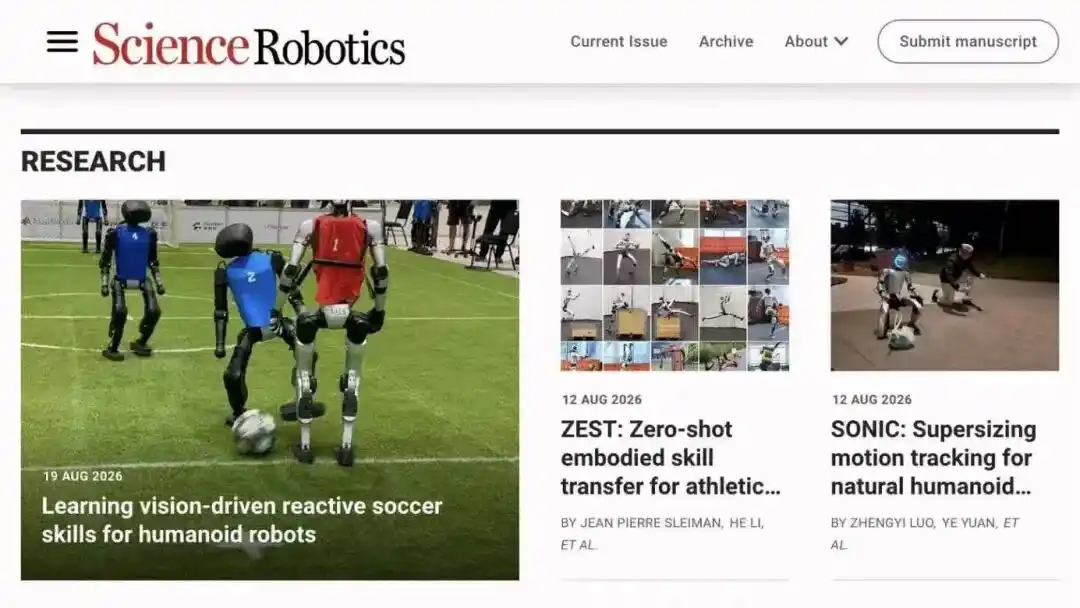
In this special issue, a team led by Professor Zhao Mingguo from the Department of Automation at Tsinghua University, in collaboration with ByteDance Seed and China Agricultural University, published a paper titled "Learning Vision-Driven Reactive Soccer Skills for Humanoid Robots". This paper proposes a vision-driven reactive soccer skill learning framework that enables humanoid robots, relying solely on onboard vision, to continuously complete tasks such as finding the ball, chasing the ball, adjusting gait, and shooting in multiple directions in dynamic environments. The physical verification platform supporting this research is the humanoid robot from Accel Robotics.
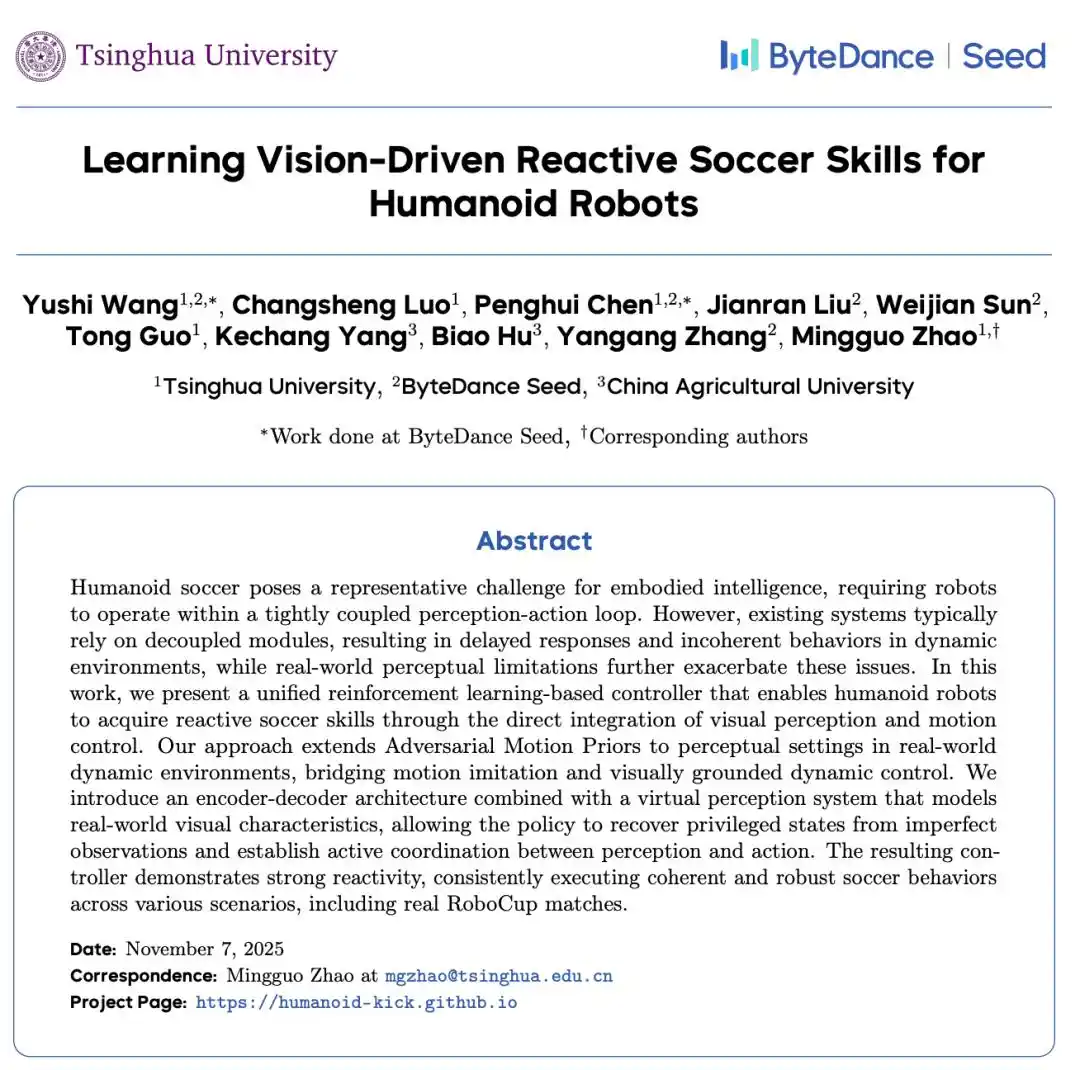
Paper link: https://www.science.org/doi/10.1126/scirobotics.aed1152
Project homepage: https://humanoid-kick.github.io/
This work does not stop at a single action or metric. It integrates visual perception, state estimation, bipedal locomotion, and physical contact into a real soccer task, and entered the RoboCup arena, tested in continuously changing environments and real adversarial situations.
A Twenty-Two Year Technical Relay
In 2004, Zhao Mingguo led students to establish the Tsinghua Huoshen Robot Soccer Team. The following year, they participated in RoboCup with self-developed robots. The early robots were only about 50 centimeters tall, walked slowly, and required personnel to prevent them from falling during matches. In the subsequent two decades, the Huoshen Team participated almost every year. The robots gradually grew to over a meter tall, learning to stand up autonomously, run fast, and shoot powerfully.
The soccer field also became a long-term testing ground for the team to examine vision, decision-making, motion control, and overall system reliability. How many milliseconds slower the visual recognition was, how many centimeters off the foot placement was, in which direction the robot was prone to miss a kick—all these issues directly surfaced in real adversarial play. The team would then bring the problems back to the lab, modify the algorithms, and continue testing in the next competition. This cycle persisted for over twenty years.
Zhao Mingguo has long been engaged in research on brain-inspired computing and robot control. He participated in the development of the "Tianjic" brain-inspired chip and the autonomous bicycle research, which was featured on the cover of Nature and selected as one of China's Top 10 Scientific Advances in 2019. From brain-inspired computing to robot soccer, his focus has always been on how perception, judgment, and action operate continuously within the same system.
As time passed, the members of the Huoshen Team changed over generations. Cheng Hao, founder of Accel Robotics, was the third captain of the Huoshen Team. After graduating from Tsinghua and gaining experience through internet entrepreneurship and serving as Vice President of Feishu at ByteDance, in 2023, this captain who never forgot about robotics chose to start anew, founding "Accel Robotics". Many members who fought alongside him in the Huoshen Team also joined, embarking on a new shared journey about robotics as a startup team. Wang Yushi, the first author of the paper, belongs to the new generation of the Huoshen Team.
From the establishment of the Huoshen Team in 2004 to the publication in the international top journal in 2026, this is a technical relay spanning twenty-two years.
Enabling Robots to See and React Amidst Noise
This paper attempts to solve a long-standing problem in the field: how humanoid robots can achieve see-and-react in real environments full of noise, delay, and occlusion.
When humans play soccer, vision and action occur almost simultaneously. The eyes track the ball, the brain judges distance and direction, and the body continuously adjusts center of gravity and foot placement. Even if the ball is briefly blocked, humans can predict its next likely position based on its previous trajectory.
Robots need to complete this process using cameras, algorithms, and joint control, but the difficulty is much greater. Images captured by the camera may blur due to rapid movement, object detection suffers from noise and delay, and the ball may run out of view or be occluded. Meanwhile, a bipedal robot must also maintain balance and decide the next foot placement within tens of milliseconds. Perception, localization, decision-making, motion, and physical contact are compressed into a continuous task. If any link is half a step slow, the robot may miss the kick or fall.
Traditional approaches often break this process into multiple modules. The vision system identifies the ball and estimates its position, the decision module selects an action, and the motion controller drives the robot to execute it. This method is convenient for debugging but also prone to cascading errors and delays. Moreover, strategies trained in perfect simulation may suffer significant performance degradation in the real world due to lighting, noise, and occlusion.
The team led by Zhao Mingguo proposes a unified perception-motion reinforcement learning framework. The core idea is to place visual perception and motion control under the same optimization objective for end-to-end training.
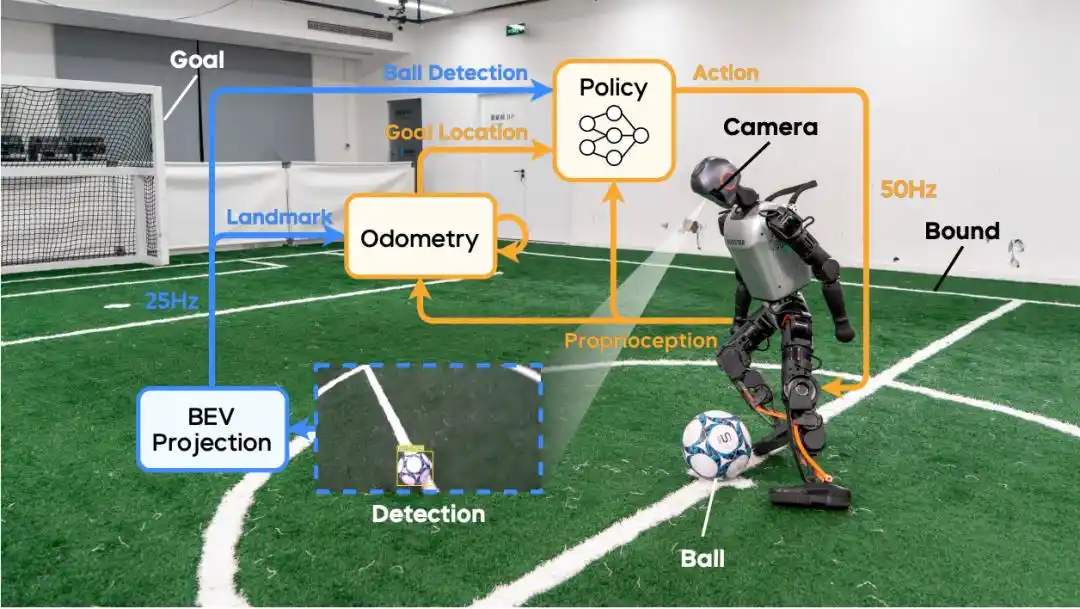
Overview of the vision-driven control system for the Accel Robotics robot.
The research team first established a virtual perception system.
They had the real robot observe a soccer ball from different distances and angles, accumulating about one hour of data, and then compared it with the real positions recorded by a motion capture system. From this, they obtained perception characteristics such as position noise, detection success rate, update frequency, and delay.
These characteristics were then imported into simulation. The farther the ball, the greater the position noise; the camera field of view changes with the robot's head posture. Even if the ball appears in the field of view, detection may fail due to motion blur. The vision system updates at about 25Hz with an average delay of about 116 milliseconds.
After a brief visual interruption, the controller still needs to judge the ball's position and movement trend based on previous information. For this, the paper designed an encoder-decoder architecture.
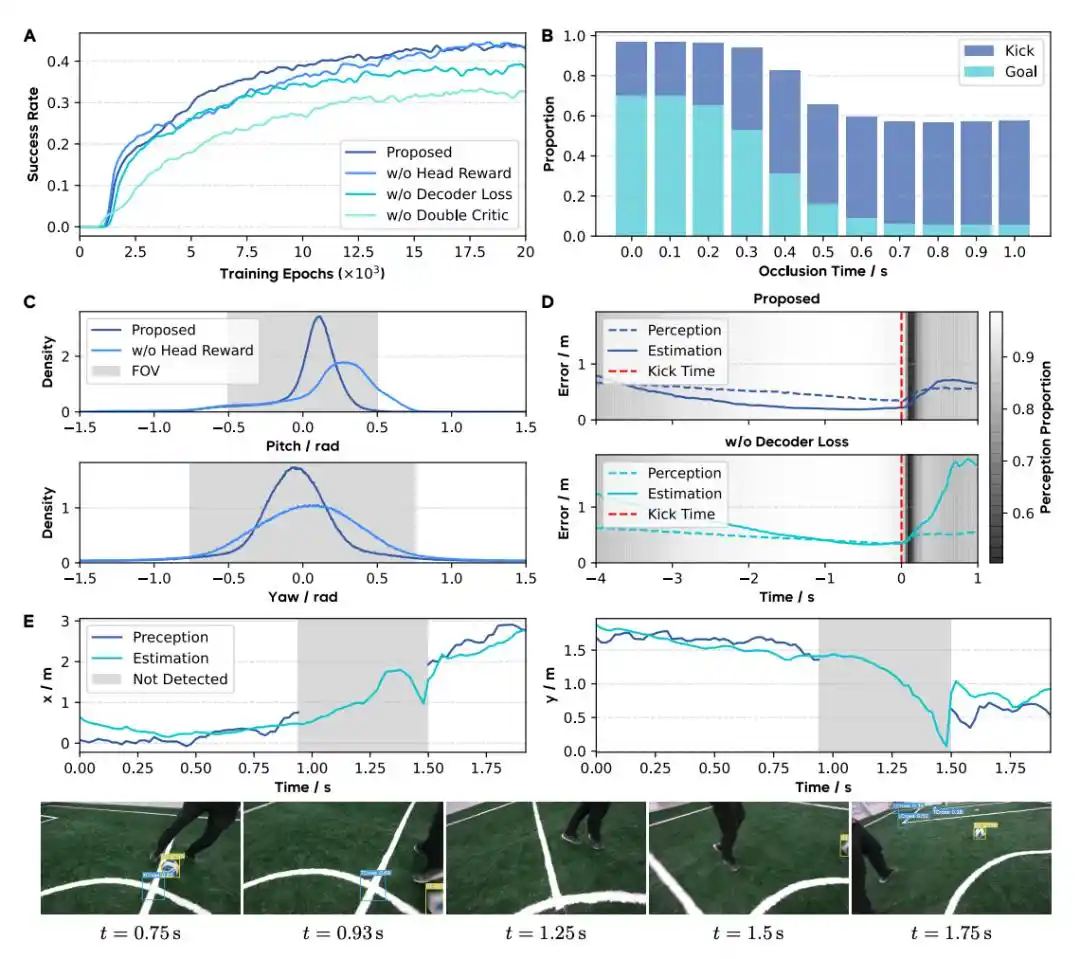
The policy reads the past 50 frames, about one second of historical observations, and compresses this information into a 64-dimensional hidden state. During training, the decoder attempts to reconstruct the ball's true position and the robot's dynamic parameters from the hidden state. This auxiliary task helps the policy perform visual denoising and enables it to continue estimating the target position after the ball briefly disappears.
The Actor responsible for outputting actions can only use the observations that the real robot can obtain, while the Critic during training can access the complete state of the simulation environment, providing additional information for policy optimization. Both the decoder and Critic are removed after deployment to the real robot.
To make the actions more natural, the team also introduced Adversarial Motion Prior (AMP). Training data included about 76 seconds of human omnidirectional walking motions and 30 seconds of instep shooting motion data. A discriminator judges how close the robot's actions are to human demonstrations, while the reinforcement learning policy continues to optimize around chasing and scoring.
Mirror symmetry constraints further help the robot master shooting with both feet, avoiding convergence to single-foot kicking. Ultimately, ball-finding, chasing, adjusting foot placement, and shooting are integrated into a single policy, with the controller outputting joint position commands at 50Hz.
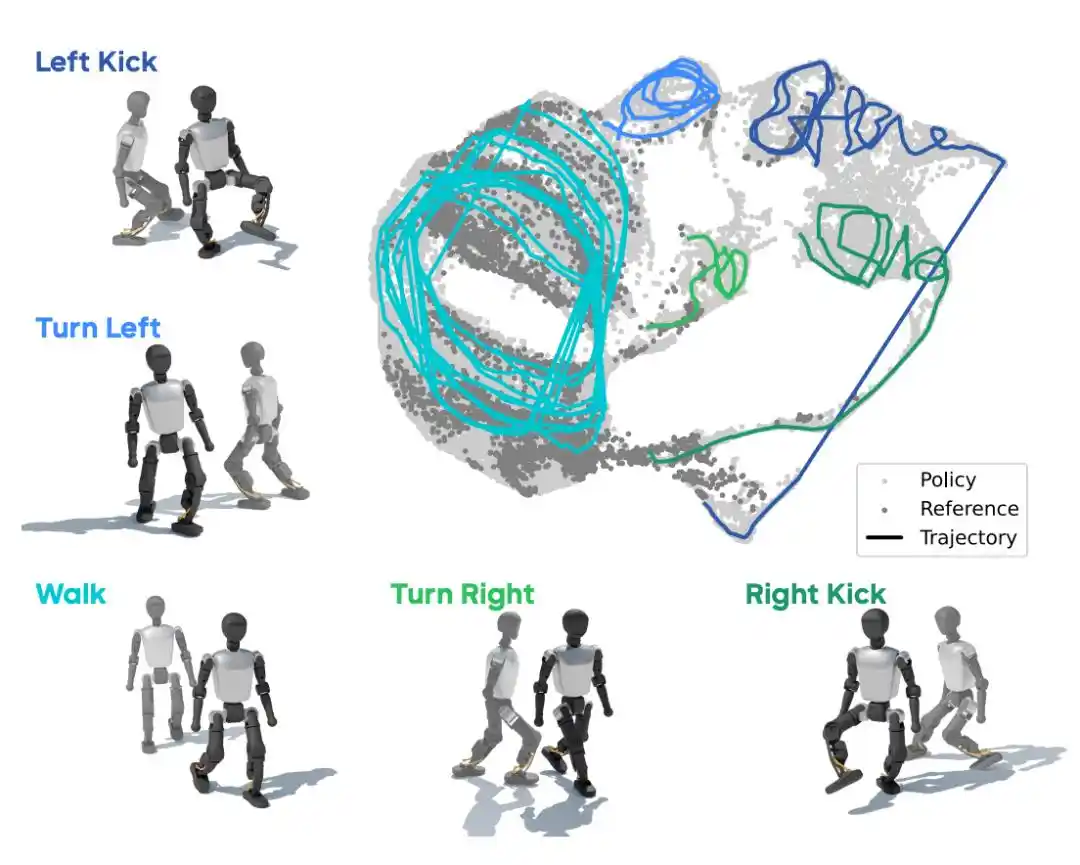
Five types of action patterns formed by the policy, including left/right foot shooting, straight walking, and left/right turning. Colored trajectories are actions generated by the policy; gray points are human reference motions.
Several autonomous behaviors also emerged during training.
When the ball approaches the edge of the field of view, the robot actively turns its head and body to bring the ball back into view. When it cannot find the ball near the field boundary, it usually first faces the center of the field before expanding the search range.
Gait also changes with the distance to the ball. When the distance is far, the robot adopts a slower stride frequency, about 0.7 to 0.8 seconds per gait cycle, to maintain stable observation; when close to the ball, the cycle shortens to 0.3 to 0.4 seconds, using shorter, faster steps to fine-tune foot placement.
When the goal is behind, the policy even generates a spinning hook-shot motion: the robot pivots on its supporting foot, using the other leg to hook the ball towards the goal from the side, saving time needed for repositioning.
These changes are ultimately reflected in the experimental data.
Within one second before shooting, the error of the ball's position in the raw visual observation was 0.344 meters. After estimation by the policy's internal state, the error reduced to 0.186 meters, a decrease of about 46%. In simulation, when visual detection was briefly interrupted for 0.3 seconds, the robot's touch success rate still exceeded 90%, with a goal rate over 50%. Facing a stationary ball, the learned policy typically takes about 1.5 seconds from initiation to touch, while traditional rule-based systems require about 2 to 5 seconds, representing a maximum reduction of 64% in time.
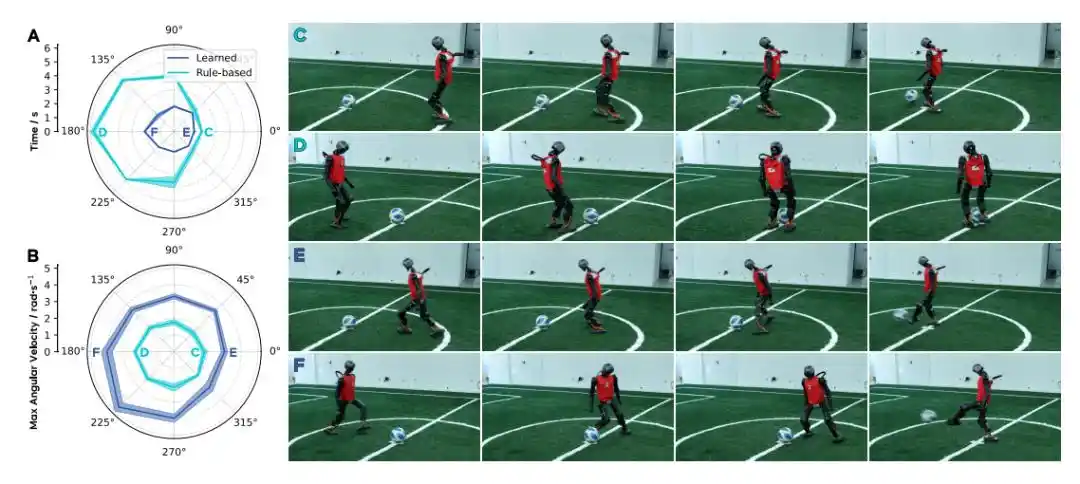
Comparison between the learned policy and current state-of-the-art rule-based policies in RoboCup. (A, B) The time required for the robot to move from start to touch the ball at different approach angles, and the maximum angular velocity during this process. The robot starts from a stationary state, 1.5 meters from the ball. Shaded areas indicate standard deviation, with 5 tests per direction. (C, D) Typical actions of the rule-based policy controlling the robot to kick forward (0°) and backward (180°). (E, F) The learned policy can integrate approaching the ball and shooting into a continuous action.
In real robot tests, the robot's success rate reached 80% to 90% in forward positions and 60% to 70% in backfield positions, with no falls during testing. Facing a rolling ball, when the ball speed was below 0.5 meters per second, the policy maintained a success rate over 50%, a trend also observed in real robot experiments.
Caption: Reactive shooting against a rolling ball.
(A) When the ball rolls laterally, the robot quickly sidesteps and completes the shot. (i) shows the motion trajectories of the robot and the ball, along with the corresponding foot contact patterns. (ii) shows the robot's continuous motion sequence.
(B) When the ball rolls behind the robot, the robot quickly turns and shoots. (i) and (ii) show the same content as (A).
(C) Success rate, goal rate, and time-to-touch at different ball speeds. Simulation results are shown as bar charts, with 8192 tests per ball speed; real robot results are marked with triangles, with 10 tests per ball speed. Error bars indicate the standard deviation of simulation test results.
This policy was also integrated as a motion skill module into the complete competition system of the Tsinghua Huoshen Team. In 2025, the Huoshen Team won the RoboCup Adult Size Humanoid League and the World Humanoid Robot Games, scoring a total of 76 goals and conceding only 11 across both events. In 2026, the team successfully defended their title in the RoboCup Large Size competition.
Towards the Next Generation of Embodied Platforms
Being able to directly deploy a learned policy from simulation to a real robot involves more than just the algorithm. Whether joint responses are consistent, if control cycles are stable, and if sensors and computing units output results on time all affect the final performance. Any underlying error can be amplified during high-speed motion.
The real robot experiments in the paper used the humanoid robot platform from Accel Robotics. The experiments did not involve specific modifications to the robot body. Ball information came from the head-mounted onboard camera, and perception and control ran on the onboard computing unit. This indicates that domestically produced, mass-produced humanoid robots are now capable of supporting world-leading embodied AI research, allowing researchers to focus their main efforts on algorithms and then deploy trained results onto real hardware.
The relationship between Accel Robotics and the Huoshen Team thus extends from talent lineage to technological platform.
In July this year, Accel Robotics released its new-generation flagship platform Booster T2. The Professional Edition is equipped with an NVIDIA Thor chip, delivering edge-side computing power of 2070 TFLOPS, making it the platform with the most advanced computing power in the bipedal humanoid robot field currently. The accompanying Booster Studio integrates simulation training, algorithm development, and real robot deployment into the same development environment.
On August 19th, Booster T2 made its official debut at the World Robot Conference, showcasing its first high-explosive action performance. Three days later, 80 Booster T2 robots performed decentralized autonomous coordination at the opening ceremony of the Robot Games, writing "BEIJING", the Games emblem, and icons of the three competition events on the ground—without remote control or verbal commands, 80 independent "brains" achieved coordination at the same moment. The total computing power of the 80 robots reached approximately 170,000 TFLOPS, forming a walking computing cluster.
Single-robot perception closed-loop and multi-robot coordinated formation changes rely on the same underlying capabilities: stable body, real-time edge computing, and precise motion control. The boundaries of these capabilities are continuously expanding with platform iteration.
From early robots 50 centimeters tall needing human support to stand, to today's Booster T2 autonomously playing soccer on a thousand-square-meter field and forming arrays to write at an opening ceremony—twenty-two years of accumulation are now being demonstrated at an increasingly larger scale. Humanoid robots are progressing step by step from "able to move" to "usable", from single-agent action to group collaboration.
Reference link: https://www.science.org/journal/scirobotics
This article is from the WeChat public account "Almost Human" (ID: almosthuman2014), edited by Yang Wen.