Publicly Pumping Ethereum, Internally Bearish in Reports: Is Tom Lee's Team Still Trustworthy?

marsbitОпубліковано о 2025-12-23Востаннє оновлено о 2025-12-23

Анотація

Tom Lee, co-founder of Fundstrat and a prominent public Ethereum bull, faces credibility questions after an internal Fundstrat report presented a bearish short-term outlook, contrasting his highly optimistic public statements. Publicly, Lee repeatedly called Ethereum to reach $12,000-$15,000 by end-2025 and declared it "severely undervalued" at $3,000. He has been a vocal "perma-bull" in media appearances. However, Fundstrat's internal 2026 Crypto Outlook report, led by Digital Asset Strategist Sean Farrell, advised paying subscribers to expect a significant market correction in early 2026. Its base case predicted ETH could fall to $1,800-$2,000 and BTC to $60,000-$65,000, citing macroeconomic risks like a potential U.S. government shutdown and Federal Reserve leadership change. The report recommended clients increase cash/stablecoin holdings and wait for better entry points, while maintaining a long-term bullish year-end 2026 target of $4,500 for ETH. Fundstrat responded that the discrepancy stems from different analysts serving different client types: Lee's long-term, structural views are for traditional investors with low (1%-5%) crypto allocations, while Farrell's tactical, short-term risk management is for crypto-heavy portfolios. Critics argue this distinction was never clearly disclosed in Lee's public media appearances, which serve as marketing for Fundstrat's subscription service. Further complicating matters, Lee is also Chairman of BitMine, a company adopting a...

Author| Aki WuShuo Blockchain

If one were to choose the most representative figure for the Ethereum bull narrative in 2025, Tom Lee, Chairman of Ethereum treasury company BitMine and Co-founder & Chief Investment Officer of Fundstrat, would often be placed in the most prominent position. He has repeatedly emphasized in public statements that ETH is undervalued, stating at the Binance Blockchain Week on December 4th that Ethereum at $3,000 was "severely undervalued," and has previously given a high target price judgment of "$15,000 for ETH by the end of 2025." As a Wall Street veteran known as the "Wall Street Soothsayer" and a strategist long active in media and institutional roadshows, Tom Lee's views are often seen as a sentiment barometer by the market.

However, when the market shifts its gaze from the camera to internal institutional documents, the tone reverses: in the latest 2026 outlook strategy advice from Fundstrat, founded by Tom Lee, for its internal subscription clients, a contrary view is presented. Its baseline forecast suggests that crypto assets may experience a significant pullback in the first half of 2026, with an ETH target range of $1800–$2000. This discrepancy between "publicly calling for gains" and "internal bearishness" has also pushed Tom Lee himself and his associated institutions into the spotlight of public opinion.

Core Predictions and Views of Fundstrat's "2026 Crypto Outlook"

The report was issued by Sean Farrell, an analyst at Fundstrat responsible for crypto asset research, currently serving as Head of Digital Asset Strategy, primarily covering strategy research and view output related to the crypto market and blockchain. The report is mainly aimed at its internal subscription-based clients, with a monthly subscription fee of $249.

The report paints a starkly different short-term market expectation for internal clients than the public sentiment, anticipating a significant market correction in the first half of 2026: Bitcoin could fall to $60,000–$65,000, Ethereum to $1,800–$2,000, and Solana to $50–$75, stating that these correction zones would be good opportunities to build long positions. If the market does not experience a deep correction as expected, the team also tends to maintain a defensive strategy, waiting for clear trend strengthening signals before entering the market.
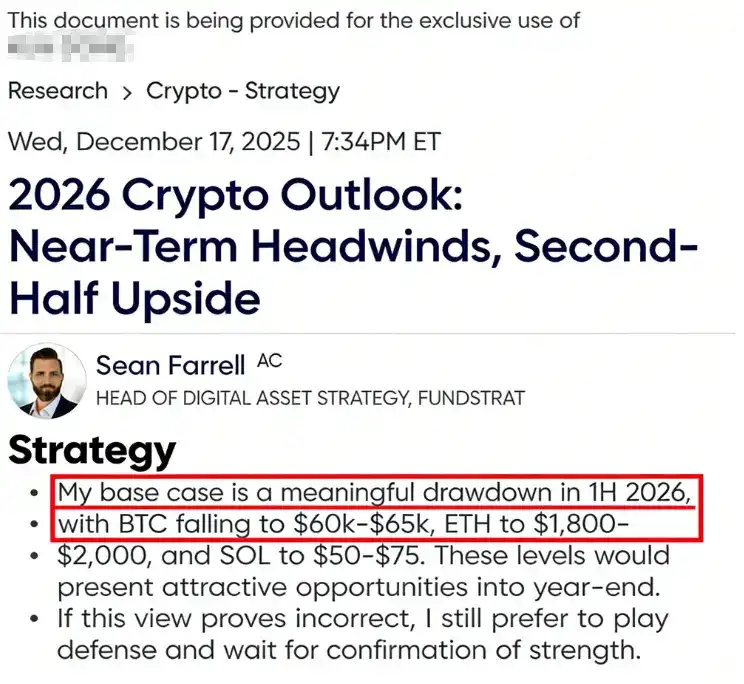
The report explains that the above pessimistic scenario is not a turn towards a long-term bear market but a "strategic reset" risk management measure. Fundstrat points out several short-term headwinds that could suppress the crypto market in early 2026: including a potential US government shutdown, uncertainty in international trade policy, fading confidence in AI investment returns, and policy suspense brought by the Federal Reserve Chair succession, among others.

These macro factors combined with high volatility could trigger a valuation pullback for crypto assets in a tight liquidity environment. Fundstrat emphasizes that this adjustment is a "correction, not a crash," believing that sharp declines are often the prelude to a new round of gains. After digesting risks in the first half of the year, the market is expected to strengthen again in the second half.

The report even gives optimistic targets for the end of 2026: Bitcoin $115,000, Ethereum $4,500, and特别提到以太坊可能在本轮调整中表现出相对强势, the report points out that Ethereum has some structural advantages: after switching to PoS consensus, there is no selling pressure from miners, unlike Bitcoin which has持续抛售的压力 from miners; it also lacks potential selling pressure factors from large holders like MicroStrategy. Furthermore, compared to Bitcoin, Ethereum faces lower concerns about quantum computing threats.

These factors mean that Ethereum may better resist selling pressure in the medium term. It can be seen that the tone of Fundstrat's internal research report is偏向谨慎, although long-term仍然看涨, but short-term it advises internal clients to increase holdings of cash and stablecoins and patiently wait for better entry points.

Tom Lee's Publicly Optimistic Predictions for Ethereum in 2025

In stark contrast to Fundstrat's internal report, its co-founder Tom Lee has played the role of a "super bull" in public场合 throughout 2025,多次发布远超市场实际的 Bitcoin and Ethereum price expectations:

Bullish on Bitcoin early in the year, according to CoinDesk, Tom Lee raised his Bitcoin year-end 2025 target to a high of approximately $250,000 at the beginning of the year. In July-August 2025, as Ethereum prices surged strongly接近历史高位, Tom Lee publicly stated that Ethereum could reach $12,000–$15,000 by the end of 2025, calling it one of the biggest macro investment opportunities for the next 10–15 years.

In August, he further raised the target price on CNBC, stating that Ethereum was entering a key inflection point similar to Bitcoin's in 2017. In 2017, Bitcoin started from less than $1,000 and rose to $12,000 (Note:原文为12万美元,但历史高点是约2万,此处按原文12万翻译,但加注说明历史事实是约2万) driven by the "digital gold" narrative, achieving 120-fold growth. Since the "Genius Act" gave the green light to stablecoins, ushering in a "ChatGPT moment" for the crypto industry, and the core advantage of smart contracts does not apply to Bitcoin, he predicted this is Ethereum's "2017 moment," and a price increase from $3,700 to $30,000 or even higher is not impossible.

Super cycle rhetoric: Entering the autumn行情, Tom Lee依然维持极端乐观立场. In November 2025, he stated in an interview, "We believe ETH is开启类似 2017–2021 年 Bitcoin那样的超级周期",暗示 Ethereum has the potential to replicate Bitcoin's hundred-fold increase trajectory in the coming years.

Dubai Summit speech: At the Binance Blockchain Week in early December 2025, Tom Lee again shocked with bullish shouts, predicting that Bitcoin could soar to $250,000 "within months," and直言当时约 $3,000 的 Ethereum price was "severely undervalued".

He pointed out through historical data comparison that if the ETH/BTC ratio returns to its eight-year average (approx. 0.07), the ETH price could reach $12,000; if it returns to the 2021 relative high (approx. 0.16), then ETH could rise to $22,000; and in an extreme scenario where the ETH/BTC ratio rises to 0.25, theoretically Ethereum's valuation could exceed $60,000.

Short-term new high expectations: Even facing market volatility at the end of the year, Tom Lee did not收敛 his bullish言论. In mid-December 2025, he stated in a CNBC interview that "I don't think this rally is over yet," and bet that Bitcoin and Ethereum will hit new all-time highs before the end of January next year. At that time, Bitcoin had already risen above the 2021 high, while Ethereum was around $3,000, still about 40% away from its historical high of $4,954.

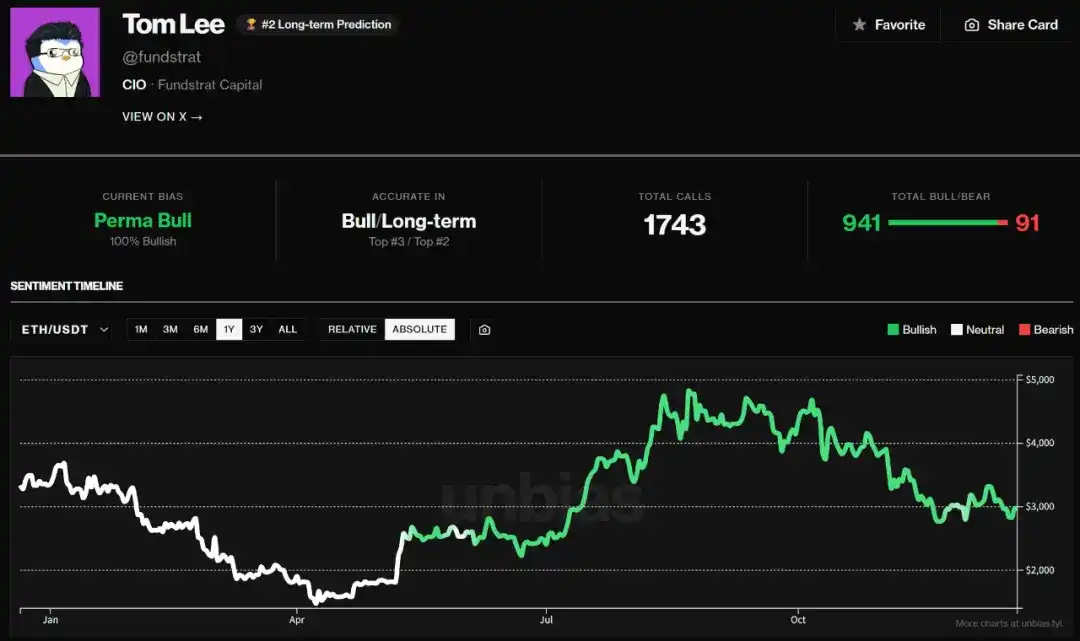
The above list of predictions covers almost most of the time nodes in 2025. On the unbias fyi Fundstrat analysis page, Tom Lee is labeled as a "Perma Bull (长期多头)". Every time he speaks, he gives the market higher target prices and more optimistic time horizons. However, these激进预测 are far from the actual price movements. This series of facts has led the market to question the credibility of the "Wall Street Soothsayer" Tom Lee.
Who is Tom Lee

Thomas Jong Lee, often referred to as Tom Lee, is a well-known US stock market strategist, research director, and financial commentator. He started on Wall Street in the 1990s, working at Kidder Peabody and Salomon Smith Barney, joined J.P. Morgan in 1999 and served as Chief Equity Strategist from 2007.

In 2014, he co-founded the independent research institution Fundstrat Global Advisors and served as Head of Research, transitioning from an investment bank strategist to the head of an independent research institution. He is regarded as one of the较早将 Bitcoin纳入主流估值讨论的 Wall Street strategists. In 2017, he published a report titled "A framework for valuing bitcoin as a substitute for gold,"首次提出 Bitcoin has the potential to partially replace gold as a store of value.

Due to his highly media-oriented research and views, Tom Lee often appears on mainstream financial programs and events as the "Head of Research at Fundstrat" (including CNBC related program/event pages and video content referencing his title). Since 2025, his influence has further extended to the "Ethereum Treasury" narrative: According to Reuters, BitMine, after advancing financing related to Ethereum treasury strategy, added Fundstrat's Thomas Lee to its board of directors to support its Ethereum-oriented treasury strategy. Meanwhile, Fundstrat also continues to release market outlooks and view snippets featuring Tom Lee as the core through its own YouTube channel.

Contradiction: The Contrast Between Public High-Profile Pumping and Internal Caution

The contradictory statements made by Tom Lee and his team on different occasions have sparked heated discussions within the circle about their motives and integrity. In response to the recent controversy, Sean Farrell, Head of Digital Asset Strategy at Fundstrat, posted a response stating that there is a misunderstanding of Fundstrat's research process externally.

He stated that Fundstrat has multiple analysts internally, each using independent research frameworks and time scales to serve the goals of different types of clients; among them, Tom Lee's research is more oriented towards traditional asset management institutions and "low allocation" investors (typically allocating only 1%–5% of assets to BTC/ETH), emphasizing long-term discipline and structural trends, while he himself mainly serves portfolios with a higher proportion of crypto assets (approx. 20%+). However, Tom Lee himself did not declare that he was targeting the group that "allocates 1%–5% of assets to BTC/ETH" when publicly pumping ETH.
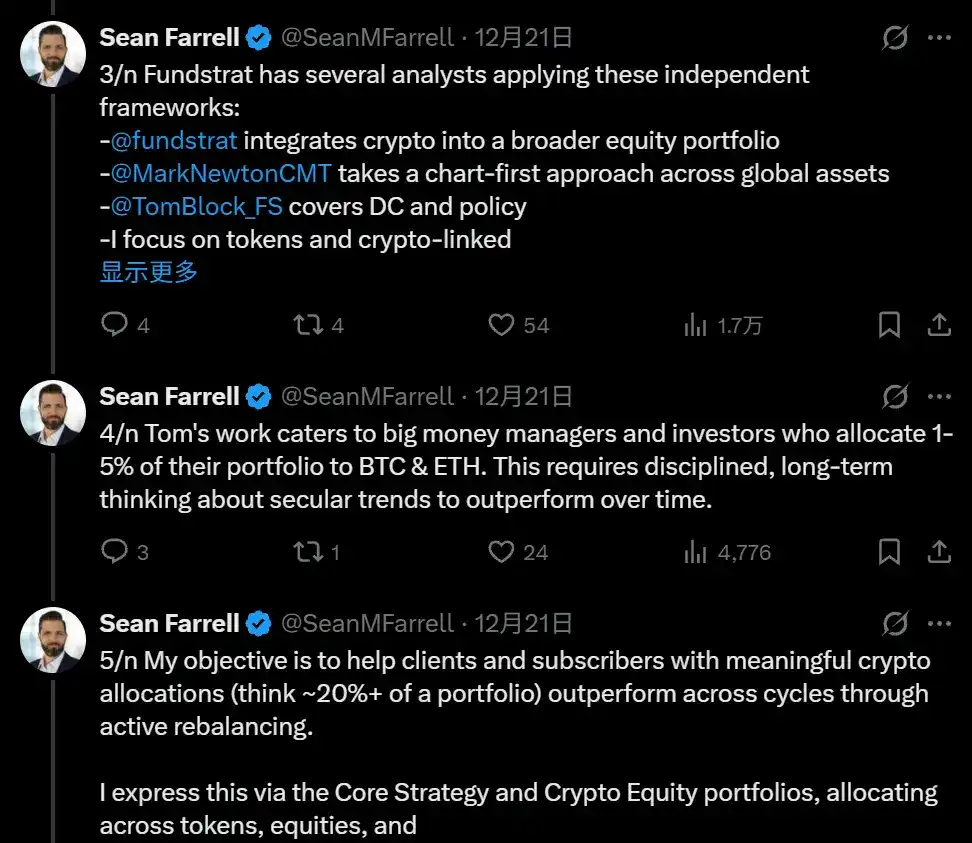
Farrell further stated that his cautious baseline scenario for the first half of 2026 is about risk management, not a turn towards bearishness on the long-term prospects of crypto. He believes that current market pricing is偏向"近乎完美", but risks such as government shutdowns, trade volatility, uncertainty in AI capital expenditure, and the Federal Reserve Chair succession remain. He also listed his historical performance, stating that his token portfolio has grown approximately 3 times since mid-January 2023, and his crypto stock portfolio has risen about 230% since its inception, with an excess of about 40% relative to BTC. During their respective existence, both have likely outperformed most liquid funds. But this wording seems more like a weak justification for Bitmine's $3 billion paper loss and the founder's contradictory statements.

Conclusion: The Contrast Isn't the Problem Itself; the Problem Lies in Disclosure and Boundaries

What真正引起争议 about this matter is not that Fundstrat has different frameworks, but that the co-founder lacks sufficiently clear scope of application and interest disclosure between the public communication end and the service end.

Sean Farrell's explanation of the contradictory statements using service to different types of clients is logically viable, but at the communication level, it still cannot avoid three problems:

1. When Tom Lee frequently expresses strong optimism about ETH in public videos and media interviews, the audience does not默认 this is "only applicable to long-term allocation discussions for low allocation positions," let alone automatically understand the implied risk premises, time scales, and probability weights. He himself has not publicly made clear clarifications and scope of application regarding this.

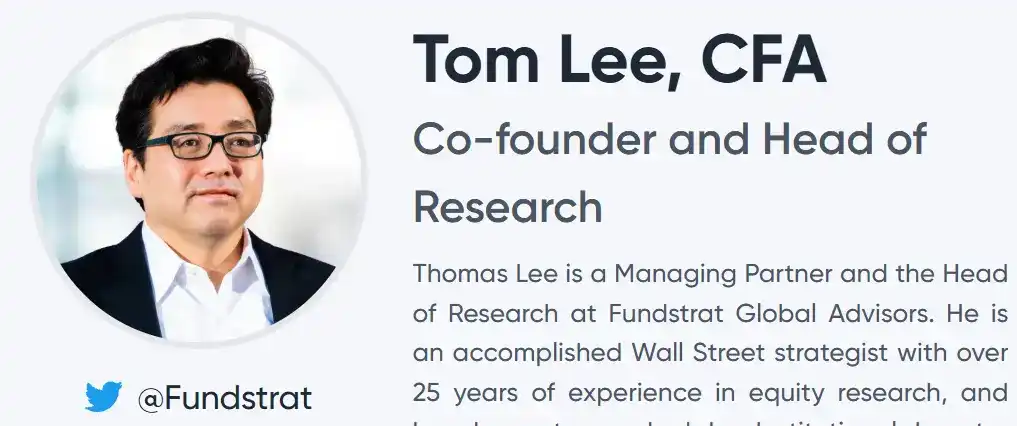
2. The subscription model of FS Insight /Fundstrat is essentially "research monetization". The official website page directly displays subscription guides like "Start Free Trial" and features Tom Lee for promotion. Tom Lee is the core招牌人物 at Fundstrat. The FS Insight page directly labels him as "Tom Lee, CFA / Head of Research". When traffic and subscription growth come more from Tom Lee's public interviews in various media, how does the company convince the public that "this is just expressing personal views".
3. Public information shows that Tom Lee concurrently serves as Chairman of the Board of Ethereum treasury strategy company BitMine Immersion Technologies (BMNR), and the company regards ETH as one of its core treasury directions. Under this identity structure, his continuous "bullish on ETH" communication externally will naturally be interpreted by the market as highly consistent with the interests of the associated entity. For CFA charterholders, professional ethics also emphasize making "full and clear disclosure" of matters that may affect independence and objectivity.

Such controversies usually involve compliance issues: anti-fraud and conflict of interest disclosure. In the context of US securities law, Rule 10b-5 is a typical anti-fraud clause, the core of which is to prohibit material false or misleading statements related to securities transactions.

Furthermore, Fundstrat's entity structure makes the controversy more complex: Fundstrat Global Advisors emphasizes in its terms and disclosure documents that it is a research company, "not a registered investment adviser, nor a broker-dealer," and subscription research is "for client use only." But at the same time, Fundstrat Capital LLC clearly provides advisory services as an "SEC-registered investment adviser (RIA)".

Considering that public interviews and the operation of the Fundstrat Youtube channel事实上承担了"customer acquisition/marketing" functions, another question arises: which content belongs to personal research dissemination, and which content belongs to company marketing. If an institution's public video channels continuously publish "pumping snippets," while the subscription service端 publishes "bearish for the first half of the year" predictions, and does not simultaneously present key limiting conditions and risk frameworks on the public communication end, then it will at least constitute a selective presentation under information asymmetry.

This may not violate the law, but it will continuously erode public trust in the independence and credibility of research, and will also blur the boundaries between "research — marketing — narrative mobilization." For research institutions whose reputation is one of their core businesses, this kind of trust cost will eventually backlash against the brand itself.


Пов'язані питання

QWhat is the main contradiction highlighted in the article regarding Tom Lee and his team at Fundstrat?

AThe article highlights a contradiction between Tom Lee's public optimism about Ethereum, where he repeatedly called it 'severely undervalued' and predicted high price targets like $15,000 by end of 2025, and Fundstrat's internal research report for subscribers, which projected a significant market correction in early 2026 with Ethereum potentially falling to $1,800–$2,000.

QWhat reasons does Fundstrat's internal report give for expecting a crypto market correction in early 2026?

AFundstrat's internal report cites several short-term headwinds that could pressure the crypto market in early 2026, including a potential U.S. government shutdown, uncertainty around international trade policies, fading confidence in AI investment returns, and policy suspense due to the Federal Reserve Chair transition.

QHow did Sean Farrell from Fundstrat attempt to explain the differing public and internal statements?

ASean Farrell, Fundstrat's Head of Digital Asset Strategy, explained that the firm has multiple analysts using independent research frameworks for different client types. He stated that Lee's public comments are aimed at traditional asset managers making small allocations (1%–5%), emphasizing long-term trends, while his own research serves clients with heavier crypto allocations (~20%+) and focuses on shorter-term risk management.

QWhat potential ethical and compliance issues does the article raise about Tom Lee's actions?

AThe article raises issues related to anti-fraud regulations (like SEC's Rule 10b-5 against misleading statements) and conflict of interest disclosure. It questions whether Lee's public 'pumping' of ETH was sufficiently distinguished from corporate marketing, especially given his role as Chairman of BitMine, a company with an Ethereum-focused treasury strategy, creating a potential conflict that may not have been fully and clearly disclosed.

QWhat is the article's conclusion about the core problem with Fundstrat's contradictory messaging?

AThe article concludes that the core problem is not the existence of different internal research frameworks, but rather a lack of clear disclosure and boundaries in public communication. It criticizes the selective presentation of overly optimistic public soundbites for marketing and traffic, which creates an information asymmetry and erodes trust in the research firm's independence and credibility.

Пов'язані матеріали

Торгівля

Спот
Ф'ючерси

Популярні статті

Що таке $S$

Розуміння SPERO: Комплексний огляд Вступ до SPERO Оскільки ландшафт інновацій продовжує еволюціонувати, виникнення технологій web3 та криптовалютних проектів відіграє ключову роль у формуванні цифрового майбутнього. Один з проектів, який привернув увагу в цій динамічній сфері, — це SPERO, позначений як SPERO,$$s$. Ця стаття має на меті зібрати та представити детальну інформацію про SPERO, щоб допомогти ентузіастам та інвесторам зрозуміти його основи, цілі та інновації в рамках web3 та крипто-сектору. Що таке SPERO,$$s$? SPERO,$$s$ — це унікальний проект у криптопросторі, який прагне використати принципи децентралізації та технології блокчейн для створення екосистеми, що сприяє залученню, корисності та фінансовій інклюзії. Проект розроблений для полегшення взаємодії між користувачами новими способами, надаючи їм інноваційні фінансові рішення та послуги. У своїй основі SPERO,$$s$ прагне надати можливості індивідам, забезпечуючи інструменти та платформи, які покращують користувацький досвід у криптовалютному просторі. Це включає в себе можливість більш гнучких методів транзакцій, сприяння ініціативам, що підтримуються спільнотою, та створення шляхів для фінансових можливостей через децентралізовані додатки (dApps). Основна концепція SPERO,$$s$ обертається навколо інклюзивності, прагнучи зменшити розриви в традиційній фінансовій системі, використовуючи переваги технології блокчейн. Хто є творцем SPERO,$$s$? Особистість творця SPERO,$$s$ залишається дещо невідомою, оскільки є обмежені публічно доступні ресурси, що надають детальну інформацію про його засновників. Ця відсутність прозорості може бути наслідком зобов'язання проекту до децентралізації — етики, яку багато проектів web3 поділяють, ставлячи колективні внески вище за індивідуальне визнання. Зосереджуючи обговорення навколо спільноти та її колективних цілей, SPERO,$$s$ втілює суть наділення без виділення конкретних осіб. Таким чином, розуміння етики та місії SPERO є більш важливим, ніж ідентифікація єдиного творця. Хто є інвесторами SPERO,$$s$? SPERO,$$s$ підтримується різноманітними інвесторами, починаючи від венчурних капіталістів до ангельських інвесторів, які прагнуть сприяти інноваціям у крипто-секторі. Зосередження цих інвесторів зазвичай узгоджується з місією SPERO — пріоритет надається проектам, які обіцяють технологічний прогрес у суспільстві, фінансову інклюзію та децентралізоване управління. Ці інвесторські фонди зазвичай зацікавлені в проектах, які не лише пропонують інноваційні продукти, але й позитивно впливають на спільноту блокчейн та її екосистеми. Підтримка з боку цих інвесторів підкріплює SPERO,$$s$ як значного конкурента в швидко змінюваній сфері крипто-проектів. Як працює SPERO,$$s$? SPERO,$$s$ використовує багатогранну структуру, яка відрізняє його від традиційних криптовалютних проектів. Ось деякі ключові особливості, які підкреслюють його унікальність та інноваційність: Децентралізоване управління: SPERO,$$s$ інтегрує моделі децентралізованого управління, надаючи користувачам можливість активно брати участь у процесах прийняття рішень щодо майбутнього проекту. Цей підхід сприяє відчуттю власності та відповідальності серед членів спільноти. Корисність токена: SPERO,$$s$ використовує свій власний криптовалютний токен, розроблений для виконання різних функцій в екосистемі. Ці токени дозволяють здійснювати транзакції, отримувати винагороди та полегшувати послуги, що пропонуються на платформі, підвищуючи загальну залученість та корисність. Шарова архітектура: Технічна архітектура SPERO,$$s$ підтримує модульність та масштабованість, що дозволяє безперешкодно інтегрувати додаткові функції та додатки в міру розвитку проекту. Ця адаптивність є надзвичайно важливою для збереження актуальності в постійно змінюваному крипто-ландшафті. Залучення спільноти: Проект підкреслює ініціативи, що підтримуються спільнотою, використовуючи механізми, які стимулюють співпрацю та зворотний зв'язок. Підтримуючи сильну спільноту, SPERO,$$s$ може краще задовольняти потреби користувачів та адаптуватися до ринкових тенденцій. Фокус на інклюзію: Пропонуючи низькі комісії за транзакції та зручні інтерфейси, SPERO,$$s$ прагне залучити різноманітну базу користувачів, включаючи осіб, які раніше не брали участі в крипто-просторі. Це зобов'язання до інклюзії узгоджується з його загальною місією наділення через доступність. Хронологія SPERO,$$s$ Розуміння історії проекту надає важливі уявлення про його розвиток та етапи. Нижче наведено пропоновану хронологію, що відображає значні події в еволюції SPERO,$$s$: Етап концептуалізації та ідеації: Початкові ідеї, що стали основою SPERO,$$s$, були сформовані, тісно пов'язані з принципами децентралізації та фокусом на спільноті в індустрії блокчейн. Запуск білого паперу проекту: Після концептуального етапу був випущений комплексний білий папір, що детально описує бачення, цілі та технологічну інфраструктуру SPERO,$$s$, щоб залучити інтерес та зворотний зв'язок від спільноти. Створення спільноти та ранні залучення: Активні зусилля були спрямовані на створення спільноти ранніх прихильників та потенційних інвесторів, що полегшило обговорення цілей проекту та отримання підтримки. Подія генерації токенів: SPERO,$$s$ провів подію генерації токенів (TGE) для розподілу своїх рідних токенів серед ранніх прихильників та встановлення початкової ліквідності в екосистемі. Запуск початкового dApp: Перший децентралізований додаток (dApp), пов'язаний з SPERO,$$s$, став доступним, дозволяючи користувачам взаємодіяти з основними функціями платформи. Постійний розвиток та партнерства: Безперервні оновлення та вдосконалення пропозицій проекту, включаючи стратегічні партнерства з іншими учасниками блокчейн-простору, сформували SPERO,$$s$ у конкурентоспроможного та еволюціонуючого гравця на крипто-ринку. Висновок SPERO,$$s$ є свідченням потенціалу web3 та криптовалют для революціонізації фінансових систем та наділення індивідів. Завдяки зобов'язанню до децентралізованого управління, залучення спільноти та інноваційно спроектованих функцій, він прокладає шлях до більш інклюзивного фінансового ландшафту. Як і з будь-якими інвестиціями в швидко змінюваному крипто-просторі, потенційним інвесторам та користувачам рекомендується ретельно досліджувати та обдумано взаємодіяти з поточними подіями в SPERO,$$s$. Проект демонструє інноваційний дух крипто-індустрії, запрошуючи до подальшого дослідження його численних можливостей. Хоча подорож SPERO,$$s$ ще триває, його основні принципи можуть справді вплинути на майбутнє того, як ми взаємодіємо з технологією, фінансами та один з одним у взаємопов'язаних цифрових екосистемах.

73 переглядів усьогоОпубліковано 2024.12.17Оновлено 2024.12.17

Що таке $S$

Що таке AGENT S

Агент S: Майбутнє автономної взаємодії в Web3 Вступ У постійно змінюваному ландшафті Web3 та криптовалюти інновації постійно переосмислюють, як люди взаємодіють з цифровими платформами. Один з таких новаторських проектів, Агент S, обіцяє революціонізувати взаємодію людини з комп'ютером через свою відкриту агентну структуру. Прокладаючи шлях для автономних взаємодій, Агент S прагне спростити складні завдання, пропонуючи трансформаційні застосування в штучному інтелекті (ШІ). Це детальне дослідження заглиблюється в складності проекту, його унікальні особливості та наслідки для сфери криптовалюти. Що таке Агент S? Агент S є революційною відкритою агентною структурою, спеціально розробленою для вирішення трьох основних викликів в автоматизації комп'ютерних завдань: Набуття специфічних знань у галузі: Структура інтелектуально навчається з різних зовнішніх джерел знань та внутрішнього досвіду. Цей подвійний підхід дозволяє їй створити багатий репозиторій специфічних знань у галузі, покращуючи її продуктивність у виконанні завдань. Планування на довгих горизонтах завдань: Агент S використовує планування з підкріпленням досвіду, стратегічний підхід, який полегшує ефективний розподіл та виконання складних завдань. Ця функція значно підвищує її здатність ефективно та результативно управляти кількома підзавданнями. Обробка динамічних, неоднорідних інтерфейсів: Проект представляє Інтерфейс Агент-Комп'ютер (ACI), інноваційне рішення, яке покращує взаємодію між агентами та користувачами. Використовуючи багатомодальні великі мовні моделі (MLLMs), Агент S може безперешкодно орієнтуватися та маніпулювати різноманітними графічними інтерфейсами користувача. Завдяки цим новаторським функціям Агент S надає надійну структуру, яка вирішує складнощі, пов'язані з автоматизацією людської взаємодії з машинами, прокладаючи шлях для численних застосувань у ШІ та за його межами. Хто є творцем Агент S? Хоча концепція Агент S є фундаментально новаторською, конкретна інформація про його творця залишається невідомою. Творець наразі невідомий, що підкреслює або початкову стадію проекту, або стратегічний вибір зберегти засновників у таємниці. Незважаючи на анонімність, акцент залишається на можливостях та потенціалі структури. Хто є інвесторами Агент S? Оскільки Агент S є відносно новим у криптографічній екосистемі, детальна інформація про його інвесторів та фінансових спонсорів не задокументована. Відсутність публічно доступних відомостей про інвестиційні фонди або організації, що підтримують проект, викликає питання щодо його фінансової структури та дорожньої карти розвитку. Розуміння підтримки є критично важливим для оцінки стійкості проекту та потенційного впливу на ринок. Як працює Агент S? В основі Агент S лежить передова технологія, яка дозволяє йому ефективно функціонувати в різних умовах. Його операційна модель побудована навколо кількох ключових функцій: Взаємодія з комп'ютером, подібна до людської: Структура пропонує розширене планування ШІ, прагнучи зробити взаємодії з комп'ютерами більш інтуїтивними. Імітуючи людську поведінку при виконанні завдань, вона обіцяє підвищити досвід користувачів. Наративна пам'ять: Використовується для використання високорівневого досвіду, Агент S використовує наративну пам'ять для відстеження історій завдань, тим самим покращуючи свої процеси прийняття рішень. Епізодична пам'ять: Ця функція надає користувачам покрокові інструкції, дозволяючи структурі пропонувати контекстуальну підтримку в міру виконання завдань. Підтримка OpenACI: Завдяки можливості працювати локально, Агент S дозволяє користувачам зберігати контроль над своїми взаємодіями та робочими процесами, узгоджуючи з децентралізованою етикою Web3. Легка інтеграція з зовнішніми API: Його універсальність і сумісність з різними платформами ШІ забезпечують те, що Агент S може безперешкодно вписатися в існуючі технологічні екосистеми, роблячи його привабливим вибором для розробників та організацій. Ці функціональні можливості колективно сприяють унікальному положенню Агент S у крипто-просторі, оскільки він автоматизує складні, багатоступеневі завдання з мінімальним втручанням людини. У міру розвитку проекту його потенційні застосування в Web3 можуть переосмислити, як відбуваються цифрові взаємодії. Хронологія Агент S Розробка та етапи Агент S можуть бути узагальнені в хронології, яка підкреслює його значні події: 27 вересня 2024 року: Концепція Агент S була представлена в комплексній науковій статті під назвою “Відкрита агентна структура, яка використовує комп'ютери як людина”, що демонструє основи проекту. 10 жовтня 2024 року: Наукова стаття була опублікована на arXiv, пропонуючи детальне дослідження структури та її оцінки продуктивності на основі бенчмарку OSWorld. 12 жовтня 2024 року: Було випущено відеопрезентацію, що надає візуальне уявлення про можливості та особливості Агент S, ще більше залучаючи потенційних користувачів та інвесторів. Ці маркери в хронології не лише ілюструють прогрес Агент S, але й вказують на його прихильність до прозорості та залучення громади. Ключові моменти про Агент S У міру розвитку структури Агент S кілька ключових характеристик виділяються, підкреслюючи її новаторський характер та потенціал: Інноваційна структура: Розроблена для забезпечення інтуїтивного використання комп'ютерів, подібного до людської взаємодії, Агент S пропонує новий підхід до автоматизації завдань. Автономна взаємодія: Здатність автономно взаємодіяти з комп'ютерами через GUI означає стрибок до більш інтелектуальних та ефективних обчислювальних рішень. Автоматизація складних завдань: Завдяки своїй надійній методології він може автоматизувати складні, багатоступеневі завдання, роблячи процеси швидшими та менш схильними до помилок. Безперервне вдосконалення: Механізми навчання дозволяють Агенту S покращуватися на основі минулого досвіду, постійно підвищуючи свою продуктивність та ефективність. Універсальність: Його адаптивність до різних операційних середовищ, таких як OSWorld та WindowsAgentArena, забезпечує його здатність служити широкому спектру застосувань. Оскільки Агент S займає своє місце в ландшафті Web3 та криптовалюти, його потенціал покращити можливості взаємодії та автоматизувати процеси означає значний прогрес у технологіях ШІ. Завдяки своїй інноваційній структурі Агент S є прикладом майбутнього цифрових взаємодій, обіцяючи більш безперешкодний та ефективний досвід для користувачів у різних галузях. Висновок Агент S представляє собою сміливий крок вперед у поєднанні ШІ та Web3, з можливістю переосмислити, як ми взаємодіємо з технологією. Хоча проект все ще на ранніх стадіях, можливості для його застосування є величезними та переконливими. Завдяки своїй комплексній структурі, що вирішує критичні виклики, Агент S прагне вивести автономні взаємодії на передній план цифрового досвіду. У міру того, як ми заглиблюємося в сфери криптовалюти та децентралізації, проекти, подібні до Агент S, безсумнівно, відіграватимуть ключову роль у формуванні майбутнього технологій та співпраці людини з комп'ютером.

548 переглядів усьогоОпубліковано 2025.01.14Оновлено 2025.01.14

Що таке AGENT S

Як купити S

Ласкаво просимо до HTX.com! Ми зробили покупку Sonic (S) простою та зручною. Дотримуйтесь нашої покрокової інструкції, щоб розпочати свою криптовалютну подорож.Крок 1: Створіть обліковий запис на HTXВикористовуйте свою електронну пошту або номер телефону, щоб зареєструвати обліковий запис на HTX безплатно. Пройдіть безпроблемну реєстрацію й отримайте доступ до всіх функцій.ЗареєструватисьКрок 2: Перейдіть до розділу Купити крипту і виберіть спосіб оплатиКредитна/дебетова картка: використовуйте вашу картку Visa або Mastercard, щоб миттєво купити Sonic (S).Баланс: використовуйте кошти з балансу вашого рахунку HTX для безперешкодної торгівлі.Треті особи: ми додали популярні способи оплати, такі як Google Pay та Apple Pay, щоб підвищити зручність.P2P: Торгуйте безпосередньо з іншими користувачами на HTX.Позабіржова торгівля (OTC): ми пропонуємо індивідуальні послуги та конкурентні обмінні курси для трейдерів.Крок 3: Зберігайте свої Sonic (S)Після придбання Sonic (S) збережіть його у своєму обліковому записі на HTX. Крім того, ви можете відправити його в інше місце за допомогою блокчейн-переказу або використовувати його для торгівлі іншими криптовалютами.Крок 4: Торгівля Sonic (S)Легко торгуйте Sonic (S) на спотовому ринку HTX. Просто увійдіть до свого облікового запису, виберіть торгову пару, укладайте угоди та спостерігайте за ними в режимі реального часу. Ми пропонуємо зручний досвід як для початківців, так і для досвідчених трейдерів.

1.3k переглядів усьогоОпубліковано 2025.01.15Оновлено 2025.03.21

Як купити S

Обговорення

Ласкаво просимо до спільноти HTX. Тут ви можете бути в курсі останніх подій розвитку платформи та отримати доступ до професійної ринкової інформації. Нижче представлені думки користувачів щодо ціни S (S).

活动图片













