Pro-Cryptocurrency PAC Wins Primaries but Loses $2M Race in Florida

cryptonews.ruОпубліковано о 2026-08-19Востаннє оновлено о 2026-08-19

Анотація

A pro-cryptocurrency political action committee (PAC), Fairshake, achieved mixed results in recent U.S. primary elections, spending millions to influence races ahead of the 2026 midterms. Fairshake's affiliated PACs, Protect Progress and Defend American Jobs, supported candidates in Alaska, Florida, and Wyoming, spending approximately $3.6 million. Four out of five candidates backed by their ads won their primaries or advanced. These included Democrat Lois Frankel in Florida, Republican Nick Begich in Alaska, Republican Sydney Gruters in Florida, and Representative Harriet Hageman in Wyoming's Senate race. However, a high-profile $2 million negative ad campaign by Protect Progress failed to defeat Democrat Oliver Gilbert in Florida's 24th District. Gilbert won despite the ads, which he attributed to "Trump's techie-billionaire friends" and "crypto-scammers trying to buy a Democratic primary." A PAC representative defended the ads' factual accuracy. Fairshake, with a reported $193 million war chest, has spent over $130 million in the 2024 cycle supporting pro-crypto candidates and opposing critics. A spokesperson stated the PAC is "just getting started" to build the largest pro-crypto Congress in history. The outcomes could impact future crypto legislation, such as the pending CLARITY Act, as the 2026 elections may shift congressional control and determine which parties advance or block industry-related bills.

Four out of five candidates supported by advertising funded by the pro-cryptocurrency political action committee (PAC) Fairshake won their primaries or otherwise advanced on Tuesday. This could indicate the industry's influence on the 2026 midterm elections.

On Tuesday, Democratic and Republican candidates supported by advertising funded by the Fairshake-affiliated PACs Protect Progress and Defend American Jobs won victories in three U.S. states. In total, these PACs spent approximately $3.6 million on House and Senate races in Alaska, Florida, and Wyoming.

Democrat Lois Frankel was re-elected in Florida's 23rd congressional district after Protect Progress spent over $150,000 on advertising in her support. Defend American Jobs also spent a total of $1.5 million on advertising supporting Republican Nick Begich in Alaska's at-large congressional district, Republican candidate Sydney Gruters in Florida's 16th congressional district, and Representative Harriet Hageman in the U.S. Senate race for Wyoming. Gruters and Hageman won their primaries, and Begich is expected to advance to the next round in Alaska.

All four candidates are likely to continue competing with rivals in the November 2026 midterm elections. A Democrat in Florida's 24th district also won, despite over $2 million worth of negative advertising funded by Protect Progress. Oliver Gilbert defeated opponents Shevrin Jones and Kendrick Meek, receiving 34.4% of the vote, in a race that raised questions about the potential influence of the crypto industry.
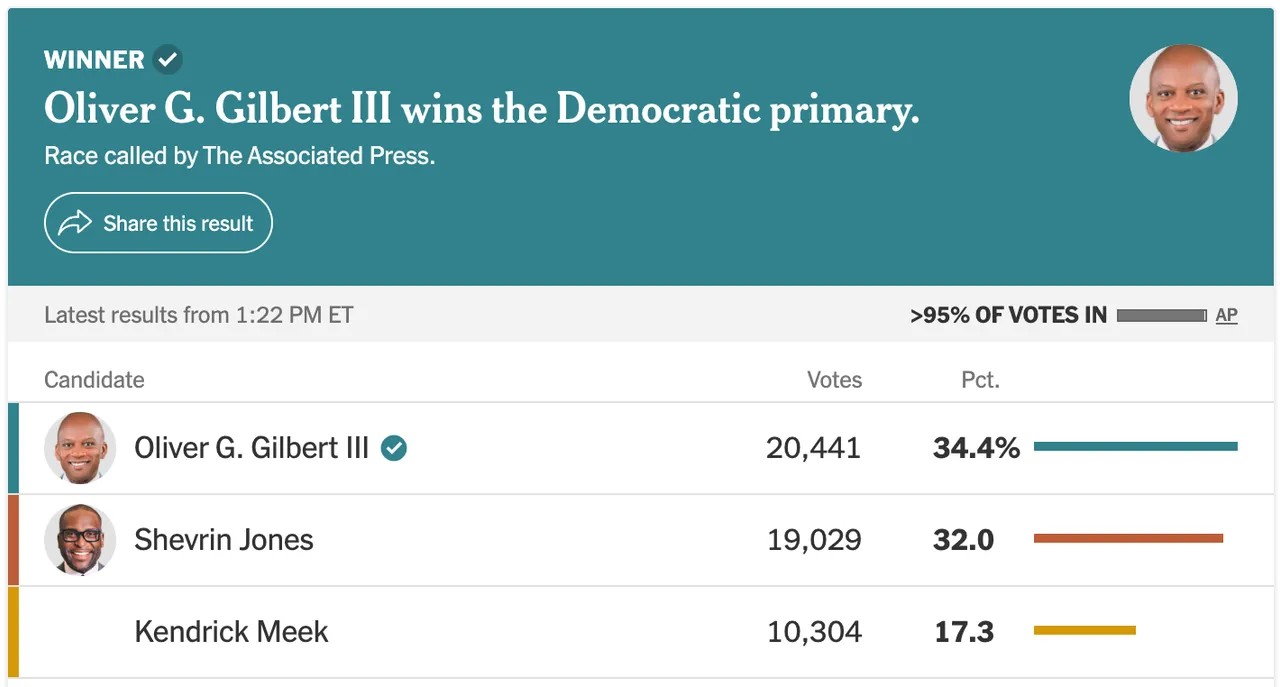
Results of the Democratic primary in Florida's 24th congressional district. Source: The New York Times

According to an August 12 report by the Miami Herald, Gilbert stated that '[Donald] Trump's buddies — the tech billionaires' were behind 'crypto crooks trying to buy the Democratic primary' through Protect Progress advertising. The publication reported that the ads used fake Miami Herald headlines that misrepresented Gilbert's policy positions, although a PAC spokesperson stated that 'the facts underlying our advertising are accurate.'

The Fairshake PAC, which reported having a war chest of $193 million in January, funded over $130 million in advertising in support of candidates it considered pro-cryptocurrency during the 2024 election cycle. The committee also ran ads against many candidates who spoke negatively about the industry or voted against its interests. By June, the committee had spent over $82 million on upcoming elections ahead of the 2026 midterms.

Related content: UK authorities continue investigation into Nigel Farage's cryptocurrency 'gifts' after by-election win

Gilbert did not mention the crypto industry or the advertising in his victory speech on Tuesday night. Fairshake spokesperson Jeff Vetter stated that after the primaries in three states and the victories of other candidates in 2026, the PAC is 'just getting started building the biggest pro-crypto Congress in history.'

Will the Composition of the Next Congress Affect the Crypto Market Structure Bill?

Both chambers of the U.S. Congress — the Senate and the House of Representatives — are on recess until September. The Senate is then expected to consider a cloture motion on the Digital Asset Regulatory Clarity Act (CLARITY Act), which is meant to establish comprehensive rules for digital assets. Although the House passed the bill with bipartisan support in July by a vote of 294–134, many Senate Democrats are pushing for stricter ethical rules related to the Trump family's cryptocurrency investments.

Following the 2026 elections, the U.S. Congress could shift from a Republican majority to a Democratic one depending on the outcome of key races that may be influenced by PACs like Fairshake. Lawmakers elected in November could accelerate or block legislative initiatives affecting the crypto industry, including the CLARITY Act, if the current session does not address the bill before 2027.

Magazine: 200,000 fake AI 'victims' used to scam internet scammers

end-content
Пов'язані питання

QWhich PAC, affiliated with the cryptocurrency industry, financed advertising campaigns in the primaries mentioned in the article?

AThe advertising campaigns were financed by the cryptocurrency-aligned Political Action Committee (PAC) Fairshake and its affiliated PACs, Protect Progress and Defend American Jobs.

QIn the Florida primaries, what was the outcome for candidate Oliver Gilbert, despite negative advertising funded by a crypto-aligned PAC?

AOliver Gilbert, a Democrat, won the primary in Florida's 24th district despite facing over $2 million in negative advertising funded by the Protect Progress PAC.

QWhat is the total amount reportedly spent by the Fairshake PAC and its affiliates on House and Senate elections in the mentioned states?

AThe Fairshake-affiliated PACs, Protect Progress and Defend American Jobs, spent about $3.6 million on House and Senate elections in Alaska, Florida, and Wyoming.

QWhat is the significance of the CLARITY Act mentioned in the article for the digital asset market in the U.S.?

AThe CLARITY Act (Clarity for Regulatory Understanding of Digital Assets) aims to establish a comprehensive regulatory framework for digital assets in the U.S., providing market clarity and rules for the industry.

QWhat is the stated goal of the Fairshake PAC's spokesperson regarding the composition of the next U.S. Congress?

AThe spokesperson for the Fairshake PAC, Jeff Vetter, stated that after the primary wins, the PAC is 'just beginning to build the largest pro-crypto Congress in history.'

Пов'язані матеріали

How Does Wall Street View Warsh's Jackson Hole Debut? Hawkish 'Correction' of July Communication; Failure to Hike in September May Further Damage Fed Credibility

Wall Street widely interpreted Fed Chair Wash's first speech at the Jackson Hole symposium as a "hawkish correction" to the Fed's July FOMC communications. Wash firmly reiterated the Fed's unwavering commitment to the 2% inflation target, indicated that overall financial conditions are not restrictive, and stated that recent positive PCE and CPI data are not enough to show meaningful improvement in underlying inflation trends. He said if confidence is lacking that inflation is falling "clearly and fast enough," the Fed "has more work to do," with Reuters calling it his closest admission yet that another rate hike may be needed. This shifted market focus to the September meeting. JPMorgan's Priya Misra called it a "hawkish speech" that cleaned up July's communication "misstep." Aberdeen's Matthew Amis warned that if the Fed doesn't hike in September, its credibility could take another hit. Barclays and Société Générale now forecast 25-basis-point hikes in September and December, with SocGen adding a March hike expectation. However, analysts noted Wash provided principles but no explicit forward guidance. The "new Fed whisperer," Nick Timiraos, observed Wash gave a more hawkish diagnosis but no clear "reaction function." The CME's FedWatch Tool showed the probability of a September hike jumped from about 35% to around 50-60% after the speech. The bond market reaction was telling: short-term yields rose more than long-term yields, indicating traders were repricing near-term rate hikes. In essence, Wash rebuilt a hawkish policy logic: if the economy remains resilient and inflation doesn't fall fast enough, more tightening is possible. The consensus is that he successfully delivered a hawkish reset. While a September hike is now a serious possibility, the final decision will hinge on incoming data, creating a credibility test for the Fed if data doesn't improve and it holds rates steady.

marsbit13 хв тому

How Does Wall Street View Warsh's Jackson Hole Debut? Hawkish 'Correction' of July Communication; Failure to Hike in September May Further Damage Fed Credibility

marsbit13 хв тому

Warsh's Latest Speech: The Era We Are In

Federal Reserve Chairman Kevin W. Warsh delivered a speech titled "In Our Time" at the Jackson Hole Economic Policy Symposium. The remarks struck a cautiously hawkish tone, with Warsh emphasizing that inflation remains significantly above the Fed's 2% target and should be the primary focus of monetary policy. He expressed that recent, better-than-expected CPI and PCE data do not yet signal a meaningful improvement in the underlying inflation trend. Warsh outlined core principles for monetary policy, including the firm commitment to the 2% inflation target, the importance of both price stability and maximum employment, and the primary role of short-term interest rates as a policy tool. He also stressed the relevance of monetary aggregates and advocated for a Fed that communicates with greater purpose and restraint. A significant portion of the speech addressed the practice of "forward guidance." Warsh argued that while essential during crises, forward guidance should be limited in normal times. He warned that excessive pre-commitment to future policy paths can constrain the Fed's flexibility and create a "hall-of-mirrors" problem, where markets rely too heavily on Fed signals rather than independently assessing economic fundamentals. On the current economy, Warsh noted impressive resilience, strong business investment (partly driven by AI infrastructure), healthy consumer spending, and a stable labor market with low unemployment. However, he observed that broad financial conditions are not particularly restrictive. Despite economic strength, inflation metrics remain elevated, with a high proportion of PCE basket components still showing price increases above 3%. Warsh concluded by stating the Fed's standard: policymakers must be confident that underlying inflation is moving clearly and sufficiently quickly toward the 2% target. Otherwise, "we have more work to do." He framed his approach as a commitment to disciplined policy-making rather than to any specific near-term decision.

marsbit2 год тому

Warsh's Latest Speech: The Era We Are In

marsbit2 год тому

Access to Active Sessions Instead of Databases: How the Shadow Market in Russia Has Changed

The Russian cybercriminal underground is shifting from selling massive, stolen corporate databases to trading active, short-term access to user accounts, according to a 2026 report. The value of information intercepted directly from infected devices by malware has risen nearly 13% in a year. Attackers now sell packets containing active session tokens (bypassing passwords and two-factor authentication), live email credentials, VPN and cloud storage logins, and corporate network access. A subscription for a steady stream of fresh data costs $250-$300 per month, far exceeding the value of outdated archives. While Russian regulators have successfully penalized companies for data leaks from centralized storage—with no repeat violations recorded after imposing turnover fines—this framework fails against the new threat model. Malware now steals data *after* it leaves the corporate perimeter and is on a user's personal device, a legal grey area. In 2026, 60% of studied web attacks aimed to steal keys for infiltrating corporate infrastructure. The situation mirrors global trends, akin to the Genesis Market shutdown in 2023, and highlights a structural risk: the demand for "fresh" data incentivizes botnet operators to maintain long-term control of infected devices for recurring revenue. This creates a persistent vulnerability layer between personal devices and corporate networks, currently outside the reach of existing regulatory protections.

cryptonews.ru4 год тому

Access to Active Sessions Instead of Databases: How the Shadow Market in Russia Has Changed

cryptonews.ru4 год тому

Торгівля

Спот
活动图片