Privacy Coin Crisis of Confidence! ZEC Plunges Over 56% in a Single Day

链捕手Опубліковано о 2026-06-05Востаннє оновлено о 2026-06-05

Анотація

Zcash (ZEC), a leading privacy-focused cryptocurrency, experienced a severe crash on June 5th, plummeting over 56% in a single day and erasing nearly two months of gains. The flash crash was triggered by the disclosure of a critical zero-knowledge proof vulnerability within Zcash's Orchard privacy pool, which had existed since the pool's launch in May 2022. The flaw theoretically allowed an attacker to forge unlimited ZEC undetectably due to the pool's privacy features. The vulnerability was discovered on May 29th by independent security researcher Taylor Hornby during a proactive audit commissioned by Shielded Labs, utilizing AI-assisted analysis. The Zcash development team responded swiftly, implementing an emergency soft fork to disable Orchard transactions on June 2nd and executing a permanent hard fork fix (NU6.2) on June 3rd. Despite the technical fix, a major crisis of confidence emerged. The core issue is that Orchard's privacy design makes it cryptographically impossible to prove whether the vulnerability was exploited over the past four years, casting permanent doubt on the historical supply integrity of ZEC. While Shielded Labs argues exploitation was unlikely, the inability to provide definitive proof has severely damaged market trust. This sentiment was exacerbated when BitMEX co-founder Arthur Hayes, a prominent ZEC supporter, announced he was selling his entire position. He stated that privacy assets require "perfect security" rather than "probable safety." ...

Author: Zhou, ChainCatcher

On June 5th, the leading privacy coin ZEC experienced a maximum intraday drop exceeding 56%, erasing nearly two months of gains, with its market cap shedding approximately $5 billion at one point.

Data shows that the total ZEC contract liquidations across all platforms reached about $100 million in the past 24 hours, with long position liquidations exceeding $76 million, second only to BTC and ETH in liquidation volume.
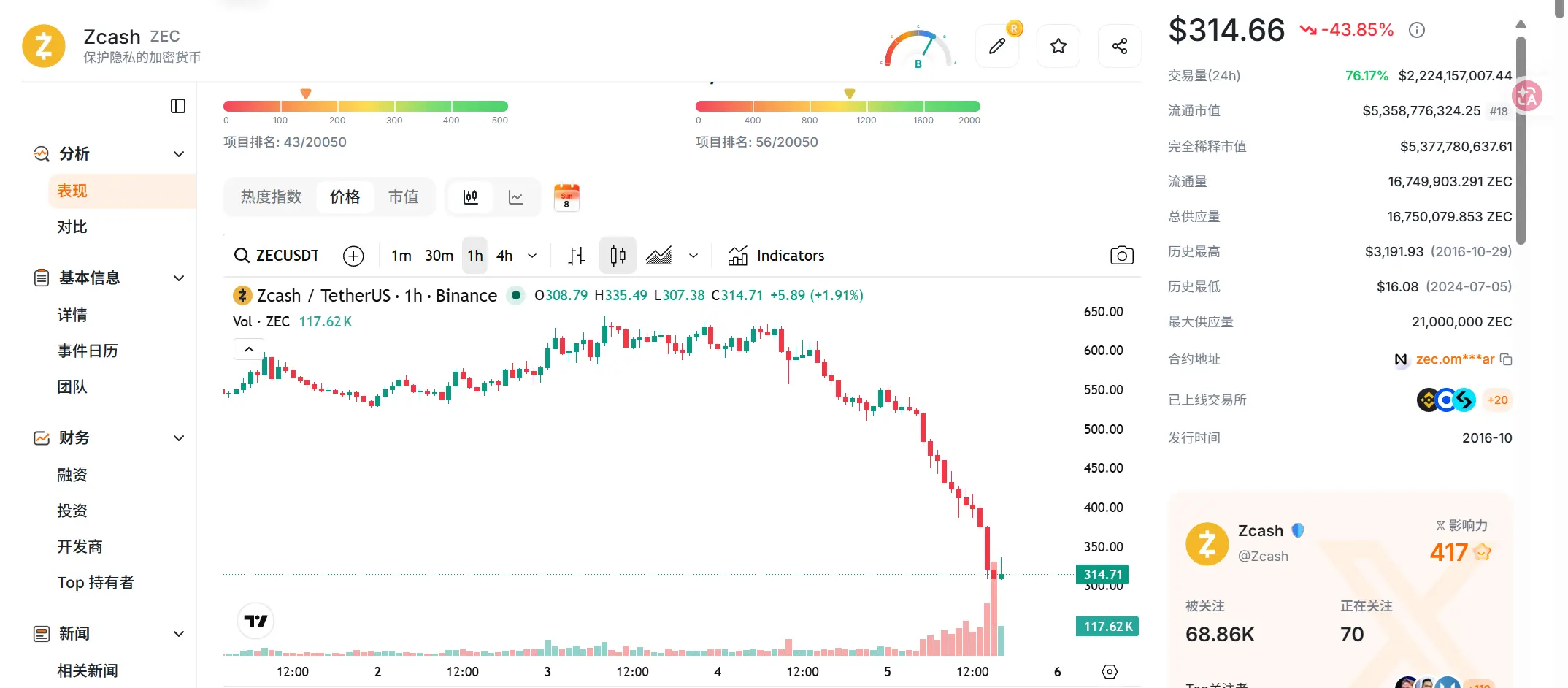
Image Source: RootData

The crash was triggered by a zero-knowledge proof vulnerability that had been latent for four years in Zcash's latest privacy transaction pool, Orchard. Theoretically, it allowed attackers to forge infinite ZEC under privacy protection, making detection extremely difficult.

The good news is the vulnerability was permanently fixed via a hard fork on June 3rd. The bad news is, due to the privacy features of the Orchard pool, no one can cryptographically prove that this vulnerability was never exploited over the past four years, leading to market doubts about ZEC's supply integrity during that period.

BitMEX co-founder Arthur Hayes announced he had liquidated all his ZEC holdings, on-chain whales profited handsomely from short positions, and market confidence was visibly shaken.

How the Vulnerability Arose and Was Discovered

The Orchard pool is Zcash's third-generation privacy transaction layer launched in May 2022. Due to insufficiently strict constraint conditions on one circuit element, attackers could input false values in elliptic curve multiplication operations yet still pass circuit verification, thereby generating unlimited forged ZEC within the pool. Because of Orchard's inherent privacy design, this forgery would leave no detectable on-chain trace.

The vulnerability was discovered by independent security researcher Taylor Hornby on May 29th. In April this year, the Zcash ecosystem independent security organization Shielded Labs had commissioned him to conduct a targeted security audit of the Zcash protocol, aiming to find potential vulnerabilities before attackers.

On May 28th, Anthropic released the Claude Opus 4.8 model. The next day, Hornby integrated it into his customized AI audit framework to conduct targeted analysis of the Orchard circuit, pinpointing the vulnerability that very day. He wrote a complete exploit program in a local test environment, verifying the technical feasibility of infinite minting. That evening, he responsibly disclosed the issue to the Zcash Open Developer Laboratory (ZODL).

ZODL engineers confirmed the vulnerability within hours and immediately activated emergency procedures. In the early hours of June 2nd, Zcash pushed an emergency soft fork via Zebra 4.5.3, temporarily disabling all Orchard transactions. On June 3rd, at 12:05 Beijing time, the mainnet completed the NU6.2 hard fork at block height 3,364,600, deploying the patched circuit and permanently closing the vulnerability.

From discovery to hard fork completion took about five days. The Zcash Foundation stated this was only the second time in Zcash's history since its 2016 launch that a protocol upgrade was triggered by a security issue. No known exploits occurred throughout the process, network total supply safeguarding mechanisms confirmed the total supply remained intact, and user privacy along with Sapling and transparent transactions were unaffected.
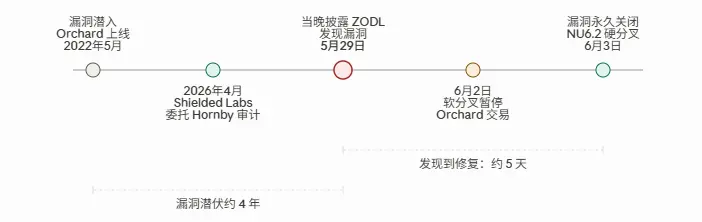
Image Source: Claude

After the Fix, Doubts Remain

Due to Orchard's privacy design, if an attacker never transfers forged tokens to the transparent pool, no existing mechanism can detect anomalies on-chain. This means the conclusion of an 'intact total supply' is based on currently observable data, not strict cryptographic proof. The vulnerability has existed since May 2022, and no one can rule out the possibility it was exploited over the past four years.

Shielded Labs believes the likelihood of exploitation is low, citing three reasons: the fact it remained undiscovered for four years indicates an extremely high technical barrier; its discovery resulted from a proactive targeted audit, not a passive exposure; and the short window from discovery to fix gave attackers very limited time to exploit. However, this very explanation itself shows the problem cannot be completely disproven.

To address this gap, Shielded Labs is collaborating with various developers to explore a new network upgrade proposal. The plan is to deploy a new privacy pool and enforce mandatory turnstile accounting scrutiny for all tokens migrating out of Orchard, allowing anyone to publicly verify supply integrity. The specific proposal is expected to be announced next week and will still need to go through community governance processes.

Crypto investor Simon Dedic pointed out that this event reveals two concurrent shifts in perception: privacy is not always an advantage; it can also be a risk in protocol design. The involvement of AI tools means vulnerabilities of similar scale can now be discovered with a lower barrier to entry, increasing the security audit pressure faced by the entire crypto industry.

On-chain analyst Haotian described the core issue of this event as 'unclearable.' Even if Shielded Labs introduces a new turnstile audit scheme, it can only prove the current supply is less than the total amount that entered the pool, still failing to cover potential historical hidden depreciation. He also noted the inherent contradiction between verifiable supply and privacy black boxes is a structural dilemma ZEC struggles to circumvent.

Concentrated Release of Market Panic

Although the technical crisis has passed, the market has not fully digested the true nature of the vulnerability.

This morning, Zcash founder Zooko Wilcox, Shielded Labs, and Taylor Hornby jointly published a detailed article comprehensively disclosing the exploitability of the vulnerability, the technical feasibility of infinite ZEC forgery, and the fact that 'cryptographic proof of historical non-exploitation is impossible' due to Orchard's privacy features, which truly ignited market panic.

On the same day, Arthur Hayes announced liquidating all his ZEC holdings, stating that while the probability of malicious minting is extremely low, it cannot be formally excluded at the cryptographic level. The value proposition of the privacy narrative demands 'perfect security,' not 'probable safety.' Hayes also indicated he might consider buying back at lower prices if subsequent assumptions are disproven.

Hayes was previously one of ZEC's most prominent public supporters, even listing it as his second-largest personal holding. He once stated ZEC should reach 10% of BTC's price, with the current rally 'having plenty of upside left.' His public departure now inevitably impacts market sentiment.

The combination of these two events caused ZEC's price to plummet rapidly. According to on-chain analyst monitoring, when ZEC fell below $400, the leveraged short position opened at $626.47 by 'insider whale' Garrett Jin resulted in floating profits reaching tens of millions of dollars.

However, some hold the view that the sharp price drop was not solely driven by the vulnerability. Crypto KOL OzLion pointed out that ZEC's previous rally already showed signs of large capital involvement. The vulnerability news might have merely provided an exit timing, with a massive influx of spot sell-offs on the day being a more direct price driver. He lamented that a 'strong-consensus blue-chip' with a $12 billion market cap losing $6 billion in a single day shows that building consensus in the crypto world is difficult, breaking it is easy, and repairing it is an even longer process.


Трендові криптовалюти

Пов'язані питання

QWhat was the main event that triggered the price crash of ZEC on June 5th?

AThe main trigger was the public disclosure of a zero-knowledge proof vulnerability in the Orchard privacy pool, which theoretically allowed unlimited undetectable minting of ZEC for four years, severely damaging market confidence.

QWhat is the core dilemma highlighted by the ZEC incident regarding privacy features?

AThe incident highlights the inherent contradiction between verifiable supply integrity and the privacy features of 'black box' systems. While privacy is a core value proposition, it creates a scenario where past exploits or supply inflation cannot be cryptographically proven or disproven, undermining trust.

QHow did Arthur Hayes' actions impact the market following the vulnerability disclosure?

AArthur Hayes, a prominent public supporter of ZEC, announced he was liquidating his entire ZEC holdings. He stated that while the probability of malicious minting was low, it couldn't be cryptographically ruled out, and 'perfect security' is required for a privacy narrative. His departure significantly impacted market sentiment and contributed to the sell-off.

QWhat was the role of AI in the discovery and handling of the Zcash vulnerability?

ASecurity researcher Taylor Hornby integrated the newly released Claude Opus 4.8 AI model into a customized audit framework. This AI-assisted analysis targeted the Orchard circuit and located the critical vulnerability within a single day on May 29th, demonstrating how AI tools can lower the barrier for discovering complex vulnerabilities.

QWhat measures are being proposed to address the trust issue after the ZEC vulnerability was fixed?

AShielded Labs is exploring a new network upgrade proposal. The plan involves deploying a new privacy pool and implementing a mandatory 'revolving door' accounting review for all funds migrating out of the Orchard pool. This would allow public verification of supply integrity going forward, though it cannot retroactively prove the historical supply was untouched.

Пов'язані матеріали

From Gold to Bitcoin: Fixed Supply + Institutional Frenzy, Might It Repeat the 'Explosive' Price Trend?

"From Gold to Bitcoin: Fixed Supply and Institutional Frenzy May Lead to 'Explosive' Price Rally Analysts suggest Bitcoin's price action could mirror gold's over the past two decades, following the launch of spot Bitcoin ETFs. Gold ETFs, introduced in 2004, drove gold's price surge to a current market cap near $28 trillion. Both gold and Bitcoin are non-yielding stores of value, with prices driven purely by investor sentiment rather than cash flows or credit. Gold ETFs experienced dramatic cycles: explosive growth, painful drawdowns, and slow recoveries, with each cycle reaching higher peaks. Bitcoin ETFs, approved in early 2024, saw rapid institutional adoption but are now facing similar volatility. Recent warnings highlight the risk of significant ETF outflows disrupting the current rebound. BlackRock's IBIT, a leading Bitcoin ETF, has sold nearly 100,000 BTC to meet redemptions while still holding over 733,000. The core parallel is fixed supply: when demand surges, prices explode, but demand is often volatile and wave-like, not steady. Institutional interest, through ETFs and corporate adoption, remains a key support pillar, helping to cushion sell-offs. If Bitcoin captures even a fraction of gold's role as a store of value, its upside potential is immense, though the path will be marked by high volatility. For investors, focusing on long-term trends and managing risk is crucial as this 'price explosion' narrative unfolds."

Foresight News10 хв тому

From Gold to Bitcoin: Fixed Supply + Institutional Frenzy, Might It Repeat the 'Explosive' Price Trend?

Foresight News10 хв тому

Why Is AI Agent Shopping Hard to Popularize?

The article argues that the popular narrative of "AI agent shopping" – equipping AI with a wallet to autonomously handle purchases – is fundamentally flawed and oversimplifies the complexity of shopping. It deconstructs shopping into two core actions: **information retrieval** (standardized, easily automated) and **value judgment** (deeply subjective and human-centric). The narrative mistakenly assumes AI can fully handle both. Value judgment itself has two layers: **evaluation** (assessing options against criteria) and **demand definition** (setting the criteria, weights, and values). The latter is inherently human and dynamic, as preferences are not fixed but constructed during the decision-making process ("constructive preferences"). The real dividing line for automation is not product standardization, but whether the **act of choosing** itself holds experiential value. For mundane purchases (e.g., printer paper), full AI delegation works. For experiential goods (e.g., wine, furniture), the joy of selection is core to consumption, so AI should act as an assistant that narrows options, leaving the final choice to humans. The "AI wallet" concept confuses three separate elements: decision-making, execution, and fund custody. Current payment industry solutions (e.g., from Stripe, Mastercard, Google, Visa) show that limited, scoped payment authorization tokens are sufficient for most consumer scenarios, not full fund custody. The true use case for autonomous AI wallets is in **B2B procurement** and **machine-to-machine (M2M) settlements** for standardized, high-frequency, low-value transactions. The real bottlenecks for AI shopping are not payment technology, but **1) the lack of trusted data sources** (e.g., fake reviews, counterfeit goods) and **2) the impossibility of automating human demand definition**. The conclusion is that the focus should be on safely automating the assessment and filtering process while reserving for humans the rights to define their criteria and enjoy the final act of choice. For experiential goods, the platform's competitive advantage shifts to providing a superior selection experience.

Foresight News1 год тому

Why Is AI Agent Shopping Hard to Popularize?

Foresight News1 год тому

After Nine Months of Shorting, a Full Turn to Long: Renowned Trader Opens Bitcoin Positions Around 64K, Crypto Market Long-Short Divergence Intensifies

After nine months of being short, prominent crypto trader Doctor Profit has closed all his bearish positions and started buying Bitcoin near $64,000, signaling a complete bullish reversal. He argues that structural market changes—such as impending U.S. regulation (CLARITY Act) and institutional adoption via securities tokenization—are rewriting the traditional four-year cycle script, potentially bringing the market bottom forward from the widely expected September/October timeframe. This view finds some technical support from on-chain analyst gumsays, who notes a bullish divergence on Bitcoin's weekly chart has persisted for 147 days, nearing the 161-day duration seen before the 2022 cycle low. However, cycle researcher Jake Pahor presents a counter-argument based on historical data. Analyzing patterns since 2014, he identifies three common features of past bear market bottoms: a ~12-month duration from peak to trough, a sustained period of extreme fear (with a proprietary risk score below 20), and the price falling below Bitcoin's realized price (~$53,000 currently). The current cycle, only nine months from its October 2025 peak, meets none of these conditions. The debate highlights a market torn between "front-running" a potential early bottom driven by new fundamentals and waiting for confirmation through traditional on-chain and sentiment metrics. While Doctor Profit opts for aggressive buying, Pahor maintains a disciplined, tiered accumulation strategy, continuing weekly buys at current risk levels but reserving larger orders for if more extreme fear emerges.

marsbit1 год тому

After Nine Months of Shorting, a Full Turn to Long: Renowned Trader Opens Bitcoin Positions Around 64K, Crypto Market Long-Short Divergence Intensifies

marsbit1 год тому

Senior Trader's Confession: How to Trade Market's False Expectations?

Veteran trader's case study: trading the market's "wrong expectations". This trade centered on a textbook "expectation error" after a weak CPI report. While the market initially priced in broad monetary easing (sending Nasdaq to 30,060), the crucial 30-year real yield hit a 20-year high. This signaled a fractured transmission mechanism: short-term rates eased, but long-term funding costs (vital for tech valuations) refused to fall. The trader executed five short positions on the Nasdaq (NQ) as it fell from 30,060 to 28,768. The core methodology: don't just trade the data, but analyze the market's implied causal chain and identify where it breaks. In this case, the chain was: Weak CPI → Policy Easing → Lower Long-Term Funding Costs → NQ Valuation Expansion. The break occurred between policy easing and long-term rates. The "veto variable" – long-term real yields – refused to confirm the bullish narrative. Trades were structured around "fast variables" (price) temporarily repairing while "slow variables" (funding conditions) remained broken. The article outlines a repeatable framework: 1) Map the market's implied causal chain. 2) Identify the veto variable. 3) Observe if it rejects the narrative. 4) Enter when price still follows the old script. 5) Choose the cleanest asset expression (e.g., short NQ, not broad S&P). 6) Define both invalidation and fulfillment exit conditions. The key insight: Alpha often comes not from an information edge, but from a "reaction function edge" – recognizing when the market is applying an outdated causal logic to new data. The critical question: What causal chain is the market's first reaction relying on, and is that chain still valid today?

marsbit2 год тому

Senior Trader's Confession: How to Trade Market's False Expectations?

marsbit2 год тому

Торгівля

Спот

Популярні статті

Як купити ZEC

Ласкаво просимо до HTX.com! Ми зробили покупку Zcash (ZEC) простою та зручною. Дотримуйтесь нашої покрокової інструкції, щоб розпочати свою криптовалютну подорож.Крок 1: Створіть обліковий запис на HTXВикористовуйте свою електронну пошту або номер телефону, щоб зареєструвати обліковий запис на HTX безплатно. Пройдіть безпроблемну реєстрацію й отримайте доступ до всіх функцій.ЗареєструватисьКрок 2: Перейдіть до розділу Купити крипту і виберіть спосіб оплатиКредитна/дебетова картка: використовуйте вашу картку Visa або Mastercard, щоб миттєво купити Zcash (ZEC).Баланс: використовуйте кошти з балансу вашого рахунку HTX для безперешкодної торгівлі.Треті особи: ми додали популярні способи оплати, такі як Google Pay та Apple Pay, щоб підвищити зручність.P2P: Торгуйте безпосередньо з іншими користувачами на HTX.Позабіржова торгівля (OTC): ми пропонуємо індивідуальні послуги та конкурентні обмінні курси для трейдерів.Крок 3: Зберігайте свої Zcash (ZEC)Після придбання Zcash (ZEC) збережіть його у своєму обліковому записі на HTX. Крім того, ви можете відправити його в інше місце за допомогою блокчейн-переказу або використовувати його для торгівлі іншими криптовалютами.Крок 4: Торгівля Zcash (ZEC)Легко торгуйте Zcash (ZEC) на спотовому ринку HTX. Просто увійдіть до свого облікового запису, виберіть торгову пару, укладайте угоди та спостерігайте за ними в режимі реального часу. Ми пропонуємо зручний досвід як для початківців, так і для досвідчених трейдерів.

587 переглядів усьогоОпубліковано 2024.12.12Оновлено 2026.06.02

Як купити ZEC

Обговорення

Ласкаво просимо до спільноти HTX. Тут ви можете бути в курсі останніх подій розвитку платформи та отримати доступ до професійної ринкової інформації. Нижче представлені думки користувачів щодо ціни ZEC (ZEC).

活动图片