Pricing the Death of Iran's Leader: Where Are the Ethical Boundaries of Prediction Markets?

Odaily星球日报Опубліковано о 2026-03-02Востаннє оновлено о 2026-03-02

Анотація

The article discusses the ethical boundaries of prediction markets, triggered by the death of Iran's Supreme Leader Ayatollah Khamenei in a military strike. Prediction markets like Kalshi and Polymarket had active markets on whether Khamenei would leave office. Kalshi’s CEO opposed profiting from death, refunded fees, and settled trades at pre-death prices to prevent incentivizing harm. This sparked debate: some argue such markets could encourage violence, while others claim it undermines market fairness and hedging value. U.S. senators had previously urged regulators to ban death-related contracts, citing risks of incentivizing real-world harm. The controversy highlights the tension between free market principles and social responsibility in prediction markets.

Original | Odaily Planet Daily (@OdailyChina)

Author | Azuma (@azuma_eth)

Iran has become the focus of the world.

On February 28, the United States and Israel jointly launched a large-scale military strike against Iran. About 30 targets within Iran, including the Iranian presidential palace, were attacked. Iran's Supreme Leader Khamenei was confirmed to have died in the attack.

In this attack, prediction markets once again demonstrated their intelligence value distinct from traditional channels. Hours before the airstrike occurred, the probability in related markets around "whether the U.S. military would attack Iran" had significantly increased, and heavy betting by new addresses was also monitored on-chain — in such globally watched public incidents, the fluctuations of prediction markets once again outpaced the reports of mainstream media.

This should have been another moment for prediction markets to declare victory after the 2024 presidential election, but Khamenei's death has plunged the industry into a major discussion about ethical boundaries.

Does Death Count as Stepping Down?

From a micro perspective, the focus of the contradiction lies in the event of "whether Khamenei will step down as Iran's Supreme Leader." As the most watched dynamic in the Iranian situation, leading platforms such as Kalshi and Polymarket had long provided betting options for related events on their platforms. However, the manner (or rather the speed) in which Khamenei ended his rule clearly took people by surprise.

After Khamenei's death was confirmed, Kalshi CEO Tarek Mansour was the first to express opposition to profiting from individual deaths on social media. "We do not list markets that are directly linked to death. When a market might result in death, we design rules to prevent people from profiting from death."

Given that death is now a fait accompli, Kalshi will handle the event related to "Khamenei stepping down as Supreme Leader" as follows:

  1. Refund all handling fees for this market;
  2. The market will be settled based on the last trading price before the confirmation of Khamenei's death. All positions, regardless of when they were opened, will be settled at this price;
  3. If users built positions after Khamenei's death, Kalshi will fully compensate for the price difference cost.
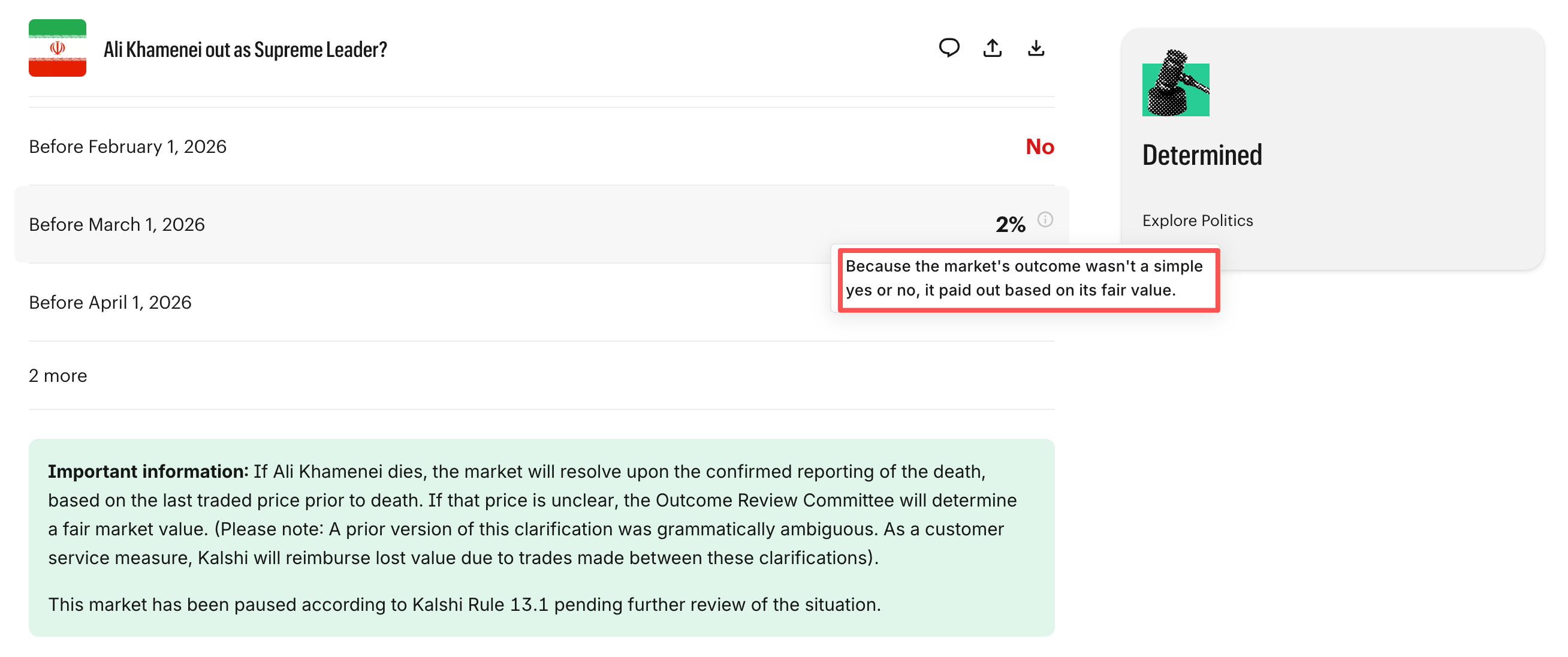
Opening the homepage of the related event on Kalshi shows that the event has been suspended by Kalshi and specially marked. Kalshi also noted that "because the market outcome is not a simple YES or NO, it is settled based on its fair value."

Kalshi's approach has sparked intense discussion in the community.

  • Those supporting Kalshi believe that avoiding events related to "death" aligns with mainstream values and the constraints of regulations on commodity contracts (the regulatory system prediction market events currently fall under). Especially considering that prediction markets have shown a certain reactive force on the real world, if boundaries are not set, over time, betting could indirectly incentivize "physical harm or murder," causing prediction markets to gradually become darknet-like.
  • Those opposing Kalshi believe that this move undermines the original transactional fairness of prediction markets and also damages their hedging value against real-world sudden changes — those who bet YES did not get the expected returns; although Tarek Mansour claimed that "not a single user will lose even $1 in this market," in reality, those who had bet NO and cut losses early cannot receive corresponding compensation.

In contrast, Polymarket has not made any statement on this matter, and the event can still be traded normally. The current price for YES shares for stepping down before March 31 is temporarily quoted at 99.9 cents, and NO at 0.2 cents.
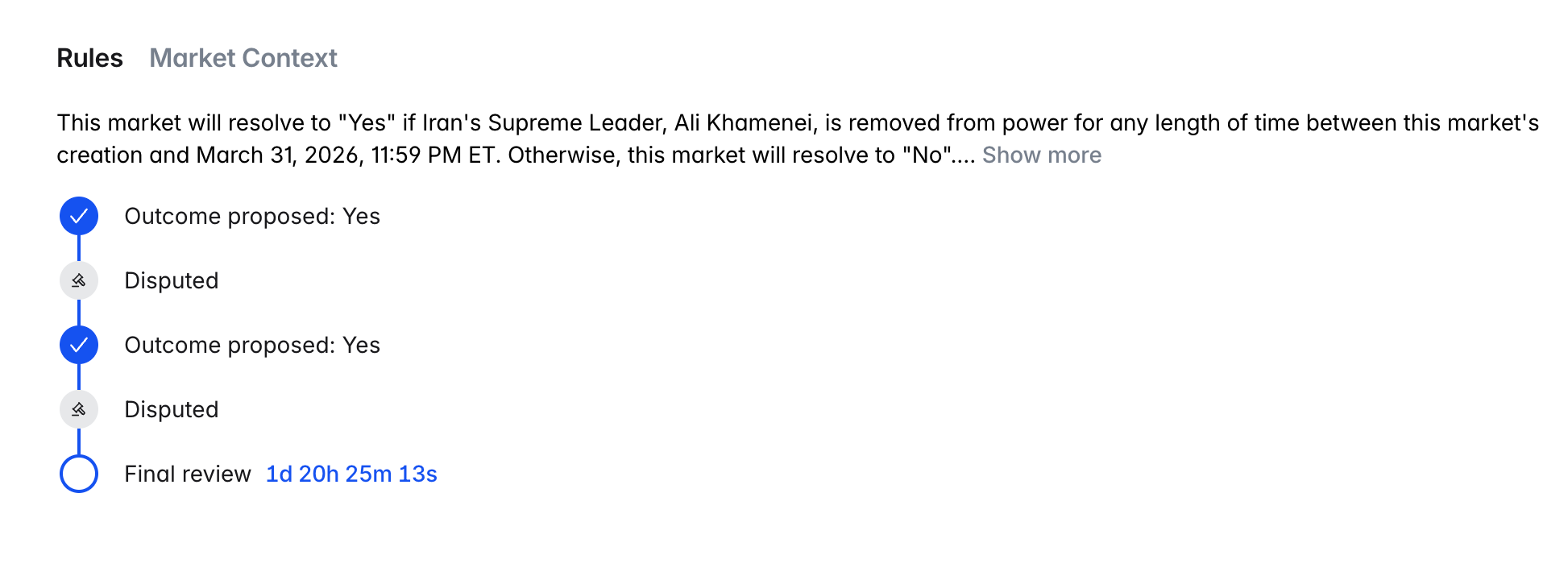
In the judgment rules for this event, Polymarket has stated that "if Khamenei resigns, is detained, or otherwise loses his position or is unable to perform his duties as Supreme Leader of Iran within the time specified by this market, it will be considered removal from office," which seems to cover the unexpected death situation. However, disagreements have still arisen in the settlement process of this event — clearly, there are also divisions within the community.

  • Odaily Note: For details on Polymarket's adjudication mechanism and the handling process in case of disputes, please refer to "Who 'Defines the Facts'? The Truth About Power and the Space for Malice in Polymarket's Adjudication Mechanism."

Calls for Bans from the Regulatory Side

The debate over whether prediction markets should list events related to "individual death" had already been discussed on the regulatory side days before Khamenei's death drew widespread industry attention.

On February 24, just a few days before the end of Khamenei's life, six U.S. Democratic senators, including Adam Schiff, jointly sent a letter to U.S. Commodity Futures Trading Commission (CFTC) Chairman Michael Selig, requesting that the CFTC categorically prohibit any prediction market contracts that use individual death as a settlement condition or are highly related to individual death.

The legal basis cited in the letter is that according to federal commodity regulations, the CFTC has already "categorically prohibited" contracts involving or referring to terrorism, assassination, war, or similar acts.

Adam Schiff and others stated that such events would create incentives for "physical harm or even death," even constituting a "dangerous national security risk" — "These contracts could incentivize real-world harm because they establish economic reward mechanisms for turbulent events or physical injury and encourage actors to influence or bring about these outcomes for personal gain."

The CFTC did not immediately publicly respond to the letter. A few days later, the news of Khamenei's death quickly made headlines in major media outlets, and Kalshi and Polymarket were plunged into a whirlpool of public opinion before regulators had made a clear stance.

Free Market vs. Social Responsibility

Prediction markets offer a new path to glimpse the probability of future events using market mechanisms, but this does not mean prediction markets are necessarily suitable for all events.

From the perspective of the prediction market's own operation, platforms tend to prefer listing events with clearly defined outcomes that are not easily manipulated by single points to avoid陷入条款解释或公平性争议陷入 (falling into disputes over clause interpretation or fairness); 而从外部影响以及监管压力来看,预测市场则需要尽量避开不符合主流价值观的事件 (from the perspective of external influence and regulatory pressure, prediction markets need to try to avoid events that do not conform to mainstream values) — if the setup of the prediction market itself could lead people to disrupt social order or harm others for profit, then it easily faces ethical and legal challenges.

The controversy over whether "death" related events should be banned is essentially a divergence in倾向 (inclination) towards free markets versus social responsibility. Those emphasizing free markets value the unique advantage of prediction markets in pricing future events more and are unwilling to compromise this ability due to any external restrictions; those valuing social responsibility worry that excessive laissez-faire could gradually evolve into a harm to public interest and social stability. This divergence has a universal solution: as friction emerges and deepens, both sides will gradually find a suitable balance point through struggle and concession.

Like every emerging industry, the regulatory details and industry self-discipline of prediction markets will not materialize out of thin air. The future of the industry will be shaped by participants, regulators, and society together. The path is walked by people. Khamenei's death is pushing prediction markets to personally step out the ethical boundaries.


Пов'язані питання

QWhat ethical dilemma did the death of Iran's Supreme Leader spark in the prediction market industry?

AThe death of Iran's Supreme Leader sparked a debate about the ethical boundaries of prediction markets, specifically whether events involving an individual's death should be allowed for betting, as it could incentivize real-world harm or assassination.

QHow did Kalshi handle the market regarding the resignation of Iran's Supreme Leader after his death?

AKalshi refunded all fees for the market, settled all positions at the last trading price before the death was confirmed, and compensated users who built positions after the death for the full cost difference.

QWhat was the regulatory action mentioned in the article regarding prediction markets and events related to death?

ASix U.S. Democratic senators sent a joint letter to the CFTC chairman requesting that the CFTC categorically ban any prediction market contracts that use an individual's death as a settlement condition or are highly related to death, citing existing bans on contracts involving terrorism, assassination, or war.

QWhat is the core conflict between the two sides in the debate over prediction markets offering death-related events?

AThe core conflict is between free market principles, which value the predictive power and hedging value of these markets, and social responsibility, which worries that such markets could incentivize physical harm or murder and pose a danger to public safety and national security.

QHow did Polymarket's rules for the 'resignation of Iran's Supreme Leader' event potentially cover the outcome of his death?

APolymarket's rules stated that the event would be considered resolved if the Supreme Leader resigned, was detained, or otherwise lost his position or became unable to perform his duties, which could be interpreted as covering the unexpected outcome.

Пов'язані матеріали

In Conversation with Ray Dalio: We Are Currently in an AI Bubble, with 1% of My Portfolio in Bitcoin

Ray Dalio, founder of Bridgewater Associates, warns in an interview that the current AI boom shows classic bubble characteristics, which could lead to significant economic downturns as seen in past cycles like 1929 or 2000. He explains that speculative enthusiasm, fueled by debt and overvaluation, often precedes a crash when rising rates or taxation force asset sales, causing widespread losses and recession. Dalio also outlines his "Big Cycle" theory, describing an approximate 80-year pattern where widening wealth gaps, massive government deficits, and shifting geopolitical power (like China's rise) create internal conflict and global instability. He emphasizes that we are in a late-cycle, transitional phase where traditional powers like the US and UK face decline. For personal wealth protection, Dalio advises diversification beyond cash into assets like stocks, bonds, real estate, and particularly gold, which he prefers over Bitcoin. While he holds about 1% of his portfolio in Bitcoin as a non-printable hard asset, he views gold as more secure from technological or governmental threats. Regarding AI's impact, Dalio believes it will disproportionately benefit capital owners, worsening inequality by replacing both physical and cognitive labor. He suggests that human intuition and emotional intelligence, combined with AI, will be key for future workers. On taxation, Dalio argues that wealth taxes are impractical and risk triggering asset sell-offs, reducing productive investment. He points to the UK as a cautionary example of debt, low productivity, and political strife. Geopolitically, Dalio foresees a more regionalized world, with the US showing weakness in prolonged conflicts like with Iran, akin to past imperial declines. The ideal outcome, he suggests, is coexisting powerful blocs (e.g., Americas, China-Asia Pacific) without major war.

marsbit3 год тому

In Conversation with Ray Dalio: We Are Currently in an AI Bubble, with 1% of My Portfolio in Bitcoin

marsbit3 год тому

Daily 7.2 Trillion KRW: Foreign Capital's Record Net Buying on Friday! Wall Street Says Headwinds for Korean Stock Fund Flows Have Subsided

South Korean stock market sees a dramatic shift in fund flows. On July 31, foreign investors made a record net purchase of approximately KRW 7.2 trillion in KOSPI stocks, marking a fundamental reversal from the persistent large-scale net outflows seen in previous months. This contributed to a significant narrowing of foreign net selling in July to KRW 9.8 trillion, down sharply from KRW 48.4 trillion in June and KRW 44.5 trillion in May. Simultaneously, domestic institutional pressure eased. South Korean pension funds and asset managers turned to a net buying position in July, purchasing KRW 1.0 trillion worth of KOSPI shares, contrasting with net sales in May and June. Market volatility is expected to be dampened by new financial regulations. Effective July 31, the Financial Services Commission tightened access for retail investors to single-stock leveraged ETFs by raising the minimum cash deposit requirement. Trading volumes for these products subsequently dropped to about 50% of their monthly average. Citigroup Research maintains its year-end KOSPI target of 10,000 points. The firm cites several supportive factors: the substantial easing of headwinds from capital outflows, a robust fundamental outlook for the semiconductor sector, historically low market valuations, strong economic fundamentals, and the potential for policy support from financial authorities if needed.

marsbit3 год тому

Daily 7.2 Trillion KRW: Foreign Capital's Record Net Buying on Friday! Wall Street Says Headwinds for Korean Stock Fund Flows Have Subsided

marsbit3 год тому

Thanks to Dice Rolls, Bitcoin Keys Are Stored Offline, But Not Everyone Will Do It

The article discusses using dice rolls to generate secure Bitcoin wallet seeds, providing entropy independent of potentially flawed hardware random number generators. It explains that each fair dice roll offers about 2.585 bits of entropy, with around 50 rolls needed for a standard 12-word seed phrase and 99+ recommended for higher security. This method gained attention after a vulnerability was revealed in some Coldcard hardware wallets, where a faulty firmware RNG (dating back to 2021) compromised generated keys. The analysis notes that while a dice-generated main seed was safe from this specific flaw, other Coldcard functions (like creating paper wallets, backup keys, or passwords) could still be vulnerable if they used the defective RNG. The piece argues that while dice-based entropy is technically robust, the manual process is error-prone, tedious, and unrealistic for most new users, who might make mistakes in recording or inputting rolls. It concludes that while manual entropy generation should remain an option for advanced users, the long-term goal is to develop reliable, user-friendly hardware and software that securely generates randomness without requiring specialized knowledge. Coldcard users are advised to check their firmware version and replace any secondary secrets (like paper wallet keys) created with vulnerable devices, while also considering multi-signature setups with devices from different manufacturers for added security.

cryptonews.ru9 год тому

Thanks to Dice Rolls, Bitcoin Keys Are Stored Offline, But Not Everyone Will Do It

cryptonews.ru9 год тому

Торгівля

Спот
活动图片




