Prediction Markets Plunge into Major Controversy Again: Are You Trading Facts or Rules?

marsbitОпубліковано о 2026-04-08Востаннє оновлено о 2026-04-08

Анотація

The prediction market sector, particularly platforms like Polymarket and Predict.fun, is facing significant controversy over event resolution rules that sometimes conflict with user expectations. Two recent cases highlight the issue. First, on Polymarket, a market asking “Will US forces enter Iran by a certain date?” was resolved as “Yes” after US special forces entered Iranian territory to rescue a downed pilot. While the rules technically defined such an operational entry as a qualifying "invasion," many users argued it contradicted the common-sense understanding of a military invasion, as the action was a limited humanitarian rescue, not a combat operation. Second, on Predict.fun, a market on “Will Polymarket launch a token?” was resolved as “Yes” after the platform announced a new stablecoin, Polymarket USD, pegged 1:1 to USDC. The rules defined a "token" as any fungible asset, but the community debated whether a stablecoin—a collateral tool rather than a governance or equity token—should truly count as the "launch" users were predicting, especially for a subsequent market on the project’s Fully Diluted Valuation (FDV). The core conflict is whether users are betting on real-world events or a platform’s specific, often technical, rules. These cases show that a high-probability bet can quickly become a loss if the rules are misinterpreted. The key takeaway for participants is to prioritize understanding the precise, written rules over their own assumptions to avoid unex...

Author | Asher(@Asher_ 0210)

Prediction markets are currently one of the most discussed sectors in Web3.

Trading around macro events, the crypto industry, and even entertainment topics continues to heat up, with discussion fervor and participation numbers constantly rising. However, as the market develops rapidly, some discordant voices have gradually emerged—some events, upon settlement, deviate from users' expectations based on common sense or "real-world understanding," sparking controversies over rule design, fairness, and even platform credibility.

Recently, two highly controversial events occurred in quick succession in prediction markets. Below, Odaily Planet Daily will sort through and discuss them.

Polymarket: U.S. Rescue of Downed Pilot in Iran Judged as U.S. Invasion of Iran

On April 3, a U.S. F-15E Strike Eagle fighter jet was shot down by Iranian air defense systems in southwestern Iran. The two crew members (one pilot, one Weapon Systems Officer/WSO) ejected; one was quickly rescued, while the other was missing for several days, hiding in the Iranian mountains.

  • The U.S. military subsequently launched a Search and Rescue (SAR) operation involving armed aircraft, helicopters, etc., ultimately successfully rescuing the second severely injured crew member (Trump personally announced "WE GOT HIM").
  • The rescue operation involved U.S. forces entering Iranian territory (mountain search and rescue, possible ground or low-altitude operations), which attracted attention given the current sensitive geopolitical conflict background.

Since U.S. forces entering Iranian territory could, in a way, be considered a U.S. invasion of Iran, this directly affected the prediction event on the Polymarket platform regarding when U.S. forces would enter Iran (US forces enter Iran by?).
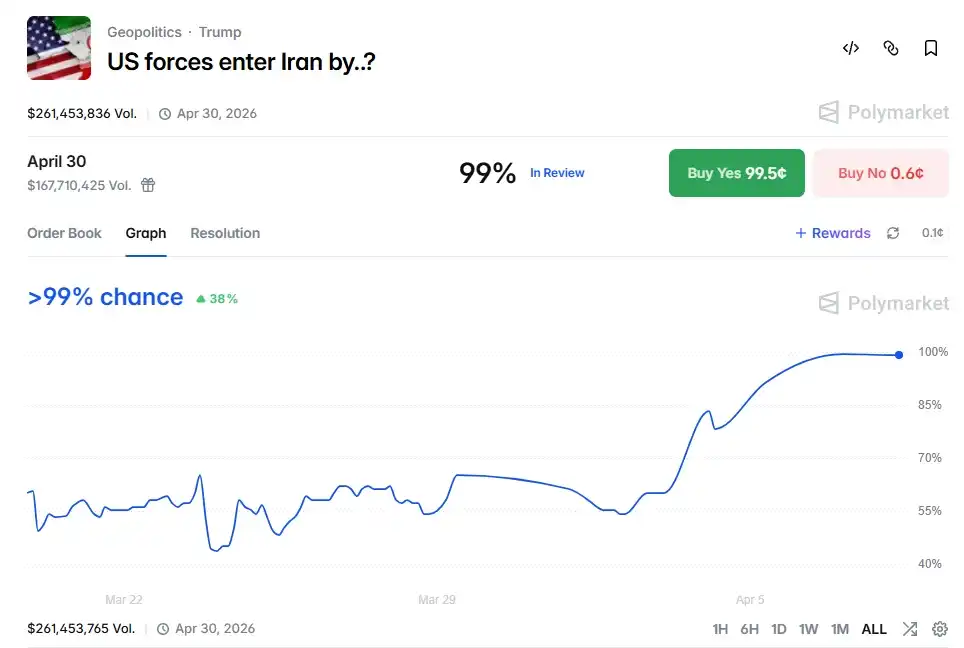
According to the settlement rules, active U.S. military personnel (including special operations forces) entering Iranian land territory before the specified date counts as an invasion. Downed pilots do not count as invasion, but the special forces sent by the U.S. military did indeed enter Iranian territory to rescue the pilot. Therefore, the special forces entering Iran to rescue the pilot met the criteria for judging "Yes" for a U.S. invasion of Iran.
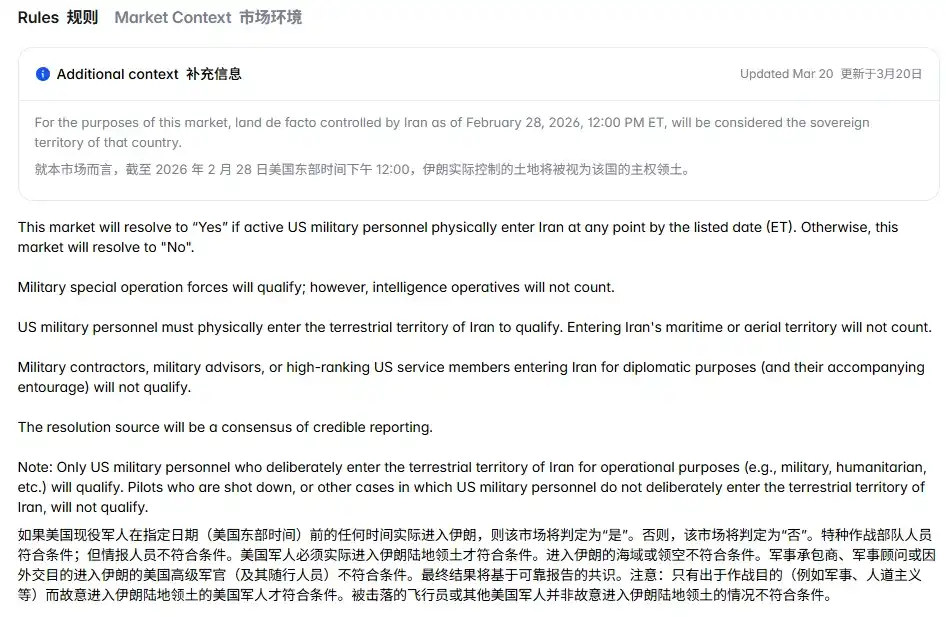
Polymarket's judgment that the "pilot rescue" event constituted a U.S. invasion of Iran has sparked strong controversy in the community.

Those supporting "counts as entry" (Yes side) argue that this operation meets the definition of "entry" in the rules. The U.S. special forces deliberately entered Iranian territory to execute a mission, and the rules explicitly state that "special operation forces will qualify," also covering "for operational purposes (including humanitarian)." Objectively, this is the first confirmed ground infiltration by U.S. forces in the current conflict context; U.S. personnel did set foot on Iranian soil, so it should be considered "entry."

Those opposing "counts as entry" (No side) believe this definition is an overextension. The action was essentially a short-term, limited-scale humanitarian rescue, not a combat invasion (invasion), nor did it have an intent to occupy, which does not align with the public's common-sense understanding of "U.S. forces entering Iran." Furthermore, the rules explicitly exclude "pilots who are shot down... will not qualify," and this operation was precisely about rescuing a downed pilot, possessing a nature of "forced entry" and should logically fall under a similar exception. Referring to past cases (e.g., similar regional actions were not considered invasions), rescue operations should not be equated with military entry; if judged as Yes, it might encourage marginal interpretations of the rules, weakening the market's seriousness and consistency. The Chinese community also generally believes that "entering Iran" should refer more to large-scale ground or amphibious operations, not short-term "rescue and leave" actions.

Predict.fun: Polymarket Issuing Stablecoin Judged as Token Launch

On the evening of April 6, Polymarket officially announced on X a comprehensive exchange upgrade:

  • Rebuilding the trading engine, upgrading smart contracts;
  • Launching a new native collateral token, Polymarket USD (1:1 pegged to USDC, to replace USDC.e and reduce bridging risks).

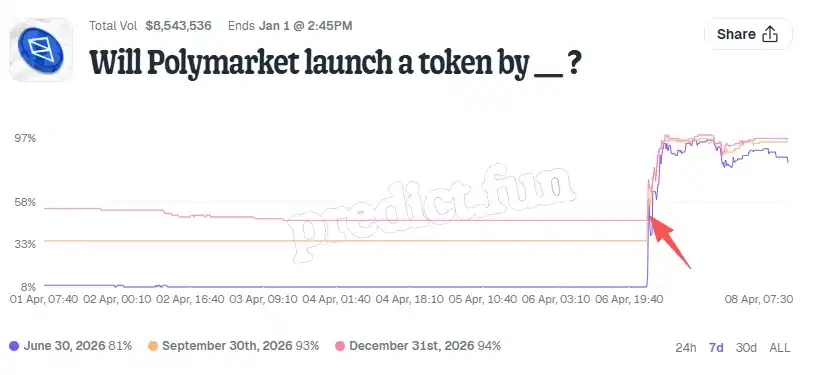
The second point, mentioning the launch of the native collateral token Polymarket USD, directly affected the probability of two related prediction events on the Predict.fun platform: one about token launch; the other about post-launch market cap:

1. When will Polymarket launch a token? (Will Polymarket launch a token by ___ ?)
2. Polymarket's FDV one day after launch (Polymarket FDV above ___ one day after launch?);
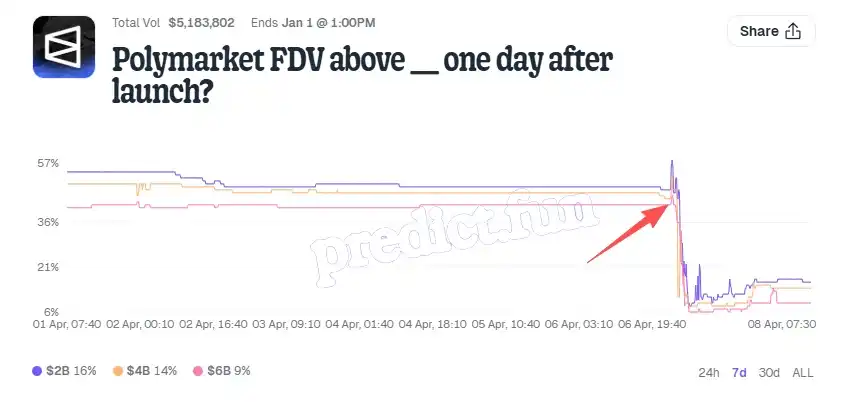
According to the settlement rules document, it clearly states that "any fungible token issued by Polymarket counts as a 'token launch' in this event", and stablecoins are of course no exception. Therefore, the Polymarket stablecoin meets the criteria for a Yes judgment.
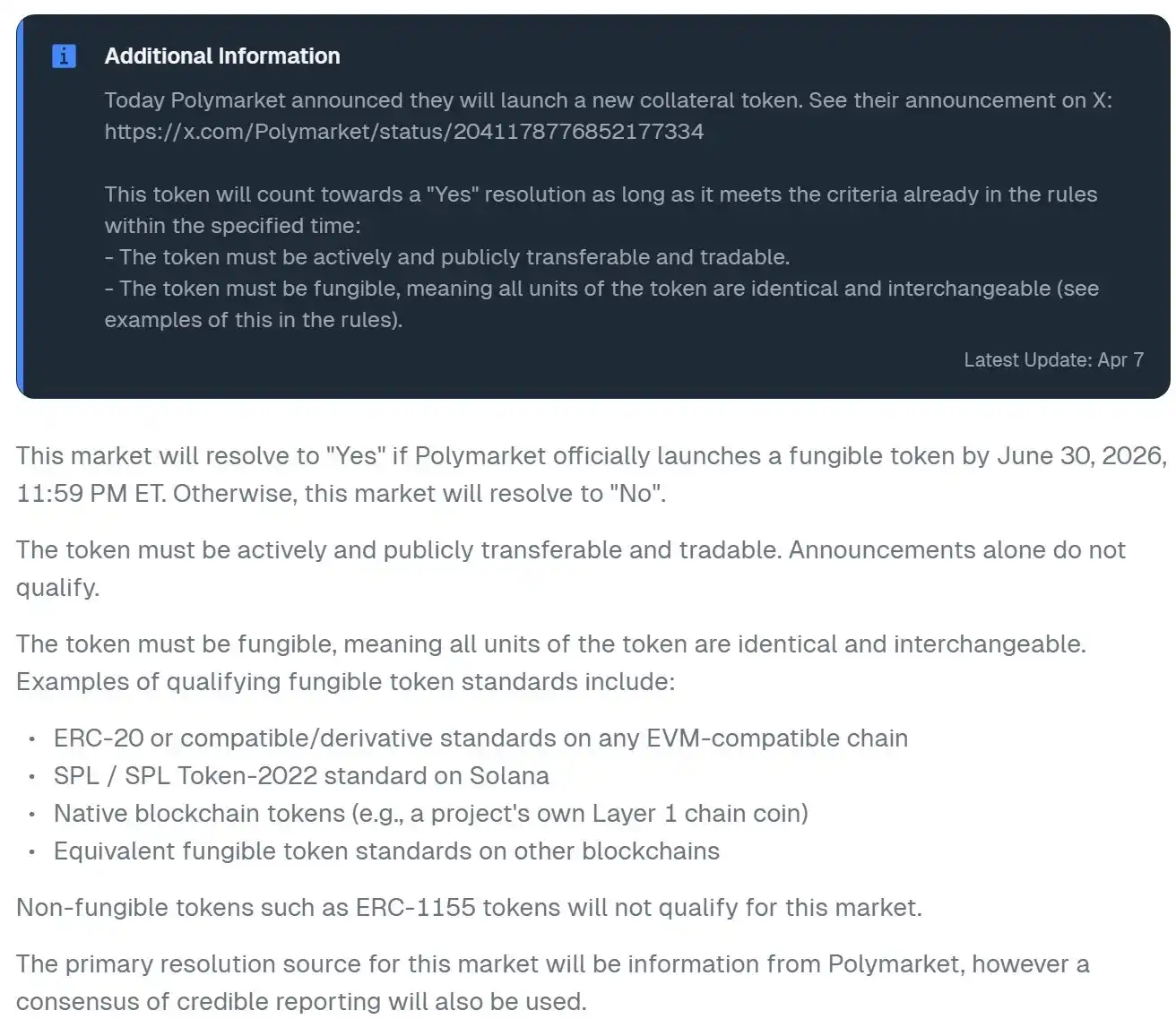
Relevant explanation of settlement rules

The community debated this issue.

Supporters argue that, literally from the rules, "issuing a token" is not limited to must be a "governance token," but is a general term for all tokens. Under this premise, Polymarket USD, as a fungible token (like ERC20/SPL) issued by Polymarket, essentially fits the definition of "token launch." Additionally, the official follow-up clarification was more a reiteration of the existing rules rather than a temporary change, so it has some legitimacy in terms of compliance.

However, skeptics do not accept this interpretation. On one hand, they believe including stablecoins in the "token launch" category is an overinterpretation of the rules, a typical play on words; on the other hand, even if stablecoins are acknowledged as "token launch," the core of this prediction market is "Polymarket FDV," not "Polymarket USD FDV." Stablecoins serve more as collateral or settlement tools; their market cap structure is fundamentally different from that of the project's main token (e.g., a POLY governance token), so they should not be directly equated or substitute for the project's overall valuation logic.

Which Side Are You On?

Overall, looking at these events, the controversies in prediction markets essentially revolve around a core question: are you betting on "reality" or are you betting on "rules"? Often, these two do not completely overlap.

For us participating in prediction markets, understanding the rules themselves might be more important than judging the direction of events. How the information source is defined, whether there are exception clauses, whether there is room for interpretation—these details can decisively determine win or loss at critical moments.

Precisely because of this, some high-probability events that look like "sure-win bets" are not without risk; they might instead be potential "lose-everything bets." Many reversals happen exactly in these overlooked details. Rather than betting blindly, taking an extra look at the rules is more useful than complaining after losing money.


Пов'язані питання

QWhat is the core issue discussed in the article regarding prediction markets?

AThe core issue is the discrepancy between user expectations based on common sense or 'real-world understanding' and the actual settlement based on predefined rules, leading to controversies about rule design, fairness, and platform credibility.

QWhy was the US rescue operation for a downed pilot in Iran considered an 'invasion' on Polymarket?

ABecause the settlement rules defined 'invasion' as active entry of US military personnel, including special operations forces, into Iranian territory for operational purposes (including humanitarian), which the rescue mission technically fulfilled.

QWhat was the controversy surrounding Polymarket's launch of Polymarket USD on Predict.fun?

AThe controversy was whether launching a stablecoin (Polymarket USD) counted as 'launching a token' under the platform's rules, as the rules broadly defined it as any fungible token, but users argued it misrepresented the intent of the prediction about a governance token and FDV.

QWhat lesson does the article suggest for participants in prediction markets?

AParticipants should prioritize understanding the specific rules and definitions of the market—such as information sources, exceptions, and interpretation space—over relying solely on common sense or real-world expectations to avoid unexpected losses.

QHow did the community react to the settlement of the 'US invasion of Iran' event on Polymarket?

AThe community was divided: supporters argued it met the rule-based definition of 'entry,' while opponents felt it was an overextension that contradicted common sense, as rescue operations shouldn't be equated with military invasion.

Пов'язані матеріали

Breaking: OpenAI Undergoes Major Reorganization, President Brockman Assumes Command

OpenAI has announced a major internal reorganization just months before its anticipated IPO. The company is merging its three flagship product lines—ChatGPT, Codex, and the API platform—into a single, unified product organization. The most significant leadership change involves co-founder and President Greg Brockman moving from a background technical role to take full, permanent control over all product strategy. This follows the indefinite medical leave of AGI Deployment CEO Fidji Simo. Additionally, ChatGPT's longtime lead, Nick Turley, has been reassigned to enterprise products, with former Instagram executive Ashley Alexander taking over consumer offerings. The consolidation, internally framed as a strategic move towards an "Agentic Future," aims to break down internal silos and create a cohesive "Super App." This planned desktop application would integrate ChatGPT's conversational abilities, Codex's coding power, and a rumored internal web browser named "Atlas" to autonomously perform complex user tasks. The reorganization occurs amid significant internal and external pressures. OpenAI has recently seen a wave of high-profile departures, including Sora co-lead Bill Peebles and other senior technical leaders, leading to concerns about a thinning executive bench. Externally, rival Anthropic recently secured funding at a staggering $900 billion valuation, surpassing OpenAI's own. Google's upcoming I/O developer conference also poses a competitive threat. Analysts suggest the dramatic restructure is a pre-IPO move to present a clearer, more focused narrative to Wall Street—streamlining operations and demonstrating decisive leadership under Brockman to counter internal turbulence and intense market competition.

marsbit1 год тому

Breaking: OpenAI Undergoes Major Reorganization, President Brockman Assumes Command

marsbit1 год тому

Two Survival Structures of Market Makers and Arbitrageurs

Market makers and arbitrageurs represent two distinct survival structures in high-frequency trading. Market makers primarily use limit orders (makers) to profit from the bid-ask spread, enjoying high capital efficiency (nominally 100%) but bearing inventory risk. This "inventory risk" arises from passive, fragmented, and discontinuous order fills in the limit order book (LOB). This risk, while a potential cost, can also contribute to excess profit if managed within control boundaries, allowing for mean reversion. Market makers essentially sell "time" (uncertainty over execution timing) to the market for price control and low fees. In contrast, cross-exchange arbitrageurs typically use market orders (takers) to exploit price differences or funding rates, resulting in lower nominal capital efficiency (requiring capital on both exchanges) and higher transaction costs. Their risk exposure stems from asymmetries in exchange rules (e.g., minimum order sizes), execution latency, and infrastructure risks (e.g., ADL, oracle drift). These exposures are active, exogenous gaps that primarily erode profits rather than contribute to them. Arbitrageurs essentially sell "space" (capital sunk across venues) for localized, immediate certainty. Both strategies engage in a trade-off between execution friction and residual risk. Optimal systems allow for temporary, controlled risk exposure rather than enforcing zero exposure at all costs. Their evolution converges towards hybrid models: arbitrageurs may use maker orders to reduce costs, while market makers may use taker orders or hedges for risk management. Ultimately, both use different forms of risk exposure—market makers exposing inventory, arbitrageurs immobilizing capital—to extract marginal, hard-won certainty from the market.

链捕手1 год тому

Two Survival Structures of Market Makers and Arbitrageurs

链捕手1 год тому

Who Will Define the Rules of the AI Era? Anthropic Discusses the 2028 US-China AI Landscape

This article, based on Anthropic's analysis, outlines the intensifying systemic competition between the U.S./allies and China for AI leadership by 2028. It argues that access to advanced computing power ("compute") is the critical bottleneck, where the U.S. currently holds a significant advantage through chip export controls and allied innovation. However, China's AI labs remain competitive by exploiting policy loopholes—via chip smuggling, overseas data center access, and "model distillation" attacks to copy U.S. model capabilities—keeping them close to the frontier. The piece presents two contrasting scenarios for 2028. In the first, decisive U.S. action to tighten compute controls and curb distillation locks in a 12-24 month AI capability lead, cementing democratic influence over global AI norms, security, and economic infrastructure. In the second, policy inaction allows China to achieve near-parity through continued access to U.S. technology, enabling Beijing to promote its AI stack globally and integrate advanced AI into its military and governance systems, altering the strategic balance. Anthropic contends that maintaining a decisive U.S. lead is essential for shaping safe AI development and governance. The core recommendation is for U.S. policymakers to urgently close compute and model access loopholes while promoting global adoption of the U.S. AI technology stack to secure a lasting strategic advantage.

marsbit3 год тому

Who Will Define the Rules of the AI Era? Anthropic Discusses the 2028 US-China AI Landscape

marsbit3 год тому

Торгівля

Спот
Ф'ючерси

Популярні статті

Як купити ONE

Ласкаво просимо до HTX.com! Ми зробили покупку Harmony (ONE) простою та зручною. Дотримуйтесь нашої покрокової інструкції, щоб розпочати свою криптовалютну подорож.Крок 1: Створіть обліковий запис на HTXВикористовуйте свою електронну пошту або номер телефону, щоб зареєструвати обліковий запис на HTX безплатно. Пройдіть безпроблемну реєстрацію й отримайте доступ до всіх функцій.ЗареєструватисьКрок 2: Перейдіть до розділу Купити крипту і виберіть спосіб оплатиКредитна/дебетова картка: використовуйте вашу картку Visa або Mastercard, щоб миттєво купити Harmony (ONE).Баланс: використовуйте кошти з балансу вашого рахунку HTX для безперешкодної торгівлі.Треті особи: ми додали популярні способи оплати, такі як Google Pay та Apple Pay, щоб підвищити зручність.P2P: Торгуйте безпосередньо з іншими користувачами на HTX.Позабіржова торгівля (OTC): ми пропонуємо індивідуальні послуги та конкурентні обмінні курси для трейдерів.Крок 3: Зберігайте свої Harmony (ONE)Після придбання Harmony (ONE) збережіть його у своєму обліковому записі на HTX. Крім того, ви можете відправити його в інше місце за допомогою блокчейн-переказу або використовувати його для торгівлі іншими криптовалютами.Крок 4: Торгівля Harmony (ONE)Легко торгуйте Harmony (ONE) на спотовому ринку HTX. Просто увійдіть до свого облікового запису, виберіть торгову пару, укладайте угоди та спостерігайте за ними в режимі реального часу. Ми пропонуємо зручний досвід як для початківців, так і для досвідчених трейдерів.

315 переглядів усьогоОпубліковано 2024.12.12Оновлено 2025.03.21

Як купити ONE

Обговорення

Ласкаво просимо до спільноти HTX. Тут ви можете бути в курсі останніх подій розвитку платформи та отримати доступ до професійної ринкової інформації. Нижче представлені думки користувачів щодо ціни ONE (ONE).

活动图片













