Prediction Markets Cannot Exist Without Insider Trading, But Insider Trading Is Killing Them

marsbitОпубліковано о 2026-04-27Востаннє оновлено о 2026-04-27

Анотація

Prediction markets face a fundamental contradiction: they rely on insider trading to generate accurate prices, yet this same activity erodes public trust and threatens their survival. Recent scandals, such as a U.S. special forces member making $400,000 on Polymarket using classified information about a raid, highlight the severity of the issue. While platforms like Polymarket and Kalshi market themselves as venues where "everyone is an expert" and encourage informed trading, they also enforce policies against illegal insider trading. The core dilemma is that these markets depend on informed insiders for price efficiency but require uninformed retail participants to provide liquidity. If insider trading is too rampant, retail traders leave, perceiving the market as unfair. If restrictions are too strict, valuable information flow dries up, reducing the market’s predictive utility. The challenge is finding a balance that maintains both accuracy and perceived fairness—a task complicated by regulatory pressures and recurring scandals.

Author: Nic Carter

Compiled by: Deep Tide TechFlow

Deep Tide Introduction: A U.S. Special Forces soldier made $400,000 on Polymarket using classified information, and this is just the latest scandal. Nic Carter points out that prediction markets are stuck in a vicious cycle: they rely on insider trading to generate accurate prices, but this makes retail investors feel the market is manipulated and leave. This contradiction determines whether prediction markets can survive in the long term.

As I wrote in February of this year, prediction markets have a serious insider trading problem, and this is no accident. This leads to a major failure mode:

The social value of prediction markets comes from using monetary incentives to get insiders to leak confidential information, but this destroys retail investor confidence in the market over time.

Two days ago, the biggest scandal to date broke. The U.S. Department of Justice charged Special Forces Sergeant Major Gannon Ken Van Dyke with improper trading using classified information. Before the Maduro raid mission, he made $400,000 on Polymarket. He was not an ordinary soldier but a senior Green Beret member responsible for special operations planning and execution.

To be clear, although many people are calling for leniency for him because (legal) insider trading is widespread among members of Congress, he should still go to jail. His actions potentially leaked raid information to Venezuelans through trading activities, which is morally and legally problematic. Although the Venezuelans don't seem to have noticed, the government cannot set a precedent where elite operatives leak details of upcoming operations through market activities for personal gain. I sympathize with Van Dyke, but he did break the law and the confidentiality he swore to uphold.

This is just the latest in a series of real or suspected insider trading scandals on prediction markets. Previously, Israel arrested two reservists for using military intelligence to trade on Polymarket. Markets concerning the start time of the Iran war, ceasefire agreements, the killing of Khamenei, and Biden's pardon order have also been under suspicion, but no arrests have been made yet. Kalshi and Polymarket have also flagged and suspended accounts trading in markets where they had a vested interest, such as three congressional candidates betting on their own election markets.

You might think that as more people realize that trading with confidential information is illegal not only in securities markets but also in prediction markets, these problems would disappear. But I think the issue is deeper.

The premise of prediction markets is that they are informationally efficient because they reward informed insiders.

In other words, prediction markets are "good" because they aggregate a large number of uninformed retail investors, who create economic incentives for insiders to reveal private information. (This concept—that retail investors create incentives for informed insiders to participate—is well-documented in financial literature, and a recent paper further extends it to prediction markets.) Prediction markets can then reliably promote themselves as having social utility because they indeed provide better, more timely signals than other platforms (experts, polls, etc.). Kalshi and Polymarket both know this but are reluctant to explicitly admit it. But they do hint at it in their marketing!

Kalshi's CEO Tarek Mansour explicitly stated on the Sourcery podcast that "There is no such thing as insider trading in commodity markets. It's all insider trading actually," which is... an extremely creative interpretation of the law. He added:

I think there is a subset of non-public information that (traders) cannot trade on, but I think we are restricting it a bit too much right now.

Kalshi has used slogans like "Trade Anything" and "Everyone is an Expert at Something," both of which imply that ordinary people can monetize any privileged information they happen to have on the platform.

Polymarket's CEO Shayne Coplan had this exchange with CBS last year:

Anderson Cooper: But prediction markets do rely on some people having inside information.

Shayne Coplan: Mhmm. Yes. I think it's a good thing that people have an edge in the market. Obviously, you need to manage them, need to be very clear and strict about drawing the lines, like on the ethics side, we spend a lot of time on that. But it's somewhat inevitable, and there's a lot of good that comes from it. You know, people will adapt.

Shayne has also said that prediction markets are "the most accurate thing that we have as humans right now, until someone creates some sort of super crystal ball." Some of that accuracy comes from insiders.

Robinhood's CEO Vlad Tenev (partnering with Kalshi) said:

Prediction markets actually allow you to get news faster, in some cases even before it happens. I think it does have tremendous economic value.

Economist Robin Hanson, considered by many to be the godfather of prediction markets, directly accepts this view and has written extensive defenses of insider trading in prediction markets. In 2024 he said:

If the purpose of the (prediction) market is to get accurate information in the price, then you definitely want to allow insiders to trade, even if that makes other people less willing to bet because they think it's unfair, because it makes the price more accurate. That's the priority.

I must point out that both Kalshi and Polymarket have anti-insider trading policies. Kalshi is regulated by the CFTC and has been explicit about prohibiting trading based on Material Non-Public Information (MNPI) and conducts market surveillance. When I wrote my last blog in February, I noted that Polymarket did not explicitly sanction insider trading, but in March they updated their rulebook, adding detailed prohibitions against trading of the following types:

  • Trading based on stolen confidential information (if you are a soldier, the battle plan does not belong to you, it belongs to the government)
  • Trading based on information illegally passed to you by an insider
  • Trading on any contract where you can influence the outcome

The point of this section is not to blame Kalshi or Polymarket or their leadership for implying that traders have an informational advantage. I think their policies (updated in March 2026) are clear enough. Instead, I want to point out the fundamental contradiction plaguing these markets:

Prediction markets rely on informed traders to generate accurate prices, but they also rely on uninformed traders to create the economic incentive to attract informed order flow. This creates a tension:

  • If they are too permissive towards insider trading, uninformed traders may exit due to a perceived lack of fairness
  • If they are too restrictive towards insider trading, the markets may exclude their most valuable source of information

Thus, there is a trade-off between informational efficiency and perceived fairness. Here is a visual version of the same idea:
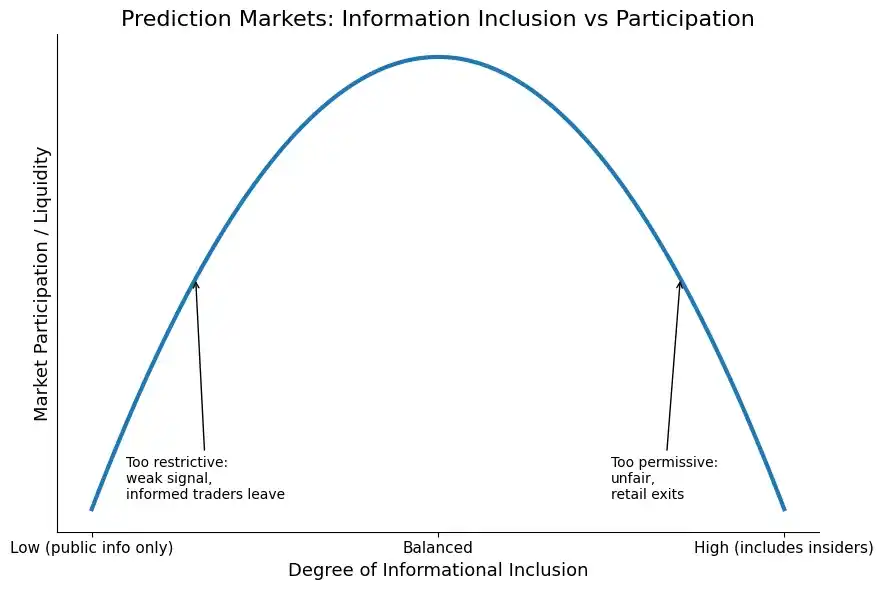
Chart: The Trade-off Curve Between Informational Efficiency and Perceived Fairness

So we end up with a few different failure modes:

Too Many Sharks, They Eat All the Fish

Insider trading standards are too loose, the market becomes very informationally efficient, but retail investors clearly feel the market is "rigged," that they are always betting against insiders. Therefore, retail leaves, and market liquidity decreases. This is the failure mode I talked about before. This is where we are now, but I think we will rebound in the other direction.

No Sharks, No Edge

This is the other end of the spectrum. Insider trading is strictly policed on the platform, with real-time market surveillance and strong regulatory reporting, so informed order flow stays away. The markets thus produce less socially valuable information, becoming mere sentiment aggregators rather than generating "news before the news." Therefore, the platform cannot market itself effectively.

The existential question is whether there is a golden mean: where liquidity is maximized, retail feels the market is "fair enough," and informed order flow is still compensated for its information gathering. The chart suggests it might exist, but reality is messier.

My prediction from February still holds. As I said then:

A serious risk remains that insider trading scandals will make retail traders feel the market is manipulated, causing them to abandon the platform. I predict a string of insider trading events this year that will convince platforms to significantly strengthen market surveillance and lead Polymarket in particular to move away from anonymous modes.

I expect Polymarket will remove the ability to trade without KYC entirely (this is currently the case for the non-US platform) and strengthen the flagging of suspicious trading on the platform. There will be a slew of criminal cases regarding stolen insider information, but the temptation will remain. While platforms won't admit it, there is a "socially optimal" amount of insider trading. But can they calibrate it optimally? Will regulators allow them to?

It's worth noting that not all informed traders are insiders. You can become informed by collecting public information and trading on it. But a subset of informed traders are indeed insiders misappropriating information.


Пов'язані питання

QWhat is the core contradiction that prediction markets face according to the article?

APrediction markets rely on informed traders (insiders) to generate accurate prices, but they also depend on uninformed traders to create the economic incentive that attracts that informed flow. This creates a tension: if insider trading is too tolerated, uninformed traders may leave feeling the market is unfair; if it is too restricted, the market loses its most valuable source of information.

QWhat are the two main failure modes for prediction markets described in the text?

AThe two failure modes are: 1. Too many sharks (insiders), which scares away the fish (retail traders) because the market feels manipulated. 2. No sharks, no edge, where strict regulation of insider trading drives away informed traders, reducing the market's social value and making it merely an aggregator of sentiment.

QHow did the recent case involving Gannon Ken Van Dyke illustrate the problem with prediction markets?

AThe case illustrated the problem as Van Dyke, a senior Green Beret, used classified information about an impending raid on Maduro to trade on Polymarket, making $400,000. This is a clear example of how the markets incentivize the leakage of confidential information, which can damage operational security and public trust.

QWhat is the proposed 'social value' of prediction markets, and what is the mechanism that enables it?

AThe proposed social value is that prediction markets provide a better, more accurate, and timely signal than other platforms like experts or polls. The mechanism that enables this is the aggregation of uninformed retail traders, which creates a financial incentive for informed insiders to reveal their private information, thus making the market informationally efficient.

QWhat specific policy change did Polymarket make in March 2026 in response to insider trading concerns?

AIn March 2026, Polymarket updated its rulebook to include a detailed ban on trading based on: 1. stolen confidential information, 2. information illegally passed to you from an insider, and 3. any contract where you can influence the outcome.

Пов'язані матеріали

GitHub, Transfixed by AI

On the night of February 9th, GitHub suffered a major outage caused by a simple configuration change—reducing a cache refresh interval from 12 to 2 hours—that triggered a cascade of failures. This was not an isolated event, but part of a broader pattern. In early 2026, GitHub experienced at least 8 major incidents, failing to meet its promised 99.9% availability. These outages stemmed from structural issues: explosive growth in load, tight service coupling, and insufficient protection against abnormal traffic. This unprecedented load is driven by AI Agents. In 2025, GitHub handled ~1 billion commits. By 2026, weekly commits reached 275 million, projecting to ~14 billion for the year—a 14x increase. AI tools like Claude Code now contribute 4.5% of all public repository commits, with weekly submissions surging 25x in just three months. AI-generated pull requests jumped from 4 million to 17 million per month in half a year. Unlike human developers, AI Agents work continuously, generating commits at a scale that overwhelms infrastructure designed for human rhythms. The surge also shattered GitHub's business model. Copilot's flat-rate pricing, based on assisting human developers, became unsustainable as Agentic AI sessions consumed resources worth hundreds of dollars for a few dollars in fees. In response, GitHub imposed usage limits and, by June 1st, shifted to a pay-per-use "AI Credits" system. Facing this new reality, GitHub realized a 10x scaling plan was insufficient. It announced a need to *redesign* its architecture for 30x current scale—decoupling services, adding fault isolation, and improving change management to prevent cascading failures. Other platforms like Stripe and AWS are facing similar challenges with AI Agents. Fundamentally, GitHub is transitioning from a human collaboration platform to an "exhaust pipe" for automated AI workflows. Its detailed post-mortem reports aim to maintain trust during this turbulent rebuild. The February outage was not just a technical glitch, but a signal of the software industry's entry into a new, AI-driven era.

marsbit8 хв тому

GitHub, Transfixed by AI

marsbit8 хв тому

Both Suffer Massive Losses Exceeding $90 Billion, Which Is in Greater Peril: Strategy or Bitmine?

Facing massive paper losses exceeding $90 billion each amidst a sharp market downturn, "Digital Asset Treasury" (DAT) giants Strategy and Bitmine find themselves in a precarious position, but with different underlying risks. Strategy, heavily invested in Bitcoin (BTC), faces significant financial strain. Its strategy relies heavily on debt, including convertible notes and preferred stock (STRC) requiring substantial dividend payments. With its cash reserves dwindling and BTC offering no staking yield for cash flow, Strategy's high leverage makes it vulnerable. A continued price decline could force asset sales to meet obligations, potentially creating a negative feedback loop. Its market value has already fallen sharply. In contrast, Bitmine, an Ethereum (ETH) holder, appears on firmer financial ground. It primarily funds its purchases through equity offerings (like ATM programs), avoiding debt pressure. It also generates income by staking a large portion of its ETH holdings. While not immune to market drops and shareholder dilution concerns, Bitmine maintains more flexibility, recently announcing a new preferred share offering to raise further capital. The core divergence lies in their financing: Bitmine uses equity (investor money), while Strategy uses debt (borrowed money). Consequently, Bitmine currently faces less immediate liquidity pressure than Strategy, which must navigate the dual challenge of servicing debt/dividends and a declining core asset (BTC) price.

marsbit15 хв тому

Both Suffer Massive Losses Exceeding $90 Billion, Which Is in Greater Peril: Strategy or Bitmine?

marsbit15 хв тому

Where the AI Bubble Really Is: Which Layer of Players Are Naked

AI Bubble: Where It Really Is and Who's Swimming Naked This analysis dissects the AI industry not as a single entity but as a five-layer pyramid, arguing that bubbles are concentrated in specific tiers, not uniformly distributed. **Key Distinction from the 2000 Dot-com Bubble:** Unlike 2000, where companies had stock prices before revenue, today's leading AI players have massive, contract-backed revenue driving their valuations. Core infrastructure demand is real, with every GPU running at full capacity for paying customers. **The Five-Layer Pyramid & Bubble Assessment:** * **L0 (Fab/Manufacturing) & Top L4 (Leading AI Apps): NO BUBBLE.** Companies like TSMC, NVIDIA, major cloud providers (Microsoft, Google, Meta, Amazon), and top AI labs have real revenues and orders. Supply is tightly constrained by TSMC's disciplined capacity control and physical limits like power/land for data centers, preventing a supply glut. * **L1 (Memory): BATTLEGROUND.** Sky-high HBM margins could signal a new structural cycle or a classic "boom before bust." The oligopoly of three major players may enforce supply discipline, making this a high-stakes bet. * **L2 (Interconnect/Optical Modules): BUBBLE TERRITORY.** Companies like Lumentum and AAOI have seen stock surges (4-10x) far outpacing revenue growth. This hardware segment has lower physical barriers to expansion than fabs, allowing speculation. It mirrors the 2000 bubble's epicenter—optics. * **L3 (Infrastructure/"GPU Landlords"): VULNERABLE.** GPU leasing companies profit from the current compute shortage but own no long-term moat. Their business model relies on a temporary bottleneck that will ease as big tech expands and new tech (e.g., potential space-based data centers) emerges. * **L4 Long Tail (VC-backed Startups): STRONG BUBBLE SIGNALS.** VC funding concentration in AI is twice that of the 1999 peak. Many startups with little revenue use the valuation logic of successful giants to justify their own, creating high risk of a "valuation crunch" when funding dries up. **Critical Risks to Monitor:** 1. **GPU Depreciation & Accounting:** Companies extending the assumed useful life of GPUs artificially boost profits. The true economic life depends on future generational leaps from NVIDIA. 2. **"GPU Credit" & Off-Balance-Sheet Leverage:** Emerging structures where shell companies borrow to buy GPUs and lease them out (with chipmakers sometimes investing) move debt off major balance sheets. This echoes the "vendor financing" of 2000 and the securitization risks of 2008, though currently small-scale. 3. **TSMC Abandoning Caution:** If the primary supply bottleneck (TSMC's conservative capacity planning) breaks, runaway supply could trigger a bust. 4. **Algorithmic Efficiency Breakthrough:** A major leap in software efficiency could drastically reduce the need for raw compute hardware, undermining the investment thesis. **Conclusion:** The AI boom is expensive and has frothy areas, but its core is underpinned by real demand and physical supply constraints. The bubble risk is layered: most present in optical components, GPU leasing, and the long-tail startup ecosystem, while the foundational chip manufacturing and leading application layers remain relatively solid—for now.

marsbit28 хв тому

Where the AI Bubble Really Is: Which Layer of Players Are Naked

marsbit28 хв тому

Торгівля

Спот
Ф'ючерси
活动图片




