Prediction Market Giants Clash as Competition Between Kalshi and Polymarket Heats Up

marsbitОпубліковано о 2026-04-02Востаннє оновлено о 2026-04-02

Анотація

The competition between US-based prediction market platforms Kalshi and Polymarket has intensified, with both companies exchanging sharp public criticisms. Kalshi, which is regulated by the CFTC, launched an ad campaign in Washington, D.C., with slogans such as "We don’t do death markets," directly targeting Polymarket’s offshore operations and its controversial contracts related to military conflicts and sensitive events. Kalshi accused Polymarket of being "irresponsible, dangerous, and non-compliant," while Polymarket responded by calling for fact-based discussions and emphasizing its commitment to market integrity. The dispute highlights fundamental differences in their regulatory approaches and comes amid growing scrutiny over insider trading and ethical concerns in the prediction market industry, which has seen combined weekly volumes nearing $6 billion.

Written by: Yash Roy, Bloomberg

Compiled by: Saoirse, Foresight News

This is an advertisement placed by the American prediction market platform Kalshi at a Washington bus stop in March. With the slogan 'We Don't Do Death Markets,' it emphasizes its own federally regulated compliance to attack its competitor Polymarket's unregulated overseas operations and sensitive contracts related to military conflicts. Photographer: Daniel Hoyle / Bloomberg

As competition in the prediction market industry intensifies and this emerging field faces strict regulatory scrutiny in Washington, Kalshi and Polymarket are exchanging heavy accusations in a fierce confrontation.

The two platforms have frequently clashed before, but recent conflicts have escalated completely — Kalshi launched a highly targeted advertising campaign, and its employees have publicly criticized Polymarket, with the rhetoric from both sides becoming increasingly heated.

Benjamin Freeman, who is responsible for political and election markets at Kalshi, posted on social media on Monday, stating: 'Polymarket's irresponsible, dangerous, and allegedly违规的行为 (non-compliant behavior) is threatening the survival of legitimate prediction markets in the United States.'

This accusation quickly sparked a fierce war of words between the two companies.

Polymarket responded in a statement: 'We welcome competition but believe discussions should be based on facts. Misleading the public only harms the entire industry and its participants.'

Kalshi spokesperson Elisabeth Diana directly retorted: 'It's laughable to hear this from a company whose vast majority of trading volume is on an unregulated overseas platform, with rules that even allow for 'death markets'.'

(Note: Death Markets is a general term in the prediction market industry for trading contracts that directly/indirectly bet on events related to death, military conflicts, assassinations, etc., also known as 'assassination markets.')

This internal strife erupts at a critical time when Polymarket and Kalshi are vying for the leading position in the rapidly growing prediction market industry. This industry provides Americans with a new way to bet on various events, from sports games to election outcomes. According to data compiled by a user on Dune Analytics, the two startups have recently set new records in weekly trading volume, with their combined nominal trading volume recently approaching $6 billion.

Prediction Market Trading Volume Reaches Billions
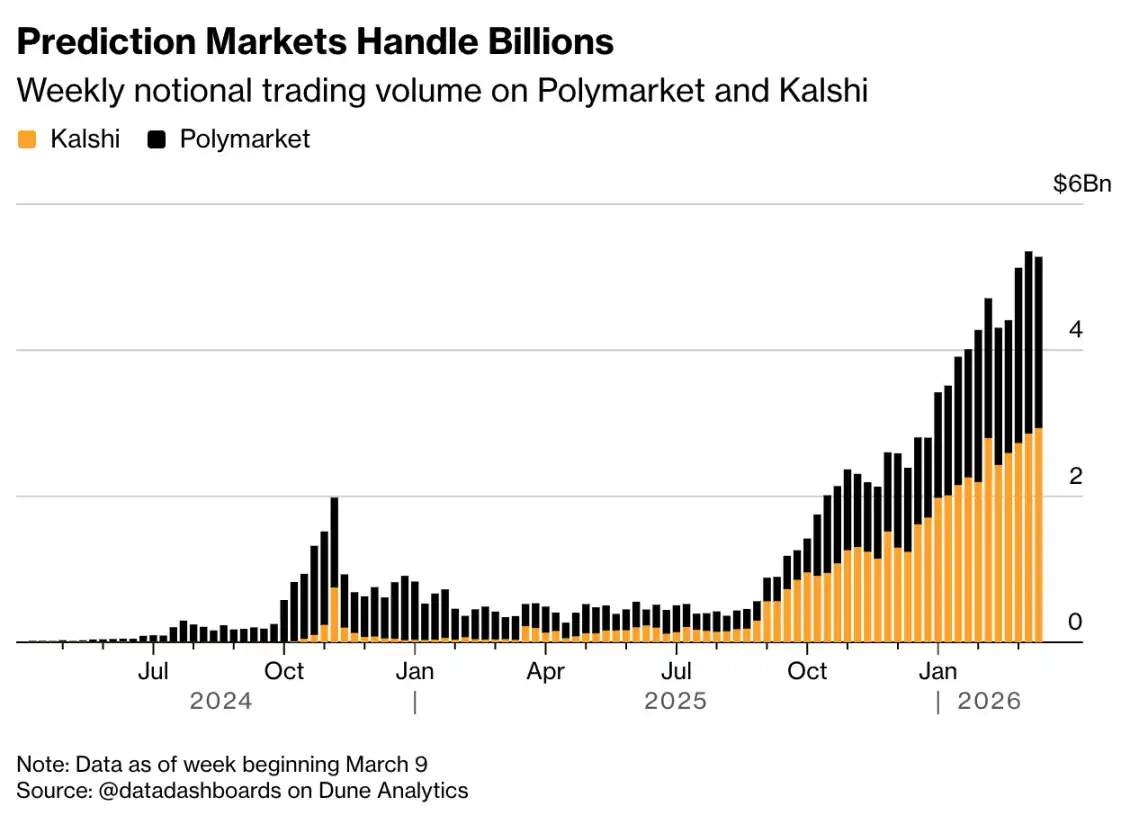
Weekly nominal trading volume of Polymarket and Kalshi. Note: Data is for the week ending March 9th. Source: @datadashboards on Dune Analytics

The core of the dispute lies in the fundamental differences in the establishment models and operating rules of the trading platforms. The Kalshi platform is headquartered in the United States and is regulated by the U.S. Commodity Futures Trading Commission (CFTC); Polymarket's main trading platform is based overseas.

Polymarket leverages its overseas operational advantage to list contracts related to military conflicts, including those involving Iran. Kalshi directly states that such products are both unethical and illegal.

One of Kalshi's advertisements bluntly states: 'We Don't Do Death Markets.'

Earlier this week, this set of marketing ads from Kalshi, in the form of a 'platform rules list,' began appearing at bus stops and subway stations in Washington.

One of them reads: 'Rule 1: We ban insider trading because Kalshi is a federally regulated U.S. exchange.' In the eyes of industry observers, the subtext of this statement is obvious: Polymarket's main platform is not under the jurisdiction of U.S. regulators.
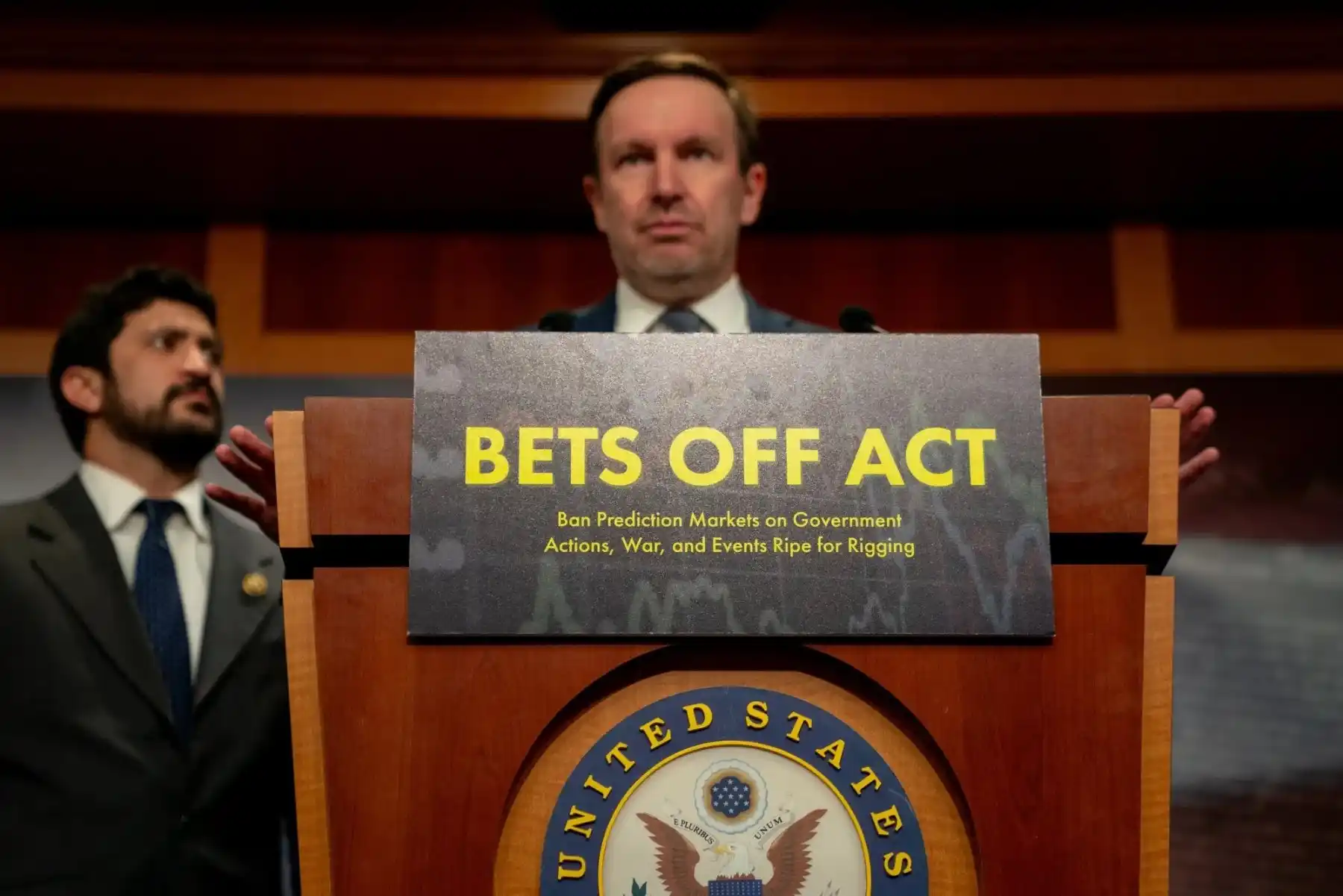
'BETS OFF Act' signage, Representative Greg Casar and Senator Chris Murphy speak at a press conference regarding the 'Betting on Events with Security and Federal Functions Off-Limits (BETS OFF) Act'. Photographer: Stephanie Reynolds / Bloomberg

Following allegations that insider information was used to improperly bet on U.S. military actions in Iran and Venezuela, Congress has turned its focus to the issue of insider trading in prediction markets. In response, Kalshi has taken a tougher stance, imposing fines, suspending trading, and other penalties on users it deems to have violated rules; Polymarket has been relatively permissive, though with increased regulatory attention, the platform recently announced its own insider trading rules.

Kalshi spokesperson Diana said: 'We want to make these significant differences clear. Many people in the market currently conflate Kalshi and Polymarket and confuse the different paths we have taken regarding regulatory compliance.'

In addition to its overseas main platform, Polymarket also has a U.S.-regulated platform, which is still in the testing phase. The company stated in a declaration that both platforms enforce 'the same strict market integrity standards, including prohibitions on insider trading and market manipulation, active monitoring of trading, and ongoing communication and cooperation with regulators and law enforcement agencies.'

A trade on the Polymarket website regarding whether the Houthis will attack Israeli territory. Photographer: Gabby Jones / Bloomberg

Just a few months ago, Kalshi co-founder Luana Lopes Lara was still trying to ease tensions between the two rivals. In a social media post last October, she expressed hope that the industry could move beyond 'destructive infighting' and develop together.

Now, that vision seems largely shattered.

The conflict became even more difficult to reconcile after Kalshi advisor and former U.S. Commodity Futures Trading Commissioner Brian Quintenz joined the fray. In response to reports that prosecutors are investigating insider trading, Brian Quintenz publicly hinted on social media this week that the investigation should focus on Polymarket. When contacted by Bloomberg News, he declined to comment further.


Пов'язані питання

QWhat is the main point of contention between Kalshi and Polymarket?

AThe core dispute revolves around their operational models and regulatory compliance. Kalshi, a US-based platform regulated by the CFTC, criticizes Polymarket for its primarily offshore, unregulated main platform and for offering controversial 'death market' contracts related to military conflicts.

QWhat specific advertising campaign did Kalshi launch against Polymarket?

AKalshi launched a targeted ad campaign in Washington, D.C., bus and metro stations. One ad stated, 'We don't do death markets,' emphasizing its federal regulation and taking a direct shot at Polymarket's offshore operations and sensitive contracts.

QHow did Polymarket respond to the allegations from Kalshi?

APolymarket responded with a statement saying, 'We welcome competition, but believe discussions should be based on facts,' and argued that misleading the public harms the entire industry and its participants. They also stated that both their offshore and US-regulated platforms maintain the same strict market integrity standards.

QWhat recent legislative focus is mentioned in the article that impacts prediction markets?

AThe article mentions that Congress has turned its focus to the issue of insider trading in prediction markets, particularly following allegations that people used inside information to bet on U.S. military actions in Iran and Venezuela. This has led to the proposed 'BETS OFF Act'.

QWhat was the reported combined recent trading volume for Kalshi and Polymarket?

AAccording to user-compiled data on Dune Analytics, the two startups recently set new weekly trading volume records, with their combined nominal trading volume approaching $6 billion.

Пов'язані матеріали

Three Months, 35 Billion Yuan: Investors Rush to Grab the OpenAI of the Physical World

Investors flock to a physical AI startup as the race for the "OpenAI of the physical world" heats up. Ji Jia Shi Jie (GigaWorld), a company dedicated to developing Artificial General Intelligence (AGI) for the physical world, has raised 3.5 billion RMB (approximately $490 million) in just three months, according to a report from investment media outlet Touzijie. The latest B2 funding round of 1 billion RMB attracted a wide range of top-tier investors, including sovereign wealth funds, industrial capital, and financial institutions. This brings the total funding for the young company, now valued over 10 billion RMB, to 3.5 billion RMB across three recent rounds. The company is led by Huang Guan, a post-90s Tsinghua University PhD with extensive experience in AI, autonomous driving, and entrepreneurship. Its core innovation is a "dual-pyramid" system comprising a five-layer data pyramid (from internet videos to real-world robot data) and a three-layer algorithm pyramid focused on world simulation, action alignment, and reinforcement learning. This system underpins its key models: the "World Action Model" (e.g., GigaBrain series for robot control) and the "World Generation Model" (e.g., GigaWorld series for simulating and understanding the physical world). Its models have reportedly achieved top rankings in global robotics benchmarks. Ji Jia Shi Jie argues that while current digital AGI excels in information processing, the next frontier is physical AGI—systems that can understand and interact with the real world. The company believes the field is approaching its "GPT-3 moment," a key inflection point in capability scaling. To achieve this, the company is pursuing a dual-market strategy. For the consumer (C) market, it launched the "SeeLight" brand and its S1 general-purpose humanoid robot, which has secured initial orders for deployment in real homes. For the business (B) market, it focuses on industrial automation with its Maker series robots, having signed agreements for large-scale deployment in factories, and its DriveDreamer world model for autonomous driving, which is already in use with over 30 automakers and tech companies. The report concludes that by bridging the gap between digital intelligence and physical action, Ji Jia Shi Jie aims to unlock a new wave of productivity, ultimately bringing physical AGI into everyday life.

marsbit11 хв тому

Three Months, 35 Billion Yuan: Investors Rush to Grab the OpenAI of the Physical World

marsbit11 хв тому

What's the Connection Between Pinduoduo's Huang Zheng and Blockchain?

This text explores the unexpected connection between Pinduoduo founder Colin Huang and blockchain, as suggested in his article *Turning Capitalism Upside Down*. Huang argues Pinduoduo's core business is about managing "uncertainty." He posits that wealth flows to the rich because they absorb life's uncertainties (e.g., illness, job loss) that devastate the poor, who pay a premium for certainty through insurance or stable prices. Pinduoduo's model attempts a "reverse insurance": by aggregating consumer demand via group-buying and flash sales, it creates a large, predictable order for manufacturers. This certainty allows factories to remove risk premiums, passing savings back as lower prices, thus partially reversing the wealth flow. The key obstacle, Huang notes, is that an individual's buying intent is an unreliable promise. He then asks if blockchain is the natural solution for this "reverse insurance." The text elaborates that blockchain, through smart contracts with binding deposits, could transform casual intent into a costly-to-break, enforceable commitment. This replaces interpersonal trust with coded rules, making promises credible, pricable, and resistant to fraud. Finally, the author draws a parallel to Bitcoin, framing two paths to creating certainty: the "Pinduoduo path" of aggregating decentralized will into scale, and the "Bitcoin path" of locking rules into immutable code. Both sacrifice something—personal freedom or system flexibility—to manufacture trust and predictability.

链捕手1 год тому

What's the Connection Between Pinduoduo's Huang Zheng and Blockchain?

链捕手1 год тому

The Storage Magnate Who Conquered a Trillion-Dollar Kingdom, Yet Ultimately Could Not Become the Richest

**Summary:** "The Memory Magnate Who Built a Trillion-Dollar Empire, Yet Never Became the Richest" explores the journey of Zhu Yiming, founder of GigaDevice (603986) and co-founder of the soon-to-IPO ChangXin Memory Technologies (CXMT). The article positions GigaDevice, a fabless chip designer now valued at ~¥340 billion, as a prequel to the massive IDM (Integrated Device Manufacturer) venture, CXMT. Starting in 2005 with minimal capital, Zhu strategically "picked up the pieces" by focusing on niche markets like NOR Flash and microcontrollers (MCUs), areas major players were exiting. This allowed GigaDevice to grow into a diversified semiconductor company, maintaining robust profitability even during industry downturns by controlling costs. However, the piece argues that in the highly cyclical and capital-intensive memory chip industry, the fabless model has limits. True resilience and scale require the ability for "counter-cyclical expansion" – investing heavily during downturns – a tactic only possible for IDMs like Samsung or SK Hynix. This insight led Zhu to partner with the Hefei city government in 2016 to establish CXMT, an IDM focused on DRAM. Zhu's symbolic moves, like forfeiting salary and diluting his equity, were crucial in securing the massive state and bank funding needed. CXMT's equipment base is now valued even higher than that of BYD's vast auto manufacturing empire. Despite the potential for CXMT to reach a market cap of ¥1-2 trillion upon its IPO, Zhu's indirect stake in both companies is estimated below 3%, placing his personal wealth far below that of China's top billionaires. The article concludes that his strategic vision built a trillion-yuan memory landscape, but the capital structure necessary to achieve it precluded a personal fortune of similar scale.

marsbit1 год тому

The Storage Magnate Who Conquered a Trillion-Dollar Kingdom, Yet Ultimately Could Not Become the Richest

marsbit1 год тому

XRP Ledger Daily Fees Drop Below $400 As Network Activity Question Returns

The XRP Ledger is drawing attention as daily network fees have fallen below $400. While low fees align with XRPL's design for affordable transactions and are often seen as a strength, the metric can also serve as an indicator of network demand and paid transaction volume. This data point of around $3,100 in weekly fee burn highlights the stark contrast with higher-fee chains like Ethereum and Bitcoin. The development fuels an ongoing debate. Proponents view low fees as a sign of efficiency and accessibility, while critics may question if the network is generating sufficient high-value activity relative to its market cap and payments-focused narrative. The article cautions against overstating the finding, noting a single low-fee day does not signify network failure. It instead adds context to discussions about XRPL's usage, especially alongside Ripple's broader initiatives in stablecoins (RLUSD), AI payments, and enterprise infrastructure. The report recommends monitoring for a fee rebound, checking transaction counts for a fuller picture, and confirming the trend via native explorers like Bithomp. It frames the story within a larger market shift where on-chain data, protocol updates, and infrastructure developments are becoming crucial alongside price action. The editorial stance is to present the verified data, explain its significance for assessing network activity, and avoid hype, positioning it as part of the daily crypto conversation.

bitcoinist6 год тому

XRP Ledger Daily Fees Drop Below $400 As Network Activity Question Returns

bitcoinist6 год тому

Торгівля

Спот
Ф'ючерси
活动图片




