Powell's Reappointment Probability Soars to 98%, Is Trump's 'Firing Order' Just Empty Talk?

Odaily星球日报Опубліковано о 2026-04-17Востаннє оновлено о 2026-04-17

Анотація

Powell's likelihood of remaining as Fed Chair surges to 98%, as Trump's threat to fire him appears increasingly unenforceable. The key issue is the Senate confirmation of Trump's nominee, Kevin Warsh, scheduled for a hearing on April 21. Opposition from Republican Senator Thom Tillis, who insists on delaying the vote until a Justice Department investigation into Powell (regarding Fed building renovation costs) is concluded, threatens to stall the process. With limited Senate working days before Powell's term ends on May 15, Warsh’s confirmation is unlikely to proceed in time. If no successor is confirmed, Powell will continue as interim Chair, a scenario supported by precedent and the Federal Reserve Act. Trump has threatened to fire Powell if he doesn’t step down, but legal authority to do so is weak—dismissal requires “for cause” justification, not policy disagreements. The ongoing investigation has so far yielded no evidence of wrongdoing by Powell, making a court challenge likely to fail. Market participants, however, may prefer Warsh, who is perceived as more open to rate cuts and crypto-friendly policies.

Original | Odaily Planet Daily (@OdailyChina)

Author | Golem (@web3_golem)
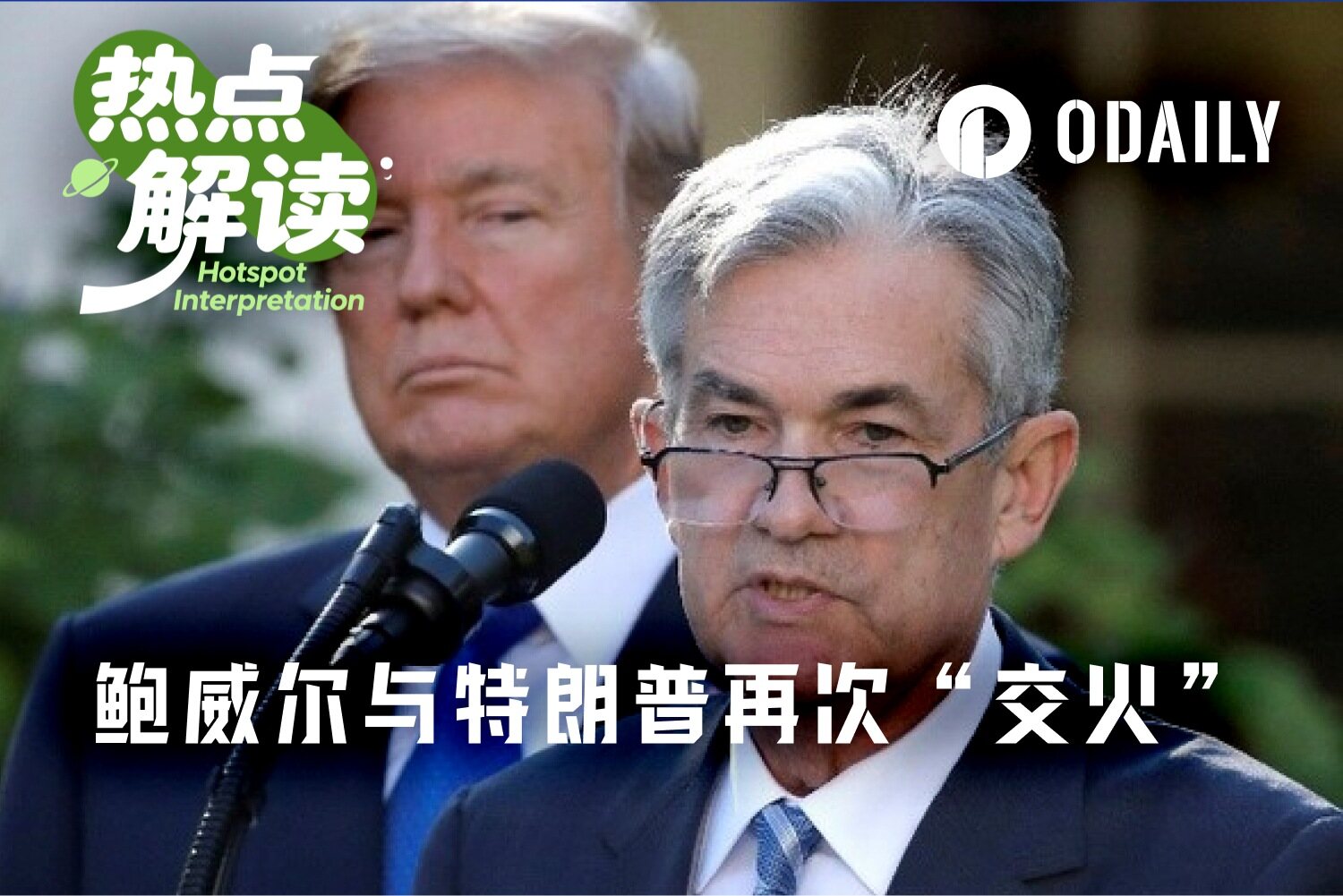
Trump is now truly facing both internal and external troubles: externally entangled in an ongoing struggle with Iran, and internally engaged in an intensifying "palace intrigue" with Federal Reserve Chairman Jerome Powell.

The two have long been at odds. Powell has repeatedly failed to follow Trump's wishes for interest rate cuts, and Trump has repeatedly stated his intention to fire Powell. Originally, if Trump could just endure a little longer, this problem would resolve itself: Powell's term as Fed Chair expires on May 15, 2026. Although he could remain on the Board of Governors until 2028, as long as Trump's favored Kevin Warsh took over, the new chair would hold the power, and an era of compliant rate cuts seemed imminent.

However, an unexpected twist has occurred. Monitoring by Odaily Seer Channel shows that the probability of Powell stepping down as Fed Chair after his term expires has dropped to 2% on Polymarket, indicating that Powell is very likely to continue serving as interim Fed Chair after May 15.

As early as March 19, Powell stated that if his successor is not confirmed before his term ends (May 15), he will continue to serve as Fed Chair. He further indicated that he would not leave the Fed Board of Governors as long as the Justice Department's investigation into him remains ongoing (Odaily Note: This investigation concerns whether Powell lied to Congress about the Fed's $2.5 billion building renovation project).

Therefore, whether Trump can get rid of Powell depends crucially on whether the Senate approves Kevin Warsh as the successor. Although prediction markets have priced in the outcome, the real answer will not be revealed until April 21 (next Tuesday).

Key Juncture: Whether Warsh's Fed Nomination Can Secure Senate Confirmation on April 21

Kevin Warsh is Trump's nominee for the next Fed Chair, but his eventual appointment is subject to review by the US Senate, which has the power to reject the nomination. Warsh will first appear at a hearing before the Senate Banking Committee on April 21, and the market is concerned that Warsh might not even pass the committee's confirmation.

The central figure obstructing Warsh's appointment is Thom Tillis, a Republican from North Carolina and a member of the Banking Committee. His reason is that the Justice Department's investigation into Powell is not yet concluded; he has publicly stated that he will block Warsh nomination from proceeding to a full Senate vote until the Justice Department ends its investigation. Thom Tillis has this influence because, although Republicans hold a 13-11 majority on the Senate Banking Committee, if Thom Tillis votes against it, Warsh's nomination could stall.

The Justice Department's investigation into Powell dates back to July 2025, when Trump visited the Fed building renovation site and publicly questioned its budget合理性. Consequently, in January 2026, the Justice Department formally launched an investigation into Powell regarding the cost of the Fed building renovation. This investigation was originally a political maneuver by Trump aimed at tarnishing Powell's public image and increasing pressure on the Fed.

Perhaps Trump didn't anticipate the backlash. However, Trump also does not intend to terminate the investigation into Powell to clear the path for Warsh's appointment. In an April 15 interview with Fox Business, he stated that while Thom Tillis's opposition would delay Warsh's confirmation, he did not plan to end the investigation, bluntly asking, "Don't you think we need to find out what happened there?"

Stepping back, even without this investigative hurdle, Warsh might struggle to secure the 51 Senate votes needed for confirmation. Under the current geopolitical and economic conditions, Warsh is likely to face questions about Fed independence and interest rate policy during his hearing. If energy and commodity bottlenecks persist due to war, the Fed's focus should be on whether to raise rates, not cut them.

This forces Warsh to choose his stance: either consistently support Trump, which would lower his confirmation chances, or defend the Fed's current wait-and-see stance, thereby angering the President.

Regardless of Warsh's choice, the window is narrow: The hearing is scheduled for April 21, meaning the Senate has only 24 days left before Powell's term ends to confirm Warsh's nomination and hold a vote; of these 24 days, the Senate is only scheduled to be in session for 13 days.

The Trump-Powell Stalemate

Therefore, based on this analysis, if Warsh encounters obstacles at the April 21 hearing, Powell is highly likely to continue serving as interim Fed Chair after his term expires on May 15, continuing to oppose Trump.

There is precedent for an incumbent chair continuing to lead the Fed as "interim chair" due to the successor's confirmation process being incomplete. For example, during President Clinton's administration, then-Fed Chair Alan Greenspan continued to lead the Fed for over three months as interim chair after his term expired while his successor's confirmation was pending; Powell himself served as interim chair for about three months in 2022 while awaiting Senate confirmation for his second term.

This mechanism also has a basis in US law. The Federal Reserve Act, the law governing the Fed, states that members of the Board of Governors shall continue to serve until their successors are appointed.

Faced with this situation, Trump is not willing to sit idly by. In his April 15 Fox Business interview, he stated that if Powell does not step down on time, he will fire him, and also will not abandon the investigation into him.

However, this might also be just an empty threat. Because Trump has not revealed what strategy he would use to fire Powell. Some conservatives believe Trump has the right to appoint one of his own nominated Fed governors—for example, Mester, Bowman, or Waller—to act in Warsh's stead before his confirmation, rather than having Powell do so, citing a memo drafted during the Carter administration which suggests the President can designate an acting chair if his nominee is not confirmed in time.

But the Fed's attitude towards this memo is unknown. Furthermore, this memo ultimately cannot serve as legal basis, so Trump appointing someone other than Powell as interim chair basically lacks legal foundation.

If Trump tries to fire Powell through normal procedures, the success rate is also low. US law states that Trump does not need Congressional confirmation to fire Powell, but he also cannot fire him directly without reason; it must be "for cause," meaning there must be legal grounds, not simply policy disagreements. Whether the reason for dismissal is justified would ultimately be decided by the courts.

Under the current circumstances, the only justifiable reason Trump has for firing Powell would be if Powell lied or was corrupt regarding the Fed's $2.5 billion building renovation project. But according to a March 25 report by The Washington Post, a senior aide to US Justice Department official Jeannie Rhee admitted during a closed-door hearing this month that the Justice Department, in its criminal investigation into Fed Chair Powell regarding the renovation costs, has not found evidence of any wrongdoing.

In other words, the investigation into Powell has not made substantial progress. Therefore, if Trump were to actually fire Powell, the latter would certainly appeal and challenge the dismissal, and with insufficient evidence, the court ruling would most likely side with Powell.

However, for capital market investors, a delay in Warsh's appointment and Powell retaining control of the Fed for several more months is not necessarily good news. Compared to Powell, who consistently preaches "patience," the market clearly prefers Warsh, who, upon taking office, might signal more rate cuts. Additionally, Warsh's own demonstrated crypto-friendly stance could more easily bring new imagination space to the crypto market.


Трендові криптовалюти

Пов'язані питання

QWhat is the probability of Jerome Powell remaining as Fed Chair after May 15th, according to the prediction market?

AAccording to the Polymarket, the probability of Jerome Powell remaining as Fed Chair after his term expires has surged to 98%.

QWho is the key Republican senator potentially blocking Kevin Warsh's confirmation, and what is his reason?

AThe key Republican senator is Thom Tillis. His reason for potentially blocking the nomination is that he will not allow the nomination to proceed to a full Senate vote until the Justice Department's investigation into Jerome Powell is concluded.

QWhat is the legal basis that could allow Jerome Powell to stay on as 'interim Chair' after his term expires?

AThe legal basis is the Federal Reserve Act, which states that a member of the Board of Governors may continue to serve until a successor is appointed and confirmed.

QWhat reason would President Trump need to legally fire Jerome Powell, and does he currently have sufficient evidence for it?

APresident Trump would need to fire Jerome Powell 'for cause,' meaning a legal reason such as proven misconduct, not just policy disagreements. The article states that the Justice Department's investigation has not yet found evidence of any wrongdoing, so sufficient evidence currently does not appear to exist.

QWhy might the market prefer Kevin Warsh over Jerome Powell as Fed Chair, according to the article?

AThe market might prefer Kevin Warsh because he is perceived as being more likely to signal interest rate cuts, and he has shown a crypto-friendly stance which could bring new imagination space to the crypto market.

Пов'язані матеріали

From Gold to Bitcoin: Fixed Supply + Institutional Frenzy, Might It Repeat the 'Explosive' Price Trend?

"From Gold to Bitcoin: Fixed Supply and Institutional Frenzy May Lead to 'Explosive' Price Rally Analysts suggest Bitcoin's price action could mirror gold's over the past two decades, following the launch of spot Bitcoin ETFs. Gold ETFs, introduced in 2004, drove gold's price surge to a current market cap near $28 trillion. Both gold and Bitcoin are non-yielding stores of value, with prices driven purely by investor sentiment rather than cash flows or credit. Gold ETFs experienced dramatic cycles: explosive growth, painful drawdowns, and slow recoveries, with each cycle reaching higher peaks. Bitcoin ETFs, approved in early 2024, saw rapid institutional adoption but are now facing similar volatility. Recent warnings highlight the risk of significant ETF outflows disrupting the current rebound. BlackRock's IBIT, a leading Bitcoin ETF, has sold nearly 100,000 BTC to meet redemptions while still holding over 733,000. The core parallel is fixed supply: when demand surges, prices explode, but demand is often volatile and wave-like, not steady. Institutional interest, through ETFs and corporate adoption, remains a key support pillar, helping to cushion sell-offs. If Bitcoin captures even a fraction of gold's role as a store of value, its upside potential is immense, though the path will be marked by high volatility. For investors, focusing on long-term trends and managing risk is crucial as this 'price explosion' narrative unfolds."

Foresight News14 хв тому

From Gold to Bitcoin: Fixed Supply + Institutional Frenzy, Might It Repeat the 'Explosive' Price Trend?

Foresight News14 хв тому

Why Is AI Agent Shopping Hard to Popularize?

The article argues that the popular narrative of "AI agent shopping" – equipping AI with a wallet to autonomously handle purchases – is fundamentally flawed and oversimplifies the complexity of shopping. It deconstructs shopping into two core actions: **information retrieval** (standardized, easily automated) and **value judgment** (deeply subjective and human-centric). The narrative mistakenly assumes AI can fully handle both. Value judgment itself has two layers: **evaluation** (assessing options against criteria) and **demand definition** (setting the criteria, weights, and values). The latter is inherently human and dynamic, as preferences are not fixed but constructed during the decision-making process ("constructive preferences"). The real dividing line for automation is not product standardization, but whether the **act of choosing** itself holds experiential value. For mundane purchases (e.g., printer paper), full AI delegation works. For experiential goods (e.g., wine, furniture), the joy of selection is core to consumption, so AI should act as an assistant that narrows options, leaving the final choice to humans. The "AI wallet" concept confuses three separate elements: decision-making, execution, and fund custody. Current payment industry solutions (e.g., from Stripe, Mastercard, Google, Visa) show that limited, scoped payment authorization tokens are sufficient for most consumer scenarios, not full fund custody. The true use case for autonomous AI wallets is in **B2B procurement** and **machine-to-machine (M2M) settlements** for standardized, high-frequency, low-value transactions. The real bottlenecks for AI shopping are not payment technology, but **1) the lack of trusted data sources** (e.g., fake reviews, counterfeit goods) and **2) the impossibility of automating human demand definition**. The conclusion is that the focus should be on safely automating the assessment and filtering process while reserving for humans the rights to define their criteria and enjoy the final act of choice. For experiential goods, the platform's competitive advantage shifts to providing a superior selection experience.

Foresight News1 год тому

Why Is AI Agent Shopping Hard to Popularize?

Foresight News1 год тому

After Nine Months of Shorting, a Full Turn to Long: Renowned Trader Opens Bitcoin Positions Around 64K, Crypto Market Long-Short Divergence Intensifies

After nine months of being short, prominent crypto trader Doctor Profit has closed all his bearish positions and started buying Bitcoin near $64,000, signaling a complete bullish reversal. He argues that structural market changes—such as impending U.S. regulation (CLARITY Act) and institutional adoption via securities tokenization—are rewriting the traditional four-year cycle script, potentially bringing the market bottom forward from the widely expected September/October timeframe. This view finds some technical support from on-chain analyst gumsays, who notes a bullish divergence on Bitcoin's weekly chart has persisted for 147 days, nearing the 161-day duration seen before the 2022 cycle low. However, cycle researcher Jake Pahor presents a counter-argument based on historical data. Analyzing patterns since 2014, he identifies three common features of past bear market bottoms: a ~12-month duration from peak to trough, a sustained period of extreme fear (with a proprietary risk score below 20), and the price falling below Bitcoin's realized price (~$53,000 currently). The current cycle, only nine months from its October 2025 peak, meets none of these conditions. The debate highlights a market torn between "front-running" a potential early bottom driven by new fundamentals and waiting for confirmation through traditional on-chain and sentiment metrics. While Doctor Profit opts for aggressive buying, Pahor maintains a disciplined, tiered accumulation strategy, continuing weekly buys at current risk levels but reserving larger orders for if more extreme fear emerges.

marsbit1 год тому

After Nine Months of Shorting, a Full Turn to Long: Renowned Trader Opens Bitcoin Positions Around 64K, Crypto Market Long-Short Divergence Intensifies

marsbit1 год тому

Senior Trader's Confession: How to Trade Market's False Expectations?

Veteran trader's case study: trading the market's "wrong expectations". This trade centered on a textbook "expectation error" after a weak CPI report. While the market initially priced in broad monetary easing (sending Nasdaq to 30,060), the crucial 30-year real yield hit a 20-year high. This signaled a fractured transmission mechanism: short-term rates eased, but long-term funding costs (vital for tech valuations) refused to fall. The trader executed five short positions on the Nasdaq (NQ) as it fell from 30,060 to 28,768. The core methodology: don't just trade the data, but analyze the market's implied causal chain and identify where it breaks. In this case, the chain was: Weak CPI → Policy Easing → Lower Long-Term Funding Costs → NQ Valuation Expansion. The break occurred between policy easing and long-term rates. The "veto variable" – long-term real yields – refused to confirm the bullish narrative. Trades were structured around "fast variables" (price) temporarily repairing while "slow variables" (funding conditions) remained broken. The article outlines a repeatable framework: 1) Map the market's implied causal chain. 2) Identify the veto variable. 3) Observe if it rejects the narrative. 4) Enter when price still follows the old script. 5) Choose the cleanest asset expression (e.g., short NQ, not broad S&P). 6) Define both invalidation and fulfillment exit conditions. The key insight: Alpha often comes not from an information edge, but from a "reaction function edge" – recognizing when the market is applying an outdated causal logic to new data. The critical question: What causal chain is the market's first reaction relying on, and is that chain still valid today?

marsbit2 год тому

Senior Trader's Confession: How to Trade Market's False Expectations?

marsbit2 год тому

Торгівля

Спот

Популярні статті

Як купити ORDER

Ласкаво просимо до HTX.com! Ми зробили покупку Orderly (ORDER) простою та зручною. Дотримуйтесь нашої покрокової інструкції, щоб розпочати свою криптовалютну подорож.Крок 1: Створіть обліковий запис на HTXВикористовуйте свою електронну пошту або номер телефону, щоб зареєструвати обліковий запис на HTX безплатно. Пройдіть безпроблемну реєстрацію й отримайте доступ до всіх функцій.ЗареєструватисьКрок 2: Перейдіть до розділу Купити крипту і виберіть спосіб оплатиКредитна/дебетова картка: використовуйте вашу картку Visa або Mastercard, щоб миттєво купити Orderly (ORDER).Баланс: використовуйте кошти з балансу вашого рахунку HTX для безперешкодної торгівлі.Треті особи: ми додали популярні способи оплати, такі як Google Pay та Apple Pay, щоб підвищити зручність.P2P: Торгуйте безпосередньо з іншими користувачами на HTX.Позабіржова торгівля (OTC): ми пропонуємо індивідуальні послуги та конкурентні обмінні курси для трейдерів.Крок 3: Зберігайте свої Orderly (ORDER)Після придбання Orderly (ORDER) збережіть його у своєму обліковому записі на HTX. Крім того, ви можете відправити його в інше місце за допомогою блокчейн-переказу або використовувати його для торгівлі іншими криптовалютами.Крок 4: Торгівля Orderly (ORDER)Легко торгуйте Orderly (ORDER) на спотовому ринку HTX. Просто увійдіть до свого облікового запису, виберіть торгову пару, укладайте угоди та спостерігайте за ними в режимі реального часу. Ми пропонуємо зручний досвід як для початківців, так і для досвідчених трейдерів.

307 переглядів усьогоОпубліковано 2024.12.10Оновлено 2026.06.02

Як купити ORDER

Обговорення

Ласкаво просимо до спільноти HTX. Тут ви можете бути в курсі останніх подій розвитку платформи та отримати доступ до професійної ринкової інформації. Нижче представлені думки користувачів щодо ціни ORDER (ORDER).

活动图片