Post a Tweet for $5 Million? The Price Tag for a President's Endorsement of a Meme Coin Exposed

比推Опубліковано о 2026-03-17Востаннє оновлено о 2026-03-17

Анотація

Argentine President Javier Milei is accused of accepting a $5 million bribe to promote the meme token LIBRA on his X (formerly Twitter) account, according to a report by local media El Destape. The allegation is based on evidence recovered from the phone of a crypto lobbyist, Mauricio Novelli, who represented KIP Protocol, the entity behind LIBRA. The scandal erupted after Milei posted a tweet on February 15, 2025, endorsing LIBRA as a project aimed at supporting Argentine entrepreneurs. The token's market cap surged to $4.56 billion within 30 minutes, but it collapsed after insiders executed a "rug pull," cashing out over $100 million. Milei later deleted the tweet, claiming he was misled and that the post was intended to support private enterprise. Investigators uncovered a purported agreement between Milei and Hayden Davis, the alleged mastermind behind the scheme. The deal involved a $5 million payment—$1.5 million upfront, another $1.5 million after Milei publicly endorsed Davis as an advisor, and a final $2 million for a blockchain consulting contract. Phone records also showed frequent communication between Novelli and Milei’s office around the time of the tweet. Despite initial investigations by anti-corruption offices and Congress, no conclusive action was taken. The report suggests Milei was aware of the token’s speculative nature but proceeded for financial gain. Davis defended the scheme in an interview, arguing that meme token trading is a “casino” where such ...

Author: Eric, Foresight News

Original Title: How Much Does It Cost for a President to Endorse a Meme Coin? Milei: $5 Million


On March 17, Beijing time, Argentine local media El Destape broke an exclusive bombshell: information recovered from the phone of a cryptocurrency lobbyist in Argentina revealed that Argentine President Milei posted a tweet promoting LIBRA a year ago because he accepted a $5 million bribe, and the mastermind was none other than Hayden Davis, as previously speculated by the outside world.

Opposition lawmakers in Argentina who pushed for the investigation called this an "explosive scandal" and demanded further investigation. However, as of the time of writing, neither Milei nor the presidential office has responded.

Promoting Meme Coin Backfires, Blames "Political Struggle"

On February 15, 2025, Argentine President Milei promoted a Meme token named LIBRA on X, with the caption "Free Argentina is growing!!! This private project will be committed to promoting Argentina's economic growth and providing funding for Argentine small businesses and startup projects. The world wants to invest in Argentina."
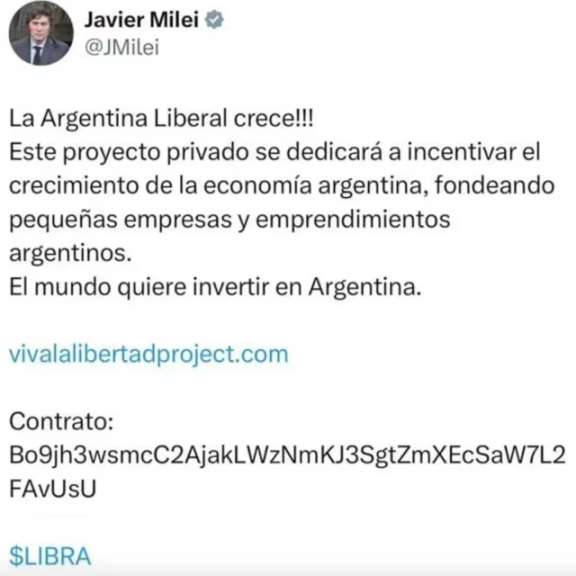
At that time, the hype around the Meme tokens of the US Trump couple had not yet subsided, and the new "presidential concept coin" once again ignited market enthusiasm. The FDV of the LIBRA token soared to a maximum of $4.56 billion within 30 minutes of its launch.

This project, which claimed it would invest token proceeds in Argentine entrepreneurs and education, saw a large number of rat warehouses withdraw liquidity and sell tokens after Milei helped the token price take off, successfully cashing out over $100 million and leaving within an hour or two. At noon Beijing time that day, Milei deleted the tweet and stated that his previous action was merely to support private enterprises and was not related to them, and that after understanding the situation, he decided not to spread the message further.

After the tweet was deleted, the price of LIBRA headed straight to zero without looking back. The entire event started in the early morning Beijing time and was over before the afternoon even arrived.

Even someone as abstract as Trump only dared to issue Meme coins before taking office, but Milei publicly helped promote a Rug project while in office. This kind of "not even pretending" blatant corruption was met with indiscriminate criticism. As the torrent of verbal and written attacks fell, Milei was forced to respond, but these responses seemed more like excuses.

The Argentine presidential office first stated that Milei met with Mauricio Novelli, the representative of KIP Protocol (the entity behind LIBRA) in Argentina, in October 2024. At that time, this representative said that a project named Viva la Libertad would be launched in the future to provide financing support for Argentine private enterprises. Milei's retweet after KIP Protocol launched the LIBRA token was merely to support Argentine entrepreneurs, and he himself was not aware of the details.

In other words, Milei believed LIBRA was a project to help Argentine entrepreneurs, and the retweet was well-intentioned.

Later, Milei himself stated again on a television program that his actions were in good faith, hoping to support any project that could improve the financing situation for technology entrepreneurs, but he was "deceived" because he did not understand the project's situation. Furthermore, Milei shamelessly stated that the vast majority of the deceived investors were Americans and Chinese, and he had not wronged his own citizens.

Finally, Milei even stated that the smear campaign against him was politically motivated and vowed to pursue the matter.

This flimsy explanation was obviously unconvincing: Why would a national president promote a private company without investigation?

Took the Money, But Didn't Fully Deliver

After this national-level scandal occurred, both the Argentine Anti-Corruption Office and Congress launched investigations. The Anti-Corruption Office believed that Milei's action was personal and did not violate public ethics regulations; the congressional investigation committee accused Milei of providing "key cooperation" in the LIBRA incident and recommended that Congress assess whether it constituted misconduct.

However, these investigation results did not reveal details, and the outside world was unclear about what exactly happened.

El Destape's爆料 revealed a key piece of evidence, shedding light on the gray transaction between LIBRA's issuer and the president.

According to the report, investigators recovered an agreement between H (confirmed to be Hayden Davis) and Milei from the phone of Mauricio Novelli, who was referred to by the Argentine presidential office as the "representative of KIP Protocol in Argentina" but was actually a cryptocurrency lobbyist.
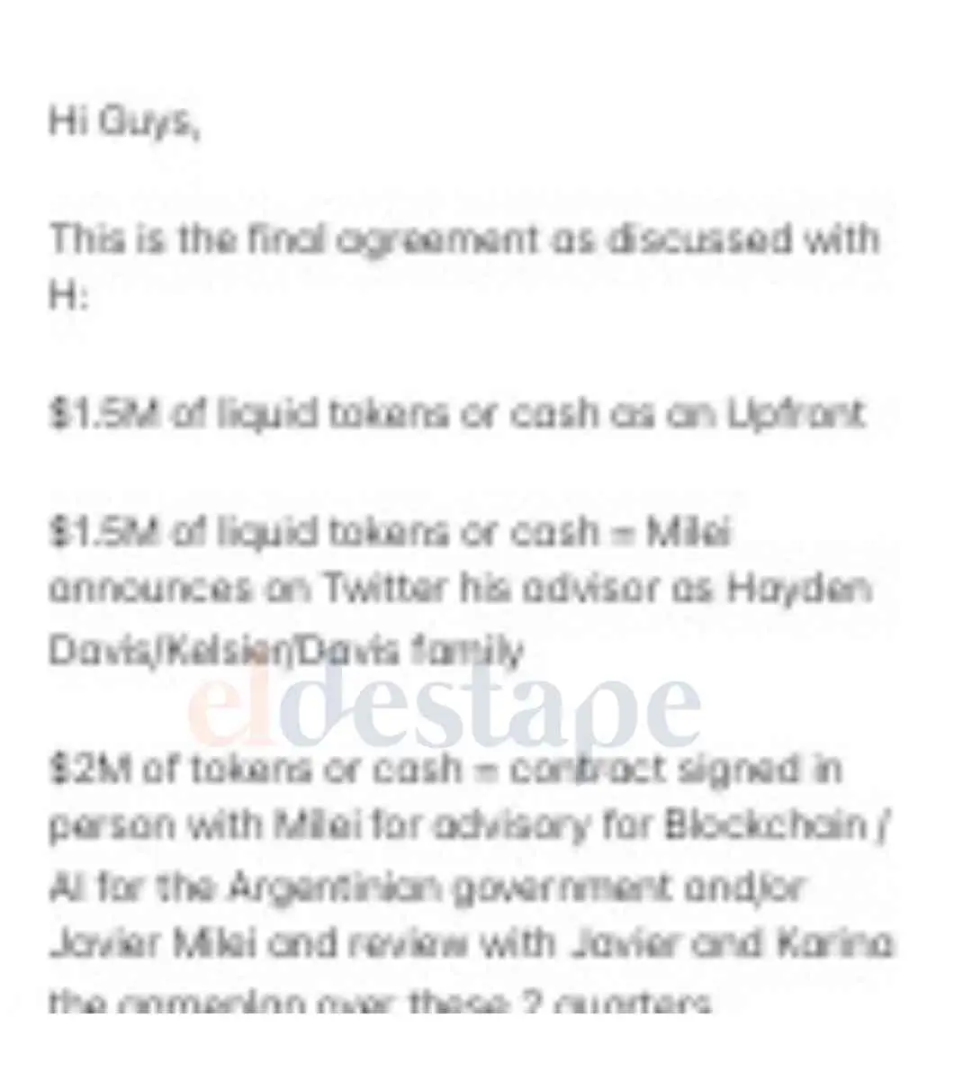
The agreement content shows that Hayden Davis would first pay Milei $1.5 million in liquid tokens or cash as an advance payment. After Milei announced on X that Hayden Davis/Kelsier/Davis family were his advisors, another $1.5 million in liquid tokens or cash would be paid. As for the final $2 million, it required Milei to sign a blockchain/artificial intelligence consulting contract.

The creation date of this file was just three days before Milei posted the promotional LIBRA tweet, and the file came from an expert report by the Argentine General Directorate of Technical Support for Criminal Investigations, but it only appeared in a folder of an attachment.

The secrets found on the phone were far more than just this file; they even included materials related to Milei teaching a cryptocurrency course at a school, which also proved that Milei's claim a year ago that he did not understand cryptocurrency was a pure lie.

In addition, the investigation report also exposed密集的通话记录 (dense call records) between Mauricio Novelli and Milei, as well as Milei's sister (who serves as Secretary General of the Argentine Presidential Office) from a few minutes before to a few hours after Milei promoted the token. Although there was no specific call content, the timing吻合 (coincidence)恰好证明 (just proves) that LIBRA was a premeditated financial scam organized with the involvement of the president.

Judging from Milei's tweet, the cooperation between the two parties may have only reached the first step. Before the tweet announcing that Hayden Davis was his advisor could be sent, the LIBRA incident spiraled out of control, forcing Milei to quickly clarify and distance himself. No wonder Hayden Davis said in an interview with crypto blogger Coffeezilla that Milei was originally supposed to post more interactive tweets, but for some reason the cooperation suddenly stopped.

Bottomless "Open Robbery"

In fact, after the LIBRA incident, some people inferred through on-chain information that Hayden Davis and his Kelsier Ventures were the masterminds behind the incident, and also uncovered that the token MELANIA launched by Trump's wife was also manipulated by him.

El Destape reported that on January 30, 2025, Hayden Davis met with Milei and Milei's sister at the Argentine presidential palace and signed a contract with Milei, making Davis an advisor to the Argentine government in the blockchain field. This contract was also found on Novelli's phone but was concealed by prosecutor Eduardo Taiano and not made known to the relevant parties.

After this agreement was reached, a bank account associated with Davis transferred $1 million to an account with an unconfirmed owner.

So far, we roughly know the whole story:

In October 2024, Mauricio Novelli introduced KIP Protocol (actually controlled by Hayden Davis) to Argentine President Milei, claiming that a project named Viva la Libertad would be launched to provide financing support for Argentine private enterprises, thereby getting closer to Milei.

At the end of January 2025, Hayden Davis, through the introduction of Mauricio Novelli, contacted Argentine President Milei and successfully became the blockchain advisor to the Argentine government. Afterwards, Hayden Davis, through Mauricio Novelli, reached an agreement with Milei: Hayden Davis would pay Milei a total of $5 million in exchange for Milei promoting the Viva la Libertad project and its issued LIBRA token on his personal X account.

Between October 2024 and the end of January 2025, Hayden Davis and Milei may have had more or less contact through Mauricio Novelli and discussed how to promote LIBRA. Milei was probably well aware that this was a pure scam project using cryptocurrency, but the reason he agreed was probably, as Hayden Davis said in an interview, their series of plans would not let this token quickly "rug pull.

But unexpectedly, after Milei posted the tweet, the rat warehouses couldn't wait to cash out over $100 million, quickly triggering a large amount of critical public opinion. Seeing the situation turning bad, Milei chose to cut losses rather than continue the cooperation. As public opinion further发酵 (fermented), the originally win-win situation turned into Milei being left alone in the lurch, while Hayden Davis cashed out and left.

The most terrifying thing about this incident is that Hayden Davis never considered it fraud. In an interview with Coffeezilla, he stated, "In the meme market, this is not illegal. This is what happens in every trade. These are the rules here. People know this, agree to this, and make money from this. If you're going to blame this, I think, for the vast majority of retail traders betting on meme tokens, especially those who get in early, this is the rules of the game in this market. This is not the capital market; this is a casino."

The development process of the industry is never afraid of speculators participating. What it fears is that speculators truly believe the industry is simply a casino for speculation.

This perhaps explains some of the chaos in the Web3 industry in the past two or three years: when schemers don't think they are scheming, they naturally lose all bottom lines. Eventually, projects no longer compare in the simple sense of good or bad, but only in who has the more clever means of "robbing."


Twitter:https://twitter.com/BitpushNewsCN

Bitpush TG Discussion Group:https://t.me/BitPushCommunity

Bitpush TG Subscription: https://t.me/bitpush

Original link:https://www.bitpush.news/articles/7620466

Трендові криптовалюти

Пов'язані питання

QWhat was the alleged bribe amount that Argentine President Javier Milei received to promote the LIBRA meme coin on Twitter?

AArgentine President Javier Milei allegedly received a bribe of $5 million to promote the LIBRA meme coin on Twitter.

QWho was identified as the mastermind behind the LIBRA meme coin promotion scandal involving President Milei?

AHayden Davis was identified as the mastermind behind the LIBRA meme coin promotion scandal involving President Milei.

QWhat was the fully diluted valuation (FDV) of the LIBRA token shortly after its promotion by President Milei?

AThe fully diluted valuation (FDV) of the LIBRA token surged to a peak of $4.56 billion within 30 minutes after its promotion by President Milei.

QHow did President Milei respond to the backlash after promoting the LIBRA meme coin?

APresident Milei deleted the promotional tweet, claimed he was deceived and acted in good faith to support Argentine entrepreneurs, and alleged that the criticism was politically motivated.

QWhat evidence was recovered from the phone of cryptocurrency lobbyist Mauricio Novelli that implicated President Milei?

AEvidence recovered from Mauricio Novelli's phone included a agreement detailing a $5 million payment plan to President Milei for promoting the LIBRA token, documents related to Milei's cryptocurrency lectures, and records of密集的通话记录 between Novelli, Milei, and his sister around the time of the promotion.

Пов'язані матеріали

The "Impossible Triad" Is Fundamentally a Pseudo-Problem

The article argues that blockchain's fundamental limitation is not the scalability trilemma (decentralization, scalability, security), which has been largely solved, but the lack of **privacy** and, until recently, clear **legitimacy**. Blockchain is described as a slow, expensive, globally shared computer whose core value is censorship resistance and verifiability. While ideal for native digital assets like money (e.g., stablecoins), its default transparency acts as a **tax**, exposing all transactions and enabling MEV extraction, which deters serious institutional capital. Simultaneously, its permissionless nature created regulatory ambiguity. The piece contends that **privacy** is the missing critical feature. It rejects the false choice between total transparency and complete anonymity. Modern cryptography (like zero-knowledge proofs) enables **compliant privacy**: users can prove facts (solvency, KYC status, compliance) without revealing the underlying sensitive data (specific holdings, identities). This preserves auditability for regulators and eliminates the leak of financial information. With recent regulatory progress (e.g., the GENIUS Act) addressing legitimacy, adding default, provably compliant privacy becomes a pure upgrade. It transforms blockchain from a costly, public ledger into a confidential settlement layer, finally bridging the gap to mainstream institutional and individual adoption of on-chain finance.

链捕手4 год тому

The "Impossible Triad" Is Fundamentally a Pseudo-Problem

链捕手4 год тому

Optical Chips: Collective Capacity Expansion

The global optical chip industry is experiencing a massive wave of expansion driven by surging AI data center demand. Major players across the US, Japan, Europe, and China are aggressively investing to ramp up production capacity. In the US, Coherent is expanding its 6-inch Indium Phosphide (InP) semiconductor fab in Texas, supported by CHIPS Act funding and a $2 billion strategic investment from NVIDIA. Lumentum is building a new factory for InP optical devices, and Nokia is scaling its advanced photonic chip packaging and testing capabilities. NVIDIA's investments aim to secure future supply of critical lasers and optical interconnect products for AI infrastructure. Japan's JX Advanced Metals, a leading InP substrate supplier, plans a multi-billion yen investment to increase its capacity 7-10 times, strengthening its grip on the crucial upstream materials market. In Europe, IQE and Tower Semiconductor settled a patent dispute and signed a multi-year InP epitaxial wafer supply agreement, highlighting that next-generation silicon photonics platforms will integrate high-performance InP components. STMicroelectronics and Sivers Semiconductors are also expanding silicon photonics production and partnerships. China is rapidly building out its domestic supply chain. Dongshan Precision's subsidiary, Source Photonics, announced a $12 billion project to expand optical chip and module production. Companies like Sanan Optoelectronics and Yunnan Germanium are scaling up InP chip manufacturing and substrate production, moving towards vertical integration from materials to modules. While debate continues around the exact future architecture—whether CPO (Co-Packaged Optics), NPO, or pluggables will dominate—analysts like Morgan Stanley argue the underlying driver is unchangeable: the explosive growth in bandwidth demand. This will inevitably increase the volume of optical engines, lasers, and related content per GPU, regardless of the final technical path. The competition for "more light" in the AI era has intensified into a global, full-chain capacity race.

marsbit6 год тому

Optical Chips: Collective Capacity Expansion

marsbit6 год тому

Stablecoins Finally Find Real Yield: An In-Depth Look at On-Chain Reinsurance Re | A Conversation with Re Founder Karan Saroya

Stablecoin Real Yield Found: A Deep Dive into On-Chain Reinsurance with Re's Karan Saroya As stablecoin supply exceeds $170 billion, the search for sustainable, non-speculative yield intensifies. Re, an on-chain reinsurance platform, provides an answer: connecting stablecoin capital to the trillion-dollar traditional reinsurance market. Re operates as a regulated reinsurer, accepting stablecoin deposits as collateral to back US insurance companies. These insurers pay premiums, generating yield that flows back to on-chain depositors. Currently supporting 35 insurers and underwriting $500 million, Re projects scaling to over $1 billion soon. Key insights from a Bankless podcast with founder Karan Saroya and investor Avichal of Electric Capital: 1. **Uncorrelated, Real-World Yield:** Re offers stablecoin holders access to reinsurance returns (targeting 12-14%+), an asset class entirely separate from crypto or equity markets. 2. **Operational Efficiency via Smart Contracts:** Re replaces traditional, labor-intensive capital fundraising with smart contracts, allowing a ~12-person team to compete with industry giants. 3. **Regulatory Leverage:** For every $1 of collateral, regulations allow backing $5-7 in written premiums. This leverage amplifies returns from the underlying risk-free rate. 4. **DeFi Integration:** Depositors receive receipt tokens, which can be used in protocols like Morpho for "looping," potentially pushing yields to 18-20%+. 5. **The "DeFi Mullet" Model:** A compliant front-end (regulated reinsurer) paired with a decentralized back-end (smart contracts, DeFi capital markets). 6. **RE Governance Token:** Modeled on Lloyd's of London, the token governs the central capital pool's allocation, counterparty acceptance, and parameters. 7. **Real Economic Impact:** Capital funds real-world productivity (factories, clinics, businesses) via insurance, moving beyond crypto's internal loops. The discussion highlights a pivotal moment: DeFi's supply-side infrastructure is now met by real demand for productive yield, potentially kickstarting a flywheel where vast on-chain stablecoin capital seeks these real-world returns.

链捕手8 год тому

Stablecoins Finally Find Real Yield: An In-Depth Look at On-Chain Reinsurance Re | A Conversation with Re Founder Karan Saroya

链捕手8 год тому

1996 or 1999? Walsh's First Test is 'How to View AI'

"1996 or 1999? Wall's First Big Test Is 'How to View AI'" Federal Reserve Chairman Wall's initial challenge is not whether to raise or cut rates, but a more fundamental judgment: what kind of boom is the current AI boom? This will determine the Fed's policy path and define his legacy. Economics is split between two opposing views, according to reporter Nick Timiraos. One sees imminent productivity gains that will increase supply and cool inflation, allowing the Fed to hold steady. The other argues that while productivity benefits are distant, demand shocks are here now, and waiting for data confirmation risks missing the intervention window, forcing sharper rate hikes later. Wall has signaled a leaning toward the first view, echoing 1996-era Alan Greenspan, who embraced strong, productivity-driven growth without fear of inflation. However, Wall faces a different macro environment than Greenspan did, with tariff pressures, expanding fiscal deficits, and diminishing globalization benefits, which could force more significant inflation pressures even if AI benefits materialize. Wall's logic, expressed before taking office, is that AI-driven productivity gains won't show in official data for years. If the Fed waits for confirmation, it might mistakenly tighten policy and choke off the very growth that could suppress inflation. This argues for using forward-looking narratives over lagging data. Chicago Fed President Austan Goolsbee presents a key counter-argument. He distinguishes between expected and unexpected productivity booms. A widely anticipated boom, like the current AI wave, can cause people to spend future wealth gains in advance, overheating the economy before productivity actually rises, thus requiring preemptive rate hikes. He cites rising costs for AI data centers as evidence of such overheating. Fed Governor Christopher Waller offers a rebuttal to Goolsbee, noting the "expected spending" mechanism only works if people can borrow against future income, which many households cannot do due to borrowing constraints. Wall also faces a paradox related to his desire to reduce the Fed's use of "forward guidance" (pre-announcing policy moves). This practice was established in 1999 when Greenspan began signaling hikes to avoid market shocks. If the economy follows a less optimistic path, Wall may be forced to choose between using the guidance he wants to abolish or risking market volatility by staying silent. The ultimate question defining Wall's first major test remains: Is this 1996 or 1999?

marsbit9 год тому

1996 or 1999? Walsh's First Test is 'How to View AI'

marsbit9 год тому

Торгівля

Спот
Ф'ючерси

Популярні статті

Що таке MEME 2.0

Memecoin 2.0: Поява $MEME 2.0 у світі криптовалюти Вступ У постійно змінному ландшафті криптовалюти з'явився новий претендент. Memecoin 2.0, що символізується як $MEME 2.0, підносить концепцію мем-криптовалют на захоплюючий новий рівень. Як побічний продукт оригінального Memecoin, цей проєкт привернув увагу крипто-спільноти, змістивши акцент з типової фінансової вигоди на захоплюючий і розважальний досвід. Працюючи на блокчейні Ethereum, Memecoin 2.0 сміливо переосмислює залучення спільноти у криптосфері. Що таке Memecoin 2.0, $MEME 2.0? У своїй основі, Memecoin 2.0 є криптовалютним проєктом, який надає пріоритет спільнотному духу і розвагам, пов'язаним з мем-культурою. На відміну від звичайних криптовалют, які зосереджені на практичних випадках використання та матеріальних вигодах, Memecoin 2.0 вирізняється тим, що обіймає легшу сторону цифрової валюти. Цей проєкт існує без обіцянок утиліти, структурованої дорожньої карти чи фінансових повернень, зосереджуючи увагу на створенні яскравої спільноти навколо мемів та спільних розваг. Зробивши це, він використовує зростаючу тенденцію мем-культури у онлайн-пробі, що робить його унікальним гравцем у світі цифрових активів. Творець Memecoin 2.0, $MEME 2.0 Не зважаючи на численні дослідження витоків Memecoin 2.0, чітка особистість його творця залишається невідомою. Ця анонімність не є рідкістю у крипто-спільноті, де багато проєктів очолюються особами або групами, які надають перевагу залишатися за лаштунками. Відсутність публічно доступної інформації про творця може розглядатися як стратегічний крок, що ставить в центр уваги залучення спільноти, а не індивідуальної популярності у цій сфері. Інвестори Memecoin 2.0, $MEME 2.0 Інформації щодо інвесторів або фінансової підтримки Memecoin 2.0 замало. Відсутність деталей може свідчити про те, що проєкт є самофінансованим або що його увага до спільноти, а не традиційних інвестиційних структур, привабила інший тип підтримки. Оскільки світ мем-криптовалют зазвичай передбачає більше участі низового рівня, а не інституційних інвестицій, цей підхід узгоджується з етосом проєктів, що управляються спільнотою. Як працює Memecoin 2.0, $MEME 2.0? Memecoin 2.0 повністю працює на блокчейні Ethereum, використовуючи його потужні функції безпеки та масштабованості. Використовуючи сильні сторони Ethereum, Memecoin 2.0 може запропонувати безпечне середовище для взаємодії користувачів, забезпечуючи при цьому, що транзакції є ефективними та економічними. Одна з унікальних характеристик Memecoin 2.0 полягає в його структурі, що керується спільнотою. Цінність та популярність токена $MEME 2.0 походять з активної участі його користувачів, а не з вродженої утиліти. Ця концепція підкреслює акцент проєкту на розважальному аспекті криптовалюти, натякаючи на те, що сміх та залучення спільноти є справжніми валютами, що ведуть до його успіху. Крім того, проєкт вписується в ширшу екосистему мем-криптовалют, де цінність кожної мем-криптовалюти коливається залежно від культури, тенденцій і участі спільноти, а не традиційних економічних принципів. Хронологія Memecoin 2.0, $MEME 2.0 Щоб краще зрозуміти еволюцію та віхи Memecoin 2.0, ось хронологія, що підкреслює значні події в його історії: 2024: Зародження Memecoin 2.0 вважається відгалуженням оригінального Memecoin, яке встановлює себе в процвітаючому контексті мем-криптовалют, працюючи на блокчейні Ethereum. 13 липня 2024: Memecoin 2.0 офіційно позиціонує себе як мем-криптовалюта, орієнтована на спільноту, в мережі Ethereum, підкреслюючи свій підхід, зосереджений на розвагах, який запрошує користувачів брати участь у його розвитку. Ключові моменти про Memecoin 2.0, $MEME 2.0 Кілька критичних характеристик визначають Memecoin 2.0: Спільнотно-центричний підхід: Основною метою Memecoin 2.0 є створення веселого, захоплюючого досвіду для спільноти, використовуючи колективне задоволення, що випливає з меметичної культури. Побудовано на Ethereum: Робота на блокчейні Ethereum надає проєкту важливу інфраструктуру, що забезпечує безпеку та масштабованість. Відсутність утиліти або дорожньої карти: У вражаючому відході від традиційних криптовалют, Memecoin 2.0 не обіцяє жодних утилітарних функцій або фінансових повернень, підтверджуючи свою прихильність до участі спільноти та соціального залучення. Акцент на меметичній культурі: Обіймаючи гумористичні та культурні аспекти мем-періоду, Memecoin 2.0 надає платформу для користувачів для залучення до крипти офлайн та онлайн. Додатковий контекст: Значення мем-криптовалют Мем-криптовалюти з'явилися як окрема класифікація криптовалюти, часто керуючись гумором та легким підходом до торгівлі. Ці валюти, як правило, не мають значної утиліти або розробницьких дорожніх карт, залучаючи користувачів обіцянкою розваг, взаємодії в спільноті та культурної значущості. В рамках ширшої екосистеми криптовалют, мем-криптовалюти відновлюють важливість залучення спільноти, протистоячи лише прибутковим підходам. Проєкти, такі як Memecoin 2.0, відкривають еру, в якій розваги можуть гармонізувати з фінансовими прагненнями, перетворюючи блокчейн на ігровий майданчик для творчості та соціальної взаємодії. Висновок Memecoin 2.0, або $MEME 2.0, втілює нову хвилю криптовалюти, яка надає пріоритет залученню спільноти над жорсткими фінансовими структурами. Зосереджуючись на гуморі та соціальній взаємодії, він використовує захоплення навколо мем-культури. Працюючи на блокчейні Ethereum, Memecoin 2.0 використовує можливості технології, залишаючись непохитним у своїй прихильності до розважальної цінності цифрової валюти. Коли простір навколо криптовалют продовжує еволюціонувати, Memecoin 2.0 служить доказом того, що майбутнє цифрових активів може значною мірою залежати від спільних досвідів, сміху та надійних зв'язків у спільноті. У непередбачуваному світі крипто, можливо, радість може бути такою ж цінною, як і традиційний фінансовий прибуток.

113 переглядів усьогоОпубліковано 2024.04.04Оновлено 2024.12.03

Що таке MEME 2.0

Як купити MEME

Ласкаво просимо до HTX.com! Ми зробили покупку Memeland (MEME) простою та зручною. Дотримуйтесь нашої покрокової інструкції, щоб розпочати свою криптовалютну подорож.Крок 1: Створіть обліковий запис на HTXВикористовуйте свою електронну пошту або номер телефону, щоб зареєструвати обліковий запис на HTX безплатно. Пройдіть безпроблемну реєстрацію й отримайте доступ до всіх функцій.ЗареєструватисьКрок 2: Перейдіть до розділу Купити крипту і виберіть спосіб оплатиКредитна/дебетова картка: використовуйте вашу картку Visa або Mastercard, щоб миттєво купити Memeland (MEME).Баланс: використовуйте кошти з балансу вашого рахунку HTX для безперешкодної торгівлі.Треті особи: ми додали популярні способи оплати, такі як Google Pay та Apple Pay, щоб підвищити зручність.P2P: Торгуйте безпосередньо з іншими користувачами на HTX.Позабіржова торгівля (OTC): ми пропонуємо індивідуальні послуги та конкурентні обмінні курси для трейдерів.Крок 3: Зберігайте свої Memeland (MEME)Після придбання Memeland (MEME) збережіть його у своєму обліковому записі на HTX. Крім того, ви можете відправити його в інше місце за допомогою блокчейн-переказу або використовувати його для торгівлі іншими криптовалютами.Крок 4: Торгівля Memeland (MEME)Легко торгуйте Memeland (MEME) на спотовому ринку HTX. Просто увійдіть до свого облікового запису, виберіть торгову пару, укладайте угоди та спостерігайте за ними в режимі реального часу. Ми пропонуємо зручний досвід як для початківців, так і для досвідчених трейдерів.

332 переглядів усьогоОпубліковано 2024.12.12Оновлено 2026.06.02

Як купити MEME

Обговорення

Ласкаво просимо до спільноти HTX. Тут ви можете бути в курсі останніх подій розвитку платформи та отримати доступ до професійної ринкової інформації. Нижче представлені думки користувачів щодо ціни MEME (MEME).

活动图片