POLY's Appearance Hints Are Getting Denser, How Far Away Is the Polymarket Airdrop?

Odaily星球日报Опубліковано о 2026-05-19Востаннє оновлено о 2026-05-19

Анотація

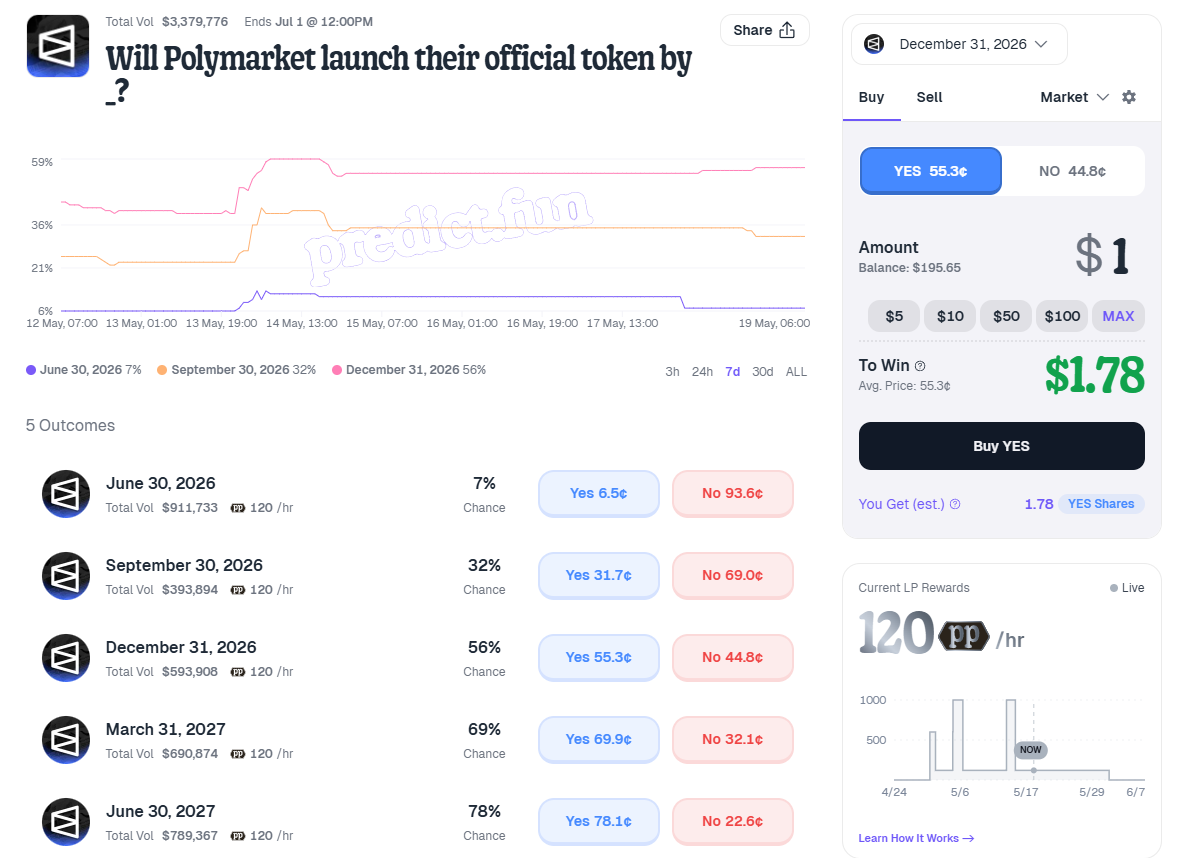
**POLY Debut Hints Grow More Frequent: How Far is the Polymarket Airdrop?** Recent continuous hints from Polymarket team members regarding the POLY token have sparked widespread analysis within airdrop communities about its launch timeline and potential scale. According to predict.fun data, the probability of "Polymarket launching its official token before year-end 2025" currently stands at 56%. Hints about POLY began in October 2024. CEO Shayne Coplan's social media post mentioning $POLY alongside major cryptocurrencies first fueled speculation. This was followed by Growth Lead William LeGate discussing "prospective airdrop farmers," and CMO Matthew Modabber explicitly confirming that "Polymarket will have a token, and there will be an airdrop." The momentum continued into 2025. In April, major crypto data platforms CoinGecko and CoinMarketCap created placeholder pages for POLY, further solidifying expectations. May saw discussions shift towards token utility and airdrop criteria. A team member's "Soon" reply to a question about staking POLY for fee reductions, and a leaked internal screenshot showing an "Airdrop" tab, significantly increased anticipation. LeGate also outlined potential airdrop qualifiers, mentioning badges for employees, high-volume/high-profit traders, and ecosystem builders. He suggested that linking a Polymarket account to X (Twitter), sharing trades and market insights, and actively engaging with the community might constitute part of the eligibilit...

Original | Odaily Planet Daily (@OdailyChina)

Author | Asher (@Asher_0210)

Recently, due to continuous hints from Polymarket's official team members regarding POLY token-related content, major airdrop farming communities have analyzed the timing and scale of a potential POLY airdrop from various angles. According to data from predict.fun, the probability of the event "Polymarket will launch its official token before the end of this year" is currently reported at 56%; there is even a 7% probability that "Polymarket will launch its official token before Q2 this year."
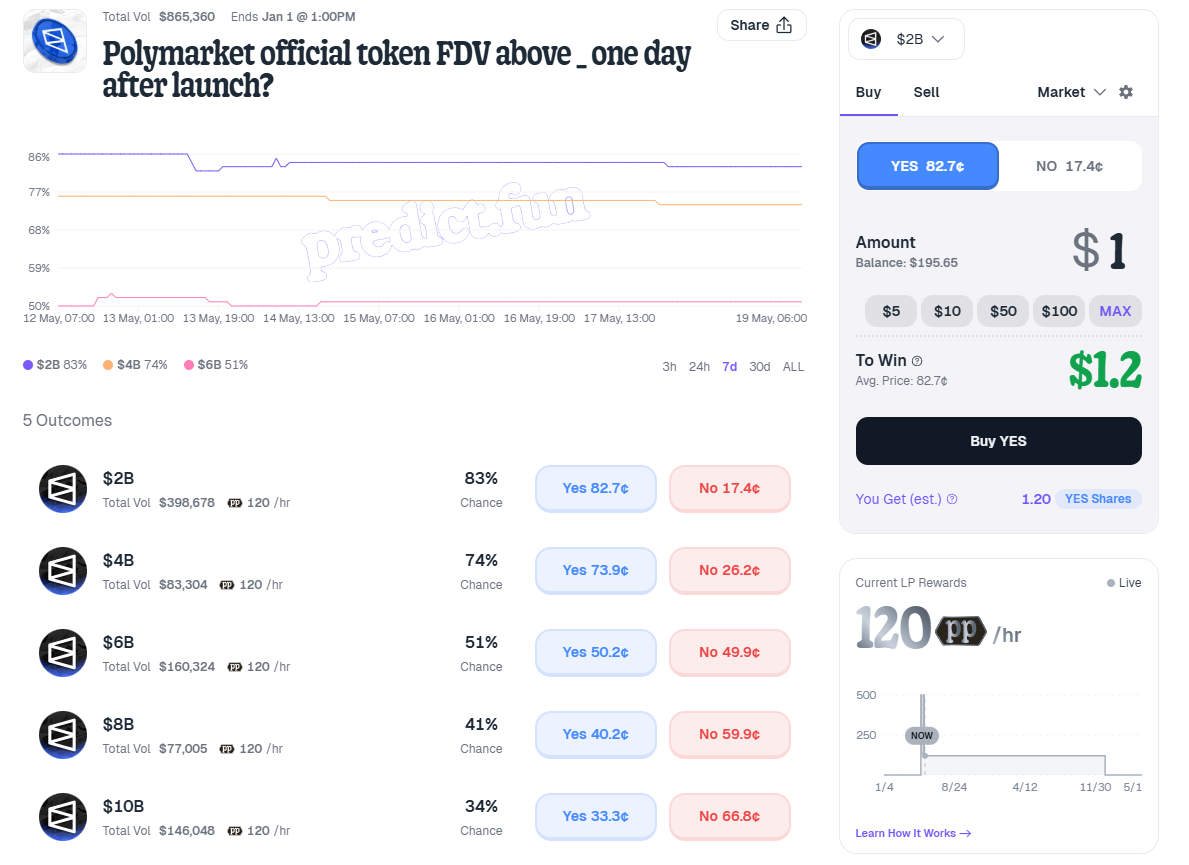
Furthermore, regarding market cap, the probability of the event "Polymarket's FDV exceeds $6 billion one day after launch" is currently reported at 51%; there is a 34% probability that "Polymarket's FDV exceeds $10 billion one day after launch."
Timeline of Polymarket's Official Token Hinting

October 2025: Initial Hints and Official Confirmation of the POLY Token

Signals from the Polymarket official team about the POLY token can be traced back to October last year.

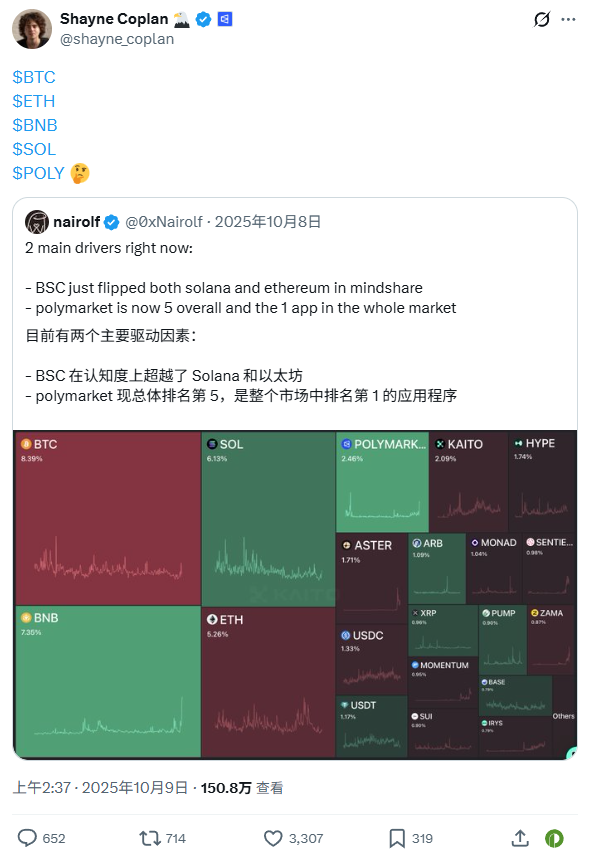
On October 8, 2025, Polymarket CEO Shayne Coplan posted on platform X, listing POLY alongside BTC, ETH, BNB, SOL, sparking community speculation about a Polymarket token launch. Although this was not an official token announcement, for the market, the founder personally writing $POLY was sensitive enough. After that, community discussion about a Polymarket token launch began to noticeably heat up.
Subsequently, the airdrop expectation was further brought into public discussion by official team members. On October 23, 2025, Polymarket Growth Lead William LeGate mentioned "prospective airdrop farmers" in a podcast or related discussion. While not an official rules clarification, this acknowledged the existence of user behavior and expectations surrounding a potential Polymarket airdrop in the market.

What further solidified the POLY token expectation was on October 24, 2025. Polymarket CMO Matthew Modabber explicitly stated in a podcast, "Polymarket will have a token, and there will be an airdrop." This statement became a key turning point for Polymarket's token expectation, shifting from community speculation to official confirmation.

After entering November, the focus of official discussions began to shift from whether there would be an airdrop to what kind of behavior would NOT qualify for an airdrop. On November 11, 2025, William LeGate explicitly stated in response to Sybil farming, "I can tell you for sure that these Sybil accounts will not get airdrop allocations. They are wasting their time."

April This Year: Major Price Tracking Platforms Launch POLY Preview Pages

Entering April this year, the POLY token expectation extended to major crypto price-tracking websites.

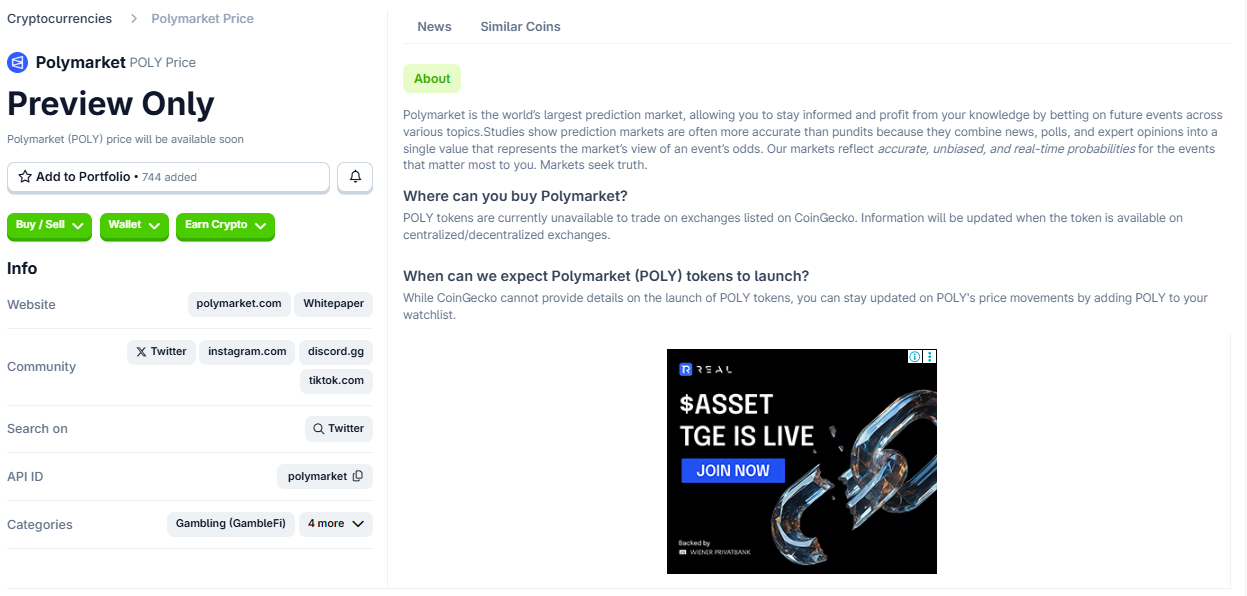
Currently, preview pages for Polymarket (POLY) have appeared on both CoinGecko and CoinMarketCap. While these pages do not equate to the formal token launch and do not represent an announced TGE date by Polymarket, the fact that external price-tracking platforms are reserving space for $POLY further reinforces the community's expectation for a Polymarket token launch.

May This Year: POLY Token Moves from Airdrop Expectation to Product Hinting

After entering May, discussions about the POLY token have progressed further towards specific functionalities and airdrop eligibility.

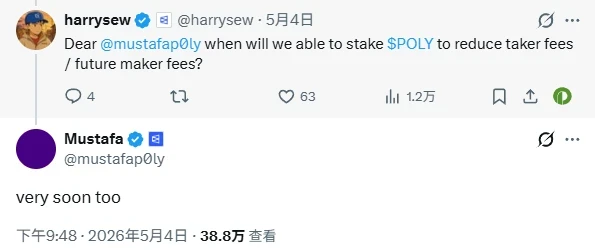
On the evening of May 4, Polymarket official team member Mustafa responded to a question about the POLY token during a community interaction. A user asked when it would be possible to stake POLY to reduce taker fees or potentially future maker fees. Mustafa replied: "Soon." The community quickly interpreted this official response as an indication that Polymarket is preparing for the token's launch.
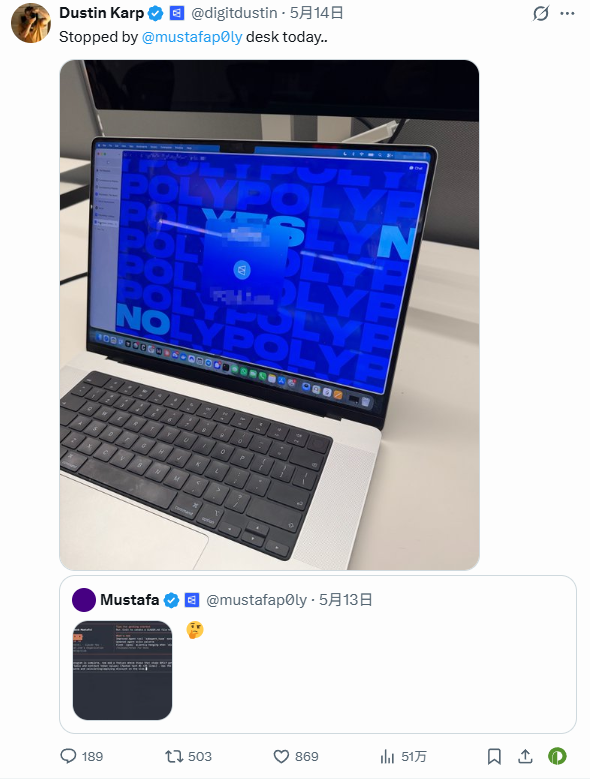
On May 13, more clues around the POLY token emerged. Polymarket Product Lead Dustin Karp posted a photo of a workstation, saying he passed by Mustafa's desk. The photo appeared to show an internal page related to the POLY token airdrop. Upon zooming in, the community spotted an "Airdrop" label, further increasing expectations for the POLY token airdrop.
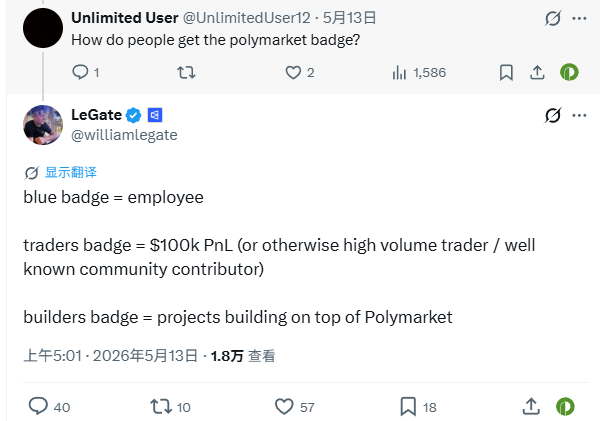
Subsequently, Polymarket Growth Lead LeGate also responded in a community discussion regarding official badges. LeGate replied that blue badges represent Polymarket employees; Traders badges are mainly for traders with cumulative profits reaching $100,000, or other high-volume users (in other tweet replies he mentioned transaction volume exceeding $10 million, adding that if users are active traders on Polymarket, profit amounts and transaction volumes could be slightly adjusted), and notable community contributors; Builders badges are for projects developing and building based on the Polymarket ecosystem.
Badges may not be the sole criterion for receiving an airdrop. The community inquired whether X content contributions would be rewarded with POLY tokens. LeGate replied that connecting an X account to a Polymarket account is only one-third of the conditions. Additionally, users should perhaps also put their Polymarket profile link in their X bio, actively share their trades, profit records, and market views on X, and engage with the community.
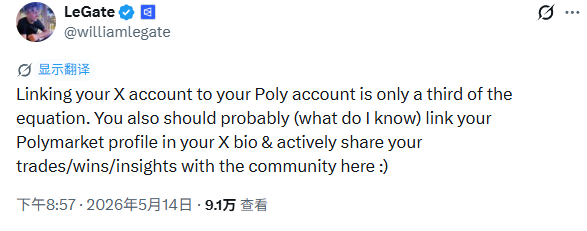
Although this reply did not explicitly confirm whether "jaw farming" (creating content for potential airdrops) would actually yield an airdrop, major communities are relatively optimistic and are actively posting Polymarket-related content on X to vie for potential token airdrops.

Personal Strategy

For me, having been deeply involved in prediction markets throughout the first half of this year, I still lean towards Polymarket not launching its token before the World Cup.

The reason is simple: Polymarket's more important task right now might not be launching a token immediately, but first refining the trading experience and infrastructure. Whether it's the continuous optimization of the V2 version or even changing chains, the essence is to prepare for high-traffic, high-frequency trading scenarios like the World Cup. For Polymarket, if the platform experience is unstable during the World Cup, launching a token beforehand might not effectively capture new users and trading volume.

Therefore, recent trading has primarily been hedging: placing orders for points on predict.fun, and then hedging the acquired positions on Polymarket. At the same time, I participate in various events on Polymarket with the goal of making profits. Additionally, I will bind my personal X account information on Polymarket and post Polymarket-related content on X, hoping that future token launches might allocate a portion of airdrops to "jaw-farming users."


Пов'язані питання

QWhat are the key pieces of evidence from Polymarket officials that have fueled speculation about a POLY token airdrop?

AThe evidence includes: CEO Shayne Coplan mentioning $POLY alongside major cryptocurrencies in Oct 2025; CMO Matthew Modabber explicitly confirming 'Polymarket will have a token, and there will be an airdrop' in late Oct 2025; Growth Lead William LeGate discussing 'prospective airdrop farmers'; internal screenshots from May 2026 showing 'Airdrop' labels; and LeGate outlining potential airdrop criteria like linking X accounts and active community participation.

QAccording to the prediction market data in the article, what is the perceived likelihood and potential valuation of a POLY token launch?

AAccording to predict.fun data: There is a 56% probability that Polymarket will launch its official token before the end of the year. There is a 34% probability that its Fully Diluted Valuation (FDV) will exceed $10 billion one day after launch, and a 51% probability it will exceed $6 billion.

QWhat specific user behaviors does the article suggest might *not* qualify for a potential POLY airdrop, based on official hints?

ABased on comments from Growth Lead William LeGate, Sybil farming (creating fake accounts to farm airdrops) will not qualify for an airdrop allocation. He stated such accounts are 'just wasting their time.'

QWhat are the three types of official badges mentioned by Polymarket's team, and what do they represent?

AThe three badge types are: 1) Blue Badge: Represents Polymarket employees. 2) Traders Badge: For users with cumulative profits of $100,000+, very high trading volume (hinted at over $10 million), or notable community contributors. 3) Builders Badge: For projects building on or developing within the Polymarket ecosystem.

QWhat is the author's personal prediction regarding the timing of the POLY token launch, and what is their reasoning?

AThe author predicts Polymarket will NOT launch the token before the FIFA World Cup. The reasoning is that Polymarket's priority is likely perfecting the trading experience and infrastructure (like V2 optimizations) to handle the high traffic and transaction volume expected during the World Cup. A stable platform is seen as more critical than an immediate token launch to capitalize on that event.

Пов'язані матеріали

Will the Next Crypto Bull Run Start with On-Chain Trading of SpaceX?

This article presents a scenario-based forecast for the crypto industry from 2026 to 2029, arguing that the next major cycle will be driven not by technological narratives but by legal access to real-world assets. The author predicts that by mid-2026, pre-IPO perpetual contracts for top private companies like SpaceX, OpenAI, and Anthropic on platforms like Hyperliquid will become the primary gateway for accessing quality assets, as most crypto-native tokens fail to capture real value. The much-hyped AI x Crypto intersection largely fails except for prediction markets, which thrive on betting on AI model supremacy. By 2027, public blockchain foundations are forced to choose between catering to retail speculation or building compliant infrastructure for institutions, with many opting for the latter. Growth in stablecoins and tokenized private credit/equity hits a "triple ceiling" due to regulatory and political uncertainty rather than market demand. The pivotal shift is forecast for 2028. A major liquidation event in pre-IPO perpetuals exposes the structural flaw of synthetic markets lacking a real underlying asset anchor. In response, regulatory changes finally allow the public solicitation of private securities resales to verified accredited investors. This creates a legitimate secondary market for real company equity, which then becomes the core asset class of the new bull market, relegating synthetic perps to a niche role. By 2029, the industry becomes "boring" but foundational. Tokens without claims on real cash flows or assets cease trading. Stablecoin growth is steady but politically capped. Crypto infrastructure fades from view as it gets absorbed into traditional finance backends. The article's central thesis is that the key bottleneck for crypto's next phase is legal and regulatory channels for real asset ownership, not technology.

marsbit14 хв тому

Will the Next Crypto Bull Run Start with On-Chain Trading of SpaceX?

marsbit14 хв тому

The Value Distribution of Stablecoins

**Summary: The Value Distribution of Stablecoins** The article argues that stablecoins are evolving from mere trading tools into broader channels for dollar access. It divides the stablecoin ecosystem into four layers to analyze how value is distributed: 1. **Issuance Layer:** Mints stablecoins, holds reserve assets, and captures the spread between reserve yield and user costs (e.g., Tether, Circle). This layer currently earns the largest profit margin. 2. **Infrastructure Layer:** Connects stablecoins to the traditional financial system, handling fiat on/off-ramps, banking integration, compliance (KYC/AML), and asset management (e.g., Bridge, BVNK). This is the "unglamorous" but critical work, building the essential bridges between crypto and real-world finance. 3. **Acquiring/Distribution Layer:** Integrates stablecoins into merchant systems, manages payment flows, and provides enterprise financial software (e.g., Stripe, Coinbase). They act as the access point for businesses. 4. **Application Layer:** The end-users and businesses that ultimately use stablecoins for payments, settlements, or as a store of value. They benefit from convenience but have little pricing power. The core thesis is that while the issuance layer currently dominates profits, the often-overlooked **infrastructure layer holds significant long-term potential**. The real challenge and barrier to mass adoption is not the on-chain transfer of stablecoins (which is simple), but the complex "last mile" integration into existing business workflows, banking systems, and regulatory frameworks across different countries. Companies in this layer are currently in a "land grab" phase, investing heavily to build networks, secure bank partnerships, and establish compliance pathways. While their position is currently pressured by the profitable issuers above and distribution platforms below, the article suggests that if stablecoins become a default financial rail for businesses, the infrastructure providers who have done the hard work of integration will ultimately gain strong pricing power and become entrenched, essential players.

marsbit6 год тому

The Value Distribution of Stablecoins

marsbit6 год тому

The Value Distribution of Stablecoins

The Value Distribution of Stablecoins The article argues that stablecoins are evolving from a mere trading tool into a broad "dollar channel." It analyzes the industry's value chain through four layers: 1. **Issuance Layer (e.g., Tether, Circle):** The top layer that mints stablecoins, holds reserve assets, and captures the thickest interest rate spread. 2. **Infrastructure Layer (e.g., Bridge, BVNK):** Connects stablecoins to the traditional financial system, handling critical but complex "dirty work" like fiat on/off-ramps, banking integration, compliance (KYC/AML), and cross-border settlement. 3. **Acquiring/Distribution Layer (e.g., Stripe, Coinbase):** Embeds stablecoins into merchant systems, manages payment flows, and integrates with enterprise software. 4. **Application Layer:** End-users and businesses that ultimately use stablecoins for payments, settlement, or storing value. The author posits that while the issuance layer currently captures the most profit, the most overlooked and potentially critical layer is infrastructure. The core challenge for stablecoin adoption isn't the on-chain transfer (which is simple), but bridging the gap between blockchain and the real-world financial system. This involves solving practical problems for businesses: fiat conversion, reconciliation, tax handling, and user onboarding. Infrastructure companies are currently in a difficult "land-grab" phase—building networks, securing banking relationships, and achieving compliance country-by-country. They face pressure from both the profitable issuance layer above and distribution platforms below. However, the author suggests this layer is building a crucial moat. Once stablecoins become a default business rail, the infrastructure players who have done the hard work of integration may gain significant, durable value and pricing power.

链捕手7 год тому

The Value Distribution of Stablecoins

链捕手7 год тому

Торгівля

Спот
Ф'ючерси
活动图片




