Polymarket And Kalshi Are Now Under Congressional Investigation — The Evidence That Triggered It Is Hard To Dismiss

bitcoinistОпубліковано о 2026-05-22Востаннє оновлено о 2026-05-22

Анотація

Congress has launched a formal investigation into prediction market platforms Polymarket and Kalshi, led by House Oversight Committee Chairman James Comer. The probe demands explanations on how the platforms prevent insider trading, sparked by suspicious bets tied to classified U.S. military actions. Evidence includes a U.S. soldier's trades before the Venezuela incursion and accounts netting millions from well-timed wagers on U.S.-Iran strikes and a ceasefire announcement. Both companies, which recently updated their rules, face scrutiny over their rapid growth and Washington lobbying. This investigation poses a significant threat that could reshape the prediction market industry.

Representative James Comer, Republican of Kentucky and chairman of the House Oversight and Government Reform Committee, announced a formal investigation into prediction market platforms Polymarket and Kalshi on May 22 — demanding that the CEOs of both companies explain how their platforms detect and prevent insider trading, in a probe triggered by a series of suspicious trades tied to classified US military operations and geopolitical events.

Comer, who announced the investigation on CNBC’s Squawk Box, sent formal letters to the leadership of both platforms seeking information on how they verify user identities, enforce bans on users from restricted jurisdictions, and identify unusual trading patterns that could indicate exploitation of non-public information, per CNBC’s reporting. The inquiry marks a significant escalation of congressional scrutiny that has been building across both parties for months.
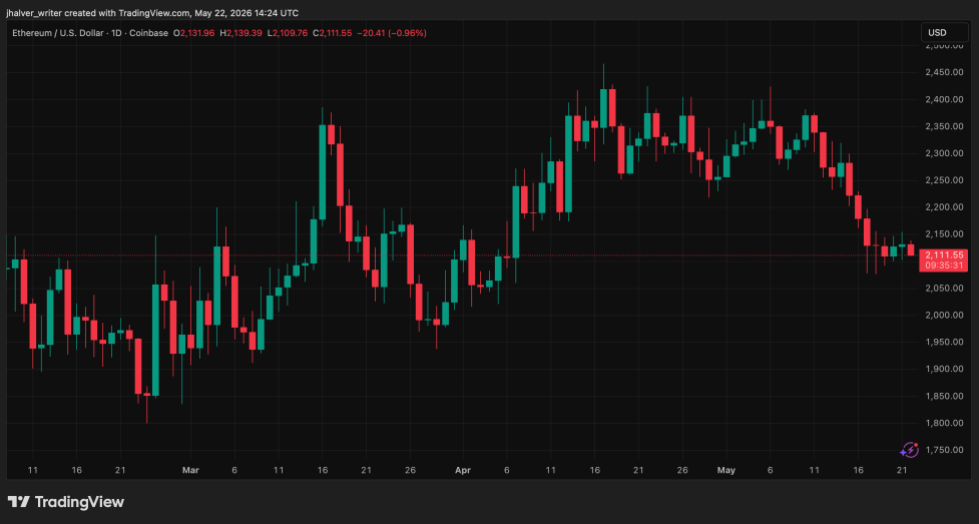
ETH's price trends to the downside on the daily chart. Source: ETHUSD on Tradingview 

The Evidence That Triggered The Probe

The specific trading patterns that prompted the investigation are difficult to dismiss as coincidence. A US special forces soldier was arrested for placing insider trades on Polymarket tied to the US military incursion into Venezuela that resulted in the capture of President Nicolás Maduro — bets placed hours before the operation became public knowledge, per The Hill’s reporting.

A separate trader accumulated nearly $1 million with a 93% success rate on wagers predicting unannounced US and Israeli operations against Iran, placing bets hours before strikes in October 2024, June 2025, and February 2026, according to a CNN report cited by Democratic lawmakers in a letter to Comer.

The February 28 incident is the most striking data point. A group of 38 accounts collectively netted more than $2 million on bets tied to that day’s Iran strikes — with the accounts preloaded with funds the preceding week, per the Democratic lawmakers’ letter. On April 7, at least 50 newly created accounts placed coordinated bets on a US-Iran ceasefire, some opened minutes before the announcement, per the same letter.

Polymarket separately reported suspicious activity across nearly 50 accounts in advance of the US-Iran ceasefire talks, per casino.org’s reporting of the congressional correspondence.

Both Platforms Push Back

Kalshi responded through its head of communications, Elisabeth Diana, who said the company looks forward to engaging with the committee and described its protections against insider trading as comprehensive, per CNBC. Polymarket did not immediately respond to a request for comment at the time of publication.

Both platforms announced updated rules and surveillance tools in March 2026, restricting politicians from trading on their own campaigns and barring athletes from sports-related contracts — moves that preceded but did not prevent the current congressional escalation.

The investigation lands at a moment of peak political sensitivity for prediction markets. Combined trading volumes on Kalshi and Polymarket reached tens of billions of dollars in March 2026 alone, per TipRanks. Both platforms count Donald Trump Jr. as an advisor. And both spent a combined nearly $1 million on federal lobbying in 2025, per CNBC — a Washington presence that may now complicate rather than protect their regulatory standing.

This development marks a pivotal and potentially consequential moment for the nascent prediction market sector. A formal congressional investigation with documented evidence of military-linked insider trading is a categorically different threat than a regulatory inquiry — and the outcome could reshape how these platforms operate, who can participate, and whether the CFTC’s current oversight framework survives intact.

Cover image from Grok, ETHUSD chart from Tradingview

Пов'язані питання

QWhat event prompted Representative James Comer to launch a congressional investigation into Polymarket and Kalshi?

AThe investigation was triggered by a series of suspicious trades tied to classified US military operations and geopolitical events, including bets placed by a US special forces soldier and other traders before the operations became public knowledge.

QWhat specific evidence of insider trading is cited in the article regarding the February 2026 Iran strikes?

AOn February 28, a group of 38 accounts collectively netted more than $2 million on bets tied to that day's Iran strikes. These accounts had been preloaded with funds the week before the event.

QWhat information did Representative Comer demand from the CEOs of Polymarket and Kalshi?

AHe demanded that the CEOs explain how their platforms detect and prevent insider trading, including their methods for verifying user identities, enforcing bans on users from restricted jurisdictions, and identifying unusual trading patterns.

QHow did the platforms of Polymarket and Kalshi attempt to address concerns before the investigation was launched?

ABoth platforms announced updated rules and surveillance tools in March 2026, which included restricting politicians from trading on their own campaigns and barring athletes from sports-related contracts.

QWhy is the current moment described as being of 'peak political sensitivity' for prediction markets like Polymarket and Kalshi?

AIt is a sensitive moment due to high trading volumes, the platforms' political connections (such as counting Donald Trump Jr. as an advisor), their significant spending on federal lobbying, and the formal congressional investigation into documented evidence of military-linked insider trading.

Пов'язані матеріали

Fei-Fei Li's Team Clarifies the Concept of 'World Models', Sora Merely a Renderer

"World Models" has become a widely used yet confusing term in AI. To address this, a team led by Fei-Fei Li and World Labs proposed a functional taxonomy based on the Partially Observable Markov Decision Process framework. This taxonomy categorizes systems called "world models" into three distinct projections: Renderers, Simulators, and Planners. Renderers, like OpenAI's Sora and other video generation models, focus on producing photorealistic visual outputs for human perception. They prioritize visual fidelity over physical accuracy. Simulators, such as NVIDIA Omniverse, aim to compute precise future environmental states for computational tasks like engineering analysis or digital twins. Planners, like Vision-Language-Action models, take in observations and goals to output executable actions for robots or agents. The article clarifies that most current "world models," including Sora, are primarily Renderers. They generate convincing visuals but lack the core ability to simulate state transitions based on actions, a key requirement for a true world model in classic reinforcement learning definitions. This conceptual confusion has practical implications, leading to potential misalignment in technology selection, investment, and public understanding of AI capabilities. Clear categorization is crucial. It helps enterprises avoid costly mistakes (e.g., using a renderer for robot training), allows investors to accurately assess markets, and enables researchers to build comparable benchmarks. While future systems may integrate these functions, recognizing current boundaries is essential for honest assessment and progress.

marsbit7 хв тому

Fei-Fei Li's Team Clarifies the Concept of 'World Models', Sora Merely a Renderer

marsbit7 хв тому

Bloomberg Uncovered: How Do China's Wealthy Circumvent the Annual $50,000 Limit to Transfer Assets?

**Summary: How Wealthy Chinese Circumvent $50,000 Annual Foreign Exchange Limits** Despite China's strict capital controls, including an annual $50,000 per person foreign exchange quota, an estimated $150 billion in funds still leaves the country annually via various gray and underground channels. This report outlines the evolution of China's "capital wall" and the methods used to bypass it. **The Evolving Capital Controls:** * **Foundation (1994):** The system of "current account convertibility with strict capital account controls" was established. * **Quota Set (2007):** The $50,000 individual annual forex purchase limit was formalized. * **Crackdown Begins (2015-2017):** Following market volatility, enforcement tightened. Banks were required to scrutinize transactions, and channels like using UnionPay cards for Hong Kong insurance premiums or buying overseas property were blocked. * **Digital & Legal Upgrades (2024-2026):** Enhanced algorithms now flag suspicious patterns (e.g., "smurfing"). The Common Reporting Standard (CRS) provides Chinese tax authorities with data on citizens' offshore accounts. Unlicensed cross-border brokers have been targeted. **Five Primary Methods for Moving Capital:** 1. **Underground Banking / "Hawala" (Duiqiao):** The largest-scale method. No money crosses borders. Clients pay RMB to a domestic account; an overseas associate deposits equivalent foreign currency into the client's offshore account. Risks include high fees, account freezes, and legal penalties. 2. **"Smurfing" or "Ant Moving":** Using multiple individuals' $50,000 quotas to pool funds for one offshore recipient. Increasingly detected by anti-money laundering algorithms. 3. **Trade Invoice Manipulation:** Businesses over-invoice imports or under-invoice exports via offshore shell companies, creating a pretext to transfer excess funds abroad under the guise of trade. 4. **Channel Migration:** After a crackdown on internet brokers, funds flow toward more compliant but costly channels like major banks' cross-border wealth management services or Qualified Domestic Institutional Investor (QDII) quotas. 5. **Structural Arrangements:** High-net-worth individuals use complex, high-cost legal structures involving offshore trusts, insurance, and investment migration programs to transfer asset ownership. **Regulatory Response: Focusing on People, Not Just Money** The current strategy extends oversight from enterprises to **individual residents**. Tools like CRS allow retroactive visibility into offshore assets. Cryptocurrencies, once seen as a potential loophole, are now actively monitored and prosecuted as an illegal channel. The underlying driver remains: with significant wealth concentrated among millions of affluent households seeking diversification amid domestic economic shifts, the incentive to move assets offshore persists despite regulatory barriers.

marsbit27 хв тому

Bloomberg Uncovered: How Do China's Wealthy Circumvent the Annual $50,000 Limit to Transfer Assets?

marsbit27 хв тому

Ethereum's Ballmer Moment: As Everyone Is Bearish, the Circulating Supply Is Disappearing

"Ethereum's Ballmer Moment: Circulation Shrinks Amid Bearish Sentiment" Amid widespread bearish sentiment, with prominent figures like Bankless founder David Hoffman selling ETH and young developers flocking to Solana, some argue Ethereum is entering its "Ballmer era"—akin to Microsoft's perceived stagnation under Steve Ballmer. While surface-level criticisms about slow protocol development, cautious leadership, and competitive pressure are valid, underlying fundamentals tell a different story. Approximately 30% of ETH is staked, major holders like BitMine are accumulating, and spot ETFs continue to absorb supply. Regulatory clarity, including the SEC/CFTC's March ruling on staking rewards and the potential passage of the CLARITY Act, is transforming crypto from a regulatory threat into a legitimized framework. This institutionalization, alongside a shrinking circulating supply (with net issuance around 0.23% annually), creates significant buy-side pressure independent of fee-based value capture. The broader crypto total addressable market is expanding through regulated stablecoins, tokenized assets, and institutional adoption. While public chains face competition from permissioned alternatives, the winning model appears to be permissioned assets settling on public chains like Ethereum and Solana. The author advocates a non-maximalist, barbell strategy: holding ETH for its institutional role and supply squeeze, SOL for consumer/throughput trends, BTC as a macro hedge, and a basket of next-gen L1s. Key bullish drivers for ETH include rapid circulation shrinkage, potential Q2 staked ETF approvals, regulatory tailwinds solidifying its role as a default settlement layer, and the optionality of an eventual "Satya moment" leadership shift. Despite bearish consensus, the current setup—where crypto is "not hot" and regulatory groundwork is being laid—presents a compelling investment opportunity. The crypto cycle's focus may have shifted to AI, but blockchain infrastructure is gaining a legal and institutional foothold precisely while attention is elsewhere.

marsbit27 хв тому

Ethereum's Ballmer Moment: As Everyone Is Bearish, the Circulating Supply Is Disappearing

marsbit27 хв тому

Торгівля

Спот
Ф'ючерси

Популярні статті

Як купити HOUSE

Ласкаво просимо до HTX.com! Ми зробили покупку Housecoin (HOUSE) простою та зручною. Дотримуйтесь нашої покрокової інструкції, щоб розпочати свою криптовалютну подорож.Крок 1: Створіть обліковий запис на HTXВикористовуйте свою електронну пошту або номер телефону, щоб зареєструвати обліковий запис на HTX безплатно. Пройдіть безпроблемну реєстрацію й отримайте доступ до всіх функцій.ЗареєструватисьКрок 2: Перейдіть до розділу Купити крипту і виберіть спосіб оплатиКредитна/дебетова картка: використовуйте вашу картку Visa або Mastercard, щоб миттєво купити Housecoin (HOUSE).Баланс: використовуйте кошти з балансу вашого рахунку HTX для безперешкодної торгівлі.Треті особи: ми додали популярні способи оплати, такі як Google Pay та Apple Pay, щоб підвищити зручність.P2P: Торгуйте безпосередньо з іншими користувачами на HTX.Позабіржова торгівля (OTC): ми пропонуємо індивідуальні послуги та конкурентні обмінні курси для трейдерів.Крок 3: Зберігайте свої Housecoin (HOUSE)Після придбання Housecoin (HOUSE) збережіть його у своєму обліковому записі на HTX. Крім того, ви можете відправити його в інше місце за допомогою блокчейн-переказу або використовувати його для торгівлі іншими криптовалютами.Крок 4: Торгівля Housecoin (HOUSE)Легко торгуйте Housecoin (HOUSE) на спотовому ринку HTX. Просто увійдіть до свого облікового запису, виберіть торгову пару, укладайте угоди та спостерігайте за ними в режимі реального часу. Ми пропонуємо зручний досвід як для початківців, так і для досвідчених трейдерів.

370 переглядів усьогоОпубліковано 2025.04.27Оновлено 2026.06.02

Як купити HOUSE

Обговорення

Ласкаво просимо до спільноти HTX. Тут ви можете бути в курсі останніх подій розвитку платформи та отримати доступ до професійної ринкової інформації. Нижче представлені думки користувачів щодо ціни HOUSE (HOUSE).

活动图片













