Polymarket acquires Brahma to fix ‘liquidity imbalance’: Report

ambcryptoОпубліковано о 2026-03-19Востаннє оновлено о 2026-03-19

Анотація

Polymarket has acquired crypto infrastructure firm Brahma to address liquidity imbalances and improve its on-chain trading systems. While popular markets like elections attract significant activity, niche markets suffer from low participation and unreliable pricing. The acquisition aims to distribute liquidity more evenly and enhance platform efficiency. Despite rapid growth and a valuation of $18–20 billion, driven by the 2024 election cycle, Polymarket faces inconsistent trading activity and a recent drop in market share. Competitor Kalshi, a regulated non-crypto platform, briefly captured 66% market share during the election. Polymarket continues to focus on crypto, with plans for a native token, contrasting with Kalshi’s traditional approach.

In a surprising shift, Polymarket has moved beyond simply hosting bets on future events and is now working to build the full infrastructure behind those wagers.

According to reports, Polymarket has acquired Brahma, a company specializing in crypto and DeFi infrastructure. This means Polymarket wants better technology to make its platform faster, smoother, and more on-chain.

Polymarket has grown rapidly, now valued at an estimated $18–20 billion, boosted by heavy activity during the 2024 elections. Yet with that growth come new challenges.

What is Polymarket trying to revamp with Brahma?

One of the core problems is liquidity imbalance. This means popular wagers, like elections or major sports events, attract a lot of money and activity.

Whereas, smaller or niche wagers struggle because not enough people are betting on them. That makes prices less reliable and the markets less useful.

Citing examples, Fortune added,

Larger event contracts, like those in sports or politics, easily bring lots of money into the pool. But smaller wagers focused on niche areas such as, for instance, the outcome of a bowling match in Spain, struggle to amass a sizable amount of liquidity.

Therefore, by acquiring Brahma, Polymarket is trying to fix this by improving how liquidity is distributed across markets. The plan also focuses on making trading more efficient and strengthening its blockchain-based system.

Remarking on this initiative, Shayne Coplan, founder and CEO of Polymarket, told Fortune,

Building reliable infrastructure across blockchain networks and traditional financial rails is hard—there are no shortcuts.

That said, Brahma, founded in 2021, has already processed over $1 billion in transactions, and by bringing its team in-house, Polymarket is effectively shutting down Brahma’s external operations to focus entirely on its growth.

Polymarket’s metrics paint a confusing picture

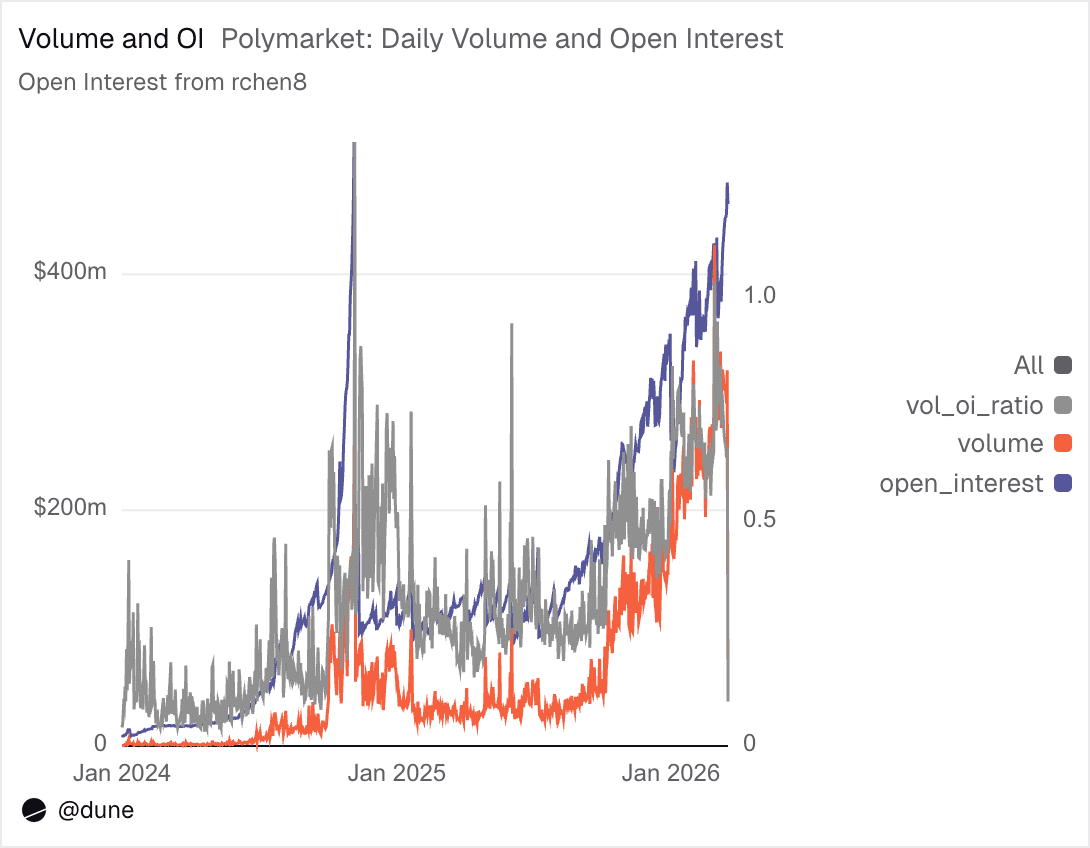
However, the platform’s internal data suggests that growth is not entirely balanced. While more capital is flowing into the system, as seen in the steady rise in Open Interest, actual trading activity remains inconsistent.
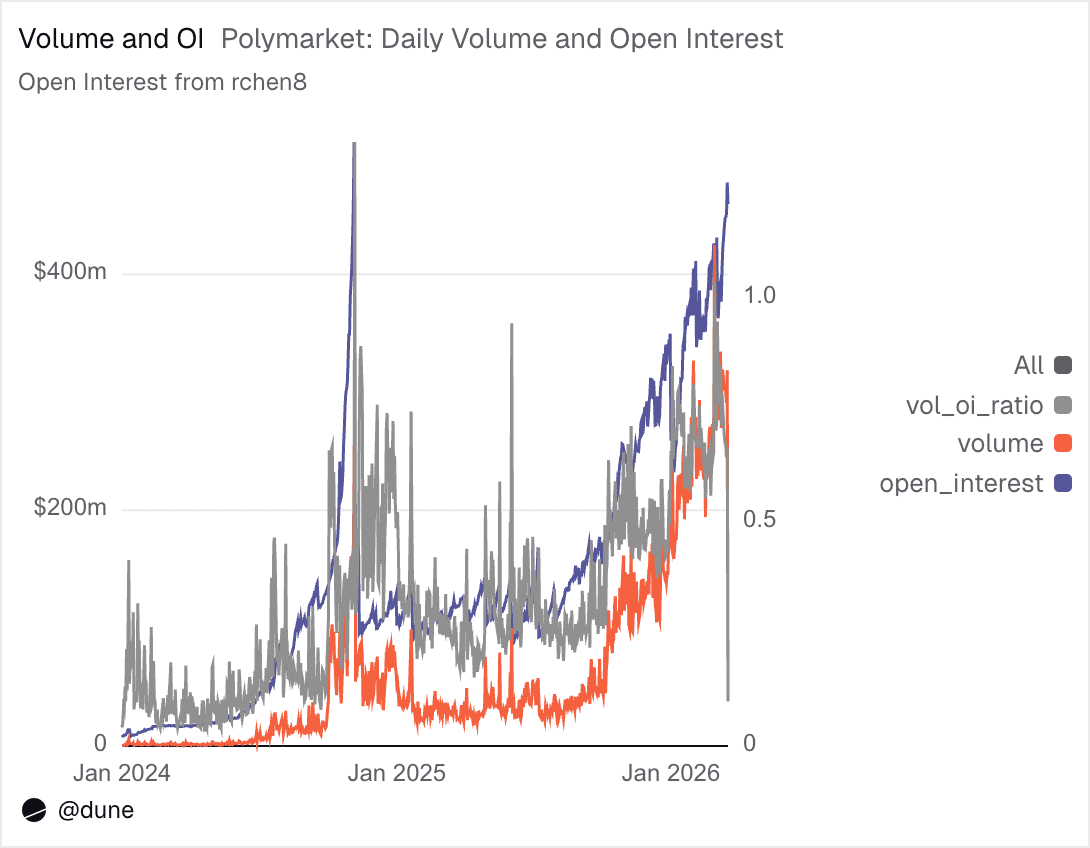
Source: Dune

This gap shows that users place long-term bets but trade inconsistently, resulting in low liquidity and one-sided markets.

Even though the platform became very popular during the 2024 election cycle, its dominance didn’t last. Its market share dropped sharply from over 61% to around 32% as the hype faded. However, at press time, Polymarket’s stock price stood at $141.60, marking a more than 20% increase year-to-date.

Is Polymarket losing ground against Kalshi?

In fact, during the 2024 election, its U.S.-based competitor Kalshi took advantage of the slowdown, briefly capturing about 66% market share and handling nearly $1 billion in weekly trading volume.

This competition reflects two very different paths. Kalshi follows a fully regulated approach with no blockchain, DeFi, or token layer.

Polymarket, in contrast, is doubling down on crypto. Besides Brahma, the platform’s CEO is also hinting at a potential POLY token. With a possible 2026 launch, it acts as a strong incentive for users, something regulated platforms like Kalshi are struggling to offer.


Final Summary

  • The Brahma acquisition shows that fixing liquidity and market efficiency is now more important than just attracting users.
  • Competition from regulated players like Kalshi adds pressure, especially as they gain ground during periods of low hype.


Пов'язані питання

QWhat is the primary reason Polymarket acquired Brahma, according to the report?

APolymarket acquired Brahma to fix the 'liquidity imbalance' on its platform by improving how liquidity is distributed across markets, making trading more efficient, and strengthening its blockchain-based system.

QWhat specific problem does the 'liquidity imbalance' cause for smaller wagers on Polymarket?

ASmaller or niche wagers struggle to attract enough betting activity, which makes their prices less reliable and the markets less useful due to low liquidity.

QHow did Polymarket's market share change after the hype of the 2024 election cycle faded?

APolymarket's market share dropped sharply from over 61% to around 32% after the hype of the 2024 election cycle faded.

QWhich competitor briefly captured about 66% market share during Polymarket's slowdown, and what is its key operational difference?

AKalshi, Polymarket's U.S.-based competitor, briefly captured about 66% market share. Its key difference is that it follows a fully regulated approach with no blockchain, DeFi, or token layer.

QWhat potential incentive is Polymarket's CEO hinting at to attract users, and how does it contrast with regulated platforms?

APolymarket's CEO is hinting at a potential POLY token, which acts as a strong incentive for users. This is something regulated platforms like Kalshi struggle to offer.

Пов'язані матеріали

$30 Billion DeFi Capital Exodus: LayerZero Stumbles, Chainlink Feasts

Following the major DeFi security incident involving Kelp DAO, a significant migration of funds is underway from the cross-chain protocol LayerZero to Chainlink's CCIP (Cross-Chain Interoperability Protocol). Over $30 billion in Total Value Locked (TVL) from protocols like Kelp DAO, Solv Protocol, Re, and Tydro has moved to Chainlink in the past week, driven by security concerns. LayerZero is facing a severe trust crisis after the attack. Initially denying responsibility, LayerZero Labs has now issued a public apology, acknowledging management oversights. These include a vulnerable "1/1" single-node configuration for its Decentralized Verification Network (DVN) and past misuse of a multi-signature wallet by a team member. The protocol's weekly bridge volume has slumped to near-historic lows of around $470 million. In contrast, Chainlink is experiencing a surge in adoption and activity. Its independent active addresses recently hit multi-month highs, and whales have been accumulating LINK tokens. Beyond DeFi, Chainlink is securing partnerships with traditional finance giants like DTCC, European stock exchange operator SIX Group, and asset manager Amundi. While LayerZero has announced security upgrades—such as migrating to stronger multi-signature configurations and developing a second DVN client—and contributed to a rescue fund, the event underscores that security is becoming a decisive competitive factor as DeFi matures.

marsbit28 хв тому

$30 Billion DeFi Capital Exodus: LayerZero Stumbles, Chainlink Feasts

marsbit28 хв тому

The $13 Trillion Repo Market Is Quietly Being Rewritten by Blockchain

The $13 trillion repurchase agreement (repo) market, a crucial artery for global short-term funding, is experiencing a significant transformation through blockchain technology. After years of limited impact in finance, blockchain is finding substantial adoption in repo transactions. Major institutions like JPMorgan Chase, HSBC, and Broadridge are deploying tokenized repo platforms, with daily volumes already reaching tens of billions of dollars. Traditional repo markets operate with fixed hours, rely on intermediaries, and involve manual, time-consuming processes. Tokenized repos, by contrast, use blockchain to create digital tokens representing cash and securities collateral. This enables near-instantaneous settlement, 24/7 trading, automated execution, and enhanced auditability. The key drivers for adoption include maturing technology, more receptive regulators, and growing client recognition of tangible benefits like reduced operational friction and capital efficiency. Analyses, such as one from Broadridge, indicate that moving a portion of repo activity onto blockchain can significantly reduce a bank's required liquidity buffers, potentially freeing up billions in capital. The infrastructure is also seen as foundational for a future of round-the-clock trading for traditional assets. Challenges remain, including the existence of fragmented blockchain networks, the need for stress testing under extreme market conditions, and the loss of operational flexibility compared to manual processes. However, the industry consensus is that these are implementation hurdles. Tokenized repo has moved beyond pilot stages to become one of blockchain's most concrete and impactful applications in traditional finance, marking a pivotal shift in how a core market functions.

marsbit29 хв тому

The $13 Trillion Repo Market Is Quietly Being Rewritten by Blockchain

marsbit29 хв тому

From Gas Limit to 'Keyed Nonces', How to Understand the Next Step in Ethereum Scalability?

Ethereum’s scalability efforts are shifting toward a user-centric approach—focusing not only on higher TPS, but on translating technical upgrades into lower costs, smoother operations, and better wallet experiences. Two recent developments highlight this direction: - **Raising the Gas Limit to 200 million**: Following the Fusaka upgrade that increased it to 60 million, a consensus has formed around a potential future increase to 200 million. This would boost Ethereum’s execution capacity, but it is planned alongside other upgrades—such as ePBS, Block-Level Access Lists (BAL), and EIP-8037—to manage state growth and keep node operation viable for average participants. - **Keyed Nonces (EIP-8250)**: This proposal aims to improve how transactions are queued. Instead of a single linear nonce per account, it introduces multiple independent nonce domains. This prevents different types of transactions—such as private payments, session keys, or batch operations—from blocking each other. Vitalik Buterin views this as a foundational step toward better privacy support and more flexible state scalability. Together, these upgrades are part of a broader move to push complexity from wallets, DApps, and relays back into the protocol layer. For everyday users, this means future Ethereum interactions could become less congested, more intuitive, and safer—especially as core improvements in account abstraction, cross-L2 interoperability, and node decentralization continue to progress. Ultimately, Ethereum is evolving to handle not just more transactions, but more varied and complex on-chain use cases while preserving its decentralized foundation.

marsbit52 хв тому

From Gas Limit to 'Keyed Nonces', How to Understand the Next Step in Ethereum Scalability?

marsbit52 хв тому

Торгівля

Спот
Ф'ючерси
活动图片




