Polymarket: 84% of Traders Are Losing Money, 0.033% of People Take the Majority of Profits

marsbitОпубліковано о 2026-04-08Востаннє оновлено о 2026-04-08

Анотація

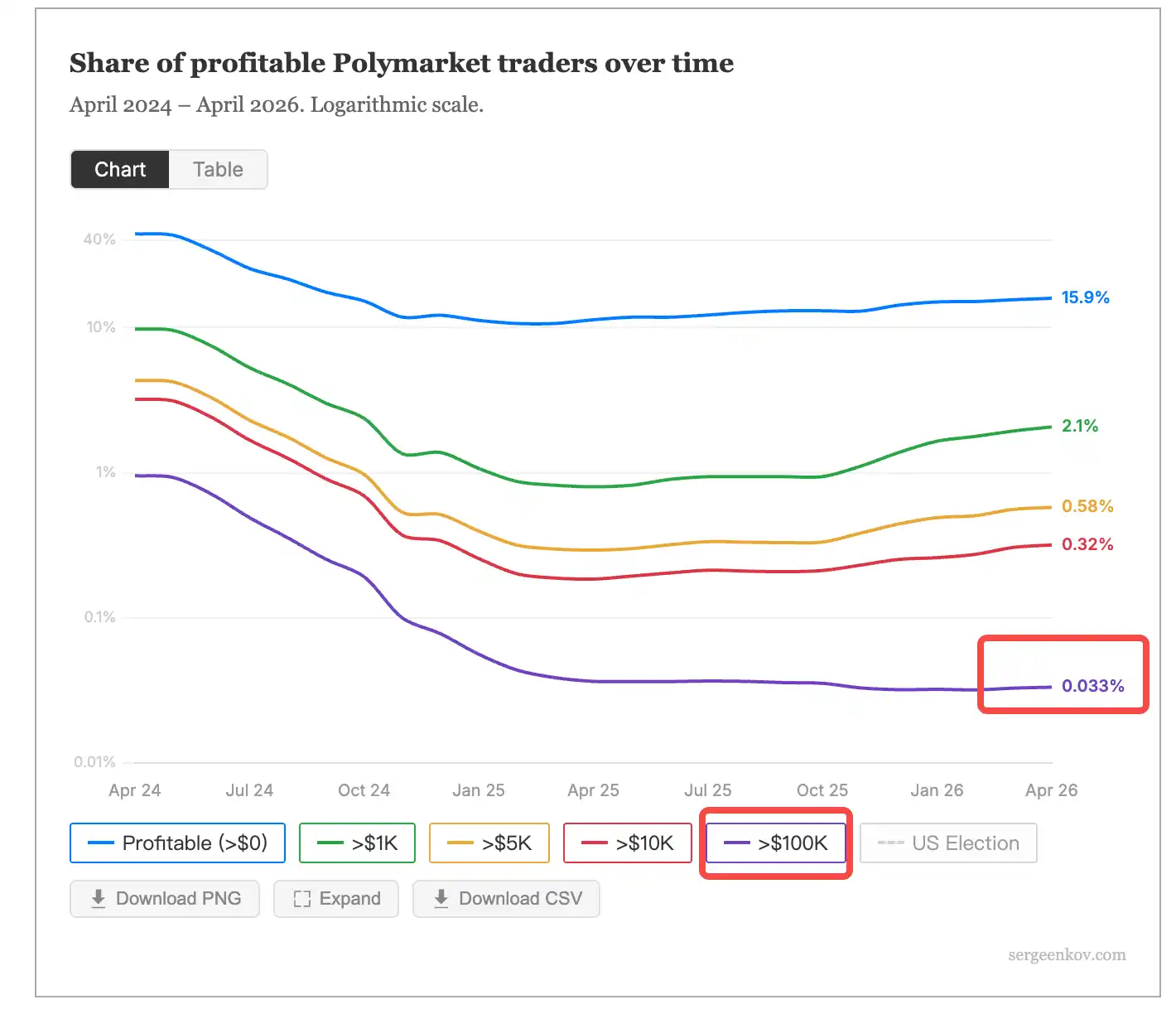
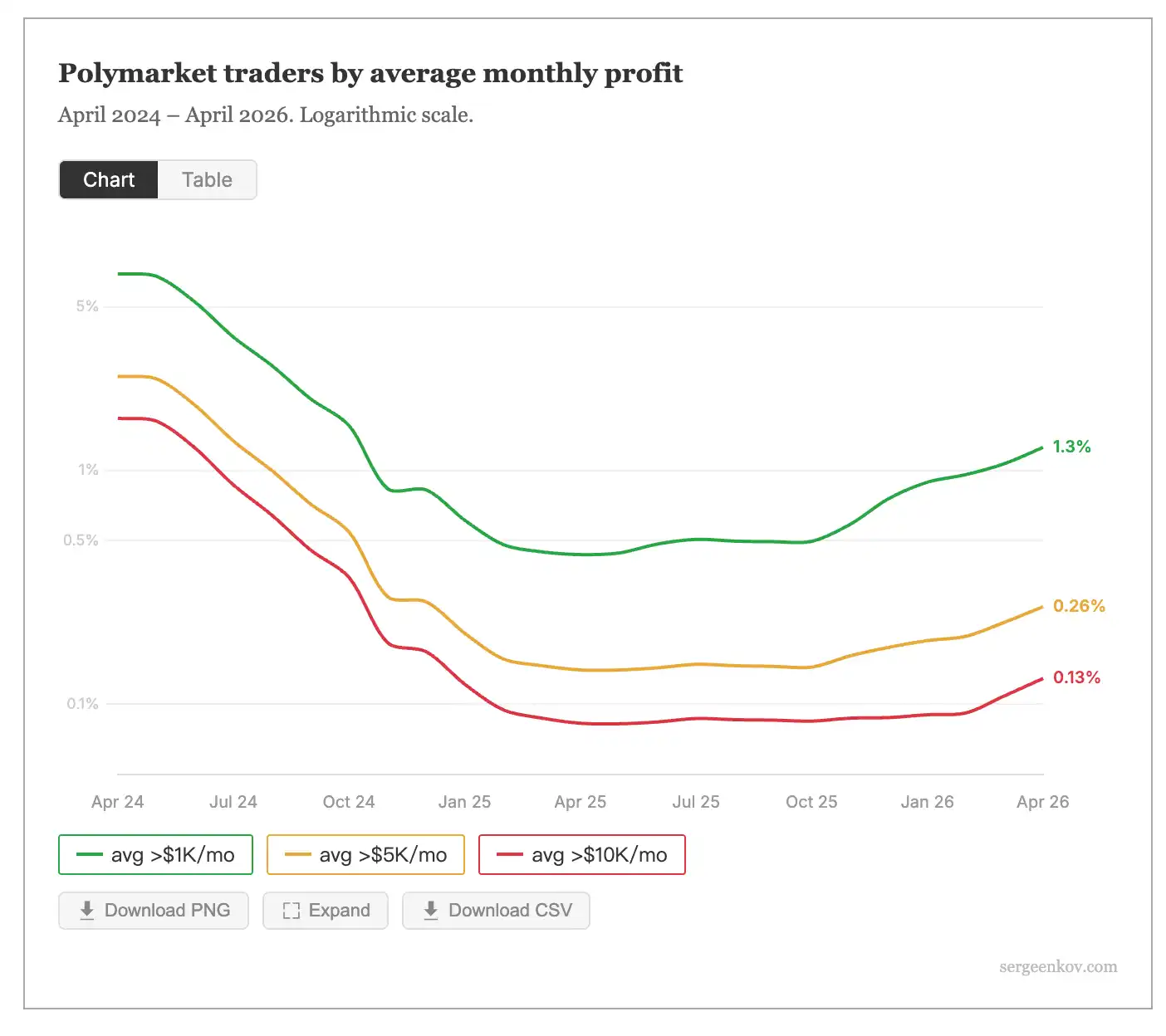
A recent analysis of 2.5 million Polymarket wallet addresses by on-chain researcher Andrey Sergeenkov reveals that 84.1% of traders are losing money, with only 16% achieving any profit. A mere 2% of addresses have accumulated over $1,000 in profits, while just 0.033% (840 addresses) have earned more than $100,000. The study, which improved on prior methodologies by accounting for token splits and mergers, shows a significant increase in unprofitable traders compared to a previous 70% estimate. Profit concentration is extreme: only 1.25% of addresses make over $1,000 monthly, 0.26% earn above $5,000, and just 0.13% surpass $10,000. Most high-earning addresses are short-lived, with 53% of top traders active for only one month. Research indicates that automated strategies—such as arbitrage bots and high-frequency trading systems—dominate profits, exploiting public on-chain data and speed advantages that manual retail traders lack. Despite Polymarket’s accuracy in prediction (94% a month before outcomes), the platform exhibits a stark wealth disparity, raising questions about its function as an information aggregator versus a zero-sum game favoring sophisticated players.

Author: Deep Tide TechFlow

Deep Tide Guide: The latest analysis of 2.5 million wallet addresses on Polymarket by on-chain researcher Andrey Sergeenkov shows that 84.1% of traders are at a loss, with only 2% of addresses accumulating profits exceeding $1,000, and 840 addresses (0.033%) profiting over $100,000. The timing of this report is quite delicate—Polymarket has just secured an exclusive predictive market partnership with MLB for up to $300 million and is pushing hard for retail user growth.

Wealth distribution in on-chain prediction markets is even more brutal than most people imagine.

According to a report by The Defiant on April 6, independent on-chain researcher Andrey Sergeenkov released a profit and loss analysis covering 2.5 million Polymarket wallet addresses, with data as of April 1, 2026. The core conclusion: 84.1% of traders are losing money, and less than 16% of addresses have achieved any level of positive returns.

This is not the first such study. In December 2025, blockchain analyst DeFi Oasis analyzed 1.7 million addresses and 124 million transactions, concluding that 70% of traders were not profitable. Sergeenkov's data sample is larger, and the methodology has been improved (capturing token splits and merges missed in previous research), with the loss ratio jumping from 70% to 84%.

The Top of the Pyramid: Less Than 0.26% Earn Over $5,000 Monthly

Sergeenkov conducted a full analysis of transaction data from two smart contracts, CTF Exchange and NegRisk CTF Exchange, by tracking all USDC fund flows (including buys, sells, redemptions, splits, and merges) on the Polygon chain.

The numbers in the high-profit range are quite stark: addresses with average monthly profits exceeding $1,000 account for 1.25%; those exceeding $5,000 are only 0.26%, about 6,600 addresses; and those exceeding $10,000 drop to 3,250, representing 0.13% of all traders.
More critical is the issue of sustainability. Among those 6,600 addresses with average monthly profits exceeding $5,000, 53% were active for one month and then disappeared, with only 2.6% trading continuously for over a year. Sergeenkov summarized in the report: "Most traders come, trade for a while, and then leave."

In contrast, bottom-feeders consistently harvest profits. An academic paper from Spain's IMDEA Networks Institute analyzed 86 million on-chain transactions between April 2024 and April 2025, finding that arbitrage traders extracted approximately $40 million in profits just from price differences. A single wallet achieved the highest profit of $2 million from 4,049 transactions, averaging $496 per trade.

Retail Manual Trading Can't Beat Bots, Information Advantage Highly Concentrated

The root cause of losses is not complicated. IMDEA's research shows that the largest profits are concentrated in wallets using automated strategies: arbitrage bots, market-making algorithms, and high-frequency trading systems. Manual retail traders typically enter the market only after prices have already adjusted.

This is the fundamental difference between prediction markets and traditional gambling. Polymarket's order book is completely public, and on-chain data is transparent, but this transparency instead makes it easier for professional traders to build systematic advantages. A quantitative wallet equipped with low-latency APIs and probability models is not in the same arena as an ordinary user who opens the app to place a bet after seeing the news.

According to Token Terminal data, Polymarket's nominal trading volume over the past 30 days is approximately $9.8 billion, with about 462,600 monthly active traders. The platform's growth itself is not an issue, but the relationship between user growth and user profitability is inverse—Sergeenkov's data shows that the decline in the proportion of profitable traders is directly related to peaks in user growth, especially the influx after the November 2024 U.S. election.
Information Aggregation Tool or Zero-Sum Game?

This report has reignited an old debate: who exactly do prediction markets serve?

The core argument of supporters is information aggregation. Polymarket's official data claims that its price prediction accuracy exceeds 94% one month before the outcome is determined. In other words, even if 84% of traders are losing money, the market as a whole is still producing valuable probability signals. The losing retail traders are essentially paying for information pricing.

Critics argue that when 84% of a platform's participants are losing money and profits are highly concentrated in the hands of automated traders, the difference between it and a casino is merely a matter of regulatory classification. Especially in the realm of sports contracts, the line between prediction markets and sports betting is being deliberately blurred.

Polymarket's valuation has exceeded $20 billion, and the Intercontinental Exchange (parent company of the NYSE) invested $2 billion in October 2025. Capital markets are clearly betting on the growth story of prediction markets.

But Sergeenkov's report raises a simple question: when the next wave of 2.5 million users floods in, how will their fate differ from the previous wave?


Трендові криптовалюти

Пов'язані питання

QAccording to the analysis of 2.5 million Polymarket wallet addresses, what percentage of traders are losing money?

A84.1% of traders are losing money.

QWhat is the estimated number of addresses that have profited more than $100,000 on Polymarket, according to the researcher Andrey Sergeenkov?

A840 addresses (0.033% of the total) have profited more than $100,000.

QWhat does the research from the IMDEA Networks Institute identify as the primary reason for散户 (retail traders) losses on prediction markets like Polymarket?

AThe research found that the largest profits are concentrated in wallets using automated strategies (arbitrage bots, market-making algorithms, and high-frequency trading systems), while manual retail traders typically enter the market after prices have already adjusted.

QWhat key statistic does the article mention about the sustainability of high-earning traders (those making over $5,000 monthly)?

AAmong the 6,600 addresses with monthly profits exceeding $5,000, 53% were only active for one month before disappearing, and only 2.6% traded consistently for over a year.

QDespite most traders losing money, what is the core argument of supporters who defend the value of prediction markets like Polymarket?

ASupporters argue that prediction markets serve as valuable information aggregation tools, with Polymarket's prices achieving over 94% accuracy in predicting outcomes one month in advance, meaning the market as a whole produces valuable probabilistic signals even if most individual traders lose money.

Пов'язані матеріали

Long-Divided Must Unite, Long-United Must Divide: When L1 Becomes Its Own Rollup, What Is Ethereum's Endgame?

"The Inevitable Cycle: When L1 Becomes Its Own Rollup – What is Ethereum's Endgame?" For years, the Ethereum community grappled with concerns that L2s were fragmenting the ecosystem and eroding L1's value. While L2s provided cheaper execution, they also splintered liquidity and the unified user experience of a single chain. This has prompted a fundamental reassessment of the relationship between L1 and L2. Ethereum's roadmap is evolving. The "Scale" initiative merges L1 and L2 expansion into a holistic framework. L1 itself is advancing with higher gas limits, statelessness, and zkEVM verification, no longer content to be just a low-throughput settlement layer. Consequently, the primary value proposition of L2s is shifting from merely providing cheap blockspace to offering L1 cannot easily provide: application-specific optimizations, privacy features, and flexible governance models. L2s are becoming a spectrum of execution environments with varying degrees of security inheritance from Ethereum. A critical challenge in this multi-chain future is interoperability. The vision is to make Ethereum "feel like one chain again." This relies on advancements in native account abstraction (like EIP-7702) and intent-based architectures (Open Intents Framework), where users declare desired outcomes, and solvers handle the complex cross-chain execution. Furthermore, shortening Ethereum's finality time from minutes to seconds is crucial, as it underpins trust between chains for bridges, stablecoins, and cross-chain applications. Perhaps the most provocative idea is that Ethereum L1 itself could become a form of "its own Rollup." As zkEVM and proof systems mature, high-performance nodes could execute transactions and generate validity proofs. Regular validators would then verify these proofs instead of re-executing all transactions. This blurs the traditional L1/L2 hierarchy, making "Rollup" more of a general execution-verification architecture. Native Rollup aims to integrate L2 validation more directly into the Ethereum protocol, allowing L2s to inherit L1's security more fully and move away from reliance on security councils. In the end, L2s are not destined to replace L1 or be made obsolete by it. The likely future is a unified system where diverse execution environments—each optimized for specific use cases like DeFi, gaming, or privacy—coexist. They will share a common foundation of security, liquidity, and verifiable state, seamlessly connected to restore a cohesive user experience. The next phase for Ethereum is not just about scaling through separation, but about intelligently reintegrating what was separated back into a coherent whole.

链捕手10 хв тому

Long-Divided Must Unite, Long-United Must Divide: When L1 Becomes Its Own Rollup, What Is Ethereum's Endgame?

链捕手10 хв тому

Agent Race Ends, Super Workbench Takes Over

The era of fragmented AI agents is ending. Over the past month, China's tech giants—Tencent, Alibaba, and ByteDance—have simultaneously shifted strategy: instead of launching new, standalone AI agents, they are consolidating their various agent projects into unified "super workbenches." Tencent integrated its QClaw teams into WorkBuddy, a strategic product hailed as a potential third flagship after QQ and WeChat. Alibaba is merging its QoderWork, Wukong, and MuleRun agents into a new "Qianwen Office" platform under DingTalk's leadership. ByteDance rebranded its TRAE SOLO coding agent to TRAE Work, signaling a broader focus on workflow collaboration. This convergence marks a pivotal industry consensus. The initial exploration phase, where companies rapidly built numerous overlapping agents for different scenarios, proved costly and inefficient. With open-source tools eroding technical barriers, competition has shifted from agent creation to resource consolidation and cost control. Historically, platform wars are won not by creating more products, but by simplifying them—as seen with browsers unifying web access and super-apps consolidating services. Now, the "super workbench" aims to become the unified AI entry point for work. This reflects a deeper market realization: the primary audience for AI is no longer just programmers (a market in the tens of millions) but all knowledge workers (a market of billions). The real opportunity lies in augmenting everyday tasks—managing emails, documents, data, and meetings—across the entire workday. The core battleground is becoming control over the primary AI entry point that employees use daily. Tencent's WorkBuddy leverages WeChat and Tencent Docs; Alibaba's Qianwen Office taps into DingTalk's organizational data; ByteDance's TRAE Work integrates with Feishu's workflows. Whoever owns this "super workbench" gains strategic control over orchestrating enterprise data and APIs. This shift is redefining enterprise software. Traditional SaaS applications, valued for their user interfaces, will recede into the background. Their core functionalities will be exposed as standardized "Skills" or APIs for the super workbench's agents to invoke. Software value will shift from selling user seats to charging based on API calls and outcomes delivered. The evolution of agents is moving through clear stages: first as novel standalone products, then as consolidated primary work entry points, and finally as pervasive, invisible capabilities embedded into the digital fabric. The recent moves by major tech firms signal the transition from the first stage into the second, accelerating toward the third. In the end, the most successful agent technology may become invisible—like electricity or the HTTP protocol—a fundamental, unnamed infrastructure powering work itself.

marsbit37 хв тому

Agent Race Ends, Super Workbench Takes Over

marsbit37 хв тому

Michael Saylor: 110 Reasons to Oppose BIP-110

Michael Saylor presents 110 arguments against Bitcoin Improvement Proposal (BIP) 110, a soft fork aimed at restricting certain non-monetary data storage uses (like inscriptions) on the Bitcoin blockchain. He acknowledges the proponents' valid concerns—such as node costs, fee pressure, and preserving Bitcoin's monetary focus—but fundamentally disagrees with the proposed solution. Saylor argues that BIP 110 represents a dangerous precedent of using consensus rules to enforce value judgments on transaction validity, moving away from Bitcoin's core principles of neutrality and permissionless innovation. His key objections are organized into eleven categories: 1) It violates neutrality and hard consensus by banning currently valid transactions. 2) It fails to meet the high burden of proof required for a consensus change, lacking concrete data on the alleged crisis. 3) Its seven bundled technical restrictions are overly broad, targeting generic script functionalities and blocking future upgrade paths. 4) It sacrifices compatibility and future optionality by closing off designed upgrade hooks. 5) Its temporary rules add significant complexity (grandfathering, expiry states) without sufficient justification. 6) The economic and security impacts, particularly on miner revenue and fee markets, are uncertain and unmodeled. 7) Superior, market-based tools (fee markets, relay/mining policies) already exist to manage blockchain load. 8) It stifles innovation by creating a chilling effect for developers. 9) Its modified activation mechanism (55% threshold, forced signaling) is aggressive and risks network splits. 10) The precedent it sets—using consensus to suppress disliked but legal uses—is more dangerous than the problem it aims to solve. 11) A better path exists: improving measurements, refining resource-based policies, and allowing market forces to work. Saylor concludes that Bitcoin's strength lies in its neutral rules, open markets, and hard consensus. Changing these foundational elements to target specific use cases is an unnecessary and risky "iatrogenic" intervention. He advocates for guarding Bitcoin's neutrality rather than acting as its redeemer.

marsbit52 хв тому

Michael Saylor: 110 Reasons to Oppose BIP-110

marsbit52 хв тому

Торгівля

Спот

Популярні статті

Як купити PEOPLE

Ласкаво просимо до HTX.com! Ми зробили покупку ConstitutionDAO (PEOPLE) простою та зручною. Дотримуйтесь нашої покрокової інструкції, щоб розпочати свою криптовалютну подорож.Крок 1: Створіть обліковий запис на HTXВикористовуйте свою електронну пошту або номер телефону, щоб зареєструвати обліковий запис на HTX безплатно. Пройдіть безпроблемну реєстрацію й отримайте доступ до всіх функцій.ЗареєструватисьКрок 2: Перейдіть до розділу Купити крипту і виберіть спосіб оплатиКредитна/дебетова картка: використовуйте вашу картку Visa або Mastercard, щоб миттєво купити ConstitutionDAO (PEOPLE).Баланс: використовуйте кошти з балансу вашого рахунку HTX для безперешкодної торгівлі.Треті особи: ми додали популярні способи оплати, такі як Google Pay та Apple Pay, щоб підвищити зручність.P2P: Торгуйте безпосередньо з іншими користувачами на HTX.Позабіржова торгівля (OTC): ми пропонуємо індивідуальні послуги та конкурентні обмінні курси для трейдерів.Крок 3: Зберігайте свої ConstitutionDAO (PEOPLE)Після придбання ConstitutionDAO (PEOPLE) збережіть його у своєму обліковому записі на HTX. Крім того, ви можете відправити його в інше місце за допомогою блокчейн-переказу або використовувати його для торгівлі іншими криптовалютами.Крок 4: Торгівля ConstitutionDAO (PEOPLE)Легко торгуйте ConstitutionDAO (PEOPLE) на спотовому ринку HTX. Просто увійдіть до свого облікового запису, виберіть торгову пару, укладайте угоди та спостерігайте за ними в режимі реального часу. Ми пропонуємо зручний досвід як для початківців, так і для досвідчених трейдерів.

542 переглядів усьогоОпубліковано 2024.12.12Оновлено 2026.06.02

Як купити PEOPLE

Обговорення

Ласкаво просимо до спільноти HTX. Тут ви можете бути в курсі останніх подій розвитку платформи та отримати доступ до професійної ринкової інформації. Нижче представлені думки користувачів щодо ціни PEOPLE (PEOPLE).

活动图片