Polygon's $250 Million Acquisition Signals Shift in L2 Competition

marsbitОпубліковано о 2026-01-14Востаннє оновлено о 2026-01-14

Анотація

Polygon Labs has announced the acquisition of cryptocurrency payment infrastructure provider Coinme and blockchain development platform Sequence for a total exceeding $250 million. The strategic move aims to bolster Polygon's stablecoin strategy and its vision for an "Open Money Stack." Coinme, a long-standing compliant crypto business in the U.S., operates a vast network of over 50,000 retail locations and holds a series of money transmitter licenses. This acquisition provides Polygon with critical off-ramp and on-ramp capabilities, enabling seamless conversion between cash, fiat, and on-chain assets like stablecoins. Sequence contributes its modular technology stack, including a smart wallet with account abstraction and a cross-chain orchestration engine called Trails. This simplifies the user experience by allowing seamless interactions across multiple chains without users needing to manage gas fees or underlying complexities. Together, these acquisitions form the foundation of Polygon's Open Money Stack, which integrates layers for fiat ramps, wallet infrastructure, cross-chain interoperability, and blockchain settlement. This reflects a broader shift in the Layer 2 competitive landscape, where success is increasingly determined by full-stack integration—combining compliant entry points with seamless user experiences—rather than just technical performance.

Original Author: Sanqing, Foresight News

On January 13, Polygon Labs announced the completion of its acquisition of cryptocurrency payment infrastructure Coinme and blockchain development platform Sequence, with a total acquisition amount exceeding $250 million. However, Polygon Labs did not disclose the specific acquisition price for each company, nor did it specify whether the transactions were conducted in cash, equity, or a combination of both.

Marc Boiron, CEO of Polygon Labs, and Sandeep Nailwal, founder of the Polygon Foundation, stated that this acquisition aims to support the blockchain network's stablecoin strategy. Coinme holds a series of money transmission licenses in the United States, while Sequence is dedicated to building blockchain infrastructure, including crypto wallets.

Coinme: Complementing the Offline Entry Point for the Stablecoin Ecosystem

On January 9, CoinDesk reported, citing sources, that Polygon was in talks to acquire Bitcoin ATM operator Coinme. Polygon plans to spend between $100 million and $125 million to complete this acquisition.

Founded in 2014, Coinme has long operated in the U.S. compliant crypto business. It launched the first licensed Bitcoin ATM in the United States and has partnered with traditional brands like Coinstar and MoneyGram to establish a cash network of over 50,000 retail points across 48 states.

Coinme is regulated by the Nationwide Multistate Licensing System (NMLS) and state financial regulators, offering online wallet and vending machine transaction services. It supports the exchange and withdrawal of mainstream cryptocurrencies such as Bitcoin, Ethereum, and Litecoin, making it easier for users to trade crypto assets.

As early as 2024, Coinme's transaction volume exceeded $1 billion and achieved profitability for the first time, demonstrating the sustained demand for its compliant payment model.

For Polygon, acquiring Coinme means directly obtaining a series of money transmission licenses across the United States, enabling Polygon to connect cash, debit cards, and on-chain assets within a compliant framework, further advancing the integration of stablecoin payments and off-chain capital inflows.

Sequence: Simplifying Web3 User Experience

While Coinme handles "money," Sequence focuses on "users." Sequence is dedicated to eliminating the complexity of blockchain through a modular stack, including smart wallets, account abstraction, and the Trails cross-chain orchestration engine.

Sequence's core technology includes the Smart Wallet, which uses account abstraction to make wallet behavior more akin to Web2 account experiences, supporting features like social recovery, gas fee abstraction, and automatic transactions.

Its key component for cross-chain execution is Trails, which allows users to automatically find and execute the optimal path for cross-chain or cross-protocol transactions without needing to be aware of cross-chain complexities, gas fees, or token compatibility after expressing their intent.

Combining chain abstraction and account abstraction, Sequence not only enables developers to "build once, run on multiple chains" but also allows end-users to trade, pay, and interact across multiple chains with a single identity, much like using internet services, lowering the barrier for new users entering the on-chain world.

Building the Open Money Stack Strategy

Polygon Labs stated that the core goal of this acquisition is its stablecoin strategy and the Open Money Stack, aiming to reduce system fragmentation through a unified API.
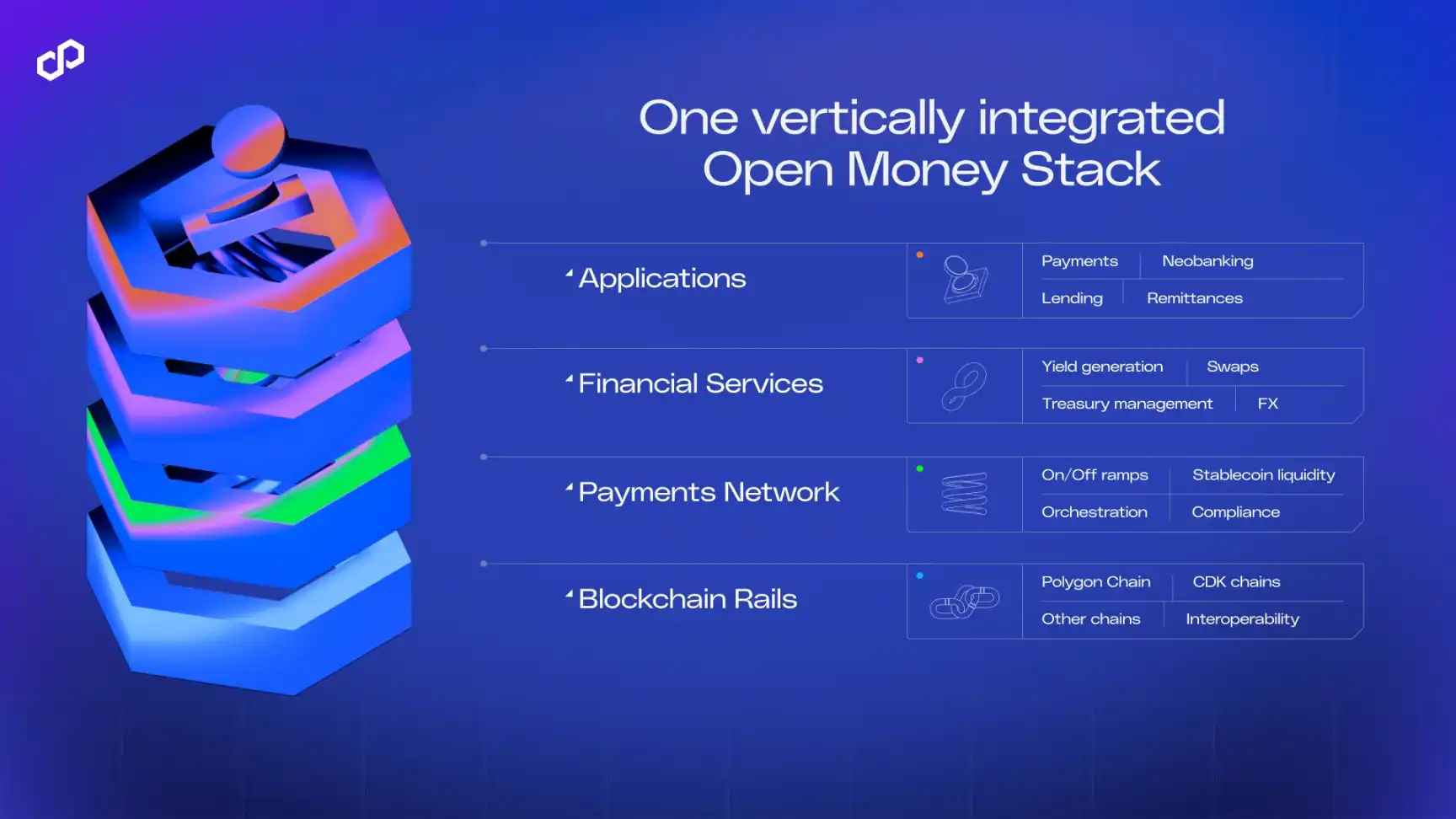
Open Money Stack | Source: Polygon Tweet

On/Off & Cash Ramps Layer: Utilizes Coinme's compliant network and U.S. regulatory licenses to enable instant cash and fiat on-ramps and off-ramps, converting physical cash or electronic fiat into stablecoins or other on-chain assets.

Wallet & Interaction Layer: Leverages Sequence's enterprise-grade smart wallets and account abstraction technology, along with one-click cross-chain transactions and cross-chain interaction capabilities, allowing end-users to receive, send, and make on-chain payments without worrying about underlying chains, gas, or intermediate assets.

Cross-Chain Interoperability Layer: Combines Sequence's Trails cross-chain orchestration engine and Polygon's interoperability protocol to make value flow between different chains completely transparent to users and support cross-chain transactions for any chain and any token.

Settlement Layer (Blockchain Rails): Relies on the Polygon network and its scaling technology to provide high-speed, low-cost, secure on-chain settlement infrastructure, enabling commercial-scale efficiency for stablecoin payments and value transfer.

Additionally, the Open Money Stack plans to integrate stablecoin orchestration with modules for compliance, identity, and yield generation, providing enterprises with payment and treasury management solutions.

L2 Competition Shifts to "Full-Stack Integration"

Polygon's $250 million acquisition reflects that the focus of competition in the L2 space is shifting from underlying technical parameters to full-stack business integration.

This path is highly consistent with the logic behind Coinbase's support for Base. The compliant entry point—acquiring Coinme—is to address the短板 (shortcoming) of fiat on-ramps and off-ramps,对标 (countering) Coinbase's CEX core advantage. For interaction experience, integrating Sequence is to lower the barrier to on-chain entry,对标 (countering) the ease of use of Coinbase Wallet (Base).

Against the backdrop of increasingly converging L2 technologies, ecosystems with compliant channels and low-barrier experiences will more easily attract incremental capital. Through this series of acquisitions, Polygon is attempting to build its own full-link moat in competition with opponents like Base, which possess native centralized advantages.


Трендові криптовалюти

Пов'язані питання

QWhat is the total acquisition amount announced by Polygon Labs, and which two companies were acquired?

APolygon Labs announced a total acquisition amount exceeding $250 million for the cryptocurrency payment infrastructure company Coinme and the blockchain development platform Sequence.

QHow does the acquisition of Coinme benefit Polygon's stablecoin strategy?

AThe acquisition of Coinme provides Polygon with a series of U.S. money transmission licenses and an extensive cash network, enabling compliant integration of cash, debit cards, and on-chain assets to facilitate stablecoin payments and off-chain capital inflows.

QWhat core technologies does Sequence offer to simplify the Web3 user experience?

ASequence offers a modular stack including Smart Wallet with account abstraction for features like social recovery and gas fee abstraction, and the Trails cross-chain orchestration engine to enable seamless cross-chain transactions without user awareness of underlying complexities.

QWhat is the 'Open Money Stack' strategy that Polygon aims to build through these acquisitions?

AThe 'Open Money Stack' strategy aims to create a unified API system comprising layers for on/off ramps (using Coinme's network), wallet infrastructure (via Sequence's technology), cross-chain interoperability, and blockchain settlement, all integrated with stablecoin orchestration and compliance modules.

QHow does Polygon's acquisition approach reflect the shifting competitive focus in the L2 space?

APolygon's acquisitions indicate that L2 competition is moving from underlying technical parameters to full-stack business integration, focusing on compliant entry points and user-friendly experiences to attract incremental capital and build a comprehensive competitive moat.

Пов'язані матеріали

GPT-5.6 Countdown: Abandon the Illusion of a Single API, Computational Iteration Can't Outpace a Single Page of Compliance

In mid-June, three seemingly independent industry events—the compliance-driven throttling of Fable 5, the open-sourcing of GLM-5.2, and the leaked release timeline for GPT-5.6—are pushing the global AI industry toward a watershed moment. These shifts signal a fundamental restructuring of the industry's underlying logic. First, **"usability" has substantially overtaken "advanced capabilities"** as the primary weight, pushing the global large language model (LLM) supply chain into a "dual-track" phase of controlled closed-source and local open-source coexistence. Second, **the competitive moats of closed-source giants are shifting**. Their technical focus is moving from "language intelligence" toward "spatial intelligence (world models)"—a domain heavily reliant on computing power. Third, faced with常态化 transnational compliance risks, **a "model-agnostic" decoupled design has become a survival necessity for application-layer developers to maintain business continuity.** The article details how Anthropic's Fable 5, despite its advanced engineering feats, was restricted for non-U.S. citizens within 72 hours of launch, highlighting how geopolitical compliance can instantly limit even the most advanced models. In response, the open-source camp, exemplified by Zhipu AI's MIT-licensed GLM-5.2, is gaining market share by offering stable performance improvements and significant cost advantages (up to 70% savings for enterprises), while achieving full adaptation with domestic semiconductor platforms. Meanwhile, closed-source leaders like OpenAI are pivoting. The anticipated GPT-5.6 reportedly shifts focus from language to spatial intelligence and world models, aiming to rebuild a generational gap in areas like 3D understanding, simulation, and industrial design that demand immense compute. The core conclusion is that the LLM supply chain's logic has changed. Enterprises must now evaluate infrastructure based on a composite of technical performance and policy compliance. For developers, complete reliance on a single closed-source API poses unacceptable risk. Implementing a truly model-agnostic architecture—enabling swift switches to compliant, locally deployable open-source alternatives—is no longer just good practice but a fundamental baseline for business continuity.

marsbit1 год тому

GPT-5.6 Countdown: Abandon the Illusion of a Single API, Computational Iteration Can't Outpace a Single Page of Compliance

marsbit1 год тому

Is the 'Token Subsidy War' Among AI Giants Almost Over?

The article discusses the ongoing "token subsidy war" among AI giants like OpenAI and Anthropic, questioning whether it's nearing its end. It reveals that current AI subscription prices are heavily subsidized, with some plans offering tokens at up to 70 times the actual cost to attract and retain heavy users, especially developers and enterprises. This strategy mirrors past internet-era subsidy battles, but with a key difference: AI tokens lack "lock-in" effects. Unlike ride-hailing or food delivery apps, users can easily switch between AI providers as APIs become standardized, making it difficult for companies to raise prices post-subsidy. The piece highlights a structural asymmetry in the competition. Giants like Google, with massive advertising revenue, can afford to subsidize tokens indefinitely, akin to using "tokens as a weapon." In contrast, venture-backed companies like OpenAI and Anthropic face pressure to become profitable, especially as they approach IPO. The article cites Google Ventures founder Bill Maris, who suggests Google could slash token prices by 80%, putting immense pressure on competitors. Two potential endgames are presented: the "internet service" model (subsidize, monopolize, then raise prices) and the "utility" model (tokens become a standardized, low-margin commodity like electricity). Given the low switching costs, the latter seems more likely. The competition may not have a single winner but could instead accelerate AI's evolution into a foundational, infrastructure-level technology, akin to a public utility. For now, users continue to benefit from heavily subsidized token costs.

marsbit1 год тому

Is the 'Token Subsidy War' Among AI Giants Almost Over?

marsbit1 год тому

Beyond the Stadium: The Profitable Games Surrounding the World Cup

"Beyond the Pitch: The Profit Game Around the World Cup" The FIFA World Cup transcends being a sporting spectacle, evolving into a massive global arena for speculation and profit-seeking. The 2026 tournament has amplified this dynamic, creating a multi-layered ecosystem of financial opportunism alongside the football. **Prediction markets** have surged into the mainstream. Platforms like Polymarket and Kalshi saw trading volumes for World Cup contracts soar, attracting new users with their financial trading model and high-profile, chain-based wealth stories that overshadow traditional sports betting in terms of growth and narrative. However, **traditional sportsbooks** remain the dominant force, leveraging established user habits, legal markets, and comprehensive product offerings to handle the vast majority of speculative wagers, with projections suggesting record-breaking betting volumes. Capital markets also react. **"Concept stocks"** in countries like South Korea and Japan experience volatile price swings based on team performance and anticipated fan spending on items like chicken, beer, and viewing parties, effectively becoming a stock market reflecting fan sentiment. The **ticket resale market** has become a sophisticated arena for arbitrage. Prices fluctuate wildly based on team draws and star power, with sellers sometimes listing tickets they don't yet own in a practice akin to short-selling, while FIFA's own "Right to Buy" tokens add another layer of speculative trading. **Collectibles and merchandise** offer another avenue. Panini sticker albums, with their inherent scarcity and nostalgic value, can become high-value collectibles. Limited-edition or locally themed jerseys command significant premiums on secondary markets, and even counterfeit vendors profit from fans' desire for affordable match-day identity. The **cryptocurrency** space has seen a frenzy of speculative, unauthorized World Cup-themed meme coins on chains like Solana. These tokens, often exploiting team names and player imagery, experience extreme pump-and-dump cycles, creating stories of massive gains for a few early entrants and steep losses for many others. Finally, an entire industry thrives on **providing information and tools** to other speculators. Developers create platforms like SeatSidekick to track ticket inventory and prices, while paid Telegram groups and subscriptions sell betting tips and predictions, monetizing the widespread desire for an informational edge. In essence, the World Cup has become a compressed, global laboratory for speculation. While the games determine champions on the field, a parallel, complex network of financial transactions—spanning prediction contracts, bets, stocks, tickets, collectibles, crypto, and information services—settles its own scores in the global market.

marsbit2 год тому

Beyond the Stadium: The Profitable Games Surrounding the World Cup

marsbit2 год тому

How Does Codex Use a Computer? Three Entry Points and Permission Boundaries

This article explains the three primary methods for Codex to interact with a computer, each with distinct use cases, permission boundaries, and trust levels. **1. Computer Use:** This offers the broadest access, allowing Codex to visually control and interact with the graphical user interface of authorized macOS/Windows apps, system settings, and even iOS simulators. It's ideal for tasks lacking APIs or structured tools, such as operating legacy software or multi-app workflows. However, it's the slowest method and has the widest permission scope, requiring careful supervision for sensitive actions. **2. Chrome Extension:** This grants Codex access to the user's logged-in Chrome browser state, including cookies, profiles, and open tabs. It's best for tasks requiring user identity across websites like Gmail, LinkedIn, Salesforce, or internal dashboards. Its key advantage is multi-tab control for complex workflows. While more powerful for browser-based tasks than Computer Use, it carries higher sensitivity as actions are performed under the user's identity. **3. In-App Browser:** This is a browser isolated within the Codex thread, separate from the user's personal browsing data. It excels in web development and debugging scenarios—previewing local servers, testing responsive layouts, or annotating designs directly on the page. Its isolation is a strength for development but a limitation for tasks requiring login sessions. The core principle is to choose the narrowest, safest, and most structured interface for the task. Use plugins or MCPs first, resort to visual control (Computer Use) only for GUI-dependent tasks, employ the Chrome extension for identity-reliant browser work, and prefer the In-App Browser for isolated development. **Appshots** are clarified as a fourth, complementary tool for *inputting* context—capturing a screenshot of a window to point Codex to something—rather than a method for Codex to *act*. Together, this layered approach highlights a key to AI agent productization: not granting unlimited permissions, but constraining them within clear boundaries for specific tasks while preserving user oversight.

marsbit3 год тому

How Does Codex Use a Computer? Three Entry Points and Permission Boundaries

marsbit3 год тому

Торгівля

Спот
Ф'ючерси

Популярні статті

Як купити T

Ласкаво просимо до HTX.com! Ми зробили покупку Threshold Network Token (T) простою та зручною. Дотримуйтесь нашої покрокової інструкції, щоб розпочати свою криптовалютну подорож.Крок 1: Створіть обліковий запис на HTXВикористовуйте свою електронну пошту або номер телефону, щоб зареєструвати обліковий запис на HTX безплатно. Пройдіть безпроблемну реєстрацію й отримайте доступ до всіх функцій.ЗареєструватисьКрок 2: Перейдіть до розділу Купити крипту і виберіть спосіб оплатиКредитна/дебетова картка: використовуйте вашу картку Visa або Mastercard, щоб миттєво купити Threshold Network Token (T).Баланс: використовуйте кошти з балансу вашого рахунку HTX для безперешкодної торгівлі.Треті особи: ми додали популярні способи оплати, такі як Google Pay та Apple Pay, щоб підвищити зручність.P2P: Торгуйте безпосередньо з іншими користувачами на HTX.Позабіржова торгівля (OTC): ми пропонуємо індивідуальні послуги та конкурентні обмінні курси для трейдерів.Крок 3: Зберігайте свої Threshold Network Token (T)Після придбання Threshold Network Token (T) збережіть його у своєму обліковому записі на HTX. Крім того, ви можете відправити його в інше місце за допомогою блокчейн-переказу або використовувати його для торгівлі іншими криптовалютами.Крок 4: Торгівля Threshold Network Token (T)Легко торгуйте Threshold Network Token (T) на спотовому ринку HTX. Просто увійдіть до свого облікового запису, виберіть торгову пару, укладайте угоди та спостерігайте за ними в режимі реального часу. Ми пропонуємо зручний досвід як для початківців, так і для досвідчених трейдерів.

459 переглядів усьогоОпубліковано 2024.12.10Оновлено 2026.06.02

Як купити T

Обговорення

Ласкаво просимо до спільноти HTX. Тут ви можете бути в курсі останніх подій розвитку платформи та отримати доступ до професійної ринкової інформації. Нижче представлені думки користувачів щодо ціни T (T).

活动图片