Polygon vs. Ethereum: Why ‘micro’ AI agents are winning fee war on POL

ambcryptoОпубліковано о 2026-02-17Востаннє оновлено о 2026-02-17

Анотація

Polygon has surpassed Ethereum in daily transaction fees, a significant milestone, with its daily fees exceeding $300,000. This surge reflects a notable increase in network activity, as daily transactions on Polygon also rose by approximately 50% over the past week. A key driver behind this growth is the rise of payment-focused AI agents, which have boosted micro-transaction volumes. Additionally, the adoption of more crypto card products and payment apps has contributed to increased activity in small and medium transfer categories. Data indicates that monthly payment transfers on Polygon nearly doubled to 2 million in January and could reach around 2.3 million in February if the current pace continues. The increased network usage is also positively impacting POL's price, which climbed roughly 15% in the past week, moving from around $0.09 to briefly test above $0.11 before settling near $0.107. While the token remains in a steady upward trend, some indicators suggest the rally may be slowing, though continued network growth could support further price stability and potential upside. Overall, Polygon's flipping of Ethereum in daily fees and its rising transaction volume signal strong momentum for the network.

Polygon has pulled ahead of Ethereum in daily transaction fees, and that doesn’t happen very often. If this pace continues, February could turn out to be a surprisingly strong month for Polygon!

Activity is picking up!

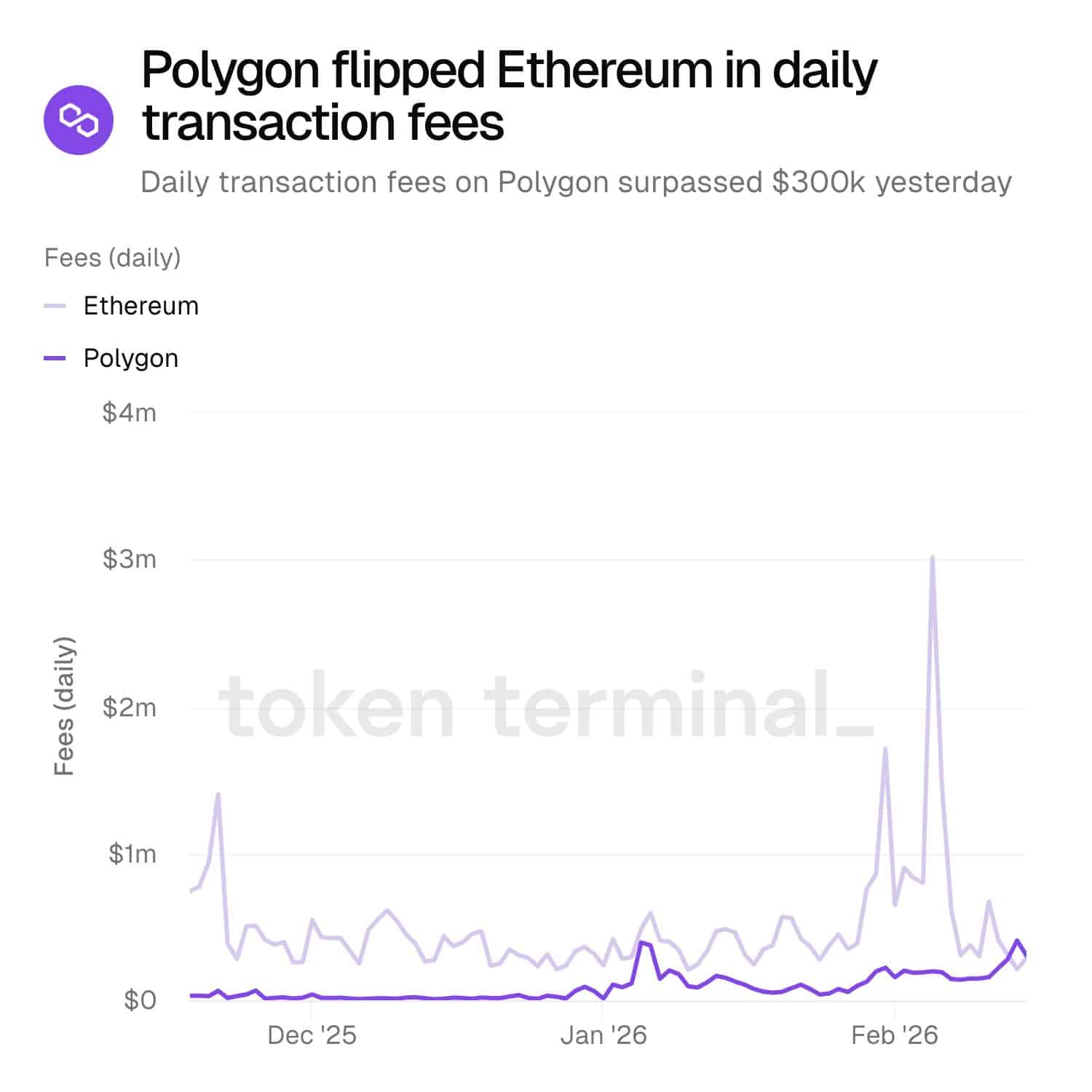
Polygon has pulled off a big win, overtaking Ethereum [ETH] in daily transaction fees! Recent data showed Polygon’s [POL] fees crossing $300K, a jump that proves rising network usage.

Source: X

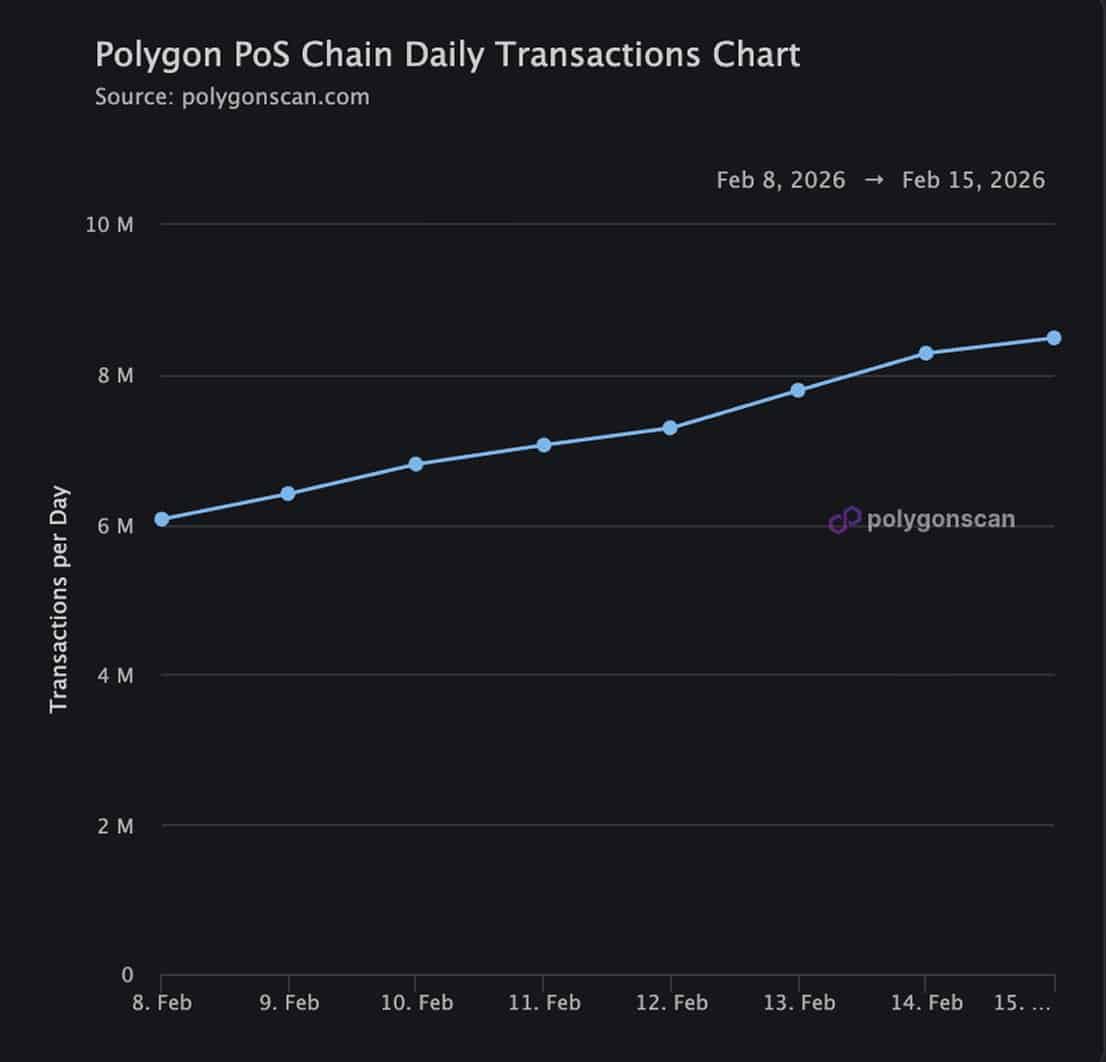
This pace wasn’t limited to fees either.

Source: X

Daily transactions on Polygon have climbed over the past week, rising about 50% in just seven days.

Payments play a big role

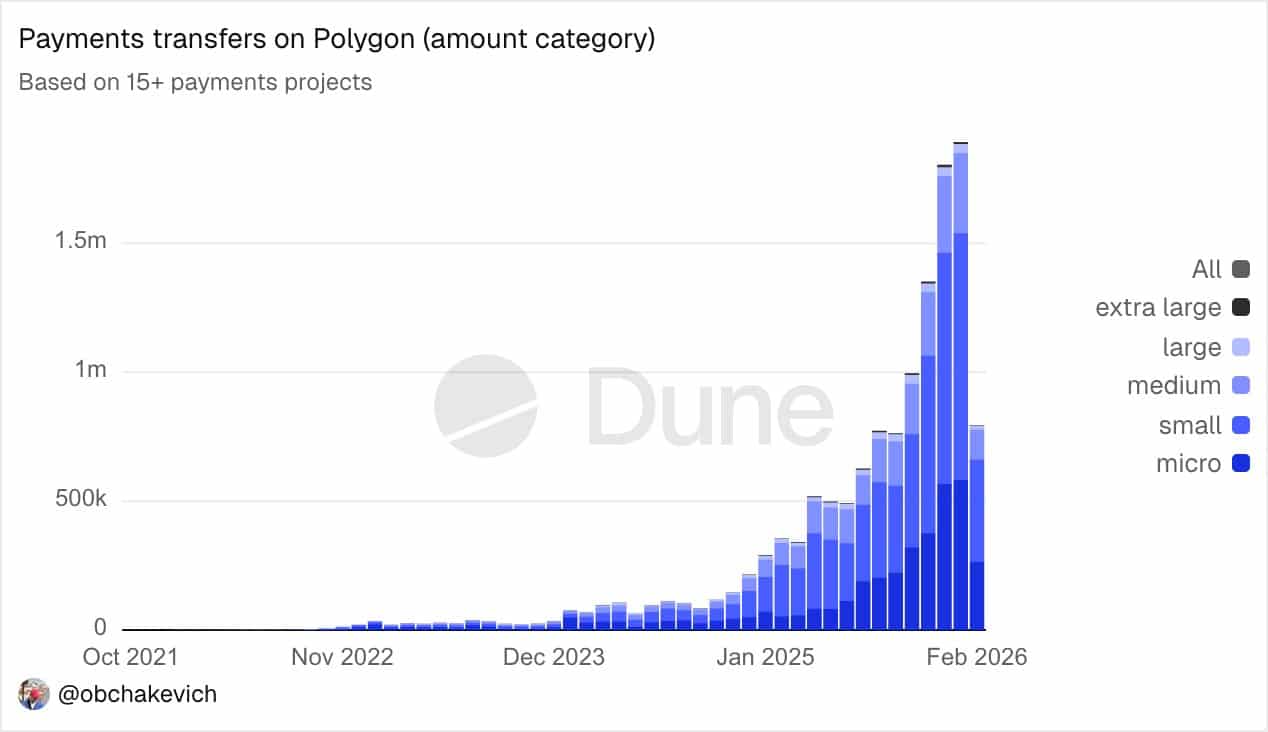
Data per Dune showed that monthly payment transfers on the network were close to 2 million in January, nearly doubling from under 1 million just two months earlier.

Source: X

A major cause seems to be the rise of payment-focused AI agents, which boosted smaller “micro” transactions. At the same time, more crypto card products and payment apps helped increase activity in the small and medium transfer categories.

At the current pace, February could see transfers reach around 2.3 million.

POL price holds gains

All this growth is showing up in the price charts too!

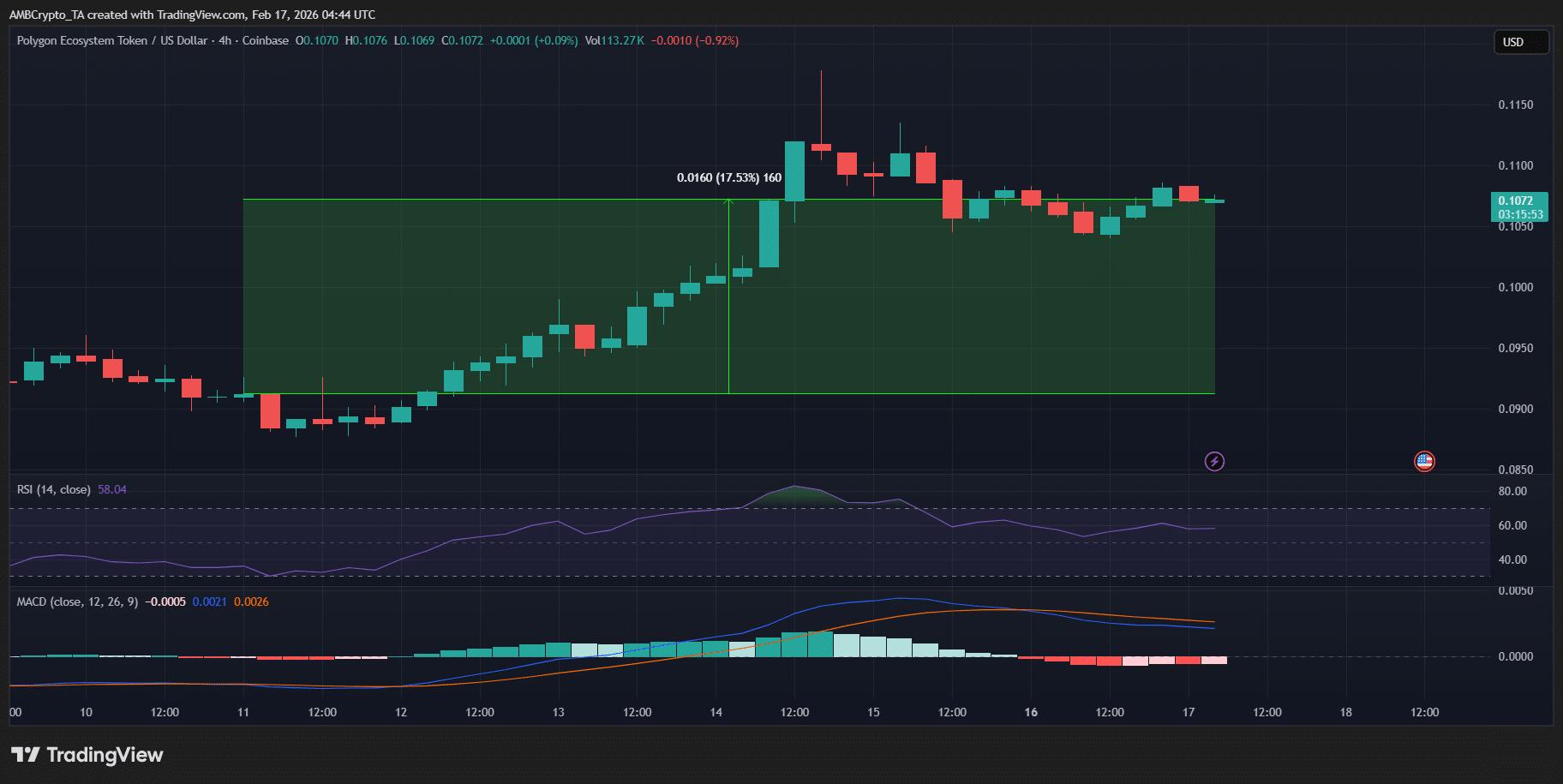
Over the past week, the token climbed roughly 15%, pushing from the $0.09 range to briefly test above $0.11. This was before it settled near $0.107 at press time.

Source: TradingView

POL moved within a steady upward range, which means buyers were still in control.

However, the rally may be slowing. The RSI was in a healthy zone, while the MACD showed lesser bullish strength after the recent push higher.

The trend is still positive, but the market may be taking a moment after a quick run-up. If network growth continues at the current pace, price stability above this range could cause further upside.


Final Summary

  • Polygon flipping Ethereum in daily fees above $300K is big news for the former.
  • If transactions keep rising, POL price momentum could see stronger upside!
Next: Worldcoin slips below $0.40 as whale dumps $5.7 mln WLD on Binance
Share
  • Share
  • Tweet

Пов'язані питання

QWhat recent achievement did Polygon accomplish in comparison to Ethereum?

APolygon overtook Ethereum in daily transaction fees, with its fees crossing $300K.

QBy what percentage did daily transactions on Polygon increase over the past week?

ADaily transactions on Polygon rose by about 50% in just seven days.

QWhat was a major factor contributing to the rise in small and medium transfers on Polygon?

AThe rise of payment-focused AI agents and more crypto card products and payment apps helped boost smaller 'micro' transactions.

QHow much did the POL token climb in price over the past week?

AThe POL token climbed roughly 15%, moving from the $0.09 range to briefly test above $0.11.

QWhat does the projected transfer volume for February indicate based on current trends?

AAt the current pace, February could see transfers reach around 2.3 million.

Пов'язані матеріали

Who Funds the Agents?

**Summary: Who Funds AI Agents?** OpenAI recently shut down a feature allowing AI agents to shop for users, highlighting the challenge of creating a secure and regulated environment for agent-driven transactions. While payment infrastructure exists, a crucial governance layer—defining spending limits, fraud detection, tax handling, and return policies—is largely missing. The potential is enormous: AI agents already processed $73M across 176M transactions last year, with McKinsey forecasting this could grow to $3-5T in global consumer commerce by 2030. The core competition isn't just about processing payments, which can be very cheap (especially with crypto-based settlement), but about controlling the rules that govern agent spending. Key players like Stripe and Coinbase are racing to dominate this governance layer. Stripe's acquisition of wallet provider Privy allows it to set spending policies, identity checks, and human-in-the-loop approvals directly at the wallet level. Similarly, Coinbase's stack, including its x402 protocol and AgentKit, embeds governance rules. This vertical integration across settlement, wallet, and governance layers is becoming the dominant strategy. Control over the governance layer is where significant future value lies. If agents handle trillions in transactions, even a small fee for managing compliance, fraud prevention, and policy enforcement could generate billions in annual revenue. The companies that successfully integrate across the payment stack will capture value from idle agent balances, transaction fees, and governance services, positioning themselves as the foundational banks of the AI agent economy.

marsbit19 хв тому

Who Funds the Agents?

marsbit19 хв тому

A Nation Blocks Chips, a Giant Buys a Nuclear Power Plant: Why It's Time to Seriously Consider DeAI

**Title: Great Powers Blockade Chips, Giants Buy Nuclear Plants: Why It's Time to Seriously Consider DeAI** In May 2026, the US closed loopholes for Chinese firms to acquire advanced NVIDIA chips via overseas subsidiaries. That same month, Kenya halted a $1B geothermal data center project involving Microsoft, fearing its immense energy consumption. Meanwhile, Huawei announced mass production of its Ascend AI chip. These disparate events underscore a new reality: the competition for computing power ("compute") has escalated beyond the tech industry, becoming a geopolitical and infrastructural battleground. A new era of oligopoly is forming, with control over the AI stack—from GPU chips (NVIDIA) and cloud platforms (AWS, Azure, Google Cloud) to foundational models (OpenAI, Anthropic)—concentrating in a few Western "AI Octopus" corporations. This centralization creates systemic risks: pricing power and platform lock-in for users, infrastructure fragility, and a widening "compute divide" that threatens to marginalize nations without independent AI capacity. An "AI Iron Curtain" is deepening through export controls. In response, some nations like Saudi Arabia and the UAE are investing heavily to buy compute power, aiming to transition from oil to AI economies. The EU seeks to triple its compute capacity by 2030 to reduce dependency. However, the spending gap is vast, with four US tech giants alone planning ~$750B in AI capex for 2026. The race is increasingly constrained by energy, with AI tasks consuming up to 1000x more power than web searches, pushing firms to even acquire nuclear plants. This landscape is fueling interest in Decentralized AI (DeAI). It proposes a third way: using open protocols to coordinate a global network of idle GPUs, independent developers, and data centers, creating an AI infrastructure without a single controlling entity. Leveraging blockchain and cryptographic verification, DeAI aims to break market concentration, disperse energy demands, reduce geopolitical dependencies, and enhance transparency. While still nascent in performance and stability, DeAI's core promise is not immediate superiority but providing a crucial alternative architecture to resist monopoly, censorship, and centralized power. As specialized AI hardware costs fall and open-source models flourish, the window to build this foundation is open. The very existence of such competition serves as a vital check against the inevitable abuse of concentrated power.

marsbit1 год тому
A Nation Blocks Chips, a Giant Buys a Nuclear Power Plant: Why It's Time to Seriously Consider DeAI

marsbit1 год тому

Торгівля

Спот
Ф'ючерси

Популярні статті

Як купити POL

Ласкаво просимо до HTX.com! Ми зробили покупку Polygon Ecosystem Token (POL) простою та зручною. Дотримуйтесь нашої покрокової інструкції, щоб розпочати свою криптовалютну подорож.Крок 1: Створіть обліковий запис на HTXВикористовуйте свою електронну пошту або номер телефону, щоб зареєструвати обліковий запис на HTX безплатно. Пройдіть безпроблемну реєстрацію й отримайте доступ до всіх функцій.ЗареєструватисьКрок 2: Перейдіть до розділу Купити крипту і виберіть спосіб оплатиКредитна/дебетова картка: використовуйте вашу картку Visa або Mastercard, щоб миттєво купити Polygon Ecosystem Token (POL).Баланс: використовуйте кошти з балансу вашого рахунку HTX для безперешкодної торгівлі.Треті особи: ми додали популярні способи оплати, такі як Google Pay та Apple Pay, щоб підвищити зручність.P2P: Торгуйте безпосередньо з іншими користувачами на HTX.Позабіржова торгівля (OTC): ми пропонуємо індивідуальні послуги та конкурентні обмінні курси для трейдерів.Крок 3: Зберігайте свої Polygon Ecosystem Token (POL)Після придбання Polygon Ecosystem Token (POL) збережіть його у своєму обліковому записі на HTX. Крім того, ви можете відправити його в інше місце за допомогою блокчейн-переказу або використовувати його для торгівлі іншими криптовалютами.Крок 4: Торгівля Polygon Ecosystem Token (POL)Легко торгуйте Polygon Ecosystem Token (POL) на спотовому ринку HTX. Просто увійдіть до свого облікового запису, виберіть торгову пару, укладайте угоди та спостерігайте за ними в режимі реального часу. Ми пропонуємо зручний досвід як для початківців, так і для досвідчених трейдерів.

231 переглядів усьогоОпубліковано 2024.12.11Оновлено 2026.06.02

Як купити POL

Обговорення

Ласкаво просимо до спільноти HTX. Тут ви можете бути в курсі останніх подій розвитку платформи та отримати доступ до професійної ринкової інформації. Нижче представлені думки користувачів щодо ціни POL (POL).

活动图片