Polygon Labs announces second round of 2026 layoffs as it targets profitability in 2027

ambcryptoОпубліковано о 2026-07-16Востаннє оновлено о 2026-07-16

Анотація

On July 16, 2026, Polygon Labs CEO Marc Boiron announced the company's second round of layoffs for the year. This move, described as "difficult, but necessary," is part of a strategic shift to transition into a "blockchain-enabled payments company" as it finalizes its acquisition of Coinme. These layoffs mark the fourth workforce reduction since February 2023, following earlier cuts of 60 staff after the $250 million acquisitions of Coinme and Sequence in January 2026. The restructuring aims to support the vision for the Polygon Open Stack, focusing on enabling seamless on-chain money transfers. Polygon Labs clarified its distinction from the Polygon Foundation, which handles network upgrades and the ecosystem. Meanwhile, the native token POL has struggled, down approximately 94% from its all-time high and 56% from a January peak. While some technical indicators showed short-term buying pressure in July, a sustained price recovery is contingent on increased network utility and organic token demand, requiring a move above $0.095 to shift the longer-term bearish trend.

On Thursday, July 16, Polygon Labs [POL] CEO Marc Boiron announced the second round of layoffs for 2026.

Polygon was in the final stages of completing the Coinme acquisition, and this move will help transition the blockchain company towards a “blockchain-enabled payments company”, the CEO wrote in a post on X.
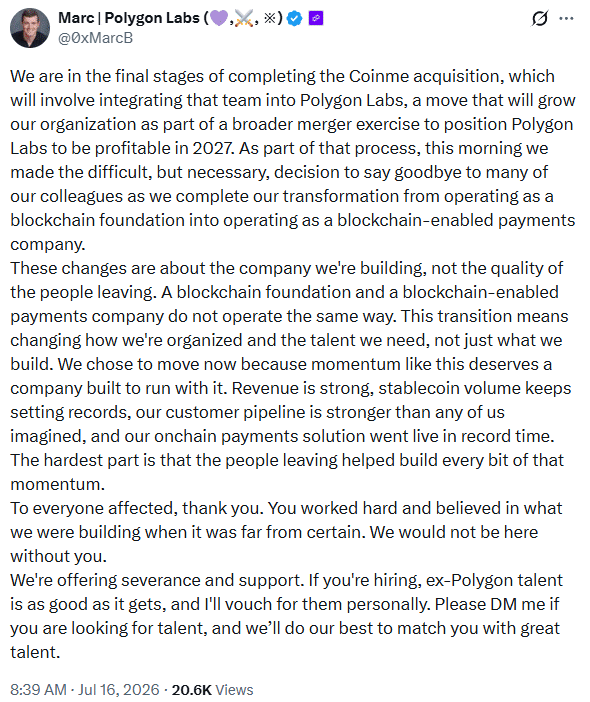
Source: Marc Boiron on X

Hence, the “difficult, but necessary” decision to let people go was made. This was the company’s fourth wave of reductions dating back to February 2023.

Coinme, the crypto exchange, and Sequence, the wallet infrastructure firm, were acquired for $250 million in January 2026. Layoffs of 60 staff members back then had been because the company was pivoting to a payment focused blockchain. They were part of restructuring after the acquisitions, a spokesperson had said.

The vision for the Polygon Open Stack is to enable seamless money transfers onchain, explaining the need for these acquisitions and their integrations.

Specific figures were not shared for Thursday’s layoffs.

The path ahead for POL

It was reported that a Polygon representative observed that the Polygon Labs and Polygon Foundation were legally and structurally distinct entities. The acquisitions and commercial vision of the former has been laid out.

Meanwhile, the Foundation is tasked with network upgrades, treasury, and ecosystem. POL, the network’s native token, was down nearly 94% from its all-time highs. Its holders have no equity and no claim in Polygon Labs’ future profits.

As such, the token’s bearish price action could be set to continue in the long-run, unless network utility picks up, creating more demand and forcing more token burns through the deflationary mechanic.
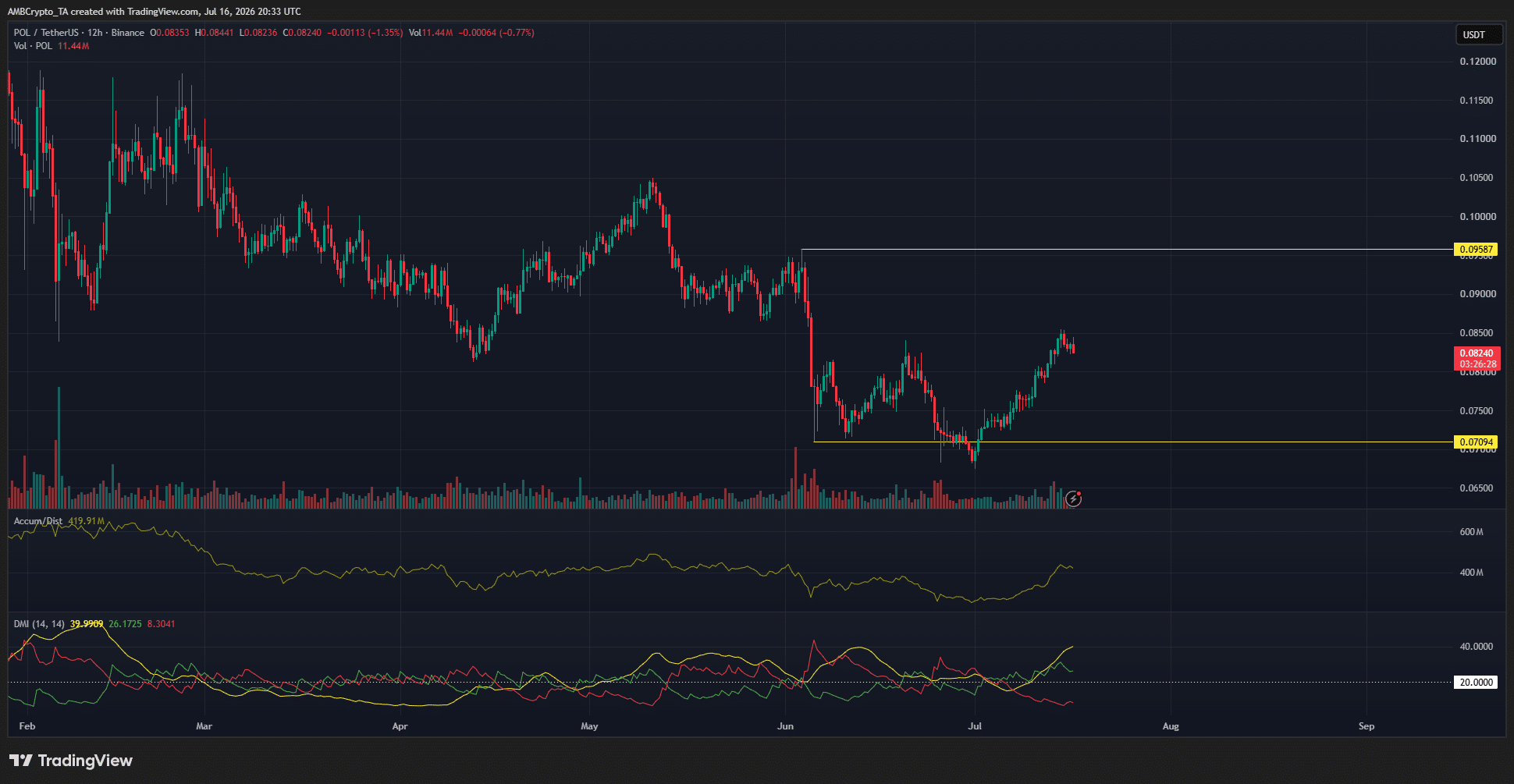
Source: POL/USDT on TradingView

The A/D indicator signaled buying pressure in July, and the DMI showed an uptrend in progress. Yet, the technical indicators did not capture the longer-term downtrend.

POL was down 56% since making a high of $0.186 in January earlier this year. The gains in July were not enough to shift the trend bullishly. A price move beyond $0.095 is needed.

Beyond the price action of the past six weeks, increased network usage and organic POL demand is needed to drive its recovery.


Final Summary

  • Polygon Labs CEO Marc Boiron announced the second round of layoffs for 2026, as the firm moved to finalize the Coinme acquisition.
  • The Polygon Open Money Stack vision envisioned as a seamless, global, blockchain-based payments platform.


Пов'язані питання

QWhat was the main reason provided by Polygon Labs CEO for the second round of layoffs in 2026?

AThe main reason was to help transition the blockchain company towards becoming a 'blockchain-enabled payments company' as it finalizes the Coinme acquisition.

QWhich two companies did Polygon acquire for $250 million in January 2026, and how many staff were laid off at that time?

APolygon acquired the crypto exchange Coinme and the wallet infrastructure firm Sequence for $250 million, and laid off 60 staff members as part of restructuring after the acquisitions.

QWhat is the stated vision for the Polygon Open Stack, and how does it relate to the recent acquisitions?

AThe vision for the Polygon Open Stack is to enable seamless money transfers onchain. This vision explains the need for the acquisitions of Coinme and Sequence and their subsequent integrations to build a global, blockchain-based payments platform.

QAccording to the article, what are the key distinctions between Polygon Labs and the Polygon Foundation?

APolygon Labs and the Polygon Foundation are legally and structurally distinct entities. Polygon Labs handles acquisitions and commercial vision, while the Polygon Foundation is tasked with network upgrades, treasury management, and ecosystem development.

QWhat does the article identify as a necessary condition for reversing POL's long-term bearish price trend?

ATo reverse POL's long-term bearish trend, the article states that increased network utility, creating more organic POL demand, and forcing more token burns through the deflationary mechanic are needed.

Пов'язані матеріали

In Jinjiang, Fujian, a Storage Super Unicorn Lies Quiet

In Fujian's Jinjiang, a city known for sportswear, lies a quiet semiconductor giant: Fujian Jinhua Integrated Circuit Co. (JHICC). Once a promising domestic DRAM manufacturer alongside Yangtze Memory and ChangXin Memory Technologies (CXMT), its journey was derailed in 2018 when the U.S. placed it on an Entity List and filed criminal charges for alleged trade secret theft. This halted production for years. A turning point came in February 2024 when a U.S. federal court found JHICC not guilty. However, it had lost crucial time. While CXMT soared to become a top-valued A-share company in 2024, JHICC, with an estimated valuation of 80 billion RMB, was just restarting. Its current output is primarily customized DDR4 chips, not the advanced DDR5/HBM demanded for AI, but it still benefits from the broader memory chip upcycle. JHICC's story is tied to Chen Zhengkun, a veteran engineer who left Micron to lead the venture. Founded in 2016 with state-backed funding, JHICC partnered with Taiwan's UMC to develop DRAM technology. Rapid progress was cut short by the U.S. actions, which Micron initiated, partly due to its heavy reliance on the Chinese market. Post-sanctions, Chen's team worked to rebuild the production line with reduced reliance on U.S. technology. According to its records, JHICC achieved small-scale production and revenue growth under immense pressure. It now focuses on the stable "niche" DRAM market (e.g., TVs, routers) with a monthly capacity of ~40,000 wafers, aiming for 60,000 by 2026. It holds over 1,000 patents but remains on the Entity List. For Jinjiang, investing in JHICC was a bold industrial leap. The local government provided unwavering financial and logistical support during the crisis, helping the company survive. JHICC has become the anchor for a growing local semiconductor cluster. Though its scale lags behind domestic peers, JHICC's persistence symbolizes a hard-won foothold in a global market long dominated by Samsung, SK Hynix, and Micron. Having missed one boom, it seeks a place in the new AI-driven memory supercycle.

marsbit2 год тому

In Jinjiang, Fujian, a Storage Super Unicorn Lies Quiet

marsbit2 год тому

Торгівля

Спот
活动图片



