Polygon deploys Madhugiri hard fork, aims for 33% throughput boost

cointelegraphОпубліковано о 2025-12-09Востаннє оновлено о 2025-12-09

Анотація

Polygon has deployed the Madhugiri hard fork, targeting a 33% increase in network throughput and reducing block consensus time to one second. The upgrade includes support for three Fusaka Ethereum Improvement Proposals (EIP-7823, EIP-7825, EIP-7883), which improve efficiency and security by limiting gas consumption for heavy mathematical operations. It also introduces a new transaction type for Ethereum-Polygon bridge traffic and adds flexibility for future upgrades. This enhancement aims to better support high-frequency use cases like stablecoins and real-world asset (RWA) tokenization. The hard fork follows the recent Heimdall 2.0 upgrade, which significantly reduced finality times, despite a brief disruption in September due to a bug that was later resolved.

Blockchain network Polygon has rolled out its latest protocol upgrade, known as the Madhugiri hard fork, which aims to achieve a 33% increase in network throughput and reduce block consensus time to one second.

Polygon core developer Krishang Shah said on X that the update includes support for three Fusaka Ethereum Improvement Proposals, specifically EIP-7823, EIP-7825 and EIP-7883. These EIPs make heavy mathematical operations more efficient and secure by limiting the amount of gas they consume.

They also prevent single transactions from consuming excessive computing power, helping the network run more smoothly and predictably.

The upgrade introduces a new transaction type for Ethereum to Polygon bridge traffic and adds a built-in flexibility feature for future upgrades. Polygon previously said that the update makes throughput increases as easy as “flipping a few switches.”

“We are also decreasing the consensus time to 1 second, so blocks can now be announced in 1 second if ready, instead of waiting the full 2 seconds,” Shah wrote.
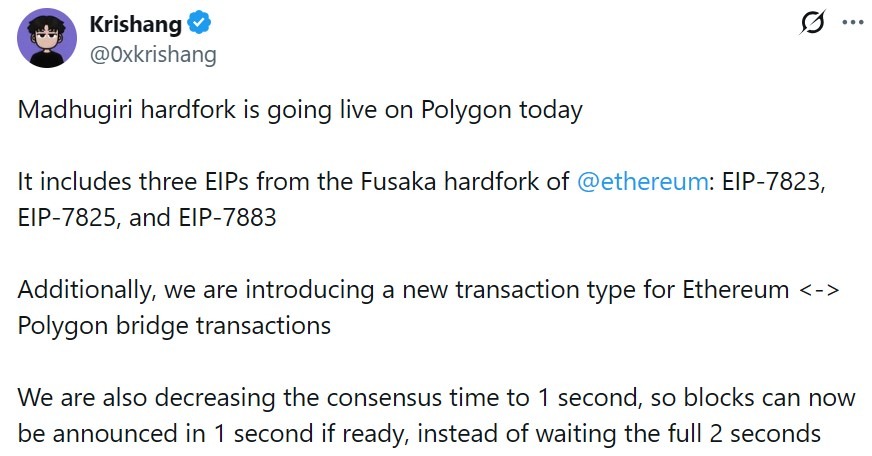
Source: Krishang Shah

New update reinforces Polygon for stablecoins and RWAs

With Madhugiri now live, Polygon aims to reinforce its infrastructure while materially improving its performance. These are prerequisites for high-frequency and high-trust use cases, such as real-world asset (RWA) tokenization and stablecoins.

Aishwary Gupta, the global head of payments and RWAs at Polygon Labs, previously forecasted a “stablecoin supercycle.”

Gupta said there will be a surge of “at least 100,000 stablecoins” in the next five years. However, he said this would not only be about minting tokens and must have a corresponding utility like yield.

Gupta also advocated for more transparency and accountability in the RWA sector. He previously argued that RWA numbers are meaningless if the assets cannot be audited, settled or traded.

“When transparency and accountability are established, RWAs will reach even greater heights, unlocking trillions in institutional capital,” he wrote.

Related: Polygon co-founder mulls resurrecting MATIC a year after POL rebrand

Hard fork follows major Heimdall upgrade

The upgrade comes on the heels of rapid prior improvements. On July 10, Polygon deployed Heimdall 2.0, dubbed by Polygon Foundation CEO Sandeep Nailwal as the network’s “most technically complex” hard fork since its launch.

The update reduced transaction finality times from one to two minutes to roughly five seconds.

However, on Sept. 10, the network experienced a significant disruption when a bug caused finality delays of 10 to 15 minutes, affecting validator sync, remote procedure call services and third-party tooling. Despite this, the team assured the community that blocks were still running.

On Sept. 11, the Polygon Foundation announced that the consensus and finality functions had been restored through a hard fork. With the update, nodes were no longer stuck, while checkpoints and milestones were finalized as expected.

Magazine: Ethereum’s Fusaka fork explained for dummies: What the hell is PeerDAS?

Пов'язані матеріали

You Bet on the News, the Pros Read the Rules: The True Cognitive Gap in Losing Money on Polymarket

The article explains that the key to profiting on Polymarket, a prediction market platform, lies not just predicting real-world events correctly, but in meticulously understanding the specific rules that govern how each market will be resolved. It illustrates this with examples, such as a market on Venezuela's 2026 leader, where the official rules defining "officially holds" the office overruled the intuitive answer of who was in practical control. Other examples include debates over the definition of a "token" or what constitutes an "agreement." The core argument is that a "reality vs. rules" gap creates pricing discrepancies that savvy traders ("车头" or "whales") exploit. The platform has a formal dispute resolution process managed by UMA token holders to settle ambiguous outcomes. This process involves proposal submission, a challenge window, a discussion period, and a final vote. However, the article highlights a critical flaw in this system compared to a traditional court: the lack of separation between the arbiters (UMA voters) and the interested parties (traders with financial stakes in the outcome). This conflict of interest undermines the discussion phase, leads to herd mentality, and results in opaque final decisions without explanatory rulings. Consequently, the system lacks a body of precedent, making it difficult for users to learn from past disputes. The ultimate takeaway is that success on Polymarket requires a lawyer-like scrutiny of the rules to identify and capitalize on the cognitive gap between how events appear and how they are contractually defined for settlement.

marsbit27 хв тому

You Bet on the News, the Pros Read the Rules: The True Cognitive Gap in Losing Money on Polymarket

marsbit27 хв тому

Will the Fed Still Cut Interest Rates? Tonight's Data Is Crucial

The core debate surrounding the Federal Reserve's potential interest rate cuts is intensifying amid geopolitical conflict and rebounding inflation. The key question is whether high energy prices will cause persistent inflation or weaken consumer demand enough to force the Fed to cut rates. Citigroup presents a bullish case for cuts, arguing that oil supply disruptions from the Strait of Hormuz are temporary and will not lead to lasting inflationary pressure. They point to receding bond yields and oil prices as evidence the market is pricing in a short-lived shock. Citi's data also shows tightening financial conditions, a stabilizing labor market, and healthy tax returns, supporting their view that the path to lower rates remains open. Conversely, Deutsche Bank offers a starkly contrasting, more hawkish outlook. They argue the Fed's current policy is already neutral and expect rates to remain unchanged indefinitely. Their view is based on stalled disinflation progress and a shift toward more hawkish rhetoric from key Fed officials like Waller, who cited risks from prolonged Middle East conflict and tariffs. Other officials, including Williams and Hammack, signaled rates would likely stay on hold for a "considerable time." The market pricing has shifted dramatically, now forecasting zero cuts in 2026. The imminent release of the March retail sales "control group" data is highlighted as a critical test. This metric, which excludes gas station sales, will reveal if high gasoline prices are eroding consumer spending in other areas. A weak reading could support the case for imminent rate cuts, while a strong one would bolster the argument for the Fed to hold steady. This data is pivotal for determining the near-term policy path.

marsbit47 хв тому

Will the Fed Still Cut Interest Rates? Tonight's Data Is Crucial

marsbit47 хв тому

Торгівля

Спот
Ф'ючерси
活动图片