Polish Parliament Slams The Brakes On Crypto Market Act After Controversial Revival

bitcoinistОпубліковано о 2025-12-20Востаннє оновлено о 2025-12-20

Анотація

Polish lawmakers have halted discussions on the controversial Crypto-Asset Market Act until January. The lower house, the Sejm, recently passed a nearly identical version of a bill previously vetoed by President Karol Nawrocki, who expressed concerns about overregulation, threats to innovation, and potential startup exodus. Despite failing to override the veto, the ruling coalition reintroduced the bill with minimal changes, including a reduced fee for crypto intermediaries from 0.4% to 0.1%. The Senate has delayed its decision to carefully review the amendments, with further discussions scheduled for January.

Polish lawmakers have reportedly halted discussions on crypto legislations until January after the parliament’s lower house, the Sejm, voted to pass a nearly identical version of a bill that was vetoed by Poland’s president earlier this month without changes.

Poland’s Sejm Passes Controversial Crypto Bill

On Friday, local news media outlets informed that the Polish Senate hit the brakes on the controversial Crypto-Asset Market Act, following the Sejm’s recent vote to pass “version 2.0” of the legislation.

According to the reports, more than half of the members of the lower chamber voted to pass the revived version of the bill on Thursday, leaving its fate in the hands of the Senate and then the President, who has strongly opposed to the legislation.

As reported by Bitcoinist, Poland’s President Karol Nawrocki vetoed the Crypto-Asset Market Act at the start of the month due to concerns of a potential exodus of startups and overregulating the sector with the “legal mess” proposed by the Polish government.

On December 1, President Nawrocki refused to sign the bill, first introduced in June, which aimed to establish strict rules on the crypto assets market. He argued that the legislation it could pose a real threat to the freedoms of Poles, the stability of the state, and market innovation.

The local crypto community had raised concerns about the bill in September, affirming that it exceeded the European Union (EU)’s minimum regulatory requirements and could drive small businesses and startups abroad.

The parliament attempted to override the President’s veto, but ultimately failed after being unable to secure the required three-fifths majority vote to overturn the presidential decision.

Nonetheless, the part of the ruling coalition in the Sejm reintroduced the bill a week later without allegedly amending any of the controversial policies, raising more concerns among crypto industry players and community members.

Senate Delays Decision Until January

According to the reports, the Senate had initially planned to pass the bill “at an express pace” before the end of the year. However, the Deputy Finance Minister Jurand Drop raised concerns about the intention to pass the legislation with no further revisions.

Deputy Minister Drop pointed out that the Sejm had introduced only one change to the proposal, a lower fee for entities intermediating in crypto trading, despite the government’s disapproval of the current text.

“This amendment, which was introduced during the Sejm vote and which the government disagrees with, concerns the level of fees paid to the Polish Financial Supervision Authority (KNF) by entities in the crypto-asset market. The fee has been reduced from 0.4% to 0.1%,” Drop explained.

“Other market segments have fees of a maximum of 0.5%; for this market, the government has proposed 0.4%. Although the KNF’s projections indicate that these fees will not exceed 0.1%, and in the first year, they will not be collected at all, the question remains what will happen if this market grows and, as a result, the fees are forced to exceed 0.1%,” he added.

On Friday morning, the Senate Budget and Public Finance Committee discussed the recently passed bill and the Ministry of Finance’s concerns. The committee chairman, Senator Kazimierz Kleina, suggested that the committee review this modification calmly.

Therefore, he withdrew the motion to pass the bill without new changes and suspended the discussions on the bill, affirming that the Sejm’s amendments “will have to be carefully considered.” Ultimately, Chairman Kleina scheduled to resume work on the legislation during the January Senate session.
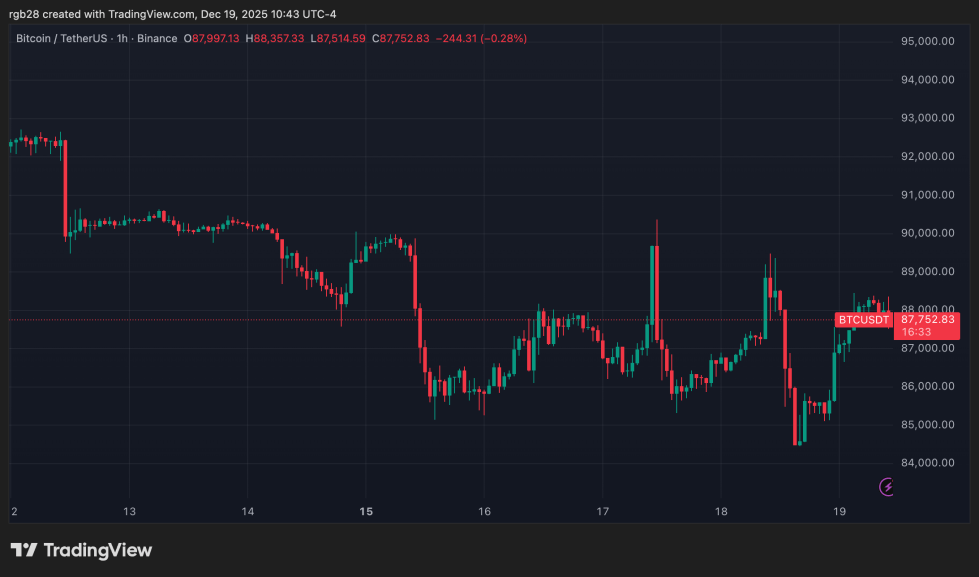
Bitcoin (BTC) trades at $87,752 in the one-week, chart. Source: BTCUSDT on TradingView


Пов'язані питання

QWhy did the Polish Sejm halt discussions on crypto legislation until January?

AThe Sejm halted discussions after passing a nearly identical version of a previously vetoed crypto bill, and the Senate decided to delay further review until January to carefully consider the amendments.

QWhat was the main reason President Karol Nawrocki vetoed the Crypto-Asset Market Act initially?

APresident Nawrocki vetoed the bill due to concerns about potential startup exodus, overregulation, and the threat it posed to Poles' freedoms, state stability, and market innovation.

QHow did the Sejm's revived version of the crypto bill change the fee structure?

AThe Sejm reduced the fee paid to the Polish Financial Supervision Authority (KNF) by crypto entities from 0.4% to 0.1%.

QWhat concerns did Deputy Finance Minister Jurand Drop raise about the revised bill?

ADrop expressed concerns about the reduced fee (0.1%) and questioned what would happen if the market grew, potentially requiring fees to exceed that level, as other market segments have fees up to 0.5%.

QWhy did the local crypto community oppose the Crypto-Asset Market Act?

AThe community argued that the bill exceeded the EU's minimum regulatory requirements and could drive small businesses and startups abroad due to overregulation.

Пов'язані матеріали

Gensyn AI: Don't Let AI Repeat the Mistakes of the Internet

In recent months, the rapid growth of the AI industry has attracted significant talent from the crypto sector. A persistent question among researchers intersecting both fields is whether blockchain can become a foundational part of AI infrastructure. While many previous AI and Crypto projects focused on application layers (like AI Agents, on-chain reasoning, data markets, and compute rentals), few achieved viable commercial models. Gensyn differentiates itself by targeting the most critical and expensive layer of AI: model training. Gensyn aims to organize globally distributed GPU resources into an open AI training network. Developers can submit training tasks, nodes provide computational power, and the network verifies results while distributing incentives. The core issue addressed is not decentralization for its own sake, but the increasing centralization of compute power among tech giants. In the era of large models, access to GPUs (like the H100) has become a decisive bottleneck, dictating the pace of AI development. Major AI companies are heavily dependent on large cloud providers for compute resources. Gensyn's approach is significant for several reasons: 1) It operates at the core infrastructure layer (model training), the most resource-intensive and technically demanding part of the AI value chain. 2) It proposes a more open, collaborative model for compute, potentially increasing resource utilization by dynamically pooling idle GPUs, similar to early cloud computing logic. 3) Its technical moat lies in solving complex challenges like verifying training results, ensuring node honesty, and maintaining reliability in a distributed environment—making it more of a deep-tech infrastructure company. 4) It targets a validated, high-growth market with genuine demand, rather than pursuing blockchain integration without purpose. Ultimately, the boundaries between Crypto and AI are blurring. AI requires global resource coordination, incentive mechanisms, and collaborative systems—areas where crypto-native solutions excel. Gensyn represents a step toward making advanced training capabilities more accessible and collaborative, moving beyond a niche controlled by a few giants. If successful, it could evolve into a fundamental piece of AI infrastructure, where the most enduring value in the AI era is often created.

marsbit14 год тому

Gensyn AI: Don't Let AI Repeat the Mistakes of the Internet

marsbit14 год тому

Why is China's AI Developing So Fast? The Answer Lies Inside the Labs

A US researcher's visit to China's top AI labs reveals distinct cultural and organizational factors driving China's rapid AI development. While talent, data, and compute are similar to the West, Chinese labs excel through a pragmatic, execution-focused culture: less emphasis on individual stardom and conceptual debate, and more on teamwork, engineering optimization, and mastering the full tech stack. A key advantage is the integration of young students and researchers who approach model-building with fresh perspectives and low ego, prioritizing collective progress over personal credit. This contrasts with the US culture of self-promotion and "star scientist" narratives. Chinese labs also exhibit a strong "build, don't buy" mentality, preferring to develop core capabilities—like data pipelines and environments—in-house rather than relying on external services. The ecosystem feels more collaborative than tribal, with mutual respect among labs. While government support exists, its scale is unclear, and technical decisions appear driven by labs, not state mandates. Chinese companies across sectors, from platforms to consumer tech, are building their own foundational models to control their tech destiny, reflecting a broader cultural drive for technological sovereignty. Demand for AI is emerging, with spending patterns potentially mirroring cloud infrastructure more than traditional SaaS. Despite challenges like a less mature data industry and GPU shortages, Chinese labs are propelled by vast talent, rapid iteration, and deep integration with the open-source community. The competition is evolving beyond a pure model race into a contest of organizational execution, developer ecosystems, and industrial pragmatism.

marsbit15 год тому

Why is China's AI Developing So Fast? The Answer Lies Inside the Labs

marsbit15 год тому

3 Years, 5 Times: The Rebirth of a Century-Old Glass Factory

Corning, a 175-year-old glass company, is experiencing a dramatic revival as a key player in AI infrastructure, driven by surging demand for high-performance optical fiber in data centers. AI data centers require vastly more fiber than traditional ones—5 to 10 times as much per rack—to handle high-speed data transmission between GPUs. This structural demand shift, coupled with supply constraints from the lengthy expansion cycle for fiber preforms, has created a significant supply-demand gap. Nvidia has invested in Corning, along with Lumentum and Coherent, in a $4.5 billion total commitment to secure the optical supply chain for AI. Corning's competitive edge lies in its expertise in producing ultra-low-loss, high-density, and bend-resistant specialty fiber, which is critical for 800G+ and future 1.6T data rates. Its deep involvement in co-packaged optics (CPO) with partners like Nvidia further solidifies its position. While not the largest fiber manufacturer globally, Corning's revenue from enterprise/data center clients now exceeds 40% of its optical communications sales, and it has secured multi-year supply agreements with major hyperscalers including Meta and Nvidia. Financially, Corning's optical communications revenue has surged, doubling from $1.3 billion in 2023 to over $3 billion in 2025. Its stock price has risen nearly 6-fold since late 2023. Key future catalysts include the rollout of Nvidia's CPO products and the scale of undisclosed customer agreements. However, risks include high current valuations and potential disruption from next-generation technologies like hollow-core fiber. The company's long-term bet on light over electricity, maintained even through the telecom bubble crash, is now being validated by the AI boom.

marsbit16 год тому

3 Years, 5 Times: The Rebirth of a Century-Old Glass Factory

marsbit16 год тому

Торгівля

Спот
Ф'ючерси
活动图片




