Plunging 10% Then Surging: Weekend Crude Oil Market Watch

marsbitОпубліковано о 2026-04-20Востаннє оновлено о 2026-04-20

Анотація

Following a 10% plunge, oil prices surged over the weekend as geopolitical tensions in the Strait of Hormuz escalated dramatically. The initial market optimism, driven by the strait’s brief reopening on Friday, quickly reversed on Saturday when Iran reinstated restrictions and fired on vessels, halting nearly all traffic. In response, oil contracts rose approximately 4.52%, while S&P futures fell nearly 0.8%. U.S. President Trump alternated between diplomatic gestures—sending an envoy for talks—and threats to destroy Iranian infrastructure if no deal was reached. Iran rejected further negotiations, fearing a U.S. attack before the midweek ceasefire deadline. This triggered another spike in oil, surpassing Saturday’s highs, and further pressured equity markets. Crypto-related stocks underperformed significantly. Market optimism is expected to be punished, and the week ahead hinges on whether Iran maintains its refusal to negotiate.

Friday's reopening of the critical Hormuz Strait waterway triggered widespread risk-on sentiment in the markets: U.S. stocks soared, crude oil prices plummeted, U.S. Treasury yields fell, as the belief spread that the worst was over and the disruption to global energy supplies had eased.

However, these moves may prove to be premature.

At 9:20 AM on the 18th (Saturday), reports broke that two oil tankers had been denied passage through the Strait of Hormuz. Trump immediately applied public pressure: if no deal was reached by Wednesday, the U.S. would continue blockading Iranian ports. At 16:00 that day, Iran announced the re-imposition of restrictions on the Strait and opened fire on vessels attempting to pass—two Indian ships turned back into the Persian Gulf after being shelled, bringing shipping traffic in the Strait to a near standstill.
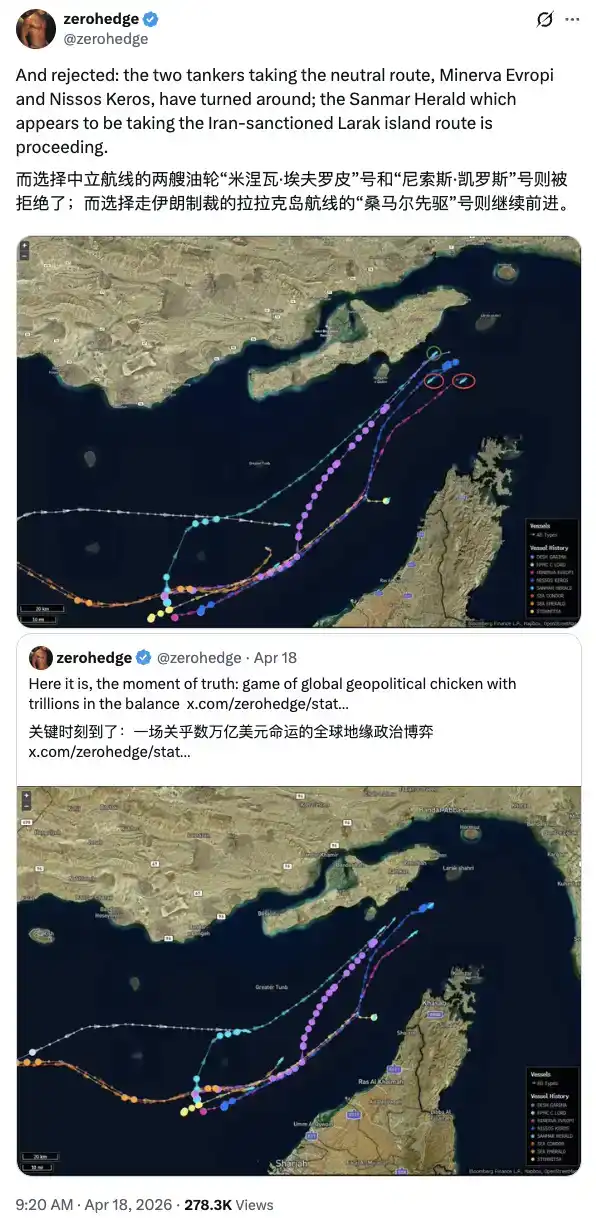
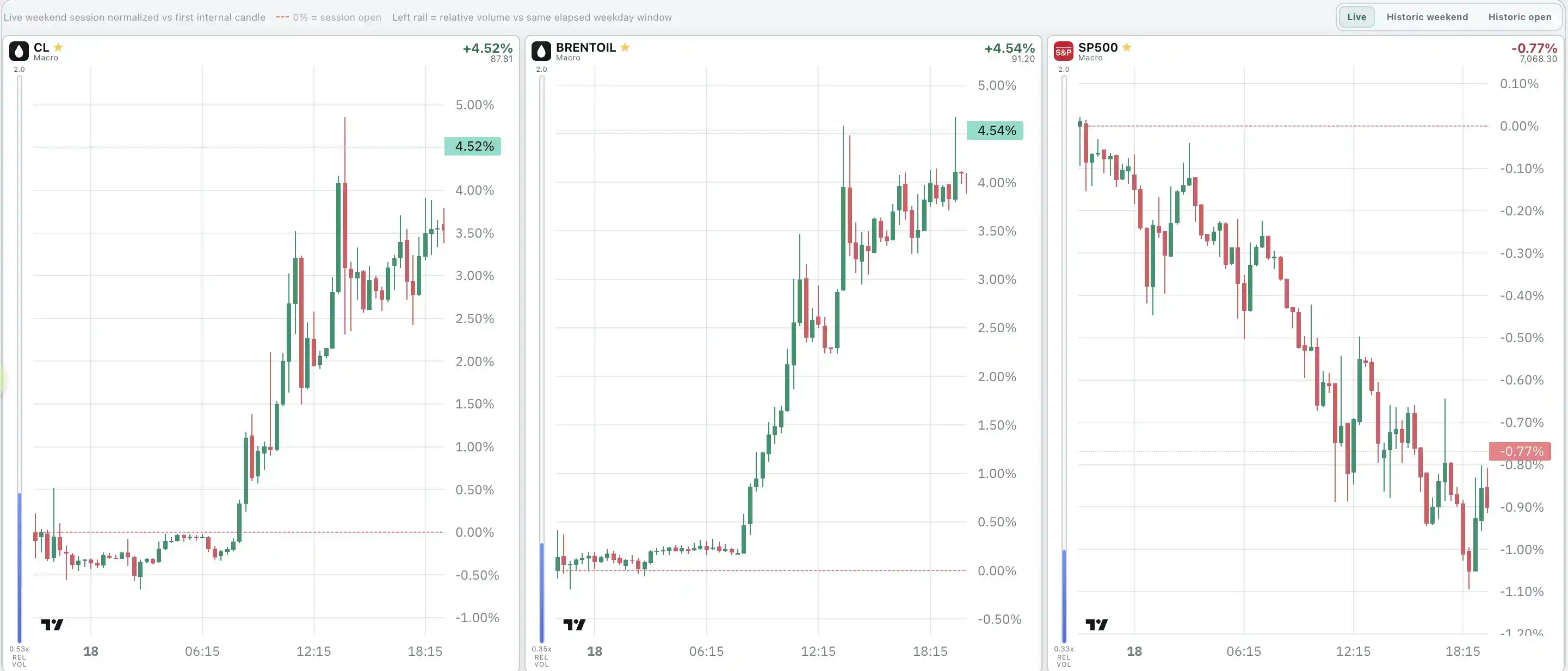
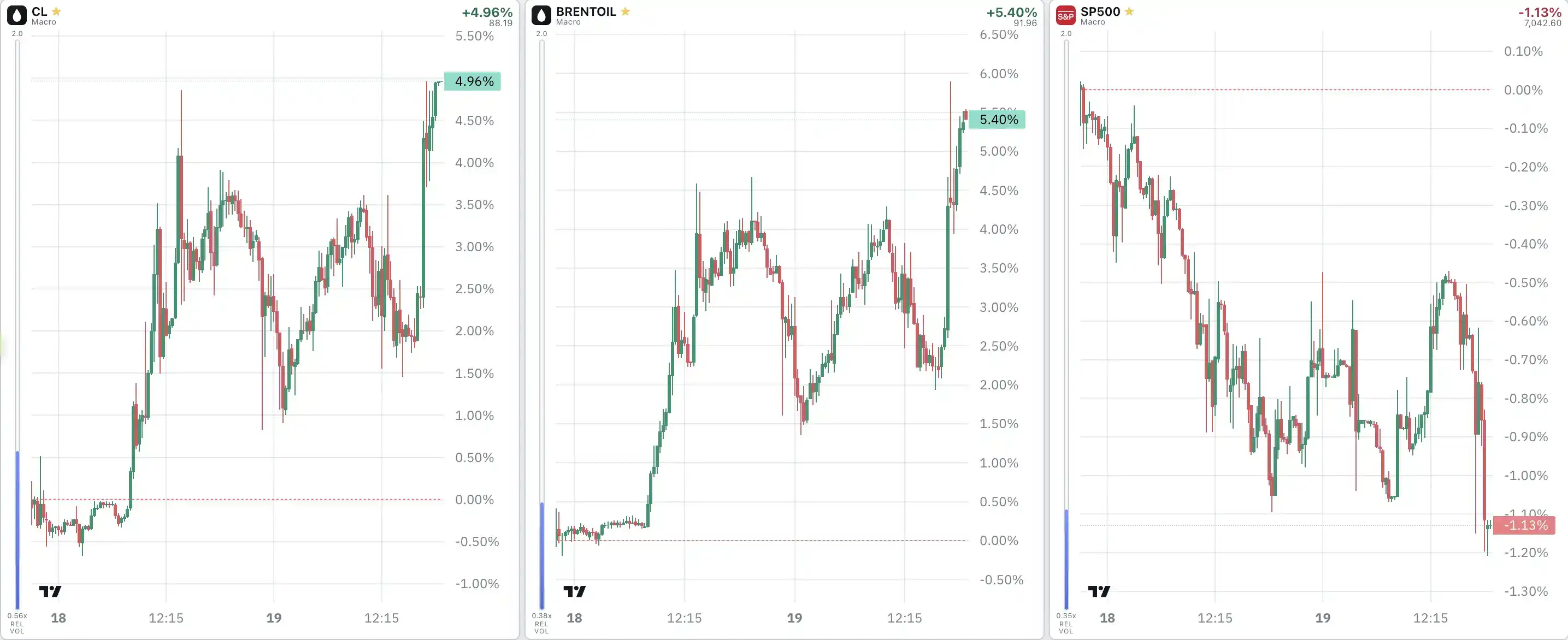
Traders reacted swiftly on TradeXYZ, with crude oil contracts gaining about 4.52% compared to the weekend closing price, and S&P index contracts falling nearly 0.8%.
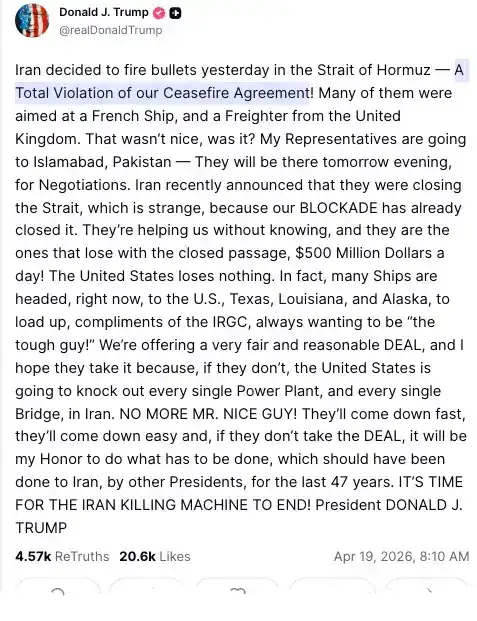
Trump then shifted his stance, revealing that envoy Steve Witkoff would travel to Pakistan for talks with the Iranian side on Tuesday, potentially extending the negotiation window until Wednesday.

He then turned around and posted on Truth Social, stating, "The deal we offered is very fair and reasonable, I hope they accept it, because if they don't, the U.S. will destroy every power plant and every bridge in Iran."
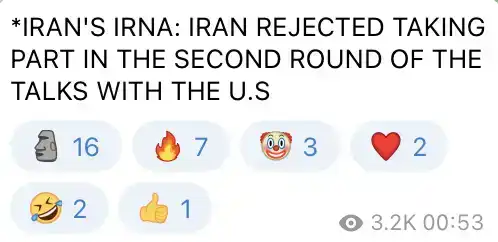
Iran was clearly not buying it. At 1:53 AM on the 20th, the Iranian side announced its refusal to participate in a second round of talks; according to Axios, Tehran's assessment was that the U.S. might launch an attack before the Tuesday night ceasefire expiration.
Driven by this news, crude oil surged again, clearing the highs from the 18th, while the S&P index correspondingly broke below the lows from the 18th.
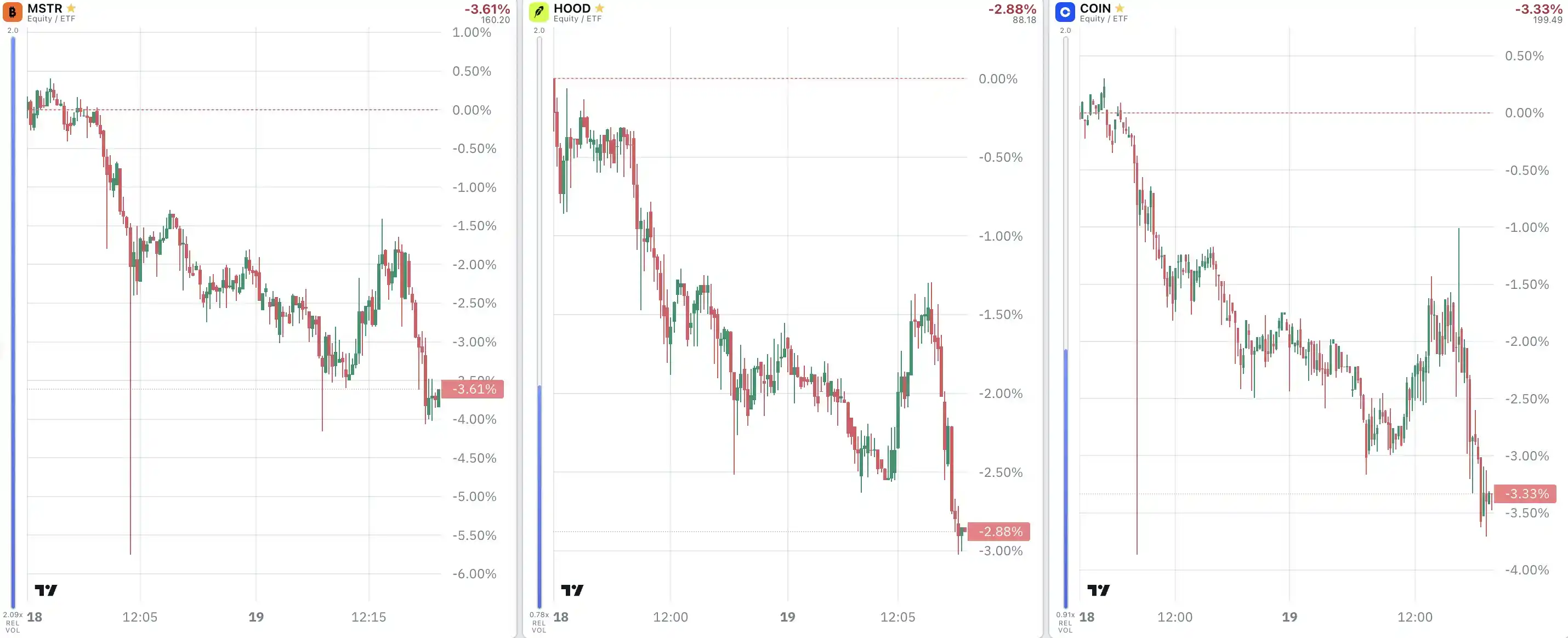
On the individual stock front, three crypto-related stocks significantly underperformed others.
Predictably, the spreading optimism in the market last week will be punished. This week's market movements will largely depend on whether Iran can maintain its no-negotiation stance.


Пов'язані питання

QWhat event initially caused the surge in risk appetite in the markets on Friday?

AThe reopening of the Strait of Hormuz shipping lane.

QWhat specific action did Iran take on Saturday that reversed the initial market optimism?

AIran re-imposed restrictions on the Strait of Hormuz and fired on vessels attempting to pass through, causing shipping to nearly halt.

QHow did crude oil futures react on TradeXYZ following the news of the Strait of Hormuz incident?

ACrude oil contracts rose by approximately 4.52% compared to the weekend's closing price.

QWhat was the content of Donald Trump's threat on Truth Social if Iran did not accept the U.S. deal?

AHe stated that if Iran did not accept the deal, the U.S. would 'destroy every power plant and every bridge in Iran.'

QWhat was the final event that caused crude oil to surge again and erase the previous day's highs?

AIran's announcement that it would refuse to participate in the second round of negotiations, fueled by reports that the U.S. might launch an attack before the ceasefire expired.

Пов'язані матеріали

The Verdict in Choi Tae-won's Divorce Case: Revealing the Inheritance Undercurrent Behind SK Hynix's Trillion-Won Empire

SK Group Chairman Chey Tae-won's high-profile divorce case, involving a record 1.38 trillion won settlement, has drawn attention to the succession plans for Korea's second-largest conglomerate, especially its crown jewel, SK hynix. Unlike traditional chaebol scripts centered on the eldest son, Chey's three children from his marriage to former President Roh Tae-woo's daughter, Roh Soh-yeong, are carving distinct, non-traditional paths. Eldest daughter Chey Yun-jung (b. 1989) is seen as the most evident successor. With a scientific and consulting background, she holds executive roles at SK bioscience and SK Inc.'s growth support department, focusing on future strategy and biopharma. Her marriage is to an AI infrastructure entrepreneur, not a traditional business alliance. Second daughter Chey Min-jung (b. 1991) took a unique route, voluntarily serving as a South Korean naval officer, including an anti-piracy deployment. She later worked on policy and strategy for SK hynix in Washington D.C. before co-founding an AI-driven healthcare startup. She married a former U.S. Marine Corps officer, connecting her to U.S. defense and policy circles—networks crucial for a global semiconductor giant. The only son, Chey In-geun (b. 1995), who studied physics like his father, worked briefly at SK E&S before joining McKinsey. Despite fitting the traditional "heir" profile as the eldest son, he remains silent and holds no public position or shares in SK, suggesting the old succession playbook is obsolete. As SK hynix's valuation soars, becoming a geopolitical asset in the AI era, the heirs' legitimacy is no longer automatic. They must prove themselves in fields like AI biotech, global policy, and strategic consulting. Their marriages also reflect new elite networks in tech and defense, not old political alliances. Their inheritance is the complex challenge of navigating a globalized, tech-driven world, not just a corporate throne.

marsbit4 год тому

The Verdict in Choi Tae-won's Divorce Case: Revealing the Inheritance Undercurrent Behind SK Hynix's Trillion-Won Empire

marsbit4 год тому

From OpenSea to OpenRouter: Is Alex Atallah Repeating His 'Exit at the Peak' Playbook?

From OpenSea to OpenRouter: Is Alex Atallah Repeating His "Exit at the Peak" Playbook? According to the Wall Street Journal, payments giant Stripe is in talks to acquire the AI model aggregation platform OpenRouter in a potential deal valuing the company near $100 billion. This would mark founder Alex Atallah's second creation of a company reaching a $100 billion valuation, following his co-founding of NFT marketplace OpenSea. OpenRouter, founded just over three years ago, has grown rapidly by acting as a unified gateway for developers to access over 400 AI models. It currently has about 10 million users and processes over 200 trillion tokens monthly. While the platform's annualized revenue is around $50 million, its valuation has skyrocketed from $1.3 billion in March 2026. The potential acquisition by Stripe, a company OpenRouter's founder once likened it to, represents a major expansion into AI infrastructure for the payments leader. This move echoes Atallah's previous timing with OpenSea, where he departed before the NFT market's significant downturn. For OpenRouter, selling now may be strategic. Despite its scale, its business model—charging a 5-5.5% fee on AI inference calls—faces pressure from competition, open-source models, and potential price wars among model providers, limiting its profitability narrative for an IPO. A key asset for potential acquirers like Stripe is OpenRouter's vast repository of real-world AI usage data, which offers unique insights into model performance and developer preferences that are difficult to replicate. Whether this potential deal signifies a new valuation benchmark for AI infrastructure or another market peak signal remains to be seen.

链捕手5 год тому

From OpenSea to OpenRouter: Is Alex Atallah Repeating His 'Exit at the Peak' Playbook?

链捕手5 год тому

Торгівля

Спот
活动图片




