Pledging ETH Earned a Steady $46 Million, So Why is BitMine Still Deep in the Red?

marsbitОпубліковано о 2026-07-16Востаннє оновлено о 2026-07-16

Анотація

BitMine reported a significant surge in revenue for Q3 FY2026, driven by its Ethereum staking and validation business which generated $45.7 million. However, the company posted a net loss of $83.6 million, primarily due to a $92.1 million loss from Ethereum derivatives and options trading. This loss, stemming largely from expired contracts and exercised positions, completely offset the gains from staking. To fund its aggressive accumulation of Ethereum, BitMine has heavily relied on equity financing, significantly diluting existing shareholders. In the first nine months of the fiscal year, it issued over 340 million shares to raise approximately $11.87 billion, using most of it to purchase Ethereum. As of May 31, the company held 5.42 million ETH with an average cost of $19.05 billion, resulting in an unrealized loss of roughly $8.2 billion due to market depreciation. While staking provides a stable cash flow that covers core operational costs, the company faces rising expenses from long-term service agreements and high management fees. Additionally, BitMine remains highly dependent on continuous access to capital markets for funding its operations and expansion. The company's long-term viability hinges on its staking income consistently covering these costs and future losses, its ability to secure ongoing equity financing, and a substantial recovery in the price of Ethereum.

Original Author: Oluwapelumi Adejumo

Original Compilation: Chopper

BitMine has aggressively built up its Ethereum holdings, aiming to turn them into a stable source of cash flow. In the last quarter, its staking business generated nearly $46 million in revenue.

However, a $92.1 million loss on derivative options completely offset the staking gains. Coupled with persistently rising asset management costs and aggressive share issuances, the profit potential for existing shareholders was significantly compressed.

The Q3 FY2026 financial report, for the period ending May 31, shows company revenue skyrocketed to $46.5 million from $2.1 million in the same period last year. Of this, 98% ($45.7 million) came from staking and node validation services. BitMine is accelerating its shift away from Bitcoin mining operations to fully embrace an Ethereum treasury model.

Behind the substantial revenue growth, the company recorded a net loss of $83.6 million this quarter, a dramatic increase compared to a modest loss of $623,000 in the same quarter last year.

Huge Options Loss Erases All Ethereum Staking Gains

The core factor dragging down this quarter's performance was the company's Ethereum derivatives options trading strategy. BitMine incurred a total loss of $92.1 million on Ethereum-related derivatives this quarter, roughly double the total revenue from its staking business in the same period. Of this, $78.6 million came from net losses on expired option contracts, and $14 million from losses on exercised positions. A mere $534,000 gain from open contracts only slightly offset part of the loss.

The company engaged in no derivative trading during the same period last year, marking a qualitative leap in the risk exposure of its asset management operations. For the first nine months of this fiscal year, cumulative derivative losses reached $133.3 million, consisting of $79.3 million in losses from exercises, $54.5 million in losses from expired contracts, and only $515,000 in profit from open contracts. During the same period, the staking and validation businesses generated only $56.9 million combined—derivative losses were over twice the staking income.

BitMine stated that its options strategy primarily involves selling put options as part of an overall portfolio management plan. While selling put options can generate premium income and allow for asset accumulation during price dips, significant losses occur when market moves against the position and contracts are exercised under unfavorable conditions. This substantial loss clearly demonstrates that the attempt to boost returns using options has currently completely negated the stable income created by node staking operations.

Simultaneously, the company's administrative and general expenses surged from $744,000 a year ago to $37.3 million. Management explained the increase was mainly due to digital asset custody and management service fees, increased salaries, and increased cash and stock-based compensation for directors.

Before adjustments for crypto asset valuation changes, staking revenue was sufficient to cover this quarter's cost of sales and administrative expenses. Even after excluding several non-cash items, the company's own adjusted non-GAAP net loss still reached $70.8 million. This report indicates that the node validation business has generated considerable stable cash flow, but the overall portfolio trading strategy continues to consume staking profits.

Continued Issuance of BMNR Stock to Hoard Ethereum, Shareholder Equity Heavily Diluted

The funds for BitMine's large-scale Ethereum hoarding come almost entirely from public market issuances of common stock, with the cost fully borne by existing shareholders. In the nine months ended May 31, the company sold a cumulative 340.7 million shares of BMNR common stock through its at-the-market offering program, raising $11.87 billion net of issuance costs. Over the same period, it spent $11.69 billion purchasing Ethereum.

Shareholder equity has been significantly diluted. The number of outstanding common shares increased by 149% over nine months, from 232.4 million shares as of August 31, 2025, to 579.7 million shares by the end of May 2026. The issuance continued after the quarter-end, with total shares reaching 603.2 million as of July 9.

Relying on equity financing, BitMine held a cumulative 5.42 million Ethereum as of May 31, with a comprehensive carrying cost of $19.05 billion. At the time of writing, the holding had increased to 5.7 million Ethereum.
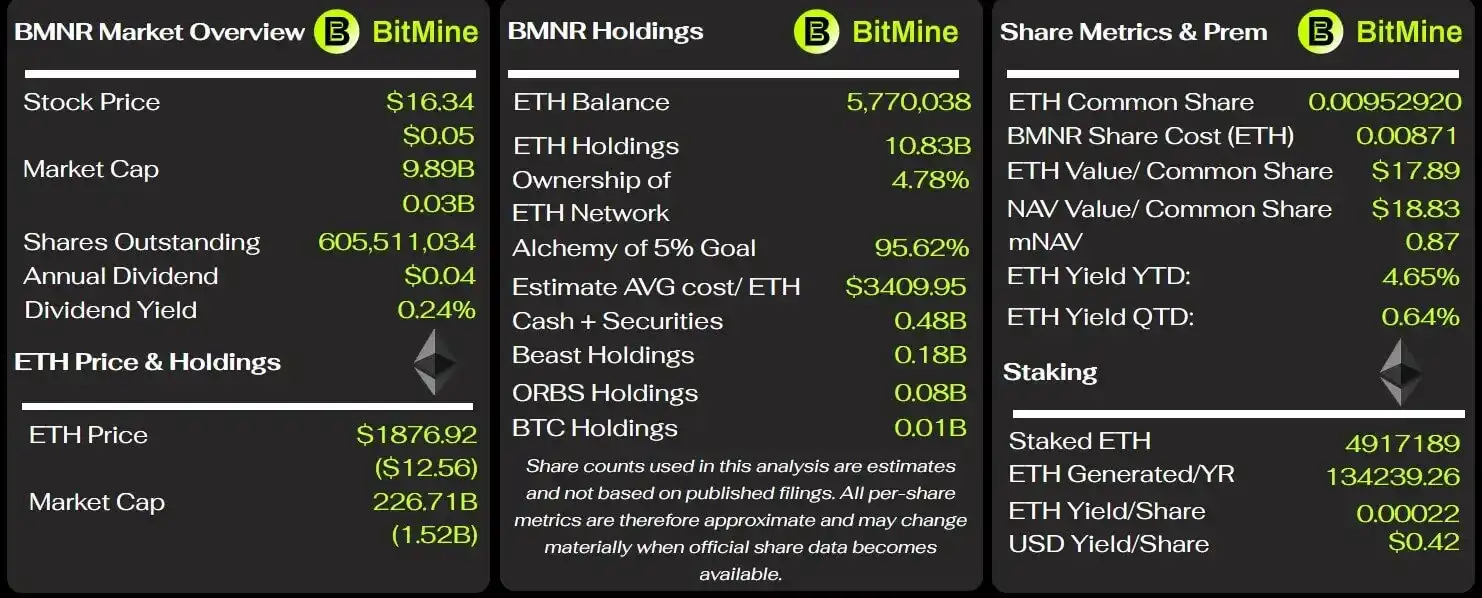
BitMine's Key Metrics, Source: BitMine Tracker

The market value of this Ethereum holding was only $10.86 billion at the end of May, representing a paper loss of approximately $8.2 billion, or a 43% unrealized loss.

This holding impairment is the primary source of the company's $9.04 billion unrealized loss on digital assets for the first nine months of this fiscal year, during which the company's cumulative net loss was $9.1 billion. The massive paper loss vividly illustrates that BitMine's share issuances to buy Ethereum at high prices place all the risk on shareholders.

A shareholder meeting in January this year approved increasing the company's authorized common share ceiling from 500 million shares to 50 billion shares. This authorization does not obligate the company to issue all shares but gives management ample room to continue issuing stock for purchasing digital assets and other investments.

BitMine notes that its ability to expand its Ethereum holdings is highly dependent on continued access to financing channels. A decline in Ethereum's price, weakness in the company's stock price, or waning investor appetite for its offerings could raise future financing costs or even limit the company's ability to issue securities on favorable terms.

The viability of this business model depends not only on staking annualized returns and future Ethereum price appreciation but also on shareholders accepting significant equity dilution and the company's portfolio carrying billions in paper losses for years, while continuously providing capital for its coin hoarding.

Long-Term Service Contracts Increase Staking Operational Costs, Squeezing Profit Margins

BitMine relies on its staking business to hedge portfolio price volatility, but the accompanying long-term cooperation agreements generate fixed fees and profit-sharing, continuously squeezing overall profits. The company has a ten-year consulting agreement with third-party service provider Ethereum Tower, incurring an expense of $12.8 million this quarter, accounting for roughly 28% of total staking revenue for the period. Cumulative expenses for this agreement totaled $37.5 million for the first nine months; the company estimates annual costs in the range of $40-50 million, calculated on a tiered basis according to the total value of custodial digital assets.

This agreement can only be terminated under a few specific conditions. If BitMine terminates the agreement without cause, it must pay Ethereum Tower 85% of all estimated service fees for the remaining contract term.

Additionally, following the acquisition of node operator Pier Two, BitMine entered a separate ten-year managed services agreement. This agreement grants Ethereum Tower a 2% equity stake in the MAVAN platform, with monthly revenue sharing based on the proportion of native staking rewards generated by the platform. As of May 31, the company had not yet recognized any expenses related to this agreement, so the sharing cost has not yet impacted the staking business profit statement.

BitMine states that the vast majority of its Ethereum is staked through MAVAN, and in the long run, staking rewards are sufficient to cover asset custody costs. At an operational level for this quarter alone, staking revenue did cover sales and administrative expenses excluding crypto asset valuation changes. However, when factoring in the decade-long fixed consulting fee, future profit-sharing, and various asset management expenses, relying solely on staking income cannot fully measure the business's true profitability.

BitMine Has No Debt, but Reliance on Capital Markets Deepens

As of the end of May, BitMine's balance sheet showed extremely low leverage, with $340.3 million in cash, working capital of $433.1 million, and no traditional debt. The company's total assets stood at $11.63 billion, with total liabilities at only $30.1 million, the vast majority of assets being digital assets like Ethereum. On paper, the company faces no immediate solvency crisis, but operating activities used $287.6 million in cash during the first nine months. The company attributes this cash burn mainly to legal, consulting, and investment banking fees related to the expansion of its Ethereum holdings and fundraising.

After the quarter ended, BitMine issued another 3.5 million shares of its 9.5% annualized perpetual preferred stock, BMNP, raising $273.8 million. This issuance provides short-term liquidity but adds a new rigid annual dividend expense of $32.25 million for the preferred shares. While these securities are equity, not debt, they rank senior to common stock for distributions, and the high dividends continuously consume company cash flow.

Management believes existing cash, anticipated operating cash flow, and its at-the-market offering facility are sufficient to fund operations for at least the next 12 months. This assessment assumes capital markets remain open for financing. Should Ethereum prices remain depressed long-term, the company's stock price weaken, or investor appetite wane, the company's financing costs would rise, limiting operational flexibility.

In summary, BitMine's latest financial report paints a picture of conflicting realities: On one hand, the company has built a mature staking business generating tens of millions per quarter, capable of covering core operating expenses. On the other hand, massive options losses completely devour staking profits, long-term contracts persistently increase management costs, Ethereum hoarding expansion relies entirely on stock issuance, and the total share count has more than doubled.

Therefore, BitMine's long-term economic viability depends on whether staking revenue can stably cover various asset management costs and options losses, whether the company can maintain consistent access to equity financing, and whether the Ethereum price can stage a significant recovery.


Трендові криптовалюти

Пов'язані питання

QAccording to the article, why did BitMine experience a significant net loss of $83.6 million in Q3 of fiscal year 2026 despite its staking revenue reaching nearly $46 million?

ABitMine's significant net loss was primarily caused by massive losses of $92.1 million from its Ethereum derivatives and options trading strategies, which completely offset the gains from its staking business. Additionally, rising administrative and management expenses contributed to the overall loss.

QHow is BitMine funding its massive accumulation of Ethereum holdings, and what impact does this have on existing shareholders?

ABitMine is funding its Ethereum purchases almost entirely by issuing new common stock (BMNR) in public markets. This has led to significant dilution of existing shareholders' equity, with the number of outstanding shares increasing by 149% over nine months.

QWhat are the key factors identified in the article that are compressing the profit margin of BitMine's staking operations?

AThe profit margin of BitMine's staking operations is compressed by long-term service contracts with fixed fees and future revenue sharing (e.g., the 10-year agreement with Ethereum Tower), high management and administrative expenses, and massive losses from its options trading strategies.

QDespite having no traditional debt, why is BitMine described as being increasingly dependent on capital markets?

ABitMine is dependent on capital markets because its business model relies on continuously issuing new securities (common stock and preferred stock) to fund Ethereum purchases and cover operational cash outflows. Its ability to maintain this model depends on favorable market conditions and sustained investor appetite for its stock.

QWhat was the unrealized loss on BitMine's Ethereum holdings as of May 31, and what contributed to this situation?

AAs of May 31, BitMine's Ethereum holdings had an unrealized loss of approximately $8.2 billion, representing a 43% loss. This situation resulted from the company aggressively buying Ethereum at high prices using funds raised from stock issuance, just before or during a market downturn where Ethereum's price fell.

Пов'язані матеріали

Are Meme Coins a Shortcut or a Trap? Robinhood Chain Faces a Crucial Decision

Robinhood Chain, the blockchain initiative by the brokerage platform, is experiencing a strong initial surge in activity. Key metrics include over 300,000 daily active addresses, daily DEX trading volume surpassing $1 billion (ranking second among public blockchains), and a TVL exceeding $3 billion. However, the article expresses significant concern that this growth is overwhelmingly driven by memecoin trading, as observed on the Robinhood Wallet. The author argues this is a dangerous shortcut. While memecoins can rapidly boost user numbers, trading volume, and liquidity, they often result in substantial investor losses, erode trust in the ecosystem, and risk cementing Robinhood's reputation as a speculative, meme-driven platform—a perception Wall Street already holds. The piece contrasts this path with that of Coinbase's Base chain, which has emphasized fostering applications with real utility and sustainable business models. It urges Robinhood Chain to avoid becoming a "memecoin chain" and instead focus its resources on substantial use cases, particularly the tokenization of real-world assets (RWA). The proposed strategic pivot is toward facilitating global access to tokenized stocks, RWA, and other real financial instruments through its chain. This aligns with crypto's original promise of democratizing finance and represents Robinhood's largest growth opportunity: tapping into over 100 million potential new international users beyond its nearing-saturation U.S. market. Success in this direction could drive significant future revenue and redefine the company's legacy beyond the meme-stock narrative. The core message is a plea to Robinhood's leadership: choose sustainable, value-creating finance over the fleeting and damaging allure of memecoins.

Foresight News1 год тому

Are Meme Coins a Shortcut or a Trap? Robinhood Chain Faces a Crucial Decision

Foresight News1 год тому

Торгівля

Спот

Популярні статті

Що таке ETH 2.0

ETH 2.0: Нова ера для Ethereum Вступ ETH 2.0, широко відомий як Ethereum 2.0, є величезним оновленням для блокчейну Ethereum. Ця трансформація не є лише косметичною зміною; вона має на меті фундаментально покращити масштабованість, безпеку та сталий розвиток мережі. З переходом від енергомісткого механізму консенсусу Proof of Work (PoW) до більш ефективного Proof of Stake (PoS), ETH 2.0 обіцяє трансформаційний підхід до екосистеми блокчейнів. Що таке ETH 2.0? ETH 2.0 — це збірка особливих, взаємопов’язаних оновлень, спрямованих на оптимізацію можливостей та продуктивності Ethereum. Це перетворення розроблене для вирішення критичних викликів, з якими стикалося існуюче механізм Ethereum, зокрема щодо швидкості транзакцій та заторів у мережі. Мета ETH 2.0 Основні цілі ETH 2.0 зосереджені на покращенні трьох ключових аспектів: Масштабованість: Мета — значно підвищити кількість транзакцій, які мережа може обробити за секунду; ETH 2.0 прагне вийти за межі поточного обмеження приблизно в 15 транзакцій на секунду, потенційно досягнувши тисяч. Безпека: Підвищені заходи безпеки є невід’ємною частиною ETH 2.0, зокрема через покращену стійкість до кібератак і збереження децентралізованої етики Ethereum. Сталий розвиток: Новий механізм PoS розроблений не тільки для підвищення ефективності, але й для різкого зменшення споживання енергії, що узгоджує операційну структуру Ethereum з екологічними міркуваннями. Хто є творцем ETH 2.0? Створення ETH 2.0 можна віднести до Ethereum Foundation. Ця неприбуткова організація, яка відіграє важливу роль у підтримці розвитку Ethereum, очолюється відомим співавтором Віталіком Бутеріним. Його бачення більш масштабованого та стійкого Ethereum стало рушійною силою цього оновлення, залучаючи внески зі всього світу від розробників і ентузіастів, які прагнуть покращити протокол. Хто є інвесторами ETH 2.0? Хоча подробиці про інвесторів ETH 2.0 не були оприлюднені, відомо, що Ethereum Foundation отримує підтримку від різних організацій та осіб у сфері блокчейну та технологій. Ці партнери включають венчурні капітальні компанії, технологічні компанії та філантропічні організації, які мають спільний інтерес у підтримці розвитку децентралізованих технологій та інфраструктури блокчейну. Як працює ETH 2.0? ETH 2.0 відзначається введенням низки ключових функцій, які відрізняють його від попередника. Proof of Stake (PoS) Перехід до механізму консенсусу PoS є одним із знакових змін ETH 2.0. На відміну від PoW, який покладається на енергомісткий видобуток для перевірки транзакцій, PoS дозволяє користувачам підтверджувати транзакції та створювати нові блоки відповідно до кількості ETH, яку вони ставлять у мережі. Це призводить до підвищення енергоефективності, зменшуючи споживання приблизно на 99,95%, завдяки чому Ethereum 2.0 стає значно більш екологічною альтернативою. Шардові ланцюги Шардові ланцюги є ще одним ключовим нововведенням ETH 2.0. Ці менші ланцюги працюють паралельно з основним ланцюгом Ethereum, що дозволяє обробляти кілька транзакцій одночасно. Це підходи покращує загальну ємність мережі, усуваючи проблеми масштабованості, які переслідували Ethereum. Beacon Chain У центрі ETH 2.0 знаходиться Beacon Chain, яка координує мережу і управляє протоколом PoS. Вона виконує роль організатора: контролює валідаторів, забезпечує з’єднання шард з мережею і моніторить загальний стан екосистеми блокчейнів. Хронологія ETH 2.0 Шлях ETH 2.0 характеризується кількома ключовими етапами, які відображають еволюцію цього значного оновлення: Грудень 2020: Запуск Beacon Chain ознаменував введення PoS, проклавши шлях до міграції на ETH 2.0. Вересень 2022: Завершення "Злиття" є знаковим моментом, коли мережа Ethereum успішно перейшла з PoW на PoS, відкриваючи нову еру для Ethereum. 2023: Очікуване розгортання шардових ланцюгів має на меті подальше покращення масштабованості мережі Ethereum, закріплюючи ETH 2.0 як надійну платформу для децентралізованих додатків і послуг. Ключові особливості та переваги Покращена масштабованість Однією з найзначніших переваг ETH 2.0 є його покращена масштабованість. Поєднання PoS та шардових ланцюгів дозволяє мережі розширити свою ємність, що дозволяє їй обробляти набагато більший обсяг транзакцій в порівнянні з класичною системою. Енергоефективність Запровадження PoS є величезним кроком до енергоефективності в технології блокчейн. Значно зменшуючи споживання енергії, ETH 2.0 не тільки знижує операційні витрати, але також ближче узгоджується з глобальними цілями сталого розвитку. Підвищена безпека Оновлені механізми ETH 2.0 сприяють підвищенню безпеки по всій мережі. Впровадження PoS, поряд з інноваційними контрольними заходами, встановленими через шардові ланцюги та Beacon Chain, забезпечує вищий рівень захисту від потенційних загроз. Зниження витрат для користувачів З покращенням масштабованості вплив на витрати на транзакції також стане очевидним. Збільшена ємність і зменшені затори, як очікується, призведуть до зниження зборів для користувачів, що зробить Ethereum більш доступним для повсякденних транзакцій. Висновок ETH 2.0 є значною еволюцією в екосистемі блокчейну Ethereum. Оскільки він вирішує важливі питання, такі як масштабованість, споживання енергії, ефективність транзакцій і загальна безпека, важливість цього оновлення не можна недооцінювати. Перехід до Proof of Stake, введення шардових ланцюгів і фундаментальна робота Beacon Chain свідчать про майбутнє, в якому Ethereum може задовольнити зростаючі вимоги децентралізованого ринку. В індустрії, що рухається вперед завдяки інноваціям та прогресу, ETH 2.0 є підтвердженням можливостей технології блокчейн у прокладенні шляху до більш сталого та ефективного цифрового економіки.

195 переглядів усьогоОпубліковано 2024.04.04Оновлено 2024.12.03

Що таке ETH 2.0

Що таке ETH 3.0

ETH3.0 та $eth 3.0: Глибоке дослідження майбутнього Ethereum Вступ У швидко змінюваному світі криптовалют та технології блокчейн, ETH3.0, часто позначуваний як $eth 3.0, став темою значного інтересу та спекуляцій. Цей термін охоплює два основні концепти, які потребують уточнення: Ethereum 3.0: Це потенційне майбутнє оновлення, яке має на меті покращення можливостей існуючого блокчейну Ethereum, зокрема, фокусуючись на поліпшенні масштабованості та продуктивності. ETH3.0 Мем Токен: Цей окремий криптовалютний проект прагне використовувати блокчейн Ethereum для створення екосистеми, орієнтованої на меми, сприяючи залученню до криптовалютної громади. Розуміння цих аспектів ETH3.0 є важливим не лише для криптоентузіастів, але й для тих, хто спостерігає за широкими технологічними тенденціями у цифровому просторі. Що таке ETH3.0? Ethereum 3.0 Ethereum 3.0 пропонується як оновлення вже існуючої мережі Ethereum, яка стала основою багатьох децентралізованих додатків (dApps) та смарт-контрактів з моменту свого виникнення. Передбачувані удосконалення зосереджені в основному на масштабованості — інтегруючи передові технології, такі як шардінг та нульові знання (zk-докази). Ці технологічні нововведення націлені на забезпечення безпрецедентної кількості транзакцій на секунду (TPS), потенційно досягаючи мільйонів, тим самим вирішуючи одну з найзначніших обмежень, з якими стикається сучасна технологія блокчейн. Покращення є не лише технічним, а й стратегічним; воно спрямоване на підготовку мережі Ethereum до широкого прийняття та корисності в майбутньому, позначеному збільшеним попитом на децентралізовані рішення. ETH3.0 Мем Токен На відміну від Ethereum 3.0, ETH3.0 Мем Токен пропонує легшу та грайливішу домену, поєднуючи культуру інтернет-мемів із динамікою криптовалют. Цей проект дозволяє користувачам купувати, продавати та обмінювати меми на блокчейні Ethereum, надаючи платформу, яка сприяє залученню громади через креативність та спільні інтереси. ETH3.0 Мем Токен має на меті продемонструвати, як технологія блокчейн може перетинатися з цифровою культурою, створюючи випадки використання, які є водночас розважальними та фінансово життєздатними. Хто є творцем ETH3.0? Ethereum 3.0 Ініціатива щодо Ethereum 3.0 переважно підтримується консорціумом розробників та дослідників у межах громади Ethereum, зокрема, до складу якого входить Джастін Дрейк. Відомий своїми думками та внеском у розвиток Ethereum, Дрейк є помітною особистістю в обговореннях щодо переходу Ethereum на новий рівень консенсусу, який називається «Beam Chain». Цей колабораційний підхід до розробки свідчить про те, що Ethereum 3.0 не є продуктом єдиного творця, а скоріше втіленням колективної винахідливості, спрямованої на просування технології блокчейн. ETH3.0 Мем Токен Деталі про творця ETH3.0 Мем Токена наразі не відстежуються. Природа мем-токенів часто призводить до більш децентралізованої та громартової структури, що може пояснити відсутність специфічної атрибуції. Це узгоджується з етикою ширшої крипто-спільноти, де інновації часто виникають з колективних, а не індивідуальних зусиль. Хто є інвесторами ETH3.0? Ethereum 3.0 Підтримка Ethereum 3.0 переважно надходить від Фонду Ethereum поряд з ентузіастичною спільнотою розробників та інвесторів. Це базове співробітництво надає значний градус легітимності та підвищує ймовірність успішної реалізації, оскільки воно використовує довіру та авторитет, накопичені за роки роботи мережі. У швидко змінюваному кліматі криптовалют підтримка громади займає важливу роль у розвитку та прийнятті, позиціонуючи Ethereum 3.0 як серйозного конкурента для майбутніх блокчейн-інновацій. ETH3.0 Мем Токен Хоча наразі доступні джерела не надають явної інформації щодо інвестиційних фондів або організацій, що підтримують ETH3.0 Мем Токен, це свідчить про типову модель фінансування для мем-токенів, яка часто спирається на підтримку знизу та залучення громади. Інвестори в такі проекти зазвичай складаються з осіб, які мотивовані потенціалом інновацій, що керуються спільнотою, та духом співпраці, притаманним крипто-спільноті. Як працює ETH3.0? Ethereum 3.0 Відмінні риси Ethereum 3.0 полягають у його запропонованій реалізації технології шардінгу та zk-proof. Шардінг — це метод розподілу блокчейну на менші, керовані частини чи «шарди», які можуть обробляти транзакції одночасно, а не послідовно. Це децентралізоване оброблення допомагає запобігти заторам та забезпечити оперативність мережі навіть під великим навантаженням. Технологія нульових доказів (zk-proof) надає ще один рівень складності, дозволяючи валідацію транзакцій без розкриття підпорядкованих даних. Цей аспект не лише підвищує конфіденційність, а й збільшує загальну ефективність мережі. Також обговорюється включення нульової Ефірної віртуальної машини (zkEVM) в це оновлення, що ще більше підвищить можливості та корисність мережі. ETH3.0 Мем Токен ETH3.0 Мем Токен виділяється завдяки використанню популярності культури мемів. Він створює ринок, на якому користувачі можуть брати участь у торгівлі мемами не лише для розваги, але й для потенційного економічного вигоди. Інтегруючи функції, такі як стейкінг, забезпечення ліквідності та механізми управління, проект сприяє створенню середовища, яке заохочує взаємодію та участь громади. Пропонуючи унікальне поєднання розваг та економічних можливостей, ETH3.0 Мем Токен прагне залучити різну аудиторію, яка охоплює від криптоентузіастів до casual-консумерів мемів. Хронологія ETH3.0 Ethereum 3.0 11 листопада 2024: Джастін Дрейк натякає на майбутнє оновлення ETH 3.0, яке зосереджене на поліпшеннях масштабованості. Це оголошення означає початок формальних обговорень щодо майбутньої архітектури Ethereum. 12 листопада 2024: Очікується, що запропоновану пропозицію для Ethereum 3.0 буде представлено на Devcon у Бангкоку, що готує ґрунт для більш широкого зворотного зв'язку від громади та потенційних наступних кроків у розвитку. ETH3.0 Мем Токен 21 березня 2024: ETH3.0 Мем Токен офіційно потрапляє у список на CoinMarketCap, що означає його дебют у публічному крипто-просторі та підвищує видимість для його меморієнтованої екосистеми. Ключові моменти На завершення, Ethereum 3.0 представляє значну еволюцію в межах мережі Ethereum, зосереджуючись на подоланні обмежень щодо масштабованості та продуктивності через передові технології. Його запропоновані оновлення відображають проактивний підхід до майбутніх вимог і корисності. Натомість ETH3.0 Мем Токен втілює суть культури, керованої громадою, у сфері криптовалют, використовуючи культуру мемів для створення привабливих платформ, які заохочують творчість і участь користувачів. Розуміння окремих цілей і функцій ETH3.0 та $eth 3.0 є надзвичайно важливим для кожного, хто цікавиться поточними подіями в крипто-просторі. З обома ініціативами, які прокладають унікальні шляхи, вони разом підкреслюють динамічну та багатогранну природу інновацій у блокчейн-технологіях.

182 переглядів усьогоОпубліковано 2024.04.04Оновлено 2024.12.03

Що таке ETH 3.0

Як купити ETH

Ласкаво просимо до HTX.com! Ми зробили покупку Ethereum (ETH) простою та зручною. Дотримуйтесь нашої покрокової інструкції, щоб розпочати свою криптовалютну подорож.Крок 1: Створіть обліковий запис на HTXВикористовуйте свою електронну пошту або номер телефону, щоб зареєструвати обліковий запис на HTX безплатно. Пройдіть безпроблемну реєстрацію й отримайте доступ до всіх функцій.ЗареєструватисьКрок 2: Перейдіть до розділу Купити крипту і виберіть спосіб оплатиКредитна/дебетова картка: використовуйте вашу картку Visa або Mastercard, щоб миттєво купити Ethereum (ETH).Баланс: використовуйте кошти з балансу вашого рахунку HTX для безперешкодної торгівлі.Треті особи: ми додали популярні способи оплати, такі як Google Pay та Apple Pay, щоб підвищити зручність.P2P: Торгуйте безпосередньо з іншими користувачами на HTX.Позабіржова торгівля (OTC): ми пропонуємо індивідуальні послуги та конкурентні обмінні курси для трейдерів.Крок 3: Зберігайте свої Ethereum (ETH)Після придбання Ethereum (ETH) збережіть його у своєму обліковому записі на HTX. Крім того, ви можете відправити його в інше місце за допомогою блокчейн-переказу або використовувати його для торгівлі іншими криптовалютами.Крок 4: Торгівля Ethereum (ETH)Легко торгуйте Ethereum (ETH) на спотовому ринку HTX. Просто увійдіть до свого облікового запису, виберіть торгову пару, укладайте угоди та спостерігайте за ними в режимі реального часу. Ми пропонуємо зручний досвід як для початківців, так і для досвідчених трейдерів.

3.2k переглядів усьогоОпубліковано 2024.12.10Оновлено 2026.06.02

Як купити ETH

Обговорення

Ласкаво просимо до спільноти HTX. Тут ви можете бути в курсі останніх подій розвитку платформи та отримати доступ до професійної ринкової інформації. Нижче представлені думки користувачів щодо ціни ETH (ETH).

活动图片