Plasma surges 12% – Can XPL break past THIS resistance?

ambcryptoОпубліковано о 2026-03-17Востаннє оновлено о 2026-03-17

Анотація

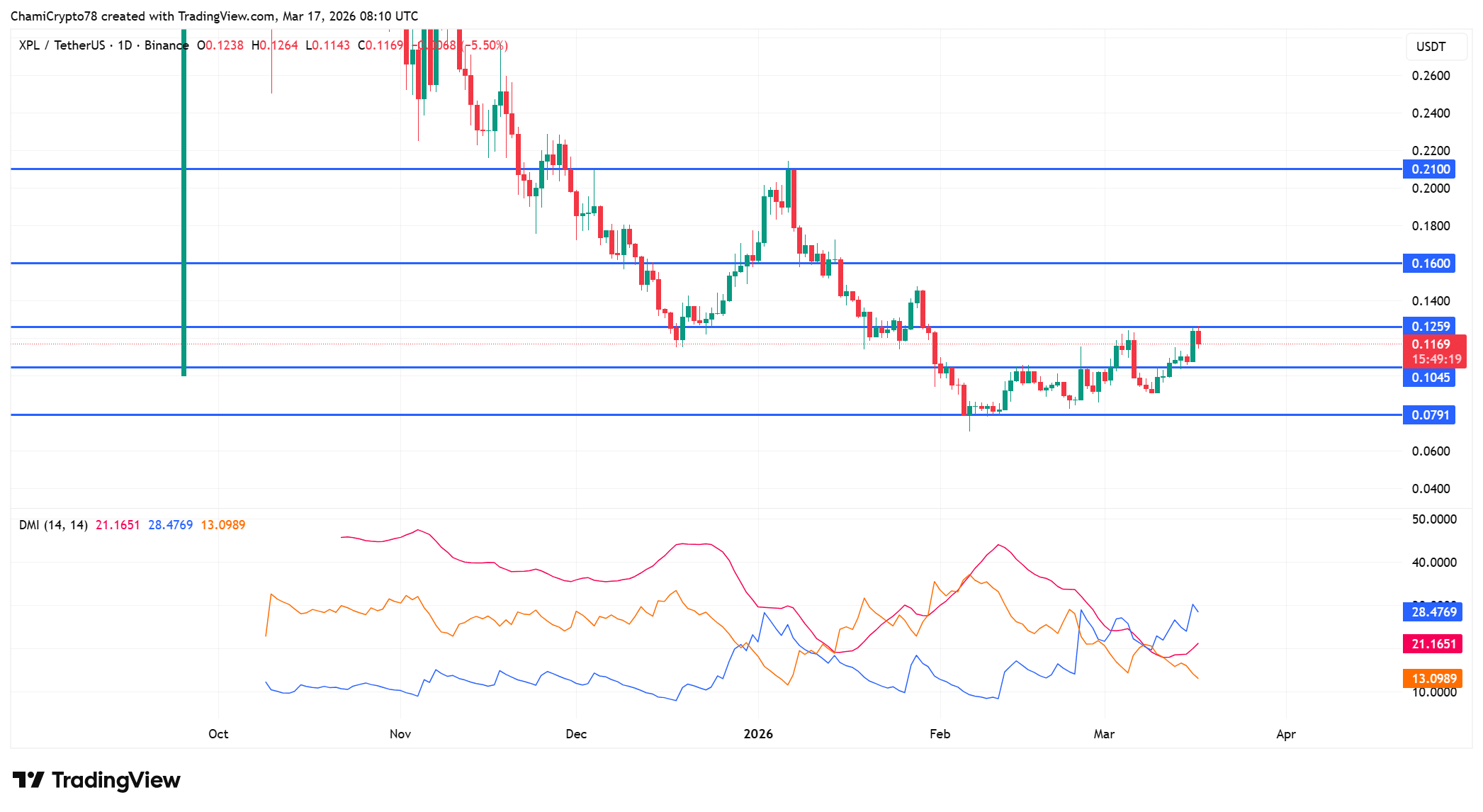
Plasma (XPL) surged 12.89% to $0.1238 on March 17, with trading volume up over 155%, signaling renewed buyer interest. The token rebounded from recent lows, reclaiming the $0.1045 support level and approaching the $0.1259 resistance. Technical indicators show buyers gaining dominance, with the +DI line above -DI and ADX around 21, indicating strengthening trend momentum. Exchange outflows of $664K suggest reduced selling pressure and accumulation behavior. Liquidity clusters above $0.128 could trigger a short squeeze if resistance is broken. Holding above $0.1045 is crucial for further upside, with a break above $0.1259 likely accelerating gains toward $0.128.

On the 17th of March, Plasma [XPL] surged 12.89% to $0.1238, while trading volume climbed over 155%, reflecting a sharp rise in participation.

The token has rebounded from recent lows, and buyers have stepped in aggressively during the latest sessions. This move suggests that interest has returned after a prolonged cooling phase.

However, the rally has not occurred in isolation, as both market structure and liquidity dynamics have started aligning with the upside.

The expansion in activity indicates that traders are repositioning rather than exiting.

As a result, this shift places XPL in a critical phase where continuation depends on how price interacts with nearby resistance zones and underlying demand strength.

Can XPL hold support and challenge resistance?

Price has reclaimed the $0.1045 level, which previously acted as a strong support base during consolidation.

Since then, XPL has pushed toward the $0.1259 resistance, where rejection has appeared before.

This area now serves as a key barrier that could define the next directional move.

However, the structure shows higher lows forming, which reflects strengthening buyer control. Each dip has attracted demand, preventing deeper retracements.

The DMI structure has shifted notably, as the +DI line has moved above the -DI line, signaling that buyers have started dominating recent price action.

At the same time, the ADX has hovered around 21, indicating that the trend strength has started building rather than fading.

This alignment reflects a transition from a neutral phase into a developing directional trend.

As the price compresses below the resistance, pressure continues building within this range.

A sustained hold above $0.1045 keeps the structure intact, while repeated tests of $0.1259 increase breakout probability.

This setup suggests that XPL is positioning for a decisive move rather than drifting sideways.
Source: TradingView

Exchange outflows tighten available supply

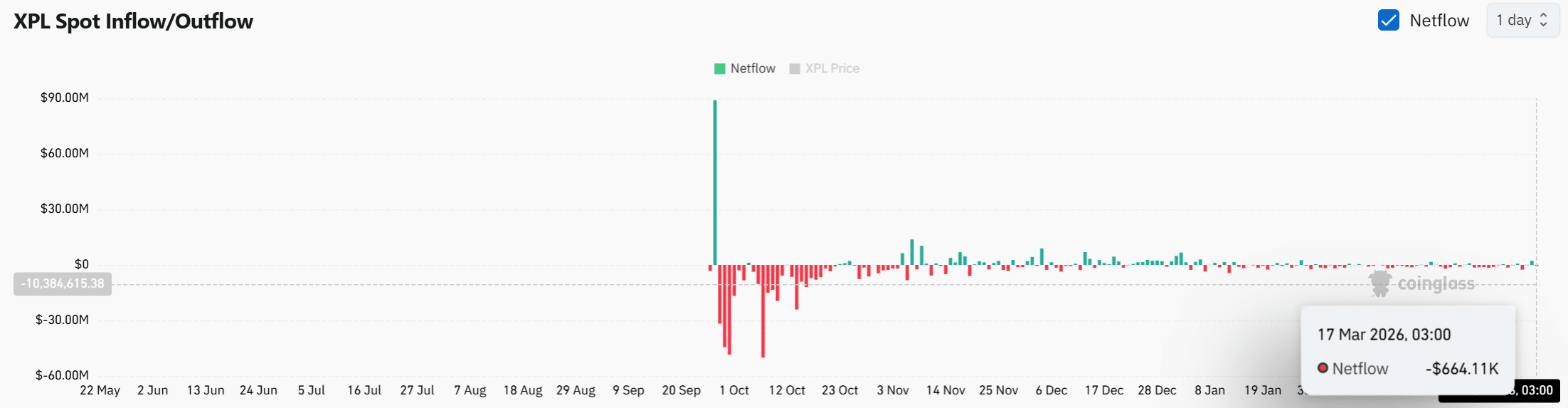
Spot Netflows have remained negative at press time, with recent outflows of approximately $664K from exchanges.

This shift indicates that tokens have been moving off trading platforms rather than preparing for immediate selling.

As supply on exchanges declines, available liquidity tightens, which can amplify price reactions during periods of strong demand.

Besides, reduced sell-side pressure creates conditions where upward moves face less resistance.

However, this dynamic also depends on whether demand continues to match the reduced supply.

As long as outflows persist, the market structure supports accumulation behavior rather than distribution.

This pattern reinforces the bullish context already visible in price action and technical indicators.
Source: CoinGlass

Liquidity clusters above price signal squeeze setup

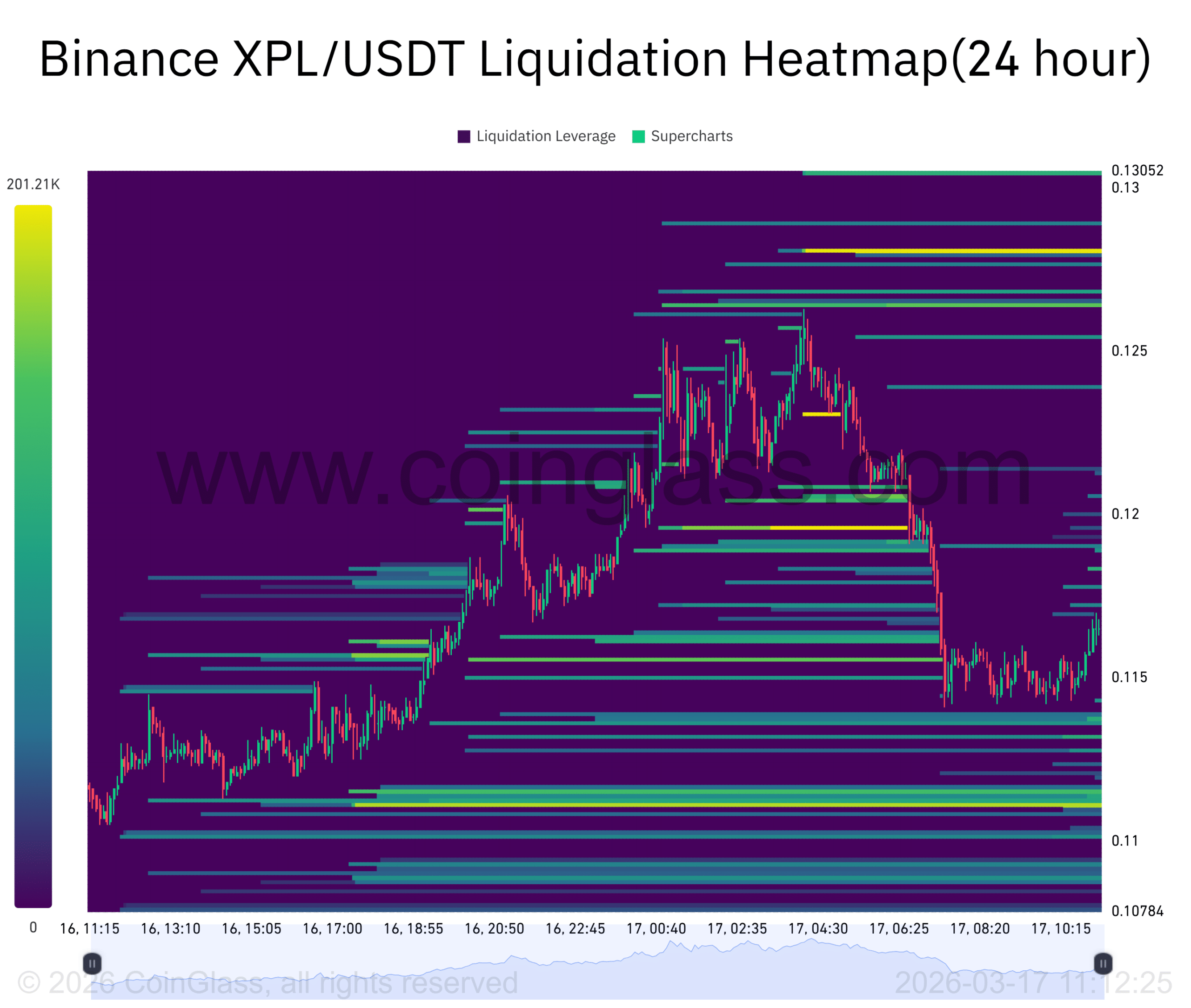
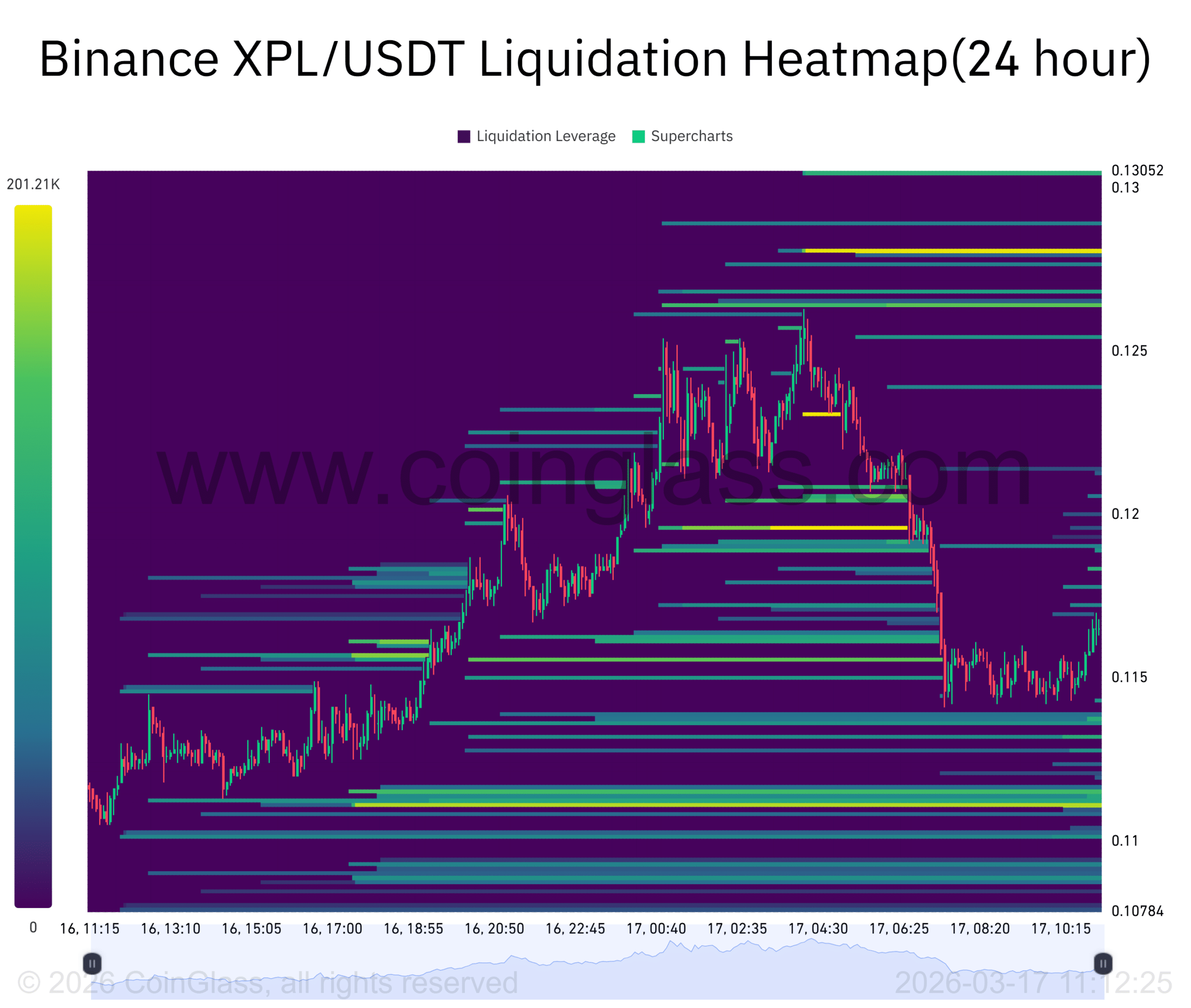
The Liquidation Heatmap has revealed dense liquidity clusters sitting above the current price, particularly around the $0.128 region.

These zones represent areas where short positions could face forced closures if the price moves higher. As XPL approaches these levels, upward pressure could accelerate due to cascading liquidations.

However, the price must first break through nearby resistance to trigger this effect.

The presence of stacked liquidity above current levels creates a magnet-like effect, drawing price toward those zones.
Source: CoinGlass

XPL appears positioned for continuation as strengthening structure, rising demand, and tightening supply align with bullish pressure.

A decisive move above $0.1259 would likely unlock liquidity around $0.128, accelerating the rally.

However, sustained strength depends on holding $0.1045 support. As long as buyers defend this base, the current setup favors further upside expansion.


Final Summary

  • XPL structure shows buyers stepping in early, building pressure that could drive continuation beyond nearby resistance levels.
  • Liquidity sitting above Plasma [XPL] price creates a path for rapid upside expansion if bullish strength remains sustained here.


Пов'язані питання

QWhat was the percentage increase in Plasma [XPL] price on March 17th, and what was the new price?

APlasma [XPL] surged 12.89% to $0.1238 on March 17th.

QWhat is the critical resistance level that XPL needs to break for a potential rally continuation?

AThe critical resistance level that XPL needs to break is $0.1259.

QWhat does the negative Spot Netflows value of approximately $664K indicate for XPL?

AThe negative Spot Netflows value of approximately $664K indicates that tokens are being moved off exchanges, suggesting accumulation behavior and a reduction in immediate selling pressure.

QAccording to the Liquidation Heatmap, what is the significance of the liquidity cluster around the $0.128 region?

AThe liquidity cluster around $0.128 represents a dense zone of short position liquidations. If the price reaches this level, it could trigger cascading liquidations, accelerating upward price movement.

QWhat key support level must XPL hold to maintain its current bullish structure?

AXPL must hold the key support level at $0.1045 to maintain its current bullish structure and favor further upside expansion.

Пов'язані матеріали

Sharplink CEO: One Million Ethereum Developers, Who Can Compete?

Etherean Ecosystem: One Million Developers and a Formidable Moat The Ethereum network has surpassed a significant milestone: over one million unique lifetime developers, with approximately 232,000 active in the past year. This vast and growing talent pool is Ethereum's core advantage, far more critical than transient metrics like speed or transaction fees. The central question is not which blockchain is fastest, but where the best builders choose to build long-term. Ethereum's answer lies in a decade-long accumulation of infrastructure, standards, tools, liquidity, and collaborative culture that is exceptionally difficult to replicate. It has become the default operating system for programmable finance. This massive developer base is actively working on complex, high-risk challenges that deepen Ethereum's strategic moat: * **Glamsterdam Upgrade (2026):** Focused on core protocol scalability (ePBS, parallel execution) while preserving core values like credible neutrality. * **Synchronous Composability:** Aims to make numerous Rollups interoperate like a single chain, directly addressing fragmentation concerns. * **Quantum Resistance:** Ethereum leads mainstream ecosystems in coordinated preparation for post-quantum cryptography, with a targeted migration plan around 2029. This developer advantage is self-reinforcing, fueled by: * **Deep Composability:** Applications interact like interoperable financial Lego bricks via shared standards (e.g., EVM, Solidity). * **Credible Neutrality:** Secured by over 900,000 validators, making it trusted by major institutions. * **Modularity:** Rollups (Base, Arbitrium, etc.) expand, rather than fracture, the ecosystem into a tightly connected modular internet economy. * **Culture:** Attracts top-tier researchers and standard-setters who guide the entire industry. In essence, while other chains generate activity, Ethereum is consolidating as the trusted, long-term coordination layer for internet-native finance. Its future is being built now by the architects of the next-generation financial infrastructure.

Odaily星球日报21 хв тому

Sharplink CEO: One Million Ethereum Developers, Who Can Compete?

Odaily星球日报21 хв тому

Ethereum Reaches the Milestone of One Million Developers, Sharplink CEO Delves Deep into Ethereum's Future Possibilities

Ethereum Surpasses One Million Developers Milestone: A Look at Its Unshakeable Dominance and Future Joseph Chalom, CEO of Sharplink, reflects on his recent Asia trip where he engaged deeply with Ethereum developers and ecosystem leaders. The most striking takeaway was not just the industry's vibrancy, but the rigorous, long-term vision of local builders. This context brings to life a pivotal statistic: Ethereum has now surpassed one million cumulative developers (1,012,824), with approximately 232,000 remaining active in the past year—a talent pool unmatched by any other crypto ecosystem. The critical question isn't which blockchain is fastest, but where top developers choose to build long-term. Ethereum's answer is unequivocal. Its decade-long lead stems from a unique convergence of technology, institutional culture, economic systems, and composability, cementing its role as the foundational operating system for programmable finance. This massive developer base is tackling the industry's hardest problems, continuously strengthening Ethereum's moat. Key initiatives include: * **The Glamsterdam Upgrade (planned 2026):** Introducing ePBS and Block-level Access Lists for parallel execution and higher throughput while preserving core values like credible neutrality and fair MEV distribution. * **Synchronous Composability:** Projects are working to enable atomic transactions across dozens of Rollups, making them function as one unified chain and eliminating ecosystem fragmentation. * **Post-Quantum Security:** Ethereum is far ahead in preparing for quantum computing threats, with a dedicated foundation working group and testnets targeting a full migration by ~2029—a crucial factor for institutional adoption. Beyond developers, Ethereum's core network effects are its unparalleled composability and unified standards (like EVM and Solidity), which create a powerful flywheel: more developers → better tools → greater liquidity → more institutional participation. Its other decisive advantages include credible neutrality (over 900k validators), a secure modular architecture with interconnected Rollups, and a deeply entrenched culture shaped by top-tier researchers. Ultimately, there's a vast difference between generating short-term activity and becoming the trusted, long-term coordination layer for global native finance. Major institutions prioritize security, trust, and liquidity—areas where Ethereum holds dominant mindshare. The industry's trajectory shows resources consolidating around unified standards, deep liquidity, and developer consensus. After meeting the builders in Seoul and Hong Kong, Chalom is more convinced than ever: Ethereum's unshakeable future is being built right now.

Foresight News32 хв тому

Ethereum Reaches the Milestone of One Million Developers, Sharplink CEO Delves Deep into Ethereum's Future Possibilities

Foresight News32 хв тому

Saylor's Latest Long Read: Bitcoin is Not Money, It's Digital Capital, and Money is Built Upon It

Michael Saylor presents his "Digital Asset Stack" theory, positioning Bitcoin as the foundational layer of digital capital. He argues Bitcoin itself should remain unchanged—no staking, inflation, or protocol alterations. Instead, a five-layer financial architecture should be built atop it: Digital Capital (BTC), Digital Credit (e.g., yield instruments like STRC), Digital Currency (stable, yield-bearing instruments pegged to fiat), Digital Yield (leveraged/structured products), and Digital Equity (e.g., MSTR stock, absorbing residual volatility). Saylor asserts this stack transforms Bitcoin's high-volatility, high-energy capital into tailored products: stable currencies for payments/savings, yield instruments for income seekers, and equity for growth investors. This approach meets diverse needs—corporate treasuries, banks, retirees, emerging market users—without compromising Bitcoin's core properties (scarcity, decentralization). The "killer use case" is rebuilding global money, credit, and capital markets on Bitcoin, bridging the fiat world with a superior digital asset foundation. The system leverages traditional finance principles (risk layering, structured products) while using Bitcoin as the ultimate collateral. This expands Bitcoin's utility, drives adoption, and offers a better monetary experience: digital, yield-bearing, stable-value tools for everyday use.

marsbit45 хв тому

Saylor's Latest Long Read: Bitcoin is Not Money, It's Digital Capital, and Money is Built Upon It

marsbit45 хв тому

Can SK Hynix's Stock Double Again in This Rally?

The article discusses the highly optimistic price target of approximately $3,500 for SK Hynix stock, set by Aletheia Capital. This target is significantly above the consensus range of $2,000-$2,520 from major brokerages. The core debate is whether SK Hynix deserves a fundamental re-rating beyond its traditional cyclical discount, based on the long-term impact of AI-driven demand. The $3,500 target hinges on three key assumptions holding simultaneously until at least 2027: 1) Continued shortage and high pricing for HBM (High Bandwidth Memory), a critical component for AI chips; 2) Sustained high prices for standard DRAM, as HBM production consumes capacity and constrains general supply; and 3) Strong AI server demand generating substantial, above-expectation free cash flow. SK Hynix's leading ~58% market share in HBM and its early certification with key clients like Nvidia provide a competitive advantage, allowing it to capture significant supply chain premiums. The HBM shortage is seen not just as a niche growth driver but as a catalyst that amplifies profitability across the entire memory business by tightening overall DRAM supply. However, the article cautions that this target represents an optimistic "tail scenario." Key risks include potential supply increases from competitors (Samsung, Micron) by 2027, a possible slowdown in HBM price growth, and high capital expenditures that could erode the projected free cash flow. The divergence in analyst targets reflects the market's uncertainty over whether the current AI-driven boom will temporarily elevate earnings or permanently raise the memory industry's profit baseline.

marsbit48 хв тому

Can SK Hynix's Stock Double Again in This Rally?

marsbit48 хв тому

Торгівля

Спот
Ф'ючерси

Популярні статті

Що таке PLASMA

Plasma: Передове рішення для масштабуємості блокчейну Вступ до Plasma Оскільки ландшафт криптовалют еволюціонує, так само зростає потреба в покращеній ефективності блокчейн-мереж. Plasma, рішення масштабування другого рівня, виступає як піонер у цій сфері, особливо в галузі розвитку Web3. Стратегічно зсуваючи суттєву частину завдань з основного ланцюга на ряд менших ланцюгів, Plasma обіцяє значно підвищити масштабованість та продуктивність Ethereum — широко використовуваної блокчейн-платформи на передньому краї децентралізованих додатків. Що таке Plasma? Plasma — це інноваційне рішення для масштабування поза ланцюгом, спеціально розроблене для блокчейну Ethereum. Воно було представлено в серпні 2017 року Віталіком Бутеріним, співзасновником Ethereum, та Джозефом Пуном, відомим прихильником рішень для масштабування, таких як Lightning Network. Plasma служить каркасом, який дозволяє створювати масштабовані додатки, встановлюючи ієрархічну структуру дочірніх ланцюгів над основним ланцюгом Ethereum. В основі Plasma лежить можливість розробки потенційно безкінечних бічних ланцюгів, які можуть функціонувати незалежно, поки все ще спираються на мережу Ethereum для забезпечення безпеки та консенсусу. Ця архітектура базується на смарт-контрактах і деревах Меркла, які ефективно обробляють транзакції та зберігання даних. Основні цілі Plasma Основною метою Plasma є підвищення пропускної здатності мережі Ethereum. Зміщуючи суттєві обсяги транзакцій з перевантаженого основного ланцюга, архітектура Plasma пропонує вищі швидкості транзакцій, більш ефективну обробку даних і нижчі витрати на транзакції. Це особливо важливо в епоху, коли попит на децентралізовані додатки — особливо у фінансовій сфері, іграх та управлінні ланцюгами постачань — досягає безпрецедентних рівнів. Творець Plasma Plasma є дітищем двох відомих фігур у блочному співтоваристві: Віталіка Бутеріна та Джозефа Пуна. Бутерін відомий перш за все як співзасновник Ethereum і за розширення меж можливостей технології блокчейн. Пун, з іншого боку, відомий своєю підтримкою рішень для масштабування, які забезпечують швидші і дешевші транзакції в блокчейн-мережах. Їхня співпраця над каркасом Plasma значно сприяла його інноваційній природі, поєднуючи передові технічні знання з практичними застосуваннями. Інвестори Plasma Хоча конкретні інвестори або організації, які підтримують Plasma, залишаються невідомими, проект викликав інтерес у різних видатних фігур і гравців у сфері блокчейн і криптовалют. Завдяки своєму потенціалу покращення масштабування в Ethereum, він привернув увагу різних організацій, які прагнуть розширити можливості технології блокчейн. Як працює Plasma? Унікальна функціональність Plasma пов'язана з її архітектурною структурою, що покладається на дочірні ланцюги та їхню взаємодію з основною мережею Ethereum. Нижче наведено деякі ключові фактори, які сприяють інноваційному підходу Plasma: Дочірні ланцюги: Plasma встановлює численні дочірні ланцюги, які можуть виконувати транзакції незалежно від основного ланцюга Ethereum. Кожен дочірній ланцюг функціонує як окремий смарт-контракт з унікальними характеристиками, що дозволяє розробникам створювати індивідуалізовані рішення на основі їхніх конкретних вимог. Смарт-контракти та дерева Меркла: Каркас використовує смарт-контракти, які є само-виконуючими угодами з попередньо визначеними умовами, в парі з деревами Меркла, які дозволяють ефективну перевірку даних. Ця технологія дозволяє Plasma досягати як високої масштабованості, так і безпеки. Стиснення транзакцій: Об'єднуючи транзакції на дочірніх ланцюгах, Plasma зменшує навантаження даних на мережу Ethereum. Це означає, що менше транзакцій потрібно записувати на основному ланцюзі — таким чином звільняючи місце та зменшуючи перевантаження. Посилена безпека: Незважаючи на те, що Plasma працює поза ланцюгом, вона використовує заходи безпеки основної мережі Ethereum, забезпечуючи, що всі транзакції на дочірніх ланцюгах зберігають високий рівень цілісності та безпеки. Хронологія Plasma Розуміння розвитку Plasma вимагає відстеження її значних етапів: Серпень 2017: Plasma вперше була представлена Віталіком Бутеріним та Джозефом Пуном як масштабоване рішення для вирішення проблем продуктивності Ethereum. 2018: Каркас Plasma був офіційно розроблений та доступний на GitHub, що стало важливим кроком до його впровадження у практичні застосування. 2019: З ростом обізнаності про Plasma вона почала привертати увагу розробників, зацікавлених у масштабуванні додатків Ethereum, що призвело до збільшення її впровадження. 2020: Plasma продовжувала еволюціонувати, з суттєвими покращеннями архітектури та функціональності — роблячи її ще більш привабливою для розробників. Ключові особливості Plasma Plasma має кілька характеристик, які роблять її трансформаційним рішенням у блочному просторі: Масштабованість: Створюючи кілька дочірніх ланцюгів, Plasma може обробляти вищі обсяги транзакцій без додаткового навантаження на основний ланцюг Ethereum. Швидкість: Кожен дочірній ланцюг може обробляти транзакції швидше, надаючи користувачам кращий досвід та обслуговування. Низькі витрати на транзакції: Структура Plasma ефективно знижує витрати, пов'язані з транзакціями, мінімізуючи навантаження на основний ланцюг. Інтероперабельність: Архітектура дозволяє Plasma безперешкодно взаємодіяти з кількома блокчейн-мережами, підвищуючи функціональність міжмережевих з'єднань. Безпека: Використовуючи безпеку основного ланцюга Ethereum, Plasma забезпечує цілісність своїх операцій, використовуючи свої дочірні ланцюги. Варіанти використання Plasma Інноваційна архітектура Plasma відкриває двері для різних практичних застосувань у різних секторах: Децентралізовані фінанси (DeFi): Plasma має потенціал покращити масштабованість та ефективність додатків DeFi, створюючи більш плавні та ефективні процеси торгівлі. Ігрова індустрія: Каркас сприяє розробці швидких і витратозберігаючих ігрових досвідців, роблячи його привабливим для розробників в ігровій індустрії. Управління ланцюгами постачань: Завдяки здатності архівувати ефективну обробку транзакцій, Plasma може сприяти розвитку децентралізованих рішень для управління ланцюгами постачань. Висновок Plasma стоїть на передньому краї технології блокчейн, позиціонуючись як ключове рішення для масштабування другого рівня, спрямоване на підвищення ефективності мережі Ethereum та інших. Завдяки своїй унікальній структурі дочірніх ланцюгів, смарт-контрактів і дерев Меркла, Plasma пропонує переконливе рішення для кризису масштабованості, яка давно турбує блокчейн-мережі. Оскільки технологія блокчейн продовжує розвиватись, такі рішення, як Plasma, обіцяють змінити підходи розробників до викликів масштабованості, потенційно революціонізуючи спосіб роботи децентралізованих додатків. Постійні зусилля її творців та інтерес різних зацікавлених сторін вказують на світле майбутнє для Plasma, оскільки вона прагне підняти можливості блокчейн на нові висоти в цифровій сфері.

242 переглядів усьогоОпубліковано 2024.12.03Оновлено 2024.12.03

Що таке PLASMA

Як купити XPL

Ласкаво просимо до HTX.com! Ми зробили покупку Plasma (XPL) простою та зручною. Дотримуйтесь нашої покрокової інструкції, щоб розпочати свою криптовалютну подорож.Крок 1: Створіть обліковий запис на HTXВикористовуйте свою електронну пошту або номер телефону, щоб зареєструвати обліковий запис на HTX безплатно. Пройдіть безпроблемну реєстрацію й отримайте доступ до всіх функцій.ЗареєструватисьКрок 2: Перейдіть до розділу Купити крипту і виберіть спосіб оплатиКредитна/дебетова картка: використовуйте вашу картку Visa або Mastercard, щоб миттєво купити Plasma (XPL).Баланс: використовуйте кошти з балансу вашого рахунку HTX для безперешкодної торгівлі.Треті особи: ми додали популярні способи оплати, такі як Google Pay та Apple Pay, щоб підвищити зручність.P2P: Торгуйте безпосередньо з іншими користувачами на HTX.Позабіржова торгівля (OTC): ми пропонуємо індивідуальні послуги та конкурентні обмінні курси для трейдерів.Крок 3: Зберігайте свої Plasma (XPL)Після придбання Plasma (XPL) збережіть його у своєму обліковому записі на HTX. Крім того, ви можете відправити його в інше місце за допомогою блокчейн-переказу або використовувати його для торгівлі іншими криптовалютами.Крок 4: Торгівля Plasma (XPL)Легко торгуйте Plasma (XPL) на спотовому ринку HTX. Просто увійдіть до свого облікового запису, виберіть торгову пару, укладайте угоди та спостерігайте за ними в режимі реального часу. Ми пропонуємо зручний досвід як для початківців, так і для досвідчених трейдерів.

326 переглядів усьогоОпубліковано 2025.09.26Оновлено 2026.06.02

Як купити XPL

Обговорення

Ласкаво просимо до спільноти HTX. Тут ви можете бути в курсі останніх подій розвитку платформи та отримати доступ до професійної ринкової інформації. Нижче представлені думки користувачів щодо ціни XPL (XPL).

活动图片