Pi Network Temporarily Halts Wallet Payment Requests Amid Rising Scams

TheNewsCryptoОпубліковано о 2025-12-31Востаннє оновлено о 2025-12-31

Анотація

Pi Network has temporarily disabled its wallet payment request feature due to widespread scams. Scammers were impersonating official accounts and targeting high-balance wallets, tricking users into approving fraudulent requests, resulting in irreversible losses. Over a million PI tokens have been stolen this year, with one wallet receiving more than 838,000 tokens. The Pi Core Team clarified that the issue stems from user approval, not a system vulnerability, and emphasized that this is a common risk across crypto wallets. The token’s value dropped 10% following the incident but has since shown slight recovery. Recent updates include standardized KYC and testnet DEX improvements to enhance security and liquidity.

The Pi network, which is the mobile-first Cryptocurrency and web3 blockchain, recently posted a tweet on DEC 30 that the team has warned that scammers are exploiting the Payment request feature to steal Pi tokens from users’ balances. In the Pi network, the wallet balances are publicly visible, and the attackers are targeting the high-balance wallets and sending the payment request to the wallet as an impersonation of official Pi accounts or community moderators.
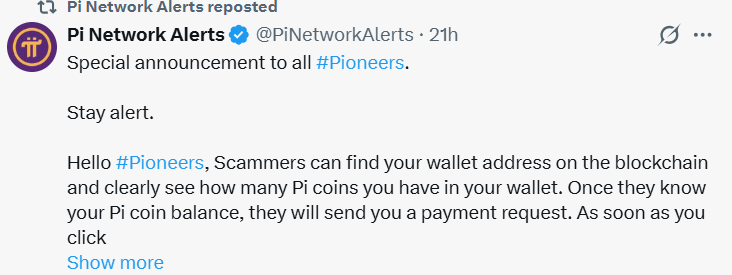
Once the user approves the payment request, the Tokens will be instantly transferred to the scammers’ account and will be gone forever. No reversal or recovery will be done. The Community reports indicate the scams are widespread, and one scammer’s wallet has received more than 838,000 PI tokens. Overall, more than a million PI tokens have been lost throughout the year. This created a panic situation among the users, and even the experienced users were tricked because the request looked legitimate.

Pi Core Team Denies System Vulnerability, Addresses Market and User Impact

After this incident happened, many users called it a wallet flaw, but the Core team clarified that the problem is from the human approval, not the protocol Flaw. They say that the wallet never sends funds on its own, and the transfer only happens after the user’s approval. This behavior exists in all major Crypto wallets. So to stop this scam, the PI network has disabled all payment requests network-wide. This stops the scams instantly and prevents further user losses. This makes the PI token safe, and it was the fastest way to contain the damage.

The token is currently trading at $0.204 with a market cap of 1.7 billion. The Token has dropped to 10% due to this issue. Recently, the token has updated its ecosystem by adding Standardized KYC to cut the verification backlogs by 50% and speed up mainnet migration for millions of users. Another update is from the testnet DEX, which makes the trading safer and easier by using Pi as the main trading Pair and improving the liquidity. This makes the token regain its momentum, and it has increased by 0.7% in 24 hours.

Highlighted Crypto News:

XDC Network Momentum Test: Will It Break Resistance or Slip Back to Lows?

TagsAltcoinCryptocurrencyPi Network

Пов'язані питання

QWhy did the Pi Network temporarily halt wallet payment requests?

AThe Pi Network temporarily halted wallet payment requests to stop scammers who were exploiting the feature to steal Pi tokens by impersonating official accounts, preventing further user losses.

QHow were the scammers able to steal Pi tokens from users?

AScammers targeted high-balance wallets, sent payment requests while impersonating official Pi accounts or community moderators, and stole tokens once users approved these deceptive transactions.

QWhat was the Pi Core Team's response to the incident being called a 'wallet flaw'?

AThe Pi Core Team clarified that the issue was due to human approval of fraudulent requests, not a protocol flaw, emphasizing that transfers only occur after user authorization, similar to other crypto wallets.

QHow much Pi token value was reported lost due to these scams?

ACommunity reports indicated that over a million Pi tokens were lost throughout the year, with one scammer's wallet receiving more than 838,000 Pi tokens.

QWhat recent updates has the Pi Network implemented to improve its ecosystem?

AThe Pi Network recently added Standardized KYC to reduce verification backlogs by 50% and introduced updates to the testnet DEX, using Pi as the main trading pair to enhance safety and liquidity.

Пов'язані матеріали

Lowering Expectations for BTC's Next Bull Market

The author, Alex Xu, explains his decision to significantly reduce his Bitcoin holdings (from full to ~30% of his portfolio) during the current bull cycle, citing a lowered long-term outlook for BTC's price appreciation in the next cycle. He outlines six key reasons for this reduced expectation: 1. **Diminished Growth Drivers:** The narrative of exponential user adoption has largely played out with institutional ETF adoption. The next major growth phase—adoption by sovereign national reserves or central banks—seems unlikely in the near future. 2. **Personal Opportunity Cost:** More attractive investment opportunities have emerged in other assets, such as undervalued companies. 3. **Industry-Wide Contraction:** The broader crypto industry is struggling, with most Web3 business models (SocialFi, GameFi, DePIN) failing. This overall萧条 (depression) reduces the fundamental demand and consensus for Bitcoin. 4. **Strain on Major Buyer:** MicroStrategy, a major corporate buyer of BTC, faces rising financing expenses for its debt, which could slow its purchasing rate and create significant marginal pressure on the market. 5. **Increased Competition from Gold:** The emergence of "tokenized gold" has closed the functional gap (portability, divisibility) between physical gold and Bitcoin, offering a strong competitor in the non-sovereign store-of-value space. 6. **Security Budget Concerns:** The block reward halving continues to exacerbate the long-standing issue of funding Bitcoin's network security, with new fee source explorations like Ordinals and L2s largely failing. The author's decision to hold a significant (though reduced) position reflects a cautious, not bearish, outlook. He remains open to increasing his exposure if the fundamental reasons for his skepticism change or if new positive catalysts emerge.

marsbit28 хв тому

Lowering Expectations for BTC's Next Bull Market

marsbit28 хв тому

Can Iran 'Control' the Strait of Hormuz?

Iran has announced a comprehensive plan to assert control over the strategic Strait of Hormuz, a critical global oil shipping chokepoint. The proposed measures include requiring all vessels to obtain Iranian permission for passage, imposing fees for security, environmental protection, and navigation management—preferably paid in Iranian rials—and absolutely banning Israeli ships. Vessels from countries deemed hostile by Iran’s top security bodies may also be barred. Analysts suggest Iran’s motives are multifaceted: increasing pressure on the U.S. and Israel by leveraging control over oil transit to influence global prices and inflation; creating a new revenue stream, potentially exceeding $7.7 billion annually, to counter Western sanctions and support postwar reconstruction; and using transit permissions as bargaining chips in future negotiations, notably with the U.S. However, the plan faces significant practical and diplomatic challenges. Enforcing comprehensive interception and fee collection in the busy waterway, patrolled by international military forces, would be difficult. The U.S. has already countering with a blockade of Iranian ports and threats to intercept any ship paying fees, potentially strangling Iran’s oil exports and fee revenue. Broad international opposition, led by European and Gulf states, and legal controversies further complicate implementation. The proposal may ultimately serve more as a negotiating tactic than a feasible policy, with its execution remaining highly uncertain.

marsbit1 год тому

Can Iran 'Control' the Strait of Hormuz?

marsbit1 год тому

Торгівля

Спот
Ф'ючерси
活动图片