Pharos Network Expands RealFi Alliance, Joins Forces with Strategic Research and Intelligence Partners to Enhance Institutional Transparency

marsbitОпубліковано о 2026-03-13Востаннє оновлено о 2026-03-13

Анотація

Pharos Network, a RealFi inclusive financial Layer 1 project, has expanded its RealFi Alliance by adding strategic "Smart Partners" focused on research, data, and institutional infrastructure. The new partners include Dune, Four Pillars, Web3Caff Research, Anchorage Digital, Alchemy, Aquaflux, and Yield Network. These collaborations aim to address information asymmetry and enhance institutional transparency in decentralized markets. Key initiatives include in-depth institutional research, real-time verifiable dashboards for RWA fund flows, enterprise-grade RPC infrastructure, federally regulated banking and custody services, on-chain treasury management, and improved capital efficiency. A core objective is to establish a standardized "RealFi Research Framework" to measure RWA performance, risk, and compliance. According to Pharos CEO Wish Wu, the partnership ensures that assets on Pharos receive the same level of scrutiny and transparency as traditional capital markets. Pharos Network is a modular Layer 1 blockchain designed for RealFi, combining institutional-grade asset circulation with decentralized composability. It is developed by a team with backgrounds from Ant Group and backed by investors like Hack VC and Faction VC.

Hong Kong, March 13, 2026 — Pharos Network, a RealFi inclusive finance Layer 1 project, has announced the list of "Intelligence Partners" for the RealFi Alliance. Following the initial cohort of members focused on core infrastructure and asset issuance, this expansion introduces a group of partners specializing in research, data, and institutional-grade infrastructure.

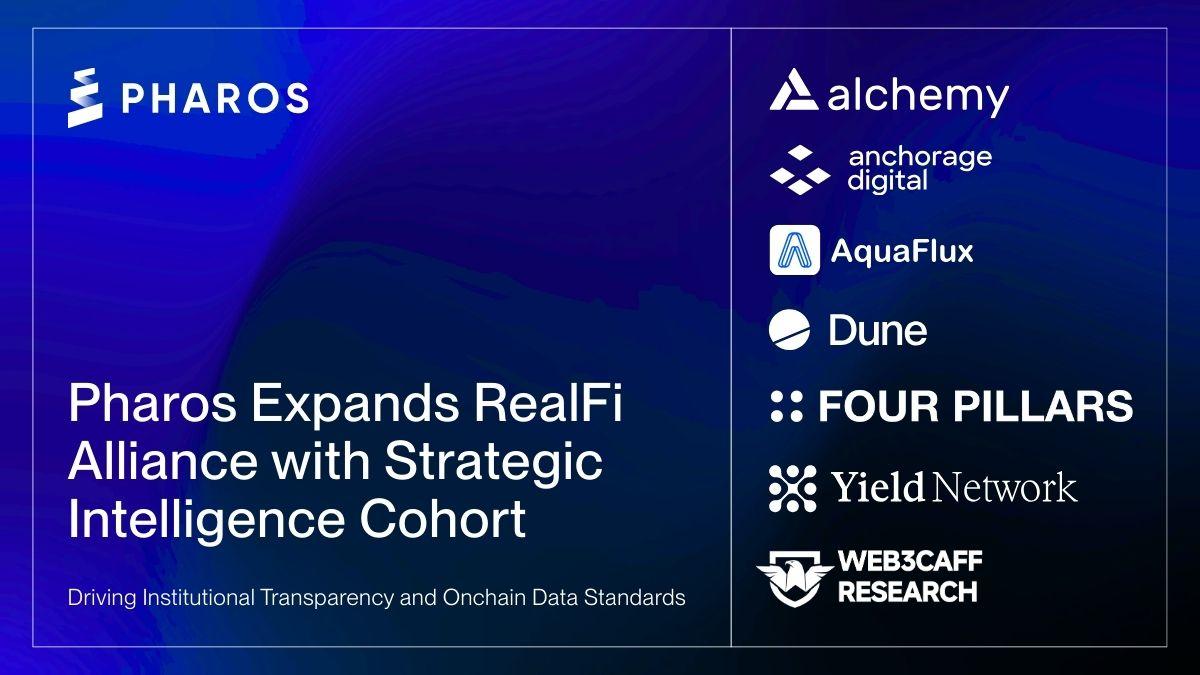
This group of partners includes industry leaders: Dune, Four Pillars, Web3Caff Research, Anchorage Digital, Alchemy, Aquaflux, and Yield Network.

By collaborating with top-tier research firms and data analytics platforms, Pharos aims to address information asymmetry, which often hinders institutional investors from entering decentralized markets.

The RealFi Alliance's "Intelligence Partners" strengthen the ecosystem through a multi-dimensional approach that integrates in-depth research, thorough transparency, and compliant financial channels. This foundation begins with a commitment to independent research and rigorous academia, bridging the gap between theoretical financial modeling and on-chain execution through academic oversight.

These partners will collectively strengthen the ecosystem through three strategic dimensions:

Four Pillars and Web3Caff Research will focus on deep institutional research coverage and market analysis, bridging the gap between theoretical financial modeling and on-chain execution;

Dune will focus on providing real-time, verifiable dashboards for RWA capital flows to ensure high transparency;

Alchemy, as the authoritative developer layer, provides the enterprise-grade RPC infrastructure necessary for building high-performance RealFi applications;

Anchorage Digital offers federally regulated banking and custody infrastructure;

In terms of capital flow management, Yield Network serves as the on-chain ledger manager for RealFi ecosystem treasuries;

Aquaflux enhances capital efficiency by optimizing liquidity and yield splitting.

Wish Wu, Co-founder and CEO of Pharos, stated:

Institutional capital doesn't just seek high yields; it also seeks high-credibility data and verified information. By partnering with world-class research institutions and data providers, we ensure that every asset on Pharos receives the same level of scrutiny and transparency as traditional capital markets.

One of the core objectives of this partner group is to establish a standardized "RealFi Research Framework." The collaborating institutions will work together on thematic reports and on-chain data standards to define how to measure the performance, risk, and compliance of RWAs. This will ensure that as Pharos moves towards its mainnet launch phase, its ecosystem is not only technically robust but also mature in its cognitive and research systems.

About Pharos Network

Pharos is an inclusive finance Layer 1 for RealFi, where real-world value and institutional-grade assets can circulate on-chain and achieve composability with decentralized assets, thereby becoming the next-generation financial infrastructure for the globe. Pharos combines a modular architecture, deep parallel execution, and built-in compliance capabilities, natively supported by a robust asset ecosystem. The project is built by a leadership team and engineers from Ant Group and is backed by Hack VC, Faction VC, and other global investors.


Пов'язані питання

QWhat is the main purpose of Pharos Network's expansion of the RealFi Alliance with 'Smart Partners'?

AThe expansion aims to enhance institutional transparency and address information asymmetry by partnering with leading research, data analytics, and institutional-grade infrastructure providers, ensuring rigorous scrutiny and data credibility for assets on the Pharos Network.

QWhich companies are included in the new 'Smart Partners' group announced by Pharos Network?

AThe new partners include Dune, Four Pillars, Web3Caff Research, Anchorage Digital, Alchemy, Aquaflux, and Yield Network.

QHow does the collaboration with Dune contribute to the RealFi ecosystem?

ADune provides real-time, verifiable dashboards for Real World Asset (RWA) capital flows, ensuring high levels of transparency in the ecosystem.

QWhat role does Anchorage Digital play in the RealFi Alliance?

AAnchorage Digital offers federally regulated banking and custody infrastructure, providing secure and compliant financial channels for the ecosystem.

QWhat is the goal of establishing a standardized 'RealFi Research Framework'?

AThe framework aims to define how to measure the performance, risk, and compliance of RWAs through collaborative thematic reports and on-chain data standards, ensuring the ecosystem is both technically robust and research-mature.

Пов'язані матеріали

Dialogue with Morgan Stanley Executive: Wall Street Isn't Rejecting Bitcoin, It's Just Waiting for the Right Time

In a podcast interview, Amy Oldenburg, Head of Digital Asset Strategy at Morgan Stanley, discusses Wall Street's evolving stance on Bitcoin, explaining the bank's measured approach and the road ahead. Oldenburg, with 26 years at Morgan Stanley, traces her perspective to witnessing transformative tech cycles and her experience in emerging markets, where she observed the need for alternative financial systems like mobile money (e.g., M-Pesa). This background informs her view of Bitcoin's value proposition. She clarifies that Morgan Stanley is "client-driven." Regulatory hurdles, particularly as a bank holding company under Federal Reserve oversight, initially slowed their entry. While the firm couldn't act as quickly as independent asset managers, persistent client demand and a changing regulatory environment led to offerings like their low-fee Bitcoin ETP (MSBT). They are now gradually rolling out spot Bitcoin trading on their E*Trade platform. Regarding advisor adoption, Oldenburg cites a "lack of education" as the primary barrier. Morgan Stanley recommends a 0-2% allocation for more conservative portfolios and 2-4% for aggressive ones, but price volatility and confusion about its place in asset allocation persist. She notes competition for investor attention from AI and commodities. Addressing Bitcoin's price stagnation despite institutional buying, Oldenburg points to a confluence of factors: competing investment narratives (AI, quantum computing) and the complex financial landscape. She suggests a catalyst for Bitcoin as a neutral reserve asset might require a "slow-burn crisis" that exposes fragility in traditional systems. For wider bank adoption, including holding Bitcoin on balance sheets, she identifies the need for regulatory clarity to reduce punitive capital treatment and for the asset to be usable as collateral within financial ecosystems. Looking ahead, Oldenburg predicts steady, moderate adoption growth through 2030 rather than an explosive "J-curve." She emphasizes the importance of differentiating Bitcoin from other crypto assets and expresses concern that the core cypherpunk ethos of self-custody is being diluted as traditional finance enters the space. She concludes that the digital asset field remains in its early stages with significant innovation, like AI agents and micropayments, still to come.

marsbit5 хв тому

Dialogue with Morgan Stanley Executive: Wall Street Isn't Rejecting Bitcoin, It's Just Waiting for the Right Time

marsbit5 хв тому

10% Position Limit Proposed: UK Retail Authorized Funds to Gain Indirect Exposure to Crypto Assets

The UK Financial Conduct Authority (FCA) is consulting on a proposal (CP26/17) that would allow retail funds, including UCITS and most Non-UCITS Retail Schemes (NURS), to invest up to 10% of their total assets in cryptoasset exchange-traded notes (crypto ETNs). This would enable indirect exposure to cryptoassets for mainstream investors through regulated funds. The rule maintains the existing prohibition on funds holding underlying cryptocurrencies like Bitcoin or Ethereum directly. The proposal introduces a strict 10% cap, positioning crypto ETNs as a potential satellite holding within diversified portfolios. Funds must ensure these investments align with their stated objectives and risk profiles. Notably, the cap does not apply to Qualified Investor Schemes (QIS) for professional clients, while Long-Term Asset Funds (LTAFs) would be prohibited from holding crypto ETNs. This move builds on the FCA's 2025 decision to permit retail trading of crypto ETNs on UK regulated exchanges. However, significant compliance burdens fall on fund managers, who must conduct thorough due diligence, assess liquidity, and provide clear risk disclosures to investors. The FCA emphasizes that even a small allocation can significantly impact a fund's risk profile. The policy's practical impact remains uncertain. Widespread adoption depends on whether asset managers deem the potential benefits worth the operational costs, disclosure requirements, and reputational risks. The consultation is open for feedback until July 13, 2026. Ultimately, the proposal represents a cautious, incremental step toward integrating cryptoassets into the regulated fund landscape, rather than a broad opening.

Foresight News33 хв тому

10% Position Limit Proposed: UK Retail Authorized Funds to Gain Indirect Exposure to Crypto Assets

Foresight News33 хв тому

Public Version of Mythos Officially Launched: Analyzing the Advantages and Limitations of AI Smart Contract Auditing

Publicly available Mythos, Anthropic's AI model, has officially launched, demonstrating both significant potential and limitations in smart contract security auditing. The article analyzes its capabilities through real-world cases. AI excels in identifying subtle, low-level vulnerabilities through pattern recognition and large-scale code screening. A key example is detecting a storage slot collision between a custom rewards mapping and a third-party library's ReentrancyGuard, a vulnerability easily missed in manual audits. In the recent Zcash incident, AI also rapidly discovered a critical soundness bug that had remained hidden for years. However, AI currently struggles with complex, interconnected scenarios. When tested on the Curve LlamaLend sDOLA exploit, which involved manipulating prices across multiple protocols (Curve pools, lending markets) to trigger liquidations, Fable 5 failed to identify the core cross-protocol attack vector. These scenarios require a deep understanding of DeFi economic models and multi-contract interactions. In conclusion, while AI tools like Mythos significantly boost efficiency in finding standardized, syntactic vulnerabilities, they cannot yet replace expert analysis for complex, business-logic, and cross-protocol attacks. An effective audit workflow combines AI's speed for initial screening with human expertise for in-depth, holistic analysis.

marsbit38 хв тому

Public Version of Mythos Officially Launched: Analyzing the Advantages and Limitations of AI Smart Contract Auditing

marsbit38 хв тому

Trade.xyz's Rebase Refusal Sparks Controversy, On-Chain Pre-IPO Market Faces Major Pricing Test

The debate surrounding Trade.xyz's refusal to adjust its SPCX (SpaceX pre-IPO) perpetual contract pricing amid updated share count revelations highlights a key challenge for on-chain pre-IPO markets. While several centralized exchanges (CEXs) paused and repriced their contracts after SpaceX's filing showed a ~10% increase in total shares, Trade.xyz maintained its market-driven pricing logic, which tracks expected per-share price sentiment rather than fundamental valuation metrics like market cap. This discrepancy triggered cross-platform arbitrage and caused leveraged long positions on Trade.xyz to suffer significant losses, as the platform's HIP-3 architecture lacks a native "Rebase" mechanism to neutrally adjust all user positions following such corporate actions. The incident underscores the difficulty for decentralized perpetual exchanges (Perp DEXs) to implement Rebase—a process CEXs handle by centrally pausing markets and adjusting ledger data. On-chain, this requires complex smart contract modifications, increasing gas costs, complexity, and potential attack surfaces. While some DEXs have managed similar adjustments, Trade.xyz's current design does not natively support it, though the team is reportedly exploring solutions for future events like stock splits. Ultimately, the controversy serves as a critical case study for the nascent on-chain pre-IPO sector, raising questions about price discovery reliability, transparent rule disclosure, and the readiness of DeFi infrastructures to handle traditional corporate actions as real-world assets (RWAs) gain traction.

marsbit46 хв тому

Trade.xyz's Rebase Refusal Sparks Controversy, On-Chain Pre-IPO Market Faces Major Pricing Test

marsbit46 хв тому

Торгівля

Спот
Ф'ючерси

Популярні статті

Як купити LAYER

Ласкаво просимо до HTX.com! Ми зробили покупку Solayer (LAYER) простою та зручною. Дотримуйтесь нашої покрокової інструкції, щоб розпочати свою криптовалютну подорож.Крок 1: Створіть обліковий запис на HTXВикористовуйте свою електронну пошту або номер телефону, щоб зареєструвати обліковий запис на HTX безплатно. Пройдіть безпроблемну реєстрацію й отримайте доступ до всіх функцій.ЗареєструватисьКрок 2: Перейдіть до розділу Купити крипту і виберіть спосіб оплатиКредитна/дебетова картка: використовуйте вашу картку Visa або Mastercard, щоб миттєво купити Solayer (LAYER).Баланс: використовуйте кошти з балансу вашого рахунку HTX для безперешкодної торгівлі.Треті особи: ми додали популярні способи оплати, такі як Google Pay та Apple Pay, щоб підвищити зручність.P2P: Торгуйте безпосередньо з іншими користувачами на HTX.Позабіржова торгівля (OTC): ми пропонуємо індивідуальні послуги та конкурентні обмінні курси для трейдерів.Крок 3: Зберігайте свої Solayer (LAYER)Після придбання Solayer (LAYER) збережіть його у своєму обліковому записі на HTX. Крім того, ви можете відправити його в інше місце за допомогою блокчейн-переказу або використовувати його для торгівлі іншими криптовалютами.Крок 4: Торгівля Solayer (LAYER)Легко торгуйте Solayer (LAYER) на спотовому ринку HTX. Просто увійдіть до свого облікового запису, виберіть торгову пару, укладайте угоди та спостерігайте за ними в режимі реального часу. Ми пропонуємо зручний досвід як для початківців, так і для досвідчених трейдерів.

318 переглядів усьогоОпубліковано 2025.02.11Оновлено 2026.06.02

Як купити LAYER

Обговорення

Ласкаво просимо до спільноти HTX. Тут ви можете бути в курсі останніх подій розвитку платформи та отримати доступ до професійної ринкової інформації. Нижче представлені думки користувачів щодо ціни LAYER (LAYER).

活动图片












