Phantom taps Kalshi to offer regulated prediction markets in wallet

cointelegraphОпубліковано о 2025-12-12Востаннє оновлено о 2025-12-12

Анотація

Cryptocurrency wallet Phantom has partnered with regulated prediction market Kalshi to integrate event-based trading directly into its wallet interface. The new feature, Phantom Prediction Markets, will allow users to trade tokenized positions on real-world events in politics, economics, sports, and culture without leaving the app. This move aligns with a broader trend, as major crypto exchanges like Gemini and Coinbase are also entering the prediction market space. However, the industry faces regulatory challenges, exemplified by Connecticut's recent cease-and-desist orders against several platforms, including Kalshi, which is now legally challenging the state's actions.

Crypto wallet application Phantom has partnered with regulated prediction market Kalshi to bring event-based trading directly inside its wallet interface, signaling a deeper convergence between onchain finance and real-world outcome betting.

The companies said Friday that the integration would allow Phantom users to discover trending events, track live odds and place bets without leaving their wallets.

A new feature called Phantom Prediction Markets would allow users to trade tokenized positions that reference Kalshi’s event markets across politics, economics, sports and culture.

“By integrating a layer of tokenized positions referencing Kalshi’s regulated event markets with Phantom, users can trade what they care about in real time,” said Phantom CEO Brandon Millman.
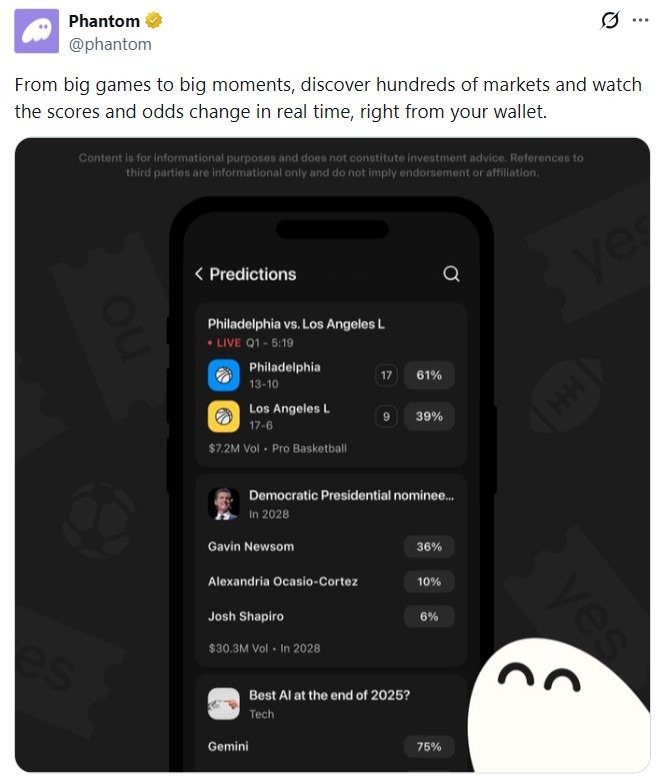
Source: Phantom

Crypto exchanges eye US prediction markets

Phantom’s move comes as major crypto trading platforms race to enter the US prediction markets business.

On Thursday, Gemini Titan, an affiliate of the crypto exchange Gemini, received a designated contract market license from the US Commodity Futures Trading Commission (CFTC). Gemini said it plans to enter the prediction markets space.

The exchange said that it would allow users to access event contract trading on its web platform. Following its announcement, Gemini shares went up by nearly 14% in after-hours trading.

On Nov. 19, tech researcher Jane Manchun Wong, known for discovering in-development features on Big Tech websites, claimed that crypto exchange Coinbase is working on a prediction market. Wong shared screenshots apparently showing the unreleased platform.

Citing anonymous sources, Bloomberg reported that Coinbase plans to announce the launch of its prediction markets and tokenized equities.

A Coinbase spokesperson previously told Cointelegraph that they company will hold a livestream on Wednesday to showcase new products. However, the spokesperson did not mention prediction markets or tokenized stocks.

Related: Polymarket trading figures are being double-counted: Paradigm

Prediction markets face regulatory pushback

While prediction markets have gained popularity in the US, the state of Connecticut has recently taken a stance against certain platforms.

On Dec. 4, the Connecticut Department of Consumer Protection (DCP) sent cease and desist orders to Robinhood, Kalshi and Crypto.com, alleging that they were conducting unlicensed online gambling. However, Kalshi immediately took action a day later.

The prediction market platform sued the DCP, arguing that its event contracts are lawful under federal law.

Connecticut federal court judge Vernon Oliver stated in an order that the DCP must refrain from taking enforcement action against Kalshi. This temporarily stops the DCP’s cease and desist order against Kalshi.

Magazine: Koreans ‘pump’ alts after Upbit hack, China BTC mining surge: Asia Express

Пов'язані матеріали

OpenAI's Largest Internal Wealth Creation: 600 People Cash Out a Total of $6.6 Billion, 75 Take Home the Maximum $30 Million Each

A Wall Street Journal report reveals OpenAI's unprecedented pre-IPO wealth creation. In a single employee stock sale last October, over 600 current and former employees sold shares, collectively cashing out approximately $6.6 billion. Due to high investor demand, the company tripled the individual sale cap to $30 million, with about 75 employees selling the maximum amount. This event represents the largest such transaction in tech industry history for a private company. OpenAI's valuation was $500 billion for this tender offer. Employees with over two years of tenure were eligible, allowing many post-ChatGPT hires their first liquidity event. The company's stock has reportedly grown over 100-fold in seven years. Following a restructuring, employees collectively hold about 26% of OpenAI. The scale of executive wealth is also staggering. In court testimony related to Elon Musk's lawsuit, President and co-founder Greg Brockman confirmed his OpenAI stake is worth around $30 billion. Analysis indicates about 165 current and former employees hold a combined ~$164.9 billion in equity, averaging nearly $1 billion per person in paper wealth. OpenAI's per-employee stock-based compensation is estimated to be 34 times the average of major tech firms before their IPOs. OpenAI continues its rapid ascent, closing a $122 billion funding round at an $852 billion valuation in March. With monthly revenue hitting $2 billion, over 900 million weekly ChatGPT users, and plans for a potential trillion-dollar IPO in late 2026, this wealth-creation engine shows no signs of stopping.

链捕手22 хв тому

OpenAI's Largest Internal Wealth Creation: 600 People Cash Out a Total of $6.6 Billion, 75 Take Home the Maximum $30 Million Each

链捕手22 хв тому

Understanding CPO (Co-Packaged Optics) in One Article: Why Nvidia Is Willing to Spend $3.2 Billion on a Fiber?

NVIDIA and Corning announced a multi-year strategic partnership on May 6, 2026, with NVIDIA committing up to $3.2 billion to support Corning's U.S. expansion. This investment will triple Corning's manufacturing plants and significantly boost its optical fiber and communications production capacity. The core driver behind this massive investment is the fundamental shift from copper to optical interconnect technology within AI data centers. As GPU clusters scale, copper wires face critical limitations: severe signal attenuation over distance, high energy consumption for signal integrity, and excessive heat generation. Optical fiber, transmitting light instead of electrical signals, solves these issues with minimal loss, near-light speed, and lower power needs. The article outlines a three-stage evolution of data center interconnect: 1. **Traditional Copper Interconnects:** The mainstream solution of the 2010s, now being phased out due to scaling bottlenecks. 2. **Pluggable Optical Modules:** The current mainstream, where modules convert electrical signals to light externally. This process still introduces energy loss and latency. 3. **CPO (Co-Packaged Optics):** The next-generation technology where the optical engine is integrated directly with the GPU chip package. This drastically reduces the electrical signal travel distance to mere millimeters, slashing power consumption and latency while boosting data density. NVIDIA CEO Jensen Huang has identified CPO as an essential core technology for AI infrastructure. NVIDIA's investment signifies a strategic shift from being a buyer to actively controlling its supply chain for critical components. With demand for specialized optical fiber far outstripping supply—evidenced by soaring prices—securing long-term manufacturing capacity has become a competitive necessity. While Corning's expansion may pressure some suppliers, a projected global fiber supply gap of 5-15% over the next few years creates a significant opportunity window, particularly for Chinese manufacturers competitive in optical preforms, chips, and modules. Ultimately, NVIDIA's move is not about chasing a trend but an engineering imperative. The transition to light-based interconnects like CPO is driven by the physical limits of copper, marking a definitive step in the ongoing AI computing revolution.

marsbit47 хв тому

Understanding CPO (Co-Packaged Optics) in One Article: Why Nvidia Is Willing to Spend $3.2 Billion on a Fiber?

marsbit47 хв тому

KOL's Perspective: Why Is SOL Set to Rise from This Point?

**Summary: Why SOL is Positioned for Growth at This Level** The article argues that SOL is poised for an upward move from its current price point, citing several key factors. Primarily, SOL has just broken out of a 4-month consolidation phase. This breakout signals a return of risk appetite to the broader crypto market, as SOL is seen as a key indicator of overall crypto health. The token's ownership has reportedly shifted from short-term traders and tourists to long-term accumulators, leading to low volume. Any meaningful increase in trading activity could thus trigger significant upward momentum. Fundamental strengths include strong institutional adoption, integration with DeFi and RWAs (Real-World Assets), and the potential benefits from the Clarity Act. Despite its high volatility—having dropped 70% from its all-time high but still up 12x from its bear market low—SOL is highlighted as one of the few tokens from the last cycle to reach new highs. It boasts a robust ecosystem of applications, users, and protocols. Future catalysts include the expected influx of AI developers following the Miami Accelerate conference, which focused on AI on Solana. Furthermore, Solana is positioned as the premier chain for memecoin activity, a trend expected to continue and drive network usage and fees. The article concludes that recent price action reflects a healthy transfer to long-term holders, setting the stage for growth.

marsbit1 год тому

KOL's Perspective: Why Is SOL Set to Rise from This Point?

marsbit1 год тому

Торгівля

Спот
Ф'ючерси
活动图片




