Peter Thiel Dumps Ethereum Treasury Play ETHZilla, Exits Entire Stake

bitcoinistОпубліковано о 2026-02-19Востаннє оновлено о 2026-02-19

Анотація

Peter Thiel and entities linked to Founders Fund have completely exited their position in ETHZilla, a publicly traded company that initially positioned itself as an Ethereum treasury play. A recent SEC filing shows the group held zero common shares as of Dec. 31, 2025, eliminating a stake that previously amounted to 5.6% of the class. This exit coincides with ETHZilla's strategic pivot away from holding ETH and toward tokenized real-world assets, such as aircraft engine leases. The timing raises questions about whether Thiel’s departure preceded the company’s shift in strategy. Commentators on social media have noted Thiel’s history of exiting positions ahead of market downturns. At the time of reporting, Ethereum was trading at $1,984.

Peter Thiel and entities tied to Founders Fund have fully exited ETHZilla, the publicly traded Ethereum treasury play that once marketed itself as a proxy bet on corporate ETH accumulation. A Schedule 13G/A filed Tuesday shows the reporting group finished 2025 with no remaining common shares, wiping out a position that had been closely watched across both crypto and small-cap equity circles.

Thiel Exists Ethereum Treasury Play

The amended filing, dated Feb. 17, 2026, is unusually blunt on the current footprint: “Aggregate amount... 0.00. Percent of class... 0.0%. Ownership of 5 percent or less of a class.” The positions are reported as of Dec. 31, 2025, meaning the exit was completed by year-end.

That zeroed-out line item is a sharp contrast to what Thiel-related vehicles disclosed just a quarter earlier. In a prior Schedule 13G/A reporting holdings as of Sept. 30, 2025, Thiel was listed with 928,389 shares beneficially owned, representing 5.6% of the class at that time, with additional blocks attributed to Founders Fund entities. The same filing noted the company’s 1-for-10 reverse stock split effective Oct. 20, 2025, with reported share counts adjusted accordingly.

ETHZilla’s story arc matters because it tried to translate the Bitcoin treasury template into an ETH-native wrapper at a moment when public-market vehicles were being pitched as liquid, leverable on-ramps to digital asset exposure. Thiel’s initial involvement, widely reported as a 7.5% stake disclosed in August 2025, helped legitimize that pitch, at least briefly.

More recently, ETHZilla has been signaling a pivot away from a pure ETH-treasury identity and toward tokenized real-world assets, including aviation. In an 8-K tied to a Feb. 12 press release, the company said its subsidiary launched “Eurus Aero Token I,” describing it as “a tokenized real-world asset instrument” that gives exposure to aircraft engines on lease “through tradable digital tokens representing contractual revenue rights.”

The sequencing leaves traders with an uncomfortable, unresolved question: did Founders Fund’s exit precede (and implicitly front-run) the strategy shift, or was it simply a portfolio cleanup after the initial “ETH treasury” narrative cooled?

On X, one commentator framed Thiel’s timing as part of a broader pattern, though several of the post’s claims go beyond what’s in the SEC filing. The account @treebook78 called Thiel a “master at sensing crises,” writing that he “dodged this current dip too,” and arguing he’s an “exit master” who gets out early when bubbles or stress build.

“Back in 2022, he posted diamond hands on SNS telling people to hold Bitcoin forever, but then he quietly sold everything and avoided the Luna crash and FTX collapse (as I recall),” @treebook78 wrote.

At press time, Ethereum traded at $1,984.
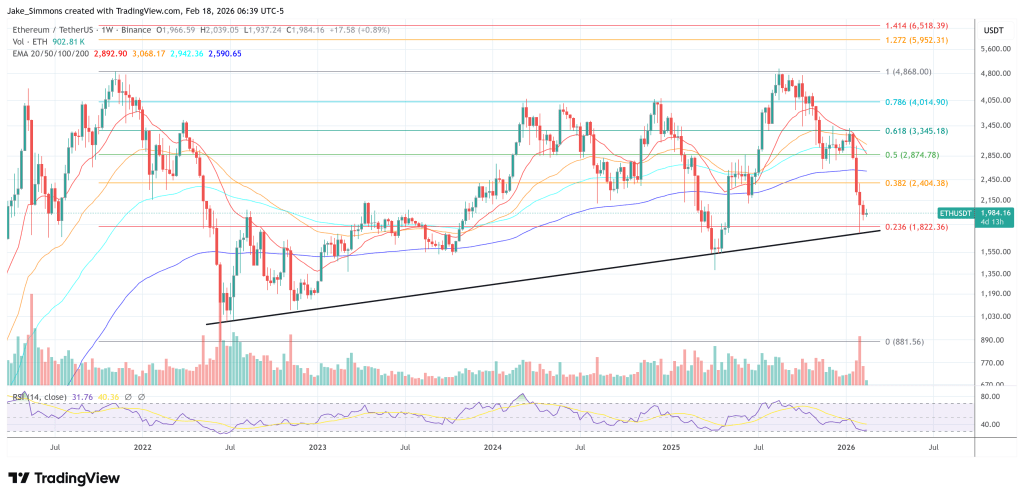
Ethereum remains below the 200-week EMA, 1-week chart | Source: ETHUSDT on TradingView.com

Пов'язані питання

QWhat action did Peter Thiel and Founders Fund take regarding their stake in ETHZilla by the end of 2025?

AThey fully exited their entire stake in ETHZilla, reducing their common share holdings to zero.

QWhat was the size of Peter Thiel's stake in ETHZilla as reported in the prior filing for September 30, 2025?

AThe prior filing reported that Peter Thiel beneficially owned 928,389 shares, representing 5.6% of the class.

QWhat new strategic direction has ETHZilla recently signaled it is pursuing?

AETHZilla is pivoting away from being a pure Ethereum treasury play and towards tokenized real-world assets, such as aviation, with the launch of its 'Eurus Aero Token I'.

QAccording to the article, what is one unresolved question that traders are left with regarding the fund's exit?

ATraders are questioning whether Founders Fund's exit preceded and front-ran the company's strategy shift, or if it was simply a portfolio cleanup after the initial 'ETH treasury' narrative cooled.

QHow does the commentator @treebook78 on X characterize Peter Thiel's investment timing?

AThe commentator characterizes Thiel as a 'master at sensing crises' and an 'exit master' who gets out early when bubbles or stress build, citing his past actions during the Luna crash and FTX collapse.

Пов'язані матеріали

Google and Amazon Simultaneously Invest Heavily in a Competitor: The Most Absurd Business Logic of the AI Era Is Becoming Reality

In a span of four days, Amazon announced an additional $25 billion investment, and Google pledged up to $40 billion—both direct competitors pouring over $65 billion into the same AI startup, Anthropic. Rather than a typical venture capital move, this signals the latest escalation in the cloud wars. The core of the deal is not equity but compute pre-orders: Anthropic must spend the majority of these funds on AWS and Google Cloud services and chips, effectively locking in massive future compute consumption. This reflects a shift in cloud market dynamics—enterprises now choose cloud providers based on which hosts the best AI models, not just price or stability. With OpenAI deeply tied to Microsoft, Anthropic’s Claude has become the only viable strategic asset for Google and Amazon to remain competitive. Anthropic’s annualized revenue has surged to $30 billion, and it is expanding into verticals like biotech, positioning itself as a cross-industry AI infrastructure layer. However, this funding comes with constraints: Anthropic’s independence is challenged as it balances two rival investors, its safety-first narrative faces pressure from regulatory scrutiny, and its path to IPO introduces new financial pressures. Globally, this accelerates a "tri-polar" closed-loop structure in AI infrastructure, with Microsoft-OpenAI, Google-Anthropic, and Amazon-Anthropic forming exclusive model-cloud alliances. In contrast, China’s landscape differs—investments like Alibaba and Tencent backing open-source model firm DeepSeek reflect a more decoupled approach, though closed-source models from major cloud providers still dominate. The $65 billion bet is ultimately about securing a seat at the table in an AI-defined future—where missing the model layer means losing the cloud war.

marsbit2 год тому

Google and Amazon Simultaneously Invest Heavily in a Competitor: The Most Absurd Business Logic of the AI Era Is Becoming Reality

marsbit2 год тому

Computing Power Constrained, Why Did DeepSeek-V4 Open Source?

DeepSeek-V4 has been released as a preview open-source model, featuring 1 million tokens of context length as a baseline capability—previously a premium feature locked behind enterprise paywalls by major overseas AI firms. The official announcement, however, openly acknowledges computational constraints, particularly limited service throughput for the high-end DeepSeek-V4-Pro version due to restricted high-end computing power. Rather than competing on pure scale, DeepSeek adopts a pragmatic approach that balances algorithmic innovation with hardware realities in China’s AI ecosystem. The V4-Pro model uses a highly sparse architecture with 1.6T total parameters but only activates 49B during inference. It performs strongly in agentic coding, knowledge-intensive tasks, and STEM reasoning, competing closely with top-tier closed models like Gemini Pro 3.1 and Claude Opus 4.6 in certain scenarios. A key strategic product is the Flash edition, with 284B total parameters but only 13B activated—making it cost-effective and accessible for mid- and low-tier hardware, including domestic AI chips from Huawei (Ascend), Cambricon, and Hygon. This design supports broader adoption across developers and SMEs while stimulating China's domestic semiconductor ecosystem. Despite facing talent outflow and intense competition in user traffic—with rivals like Doubao and Qianwen leading in monthly active users—DeepSeek has maintained technical momentum. The release also comes amid reports of a new funding round targeting a valuation exceeding $10 billion, potentially setting a new record in China’s LLM sector. Ultimately, DeepSeek-V4 represents a shift toward open yet realistic infrastructure development in the constrained compute landscape of Chinese AI, emphasizing engineering efficiency and domestic hardware compatibility over pure model scale.

marsbit2 год тому

Computing Power Constrained, Why Did DeepSeek-V4 Open Source?

marsbit2 год тому

Торгівля

Спот
Ф'ючерси
活动图片





