Pendle Dismantles the 'Walls': From 'Locking' to 'Retaining' Users

比推Опубліковано о 2026-01-22Востаннє оновлено о 2026-01-22

Анотація

Pendle, a leading DeFi protocol in the interest rate derivatives sector, has announced a major shift away from its long-standing veTokenomics model, transitioning to a more liquid sPENDLE system. This move sparked debate, with critics like Curve’s Michael Egorov calling it a mistake, while the token price rose 11% following the news. The vePENDLE model, which required long-term locking for governance and rewards, was deemed inefficient—concentrating power and yields among a small group of sophisticated users and creating imbalanced incentives across liquidity pools. Over 60% of pools were unprofitable, relying on a few high-performing ones like Ethena for subsidies. The new sPENDLE model introduces a 14-day unstaking period (with a 5% fee for instant exit), replacing indefinite locks. It also adopts algorithmic reward distribution—cutting emissions by ~30%—and directs 80% of protocol revenue to buy back and distribute PENDLE to stakers. Existing vePENDLE holders will receive up to 4x sPENDLE bonuses based on remaining lock-up time at the snapshot on January 29. This shift reflects a broader DeFi trend away from forced loyalty via locking and toward attracting users through real yields and flexibility, as seen in updates by PancakeSwap, Balancer, and Ethena. The industry is increasingly prioritizing product appeal and capital efficiency over locked value.

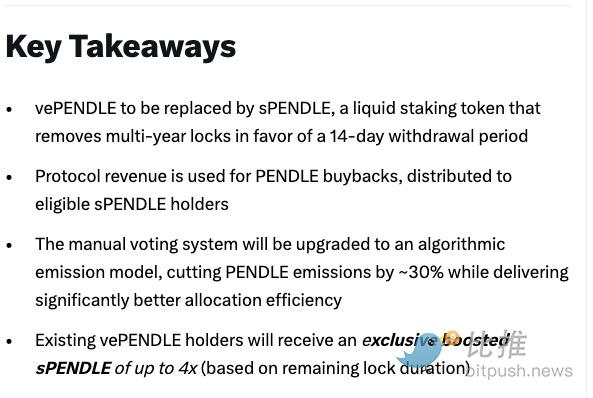
Recently, Pendle, the "long-distance runner" in the DeFi space, announced a major update: abolishing its long-standing veTokenomics (vote-escrowed economic model) and shifting to the more liquid sPENDLE.
The news quickly sparked heated discussions in the community. Curve founder Michael Egorov promptly voiced his doubts, stating bluntly that 'abolishing the ve model is a mistake.' However, on the other side, the market voted with real money—the price of PENDLE rose by 11%.

As the absolute dominator in the interest rate derivatives track, Pendle's 'self-dismantling' reform not only concerns the growth of its $3.5 billion TVL but also seems like a public trial of DeFi's core narrative over the past three years: the model of exchanging 'lock-up periods' for 'loyalty' appears to be losing its effectiveness.

The Shackles of Locking: 20% 'Minority' Governance

Although Pendle's revenue growth has been significant over the past two years, the performance of its core governance asset, vePENDLE, has not fully kept pace with the protocol's explosive growth.
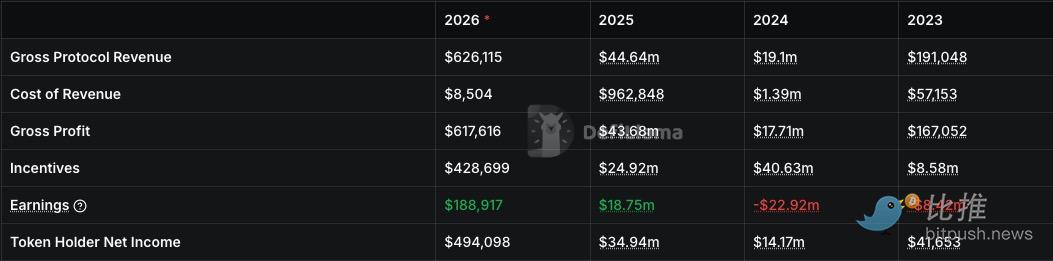
The harsher truth is:

  • Reward 'Wealth Gap': The complex weekly manual voting system is extremely unfriendly to ordinary users, causing rewards to be concentrated in the hands of a few professional players.

  • False Efficiency Boom: Although Pendle's annualized fee efficiency ratio is excellent—with annualized fees of approximately $13.99 million and annualized revenue of about $13.83 million—if broken down by specific pools, over 60% of the pools are actually operating at a loss. The protocol has long relied on profits from a few core high-quality pools (such as Ethena) to subsidize inefficient pools.

This non-transferability of 'lock-up equals disconnection' completely insulates holders from DeFi's most powerful feature: composability.

Algorithms and Buybacks: Shifting from 'Manual' to 'Autopilot'

Pendle's new solution, sPENDLE, essentially transforms the protocol from a 'power game' to an 'efficiency tool.'

The most significant change is the release of liquidity: users no longer face lock-ups of several years; instead, there is a 14-day exit period. If funds are urgently needed, paying a 5% fee allows instant redemption. This 'current account' style treatment provides higher flexibility for the approximately $127 million (35.51% of the market cap) of currently staked funds.

At the governance level, Pendle introduces two 'game-changers':

  1. Algorithm-Driven Emissions: Reward distribution, once determined by manual voting, is now handled by an algorithm. This model will automatically configure rewards based on the actual contribution of each pool, expected to reduce overall emissions by about 30%.

  2. Substantive Buybacks: Up to 80% of protocol revenue will be directly used to buy back PENDLE and distribute it to stakers. Current annualized holder revenue has reached $11.06 million, and cumulative total fees have exceeded $64.56 million. The buyback mechanism will make these earnings directly impact the token's value.

Change inevitably comes with interest restructuring. To appease those 'old contributors' who had locked for years, Pendle set a snapshot date for January 29th.

According to the plan, existing vePENDLE holders can receive up to a 4x sPENDLE multiplier upon conversion. This multiplier will linearly decay based on the original remaining lock-up period, ensuring that those who truly supported the protocol retain the strongest voice and profit rights in the early stages of the transition. This design cleverly alleviates old users' concerns about a 'collapse of long-term consistency.'

This change instantly made PENDLE more 'liquid.' The market clearly prefers liquid assets that allow easy exit while still sharing in buyback dividends, rather than a distant 'long-term meal ticket.'

III. Controversy: Consistency or Liquidity?

However, many industry insiders are not optimistic about this approach.
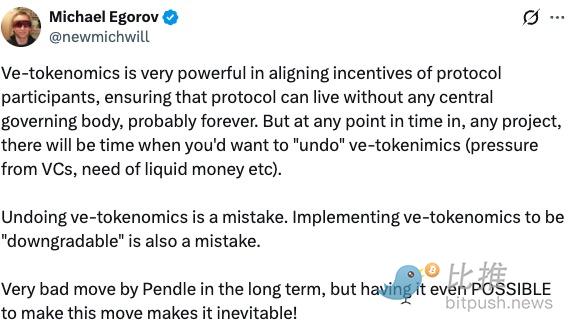
'Opposing' view from Curve founder Michael Egorov:

"Abolishing the vote-escrowed token economics is a mistake. Designing it as 'downgradable' from the start was also a mistake. In the long run, Pendle's move is very bad—but more critically, when such an operation becomes mechanically 'possible,' its occurrence was inevitable."

Maple co-founder and CEO Sid Powell believes that long-term lock-ups essentially 'forcibly retain capital,' which often masks the protocol's true risks and leads to excessive concentration of power. Pendle's approach is 'no longer forcing loyalty through locking, but attracting stay through yields.'

The essence of this debate is: should the moat of a mature DeFi protocol be 'lock-up scale' or 'the appeal of the product itself'?

In fact, Pendle is not alone.

Amid the bull and bear cycles of DeFi in recent years, a group of established protocols have率先 realized that loyalty bought with 'lock-up periods' essentially mortgages the protocol's future.

PancakeSwap was one of the pioneers of this change. As early as the end of 2023, it began reforming its old system that required users to lock CAKE for up to four years. By introducing a flexible Revenue Share mechanism for veCAKE, PancakeSwap directly distributed 5% of protocol fees to stakers, no longer mandating years of immobility. By the end of 2025, despite multi-chain competition, its TVL steadily recovered and remained around $2.3 billion, successfully attracting many retail users unwilling to be locked in long-term.

Balancer's trajectory is also highly illustrative. Its veBAL model long faced difficulties, with nearly 80% of tokens in a 'non-active governance state,' meaning the vast majority of holders only locked and did not vote. In 2025, the team彻底 adjusted the incentive structure in the v3 upgrade: introducing short lock-up options and automated fee adjustments, turning governance from a 'chore' into a flexible tool. Within half a year, the protocol's governance participation rate increased by about 40%.

A more radical experiment came from the stablecoin protocol Ethena. In September last year, it activated a 'fee switch,' directly distributing protocol revenue to holders of the liquidity token sENA, completely bypassing the complex vote-escrow model.

These cases point to a new consensus: DeFi protocols are shifting from 'forcing user binding' to 'retaining users with tangible benefits.' Locking was once a shortcut to maintain data stability but also led ecosystems into false prosperity. Now, protocols prefer to gain real activity by lowering participation barriers and improving capital efficiency.

The effectiveness of Pendle's reform will be tested after the official end of vePENDLE lock-ups on January 29th. But regardless of the outcome, it has sent a clear signal to the industry: in the future DeFi world, excellent products should not make users 'staking prisoners.'

Author: Bootly


Twitter:https://twitter.com/BitpushNewsCN

Bitpush TG Discussion Group:https://t.me/BitPushCommunity

Bitpush TG Subscription: https://t.me/bitpush

Original link:https://www.bitpush.news/articles/7604977

Трендові криптовалюти

Пов'язані питання

QWhat major update did Pendle recently announce regarding its tokenomics model?

APendle announced the abolition of its veTokenomics (vote-escrowed tokenomics) model and transitioned to a more liquid sPENDLE model.

QWhat are the two key features introduced in Pendle's new sPENDLE model?

AThe two key features are algorithm-driven emissions for reward distribution and a substantial buyback mechanism where 80% of protocol revenue is used to repurchase PENDLE for stakers.

QHow did the market initially react to Pendle's announcement of abandoning veTokenomics?

AThe market reacted positively, with the price of PENDLE increasing by 11% following the announcement.

QWhat criticism did Curve founder Michael Egorov raise about Pendle's decision?

AMichael Egorov criticized the move, stating that撤销投票托管代币经济模型是一个错误 (revoking the vote-escrowed tokenomics model is a mistake) and that designing it as 'degradable' was also an error, predicting negative long-term consequences.

QWhat is the exit period for users in the new sPENDLE model, and what option is available for immediate withdrawal?

AThe exit period is 14 days, but users can withdraw immediately by paying a 5% fee for instant redemption.

Пов'язані матеріали

After Three Consecutive Quarters of Decline, Can the Crypto Market Find a Window for Stabilization in Q3?

The cryptocurrency market has just concluded its worst-performing quarter since 2022, with total capitalization dropping 12.6% to $2.1 trillion. All core metrics indicate capital is leaving the sector, not just rotating within it. Bitcoin fell 14.2% and Ethereum dropped 25.4% in Q2, breaking their previous correlation with US tech stocks. A key driver is the reversal in US spot Bitcoin ETF flows, which saw a net outflow of approximately $4.67 billion in Q2, including a record monthly outflow near $4.5 billion in June. While recent data suggests long-term holders are accumulating again, sustained ETF outflows mean continued selling pressure. Market focus is now singularly on the Federal Reserve. The upcoming July FOMC meeting is seen as the most critical event for Q3. A dovish signal could support Bitcoin reclaiming a $68,000-$84,000 range, while a hawkish stance might establish a new trading band around $50,000-$56,000. Additionally, regulatory uncertainty persists, with the progress of the crucial *CLARITY Act* stalling in the Senate, reducing its perceived 2026 passage probability to 40-45%. Despite the broad downturn, a few sectors showed growth. Prediction markets saw nominal volume surge 48.7% year-over-year to $113.8 billion, and tokenized collectibles transaction volume rose 143% quarterly to $1.4 billion. The Real-World Asset (RWA) tokenization sector also continued steady growth, now representing ~$28.1 billion in on-chain value. The market's foundation for an extreme crash appears limited, with Bitcoin price hovering near its 200-week moving average. However, the trading paradigm has shifted from narrative-driven speculation to decisions based on price action, policy developments, and interest rate expectations, making a broad sentiment-driven rally unlikely in the near term.

marsbit35 хв тому

After Three Consecutive Quarters of Decline, Can the Crypto Market Find a Window for Stabilization in Q3?

marsbit35 хв тому

BIT Trading Moment: BTC Still Suppressed by Weekly 200 EMA, Rejection May Restart Decline; Storage and Semiconductors that Surged Last Night Begin Falling in Evening Trading

**Crypto & Stock Market Wrap: Bitcoin Tests Resistance, Stocks Retreat After AI Surge** Bitcoin consolidates around $66,000, facing key resistance near $68,000—an area seen as a major psychological and technical hurdle where previous rallies have failed. Analysts note the cryptocurrency is caught between its 200-week moving average (~$63,333) and 200-week EMA (~$68,328). A clear break above $68k is needed to signal a stronger bullish trend, while a rejection could lead to a retest of $63k support. Market sentiment remains cautious, with low futures open interest pointing to a low-liquidity rebound rather than a full bull market. Bitcoin spot ETFs saw another $203 million inflow. US stock futures pointed lower after a strong Tuesday session led by a massive rebound in semiconductors and memory stocks. The rally was fueled by renewed optimism about AI-driven hardware demand, with Micron, SanDisk, and SK Hynix surging. However, those gains reversed in pre-market trading. Super Micro Computer (SMCI) soared over 20% after hours on strong guidance and a record backlog. Other standouts included Rocket Lab and nuclear energy plays Oklo and X-Energy. Rising oil prices (Brent above $91) and climbing Treasury yields (10-year near 4.64%), however, are reigniting inflation concerns and acting as a headwind for equities. In Asia, markets were mixed. South Korea's KOSPI pared early gains to close slightly higher as semiconductor stocks like SK Hynix gave back initial surges. Japan's Nikkei edged lower as the yen hit a fresh 38-year low against the dollar, raising fears of potential market intervention. Key events to watch include the Samsung Galaxy launch, AMD's AI event, and a slew of major tech earnings from Alphabet, Tesla, and IBM after the close on Wednesday, followed by the ECB meeting and Intel's earnings on Thursday.

marsbit43 хв тому

BIT Trading Moment: BTC Still Suppressed by Weekly 200 EMA, Rejection May Restart Decline; Storage and Semiconductors that Surged Last Night Begin Falling in Evening Trading

marsbit43 хв тому

Former CFTC Chairman, Circle President Tarbert: Preaching Long-Termism While Cashing Out $30 Million Himself

Former CFTC Chairman and Circle President Heath Tarbert has consistently advocated for a long-term vision in public, urging patience from investors as Circle’s stock price has fallen significantly from its peak. However, it has been revealed that since Circle’s IPO, Tarbert has continuously sold his CRCL shares through pre-arranged trading plans, cashing out approximately $30 million, without making any public market purchases. This contrast between his public messaging and personal actions has drawn criticism. Tarbert joined Circle in July 2023 as Chief Legal Officer, leveraging his regulatory experience to help guide the company through its IPO and expansion. Despite promoting stablecoins as long-term infrastructure, he established a 10b5-1 trading plan just before Circle went public, leading to substantial stock sales over the following year. In March 2026, he initiated another plan to sell more shares. His career trajectory highlights a pattern of moving between high-level regulatory roles and influential positions in the financial sector. After resigning as CFTC Chairman in early 2021, he joined Citadel Securities as Chief Legal Officer just 27 days later, during a period of intense regulatory scrutiny for the firm. He later joined Circle, aiding its efforts to navigate regulatory challenges for its public listing. While Tarbert's expertise in policy and compliance is valuable to companies like Circle, his actions—advocating long-term confidence while personally divesting—raise questions about the alignment between his public statements and his private financial decisions, leaving investors who followed his advice to bear the market risks.

marsbit1 год тому

Former CFTC Chairman, Circle President Tarbert: Preaching Long-Termism While Cashing Out $30 Million Himself

marsbit1 год тому

Gate Research Institute: The 'Wall Street-ization' Wave of Crypto Financial Products – Competition or Integration?

The article titled "Gate Research Institute: Are Crypto Financial Products Sparking a 'Wall Street' Wave—Competition or Convergence?" explores the evolving relationship between the crypto ecosystem and traditional finance (TradFi). The piece begins by reflecting on Bitcoin's original 2009 vision of decentralization, disintermediation, and moving away from banks. It then contrasts this with the 2024 landscape, where key crypto assets like Bitcoin are increasingly held through Wall Street products like ETFs issued by giants like BlackRock. The article questions whether this signifies that TradFi is systematically taking over the rights to issue, price, custody, and distribute crypto financial assets. The core argument is that this is not a zero-sum takeover but rather a bidirectional convergence where each side addresses the other's weaknesses. Crypto offers 24/7 global markets, programmable settlement, and open access but lacks compliant channels, institutional-grade custody, deep fiat liquidity, and mainstream distribution. TradFi possesses these but is constrained by legacy systems, limited operating hours, and slow settlement. Two primary convergence paths are highlighted: * **Path A (CEX to TradFi):** Exemplified by Gate, which has progressed from offering tokenized stocks and CFDs to providing direct, real stock trading (US, Hong Kong, South Korea) within its platform, using USDT. * **Path B (TradFi to Crypto):** Exemplified by Robinhood, which has integrated crypto trading, acquired exchanges like Bitstamp, and is moving traditional assets like stocks onto the blockchain via tokenization and its own Layer 2. Both paths are ultimately competing to become the next-generation, unified financial account—a "super account" where users can seamlessly trade cryptocurrencies, stocks, ETFs, RWA (Real World Assets), and tokenized treasury products in one interface. The growth of RWA and tokenized treasuries (e.g., BlackRock's BUIDL) is presented as the asset-layer fusion, providing stable, yield-bearing assets on-chain and acting as a bridge between the two worlds. In conclusion, the "Wall Street-ization" of crypto is framed as a mutual transformation. Decentralized ideals persist in the protocol layer, while at the application layer, a more efficient, global, and accessible unified capital market is emerging from this convergence. The future competition lies not between crypto exchanges and stockbrokers, but between platforms vying to offer the most comprehensive asset coverage, liquidity, and user experience within a single account.

marsbit1 год тому

Gate Research Institute: The 'Wall Street-ization' Wave of Crypto Financial Products – Competition or Integration?

marsbit1 год тому

Торгівля

Спот

Популярні статті

Як купити PENDLE

Ласкаво просимо до HTX.com! Ми зробили покупку Pendle (PENDLE) простою та зручною. Дотримуйтесь нашої покрокової інструкції, щоб розпочати свою криптовалютну подорож.Крок 1: Створіть обліковий запис на HTXВикористовуйте свою електронну пошту або номер телефону, щоб зареєструвати обліковий запис на HTX безплатно. Пройдіть безпроблемну реєстрацію й отримайте доступ до всіх функцій.ЗареєструватисьКрок 2: Перейдіть до розділу Купити крипту і виберіть спосіб оплатиКредитна/дебетова картка: використовуйте вашу картку Visa або Mastercard, щоб миттєво купити Pendle (PENDLE).Баланс: використовуйте кошти з балансу вашого рахунку HTX для безперешкодної торгівлі.Треті особи: ми додали популярні способи оплати, такі як Google Pay та Apple Pay, щоб підвищити зручність.P2P: Торгуйте безпосередньо з іншими користувачами на HTX.Позабіржова торгівля (OTC): ми пропонуємо індивідуальні послуги та конкурентні обмінні курси для трейдерів.Крок 3: Зберігайте свої Pendle (PENDLE)Після придбання Pendle (PENDLE) збережіть його у своєму обліковому записі на HTX. Крім того, ви можете відправити його в інше місце за допомогою блокчейн-переказу або використовувати його для торгівлі іншими криптовалютами.Крок 4: Торгівля Pendle (PENDLE)Легко торгуйте Pendle (PENDLE) на спотовому ринку HTX. Просто увійдіть до свого облікового запису, виберіть торгову пару, укладайте угоди та спостерігайте за ними в режимі реального часу. Ми пропонуємо зручний досвід як для початківців, так і для досвідчених трейдерів.

371 переглядів усьогоОпубліковано 2024.12.12Оновлено 2026.06.02

Як купити PENDLE

Обговорення

Ласкаво просимо до спільноти HTX. Тут ви можете бути в курсі останніх подій розвитку платформи та отримати доступ до професійної ринкової інформації. Нижче представлені думки користувачів щодо ціни PENDLE (PENDLE).

活动图片













