Payy Unveils Privacy-First L2 for Institutional Capital: Why $BMIC is the Missing Layer of Quantum Defense

bitcoinistОпубліковано о 2026-02-05Востаннє оновлено о 2026-02-05

Анотація

Payy has launched a privacy-focused Ethereum Layer 2 solution using zero-knowledge proofs to enable institutions to settle transactions on-chain without exposing sensitive data to competitors. While this addresses transparency and front-running risks, it doesn’t protect against the long-term threat of quantum computing, which could decrypt current cryptographic systems. This vulnerability is where BMIC ($BMIC) positions itself as a critical security layer. It introduces a quantum-resistant financial stack using post-quantum cryptography (PQC) to safeguard private keys and assets from future quantum attacks. BMIC’s architecture includes AI-enhanced threat detection and integrates with ERC-4337 smart accounts for a user-friendly yet highly secure experience. The project has raised over $432K in its presale, with the token priced at $0.049474. $BMIC supports ecosystem operations through a "Burn-to-Compute" mechanism and enables quantum-secure staking. As institutional adoption of privacy L2s grows, BMIC aims to become an essential component in protecting high-value on-chain transactions from quantum decryption threats.

The friction between blockchain’s radical transparency and traditional finance’s need for discretion has long been a bottleneck for institutional adoption. Now, Payy is moving to break that deadlock.

With the launch of its privacy-enabled Ethereum Layer 2, the protocol uses zero-knowledge proofs to offer banks and fintechs a way to settle transactions on-chain without broadcasting their entire ledger to competitors.
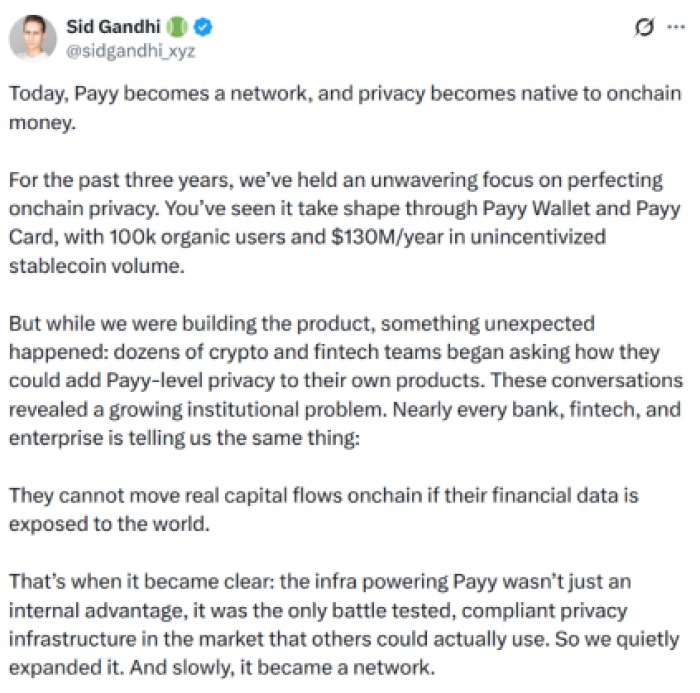
This isn’t just about masking transactions. For years, major financial institutions have hesitated to move proprietary trading algorithms or sensitive settlement layers onto public ledgers like Ethereum.

Why? The ‘dark forest’ of the mempool, where MEV bots and rivals front-run visible trades, is simply too risky. While Payy’s integration with MetaMask suggests a seamless bridge for Web3 natives, the real target is the massive institutional flow that demands regulatory compliance paired with on-chain finality.

But let’s be honest: privacy is only half the battle. While Payy obscures the flow of funds, the assets themselves remain vulnerable to a quieter, existential threat: quantum computing. As banks move billions onto these new rails, they face the ‘harvest now, decrypt later’ vector, where hostile actors collect encrypted data today to crack it once quantum processors mature.

This specific gap, protecting the vault rather than just the transaction, is driving smart money toward BMIC ($BMIC), a project building the first quantum-secure financial stack for the Ethereum ecosystem.

Quantum-Proofing the Institutional Ledger

If Payy secures the pipe, BMIC is engineering the steel plating for the vault. The current cryptographic standards securing the $2.5T crypto market (Elliptic Curve Cryptography) are notoriously vulnerable to Shor’s algorithm.

That’s the method quantum computers will eventually use to reverse-engineer private keys from public addresses. For a retail trader, it’s a risk. For a bank moving nine-figure sums on Payy’s L2? It’s an unacceptable systemic failure point.

BMIC addresses this with a full finance stack running on post-quantum cryptography (PQC). Unlike legacy wallets that expose public keys during signing, BMIC uses a zero public-key exposure protocol. That matters.
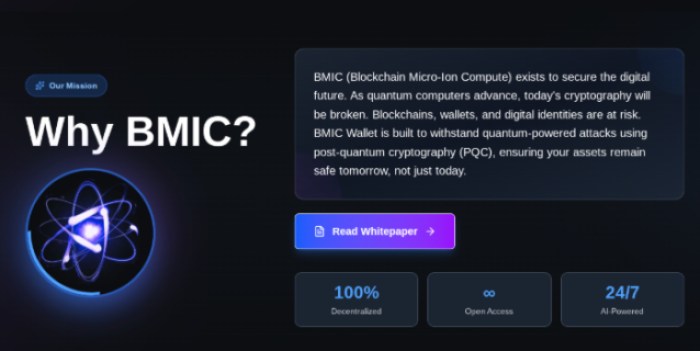
It neutralizes the primary vector for quantum attacks before they even begin. The platform’s ‘Quantum Meta-Cloud’ architecture insulates assets from underlying chain vulnerabilities, creating an environment where institutions can stake, store, and transact without fear of retrospective decryption.

The technological leap here is the integration of AI-enhanced threat detection within the wallet infrastructure itself. By combining quantum-resistant algorithms with ERC-4337 smart accounts, BMIC offers a user experience that mimics the ease of MetaMask, essential for Payy’s target demographic, while operating on a security standard that exceeds current military-grade requirements.

As the industry pivots toward privacy L2s, the infrastructure securing the keys themselves becomes the most critical, yet undervalued, layer of the stack.

LEARN MORE ABOUT THE BMIC’S QUANTUM SECURITY

$0.049474 Entry Point Attracts Defensive Capital

The market is waking up to the reality that privacy rails like Payy need quantum-resistant locks. BMIC has already raised over $432K in its ongoing presale, signaling growing awareness of the ‘quantum threat’ among sophisticated investors.

Currently priced at $0.049474, the token offers an entry point into a sector that many analysts predict will be mandatory for institutional volume by 2026. It’s easy to see why it could be the best new cryptocurrency.

Frankly, the token utility distinguishes the presale raise. $BMIC isn’t just for governance; it fuels the ecosystem’s computational power (via the ‘Burn-to-Compute’ mechanism) and is required for quantum-secure staking. In a market where yield often carries the risk of smart contract exploits or key exposure, BMIC offers a secure staking environment where cryptographic integrity beats complex, risky DeFi loops.

For investors watching the infrastructure narrative, the correlation is clear: as adoption of privacy L2s like Payy grows, the underlying security layer must scale to match the assets it protects. With the presale still under half a million dollars, the valuation hasn’t yet priced in the inevitable shift toward post-quantum standards.

As regulatory frameworks tighten around data security, protocols offering harvest-resistant encryption could decouple from the broader altcoin market.

CHECK OUT THE $BMIC PRESALE PAGE

This article is for informational purposes only and does not constitute financial advice. Cryptocurrencies are high-risk assets. The “harvest now, decrypt later” threat is a long-term projection. Always conduct your own due diligence before investing.


Трендові криптовалюти

Пов'язані питання

QWhat is the primary purpose of Payy's new Ethereum Layer 2 solution?

APayy's privacy-enabled Ethereum Layer 2 uses zero-knowledge proofs to allow banks and fintech companies to settle transactions on-chain without broadcasting their entire ledger to competitors, addressing the friction between blockchain transparency and traditional finance's discretion.

QAccording to the article, what is the 'harvest now, decrypt later' threat?

AThe 'harvest now, decrypt later' threat is a vector where hostile actors collect encrypted data today with the intention of decrypting it once quantum processors become powerful enough, posing a risk to assets secured by current cryptographic standards.

QHow does BMIC ($BMIC) aim to protect against quantum computing threats?

ABMIC uses a full finance stack running on post-quantum cryptography (PQC) with a zero public-key exposure protocol. Its 'Quantum Meta-Cloud' architecture insulates assets from underlying chain vulnerabilities, preventing quantum computers from reverse-engineering private keys.

QWhat technological features does BMIC integrate to enhance its security and user experience?

ABMIC integrates AI-enhanced threat detection within its wallet infrastructure and combines quantum-resistant algorithms with ERC-4337 smart accounts. This provides a user experience similar to MetaMask while operating on a security standard that exceeds current military-grade requirements.

QWhat is the current price and key utility of the $BMIC token as mentioned in the article?

AThe $BMIC token is currently priced at $0.049474 in its presale. Its utility includes fueling the ecosystem's computational power via a 'Burn-to-Compute' mechanism and is required for participating in quantum-secure staking, offering a secure alternative to risky DeFi yield strategies.

Пов'язані матеріали

Interview with Robinhood Executive: Meme + Tokenized US Stocks as "Barbell" Customer Acquisition Strategy, All Business Lines Achieve Hundreds of Millions in Revenue

Interview with Robinhood executive Johann Kerbrat reveals the company's "barbell" customer acquisition strategy for its new Robinhood Chain, combining meme tokens with tokenized stocks. Three weeks after mainnet launch, the chain has seen over $3B in weekly DEX volume and 105M transactions. Kerbrat explains the logic behind the permissionless chain: meme tokens attract DeFi users, while tokenized real-world assets (RWA), currently over 90 US stocks and ETFs accessible in 120+ countries, serve global users. The goal is to bring Robinhood's 27 million funded accounts on-chain by simplifying DeFi with a user-friendly interface, exemplified by features like Robinhood Earn which offers yield without requiring wallet management. Built on Arbitrum's technology stack for its speed, low cost, and Ethereum's security, the chain focuses on financial products like Earn, spot trading, and perpetuals. Kerbrat downplays direct competition with platforms like Base, emphasizing the goal of expanding the overall market for on-chain assets. He details selective partnerships (e.g., Morpho, Lighter) based on compliance, unique UX, and differentiation. While regulatory clarity is pending for US perpetuals, the expansion continues via Bitstamp in Europe. Finally, Kerbrat positions Robinhood as a "super app" integrating stocks, options, crypto, banking, and AI trading, with all major business lines generating hundreds of millions in revenue. For the chain, current priority is driving adoption over maximizing gas fee revenue.

marsbit2 год тому

Interview with Robinhood Executive: Meme + Tokenized US Stocks as "Barbell" Customer Acquisition Strategy, All Business Lines Achieve Hundreds of Millions in Revenue

marsbit2 год тому

Fidelity Q3 Report: BTC, ETH, and SOL Continue to Build Bottoms; How Much Further Will This Crypto Bear Market Go?

Fidelity's Q3 Crypto Signal Report analyzes the current bear market, noting Bitcoin (BTC), Ethereum (ETH), and Solana (SOL) are in a prolonged bottoming phase. Key indicators like the weighted Net Unrealized Profit/Loss (NUPL) have turned negative (-0.01), signaling the market is slightly below its aggregate cost basis, with BTC acting as the primary stabilizing asset. BTC's dominance has risen to 68%, indicating a lack of capital rotation to other digital assets. Performance has been weak across the board, with BTC, ETH, and SOL down significantly year-to-date. Market sentiment is depressed, exacerbated by substantial outflows from spot ETPs and a challenging macro environment. The report compares the current ~203-day downtrend to historical ~300-day bottoming cycles, suggesting the process may be two-thirds complete, with late 2026 as a potential timeframe to monitor. For Bitcoin, NUPL at 0.09 indicates cautious sentiment, while momentum signals remain negative. The Yardstick metric points to potential undervaluation relative to network security (hashrate). Ethereum's NUPL is deep in the "capitulation" zone at -0.43, a historically positive signal for future returns, though its momentum and network fee revenue are negative. Solana shows the deepest NUPL at -0.72 but demonstrates relative resilience in on-chain activity and stablecoin transfer volume. The report concludes that while several metrics are near historical capitulation levels, a definitive market bottom has not yet been established. The path forward likely involves continued consolidation, with BTC's relative strength and fundamental on-chain usage for ETH and SOL providing key areas for investor observation.

marsbit2 год тому

Fidelity Q3 Report: BTC, ETH, and SOL Continue to Build Bottoms; How Much Further Will This Crypto Bear Market Go?

marsbit2 год тому

Торгівля

Спот

Популярні статті

Як купити LAYER

Ласкаво просимо до HTX.com! Ми зробили покупку Solayer (LAYER) простою та зручною. Дотримуйтесь нашої покрокової інструкції, щоб розпочати свою криптовалютну подорож.Крок 1: Створіть обліковий запис на HTXВикористовуйте свою електронну пошту або номер телефону, щоб зареєструвати обліковий запис на HTX безплатно. Пройдіть безпроблемну реєстрацію й отримайте доступ до всіх функцій.ЗареєструватисьКрок 2: Перейдіть до розділу Купити крипту і виберіть спосіб оплатиКредитна/дебетова картка: використовуйте вашу картку Visa або Mastercard, щоб миттєво купити Solayer (LAYER).Баланс: використовуйте кошти з балансу вашого рахунку HTX для безперешкодної торгівлі.Треті особи: ми додали популярні способи оплати, такі як Google Pay та Apple Pay, щоб підвищити зручність.P2P: Торгуйте безпосередньо з іншими користувачами на HTX.Позабіржова торгівля (OTC): ми пропонуємо індивідуальні послуги та конкурентні обмінні курси для трейдерів.Крок 3: Зберігайте свої Solayer (LAYER)Після придбання Solayer (LAYER) збережіть його у своєму обліковому записі на HTX. Крім того, ви можете відправити його в інше місце за допомогою блокчейн-переказу або використовувати його для торгівлі іншими криптовалютами.Крок 4: Торгівля Solayer (LAYER)Легко торгуйте Solayer (LAYER) на спотовому ринку HTX. Просто увійдіть до свого облікового запису, виберіть торгову пару, укладайте угоди та спостерігайте за ними в режимі реального часу. Ми пропонуємо зручний досвід як для початківців, так і для досвідчених трейдерів.

436 переглядів усьогоОпубліковано 2025.02.11Оновлено 2026.06.02

Як купити LAYER

Обговорення

Ласкаво просимо до спільноти HTX. Тут ви можете бути в курсі останніх подій розвитку платформи та отримати доступ до професійної ринкової інформації. Нижче представлені думки користувачів щодо ціни LAYER (LAYER).

活动图片