PayPal Expands PYUSD Access To 68 New Countries Amid Stablecoin Push

bitcoinistОпубліковано о 2026-03-18Востаннє оновлено о 2026-03-18

Анотація

PayPal has expanded access to its U.S. dollar-pegged stablecoin, PayPal USD (PYUSD), to 70 markets worldwide, including 68 new countries this month. This expansion allows users in regions like Asia-Pacific, Europe, and Latin America to send, hold, and receive PYUSD, enabling faster and lower-cost cross-border transactions compared to traditional methods. The stablecoin, which initially faced regulatory scrutiny, saw its market cap grow to $4.1 billion after the SEC closed its investigation in February 2025. Users in most regions can also receive rewards on holdings, though exceptions include Singapore and the UK. PayPal aims to build a more inclusive global commerce ecosystem by increasing PYUSD’s utility and accessibility.

PayPal has expanded access to its stablecoin PayPal USD (PYUSD) to 70 markets, allowing users worldwide to send, hold, and receive the token while enabling faster, lower-cost global transactions.

PayPal Expands PYUSD Across 70 Markets

On Tuesday, payments giant PayPal announced that its USD-pegged stablecoin, PYUSD, will be available to users in 70 markets worldwide following its expansion into 68 new countries this month.

The fintech launched the stablecoin in August 2023 after initially pausing development due to scrutiny of PayPal’s issuance partner, Paxos. That same year, PayPal received a subpoena from the US Securities and Exchange Commission (SEC) related to its stablecoin.

As crypto regulation gained momentum and financial watchdogs loosened their grip under the Trump Administration, the Commission concluded its 16-month investigation into PYUSD without enforcement action in February 2025. Since then, PYUSD’s total market capitalization has reached $4.1 billion, a fivefold increase over the past year.

Previously, only customers in the US and the UK had access to the PYUSD. However, the latest expansion has made PYUSD available to users across multiple global regions, including Asia-Pacific, Europe, Latin America, and North America.

This includes Colombia, Costa Rica, the Dominican Republic, the Faroe Islands, Greenland, Guatemala, Honduras, Panama, Peru, Singapore, the United Kingdom, and the United States. Meanwhile, users in the remaining markets will have access to PYUSD in the coming weeks.

Users in the newly supported regions will be able to hold, send, and receive the stablecoin directly on their PayPal accounts, enabling faster settlement and lower cost than traditional payment methods.

Users will also be eligible to earn rewards on their stablecoin holdings, but rewards won’t be available to users in Singapore or the United Kingdom, the official announcement noted. Existing holders in the United States receive an annual 4% reward.

PayPal Eyes ‘More Inclusive, Global Commerce Ecosystem’

The payments giant affirmed that this geographical expansion marks a critical step in its stablecoin push to build “the liquidity, utility, and ubiquity of PYUSD necessary to create a more inclusive, global commerce ecosystem.”

While consumers and businesses worldwide are seeking faster, more seamless global transactions, the current system still incurs excessive charges and adheres to outdated timelines, May Zabaneh, Senior Vice President and General Manager of Crypto at PayPal, noted, adding that the company is working to change that.

“Enabling PYUSD in users’ accounts across 70 markets gives people faster access to their funds, lower-cost ways to send money across borders, and a more direct path to participating in the global economy, and that is what drives commerce forward for everyone,” she affirmed in the official announcement.

“Now you’re really opening up not only access—especially in places where they need it most— but also cross-border transfers and volume, where the pain is felt so high,” Zabaneh also told Fortune.

The stablecoin was initially launched on Ethereum and later expanded to other networks, including Tron, Avalanche, Aptos, and Sei, through LayerZero in September. In addition, YouTube added a new payout option last December that allows US creators to receive earnings in PYUSD.
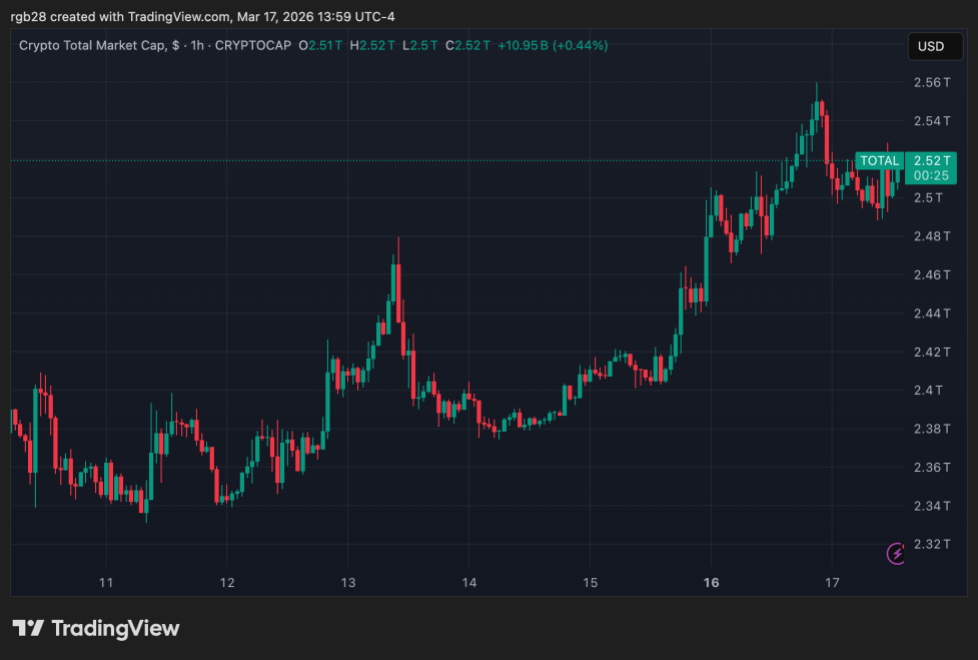
The total crypto market capitalization is at $2.52 trillion in the one-week chart. Source: TOTAL on TradingView


Пов'язані питання

QHow many new countries did PayPal expand PYUSD access to in its latest announcement?

APayPal expanded PYUSD access to 68 new countries.

QWhat was the total market capitalization of PYUSD as mentioned in the article, and how much has it increased over the past year?

APYUSD's total market capitalization reached $4.1 billion, which is a fivefold increase over the past year.

QWhich regions are included in the latest expansion of PYUSD access?

AThe latest expansion includes users across multiple global regions, such as Asia-Pacific, Europe, Latin America, and North America.

QWhat benefits do users in newly supported regions gain from holding PYUSD?

AUsers in newly supported regions can hold, send, and receive PYUSD directly on their PayPal accounts, enabling faster settlement and lower costs compared to traditional payment methods.

QOn which blockchain networks is PYUSD available besides Ethereum?

ABesides Ethereum, PYUSD is available on other networks including Tron, Avalanche, Aptos, and Sei.

Пов'язані матеріали

Gensyn AI: Don't Let AI Repeat the Mistakes of the Internet

In recent months, the rapid growth of the AI industry has attracted significant talent from the crypto sector. A persistent question among researchers intersecting both fields is whether blockchain can become a foundational part of AI infrastructure. While many previous AI and Crypto projects focused on application layers (like AI Agents, on-chain reasoning, data markets, and compute rentals), few achieved viable commercial models. Gensyn differentiates itself by targeting the most critical and expensive layer of AI: model training. Gensyn aims to organize globally distributed GPU resources into an open AI training network. Developers can submit training tasks, nodes provide computational power, and the network verifies results while distributing incentives. The core issue addressed is not decentralization for its own sake, but the increasing centralization of compute power among tech giants. In the era of large models, access to GPUs (like the H100) has become a decisive bottleneck, dictating the pace of AI development. Major AI companies are heavily dependent on large cloud providers for compute resources. Gensyn's approach is significant for several reasons: 1) It operates at the core infrastructure layer (model training), the most resource-intensive and technically demanding part of the AI value chain. 2) It proposes a more open, collaborative model for compute, potentially increasing resource utilization by dynamically pooling idle GPUs, similar to early cloud computing logic. 3) Its technical moat lies in solving complex challenges like verifying training results, ensuring node honesty, and maintaining reliability in a distributed environment—making it more of a deep-tech infrastructure company. 4) It targets a validated, high-growth market with genuine demand, rather than pursuing blockchain integration without purpose. Ultimately, the boundaries between Crypto and AI are blurring. AI requires global resource coordination, incentive mechanisms, and collaborative systems—areas where crypto-native solutions excel. Gensyn represents a step toward making advanced training capabilities more accessible and collaborative, moving beyond a niche controlled by a few giants. If successful, it could evolve into a fundamental piece of AI infrastructure, where the most enduring value in the AI era is often created.

marsbit9 год тому

Gensyn AI: Don't Let AI Repeat the Mistakes of the Internet

marsbit9 год тому

Why is China's AI Developing So Fast? The Answer Lies Inside the Labs

A US researcher's visit to China's top AI labs reveals distinct cultural and organizational factors driving China's rapid AI development. While talent, data, and compute are similar to the West, Chinese labs excel through a pragmatic, execution-focused culture: less emphasis on individual stardom and conceptual debate, and more on teamwork, engineering optimization, and mastering the full tech stack. A key advantage is the integration of young students and researchers who approach model-building with fresh perspectives and low ego, prioritizing collective progress over personal credit. This contrasts with the US culture of self-promotion and "star scientist" narratives. Chinese labs also exhibit a strong "build, don't buy" mentality, preferring to develop core capabilities—like data pipelines and environments—in-house rather than relying on external services. The ecosystem feels more collaborative than tribal, with mutual respect among labs. While government support exists, its scale is unclear, and technical decisions appear driven by labs, not state mandates. Chinese companies across sectors, from platforms to consumer tech, are building their own foundational models to control their tech destiny, reflecting a broader cultural drive for technological sovereignty. Demand for AI is emerging, with spending patterns potentially mirroring cloud infrastructure more than traditional SaaS. Despite challenges like a less mature data industry and GPU shortages, Chinese labs are propelled by vast talent, rapid iteration, and deep integration with the open-source community. The competition is evolving beyond a pure model race into a contest of organizational execution, developer ecosystems, and industrial pragmatism.

marsbit11 год тому

Why is China's AI Developing So Fast? The Answer Lies Inside the Labs

marsbit11 год тому

3 Years, 5 Times: The Rebirth of a Century-Old Glass Factory

Corning, a 175-year-old glass company, is experiencing a dramatic revival as a key player in AI infrastructure, driven by surging demand for high-performance optical fiber in data centers. AI data centers require vastly more fiber than traditional ones—5 to 10 times as much per rack—to handle high-speed data transmission between GPUs. This structural demand shift, coupled with supply constraints from the lengthy expansion cycle for fiber preforms, has created a significant supply-demand gap. Nvidia has invested in Corning, along with Lumentum and Coherent, in a $4.5 billion total commitment to secure the optical supply chain for AI. Corning's competitive edge lies in its expertise in producing ultra-low-loss, high-density, and bend-resistant specialty fiber, which is critical for 800G+ and future 1.6T data rates. Its deep involvement in co-packaged optics (CPO) with partners like Nvidia further solidifies its position. While not the largest fiber manufacturer globally, Corning's revenue from enterprise/data center clients now exceeds 40% of its optical communications sales, and it has secured multi-year supply agreements with major hyperscalers including Meta and Nvidia. Financially, Corning's optical communications revenue has surged, doubling from $1.3 billion in 2023 to over $3 billion in 2025. Its stock price has risen nearly 6-fold since late 2023. Key future catalysts include the rollout of Nvidia's CPO products and the scale of undisclosed customer agreements. However, risks include high current valuations and potential disruption from next-generation technologies like hollow-core fiber. The company's long-term bet on light over electricity, maintained even through the telecom bubble crash, is now being validated by the AI boom.

marsbit11 год тому

3 Years, 5 Times: The Rebirth of a Century-Old Glass Factory

marsbit11 год тому

Торгівля

Спот
Ф'ючерси

Популярні статті

Як купити PUSH

Ласкаво просимо до HTX.com! Ми зробили покупку Push Protocol (PUSH) простою та зручною. Дотримуйтесь нашої покрокової інструкції, щоб розпочати свою криптовалютну подорож.Крок 1: Створіть обліковий запис на HTXВикористовуйте свою електронну пошту або номер телефону, щоб зареєструвати обліковий запис на HTX безплатно. Пройдіть безпроблемну реєстрацію й отримайте доступ до всіх функцій.ЗареєструватисьКрок 2: Перейдіть до розділу Купити крипту і виберіть спосіб оплатиКредитна/дебетова картка: використовуйте вашу картку Visa або Mastercard, щоб миттєво купити Push Protocol (PUSH).Баланс: використовуйте кошти з балансу вашого рахунку HTX для безперешкодної торгівлі.Треті особи: ми додали популярні способи оплати, такі як Google Pay та Apple Pay, щоб підвищити зручність.P2P: Торгуйте безпосередньо з іншими користувачами на HTX.Позабіржова торгівля (OTC): ми пропонуємо індивідуальні послуги та конкурентні обмінні курси для трейдерів.Крок 3: Зберігайте свої Push Protocol (PUSH)Після придбання Push Protocol (PUSH) збережіть його у своєму обліковому записі на HTX. Крім того, ви можете відправити його в інше місце за допомогою блокчейн-переказу або використовувати його для торгівлі іншими криптовалютами.Крок 4: Торгівля Push Protocol (PUSH)Легко торгуйте Push Protocol (PUSH) на спотовому ринку HTX. Просто увійдіть до свого облікового запису, виберіть торгову пару, укладайте угоди та спостерігайте за ними в режимі реального часу. Ми пропонуємо зручний досвід як для початківців, так і для досвідчених трейдерів.

518 переглядів усьогоОпубліковано 2024.12.13Оновлено 2025.03.21

Як купити PUSH

Обговорення

Ласкаво просимо до спільноти HTX. Тут ви можете бути в курсі останніх подій розвитку платформи та отримати доступ до професійної ринкової інформації. Нижче представлені думки користувачів щодо ціни PUSH (PUSH).

活动图片












