Paradigm's Stalling Moment: When a 'Research-Driven Crypto VC' Faces Reality Test

marsbitОпубліковано о 2025-12-30Востаннє оновлено о 2025-12-30

Анотація

Paradigm, once a leading research-driven crypto VC, is facing significant challenges marked by an unprecedented wave of high-level departures since April, including multiple partners. Its investment strategy, which previously yielded iconic deals like Uniswap and Flashbots, has struggled to adapt to shifting industry trends toward application-layer innovation and financial products. The firm has made several high-valuation, late-stage investments—such as Farcaster, Babylon, and Monad—that have underperformed post-token, while missing early opportunities in high-return areas like derivatives and RWA. Its incubation initiatives, including the EIR program, have also seen setbacks, with projects like Shadow and Yield Protocol halting operations. Recently, Paradigm has increased investment frequency and shifted toward earlier-stage deals. It is now focusing heavily on Tempo, a payment-focused Layer-1 blockchain developed with Stripe, aiming to regain its influence in a more results-driven market. Despite these challenges, Paradigm remains one of the best-capitalized VCs in crypto.

Author: Gu Yu, ChainCatcher

For a long time, Paradigm has been an iconic venture capital firm in the crypto industry, representing the top-tier investment style and aesthetic, with its research-driven crypto VC approach highly praised. However, affected by the industry's cyclical downturn, Paradigm has not been immune to the current widespread VC slump. One manifestation is an unprecedented wave of executive departures, with at least seven employees leaving since April this year, including several partners.

In December, Charlie Noyes, Paradigm's first employee and general partner, and Nick Martitsch, Head of Market Development at Paradigm, announced their departures successively.

In September, Gina Moon, General Counsel at Paradigm, and researcher Transmissions11 left.

In June, Teresa G. Grandía, Head of Business Operations at Paradigm, departed.

In April, Loren Siebert, Head of Engineering at Paradigm, and research partner samczsun left successively.
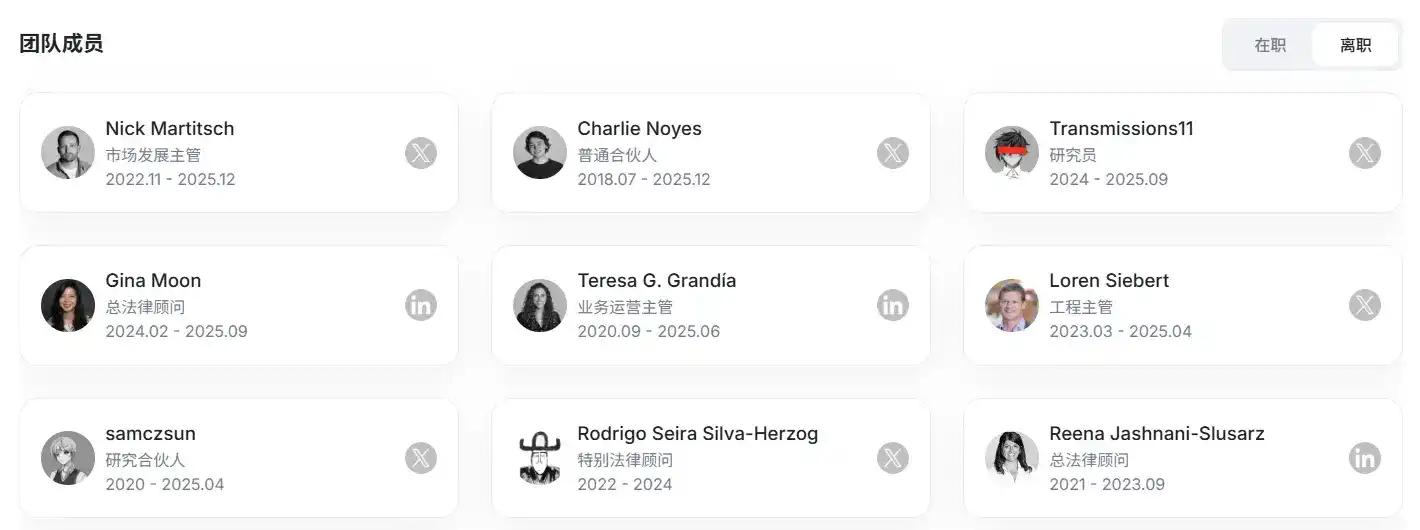
Source: RootData

Such a wave of departures is extremely rare among first-tier VCs, reflecting that Paradigm is in a rather difficult phase. Judging from its public portfolio and transaction frequency, Paradigm's investment pace has significantly slowed over the past two to three years, lacking industry-consensus "masterpiece" investments and missing out on many high-return projects, which are likely the main sources of Paradigm's predicament.

Frequently Taking Over Late Rounds, Missing Star Projects

Paradigm's golden era roughly spanned 2019 to 2021. During this period, it completed investments in key projects like Uniswap, Optimism, Lido, and Flashbots, thereby establishing a strong brand identity: technical infrastructure, Ethereum core ecosystem, long-termism, which also earned Paradigm considerable reputation within crypto entrepreneur and investor circles.

These typical investments shared several common features: they were not short-term trends but rather underlying protocols or critical middleware; the investment timing was relatively early but not extremely so; and they were highly aligned with Paradigm's internal research directions.

It was during this phase that Paradigm formed its clear and repeatedly emphasized investment strategy: research-driven. However, the problem is that this methodology gradually revealed its lack of adaptability in subsequent cycles, facing rapid changes in industry logic, leading to a noticeable gap between Paradigm's investment performance and its influence.

Starting in 2022, the new generation of high-growth projects began to emerge more in areas like the application layer, financial structure innovation, mechanism design, and product experience, such as prediction markets, yield structuring protocols, and perpetual contract protocols. This wave of projects often iterated quickly, were more product-oriented, tolerated higher levels of "technical correctness," and were more sensitive to "user growth" and "mechanism efficiency."

In the last cycle, Paradigm notably supported and invested in the hit projects Blur and Friend.tech, becoming one of the main drivers behind their popularity. However, both projects declined rapidly after token launches, with teams dumping large amounts of tokens and becoming inactive, leading the market to question Paradigm's investment acumen and style.

Simultaneously, Paradigm also took over later-stage financing rounds for many high-valuation projects. While this strategy had been profitable during the bull market, due to the continued slump in the altcoin market and issues with the invested projects themselves, Paradigm's heavily invested projects almost all fell below their cost price quickly after token launches or faced poor development and sought transformations.

In May 2024, Paradigm led a $150 million Series A round for Farcaster at a $1 billion valuation. Farcaster has now announced abandoning the social track to pivot to the wallet space.

In May 2024, Paradigm led a $70 million round for Babylon at an $800 million valuation. Babylon's token FDV is now only $180 million.

In April 2024, Paradigm led a $225 million round for Monad at a $3 billion valuation. Monad's token FDV is now only $1.7 billion.

In June 2022, Paradigm participated in a $130 million round for Magic Eden at a $1.6 billion valuation. Magic Eden's token FDV is now only $200 million.

More difficult for Paradigm to accept is that it also missed early investments in many high-return projects in recent years, such as Ethena, Pump.fun, Ondo Finance, MYX, etc. In the hot derivatives and RWA sectors, Paradigm has not invested in any projects in recent years.

Regarding the prediction market sector, which has been highly favored by the capital market in the crypto industry these past few years, Paradigm invested in the prediction market project Veil as early as January 2019, but the project ceased operations less than a year later.

The prediction market model is not novel in theory, and the technical difficulty is not top-tier. The failed investment experience led to Paradigm not participating in any of the first five funding rounds of Polymarket. Perhaps it wasn't until Polymarket announced a $150 million funding round at a $1.2 billion valuation in January this year that Paradigm realized the value of this sector,转而开始 heavily betting on Polymarket's competitor Kalshi. It first led an $185 million round for Kalshi at a $2 billion valuation in June this year, then participated in two subsequent rounds within six months at valuations of $5 billion and $11 billion respectively. This is also the highest valuation project Paradigm has invested in historically.

This shows that Paradigm is determined not to miss core investment targets in the hottest sectors, even to the point of having a "FOMO" (fear of missing out) mentality.

Stalled Incubation

Deep involvement in project incubation has long been a signature style of Paradigm, with Uniswap and Flashbots being representative cases from previous cycles.

In a previously published article, the firm stated that Paradigm is a group of developers aimed at supporting other developers. The most fruitful collaborations often involve deep cooperation with startup teams to solve important business and research challenges together.

For a VC, joining a project at the conceptual stage allows for better influence on product design and strategic direction, thereby unlocking greater value potential and achieving higher bargaining power and returns on investment.

With several success cases, Paradigm continued to explore the incubation model in recent years and even introduced an institutionalized EIR (Entrepreneurs-in-Residence) model, where both parties work together in the same office, with the VC providing substantive support in strategy, technology, recruitment, etc. However, judging from recent cases, this model has also hit a wall for Paradigm.

In December 2023, Paradigm co-developed the on-chain developer platform Shadow through the EIR mechanism and invested $9 million, but the project ceased development this year, with the founding team转而 launching Ventuals, a platform for derivatives on unlisted company equity.

The decentralized fixed-rate protocol Yield Protocol, in which Paradigm previously participated in writing the whitepaper, development, and investment, also announced it was ceasing operations in October 2023.

Subsequently, Paradigm shifted its focus to the infrastructure track. In October 2024, crypto VC firm Paradigm announced a $20 million investment in its spin-off company Ithaca. Ithaca is developing a new Layer 2 blockchain called Odyssey, with Paradigm's CTO and General Partner Georgios Konstantopoulos serving as CEO of Ithaca while retaining his position at Paradigm. Paradigm co-founder Matt Huang serves as Chairman of Ithaca.

This team structure shows that Ithaca is entirely developed by Paradigm's core team, with deeper involvement than previous projects like Uniswap. Choosing the Layer 2 sector at this time点, in hindsight, was not a wise choice. In the following year, Ithaca had almost no significant developments in the market.

Earlier this year, the crypto industry's trend completely towards stablecoins and the payments sector, and Paradigm once again "followed the trend," jointly launching Tempo, a high-performance Layer 1 public chain for payment scenarios, with internet payment giant Stripe in August this year. Paradigm co-founder Matt Huang serves as CEO of the project. In October, Tempo acquired Ithaca, with all members of the latter joining Tempo.

By this time, the payments sector already had powerhouse projects like Arc, RedotPay, Plasma, Stable, 1Money, and BVNK making efforts. Tempo holds a leading position in terms of funding amount and has the resource support of Stripe, giving it a relatively leading position in the fierce competition.

The battle for payments with Tempo will become a decisive campaign for Paradigm to prove its product and research capabilities once again.

Conclusion

Whether Paradigm will find its rhythm again remains to be seen. But one thing is certain: it is at a position where change is necessary.

Since January this year, Paradigm's investment frequency has increased significantly, from an average of 1 deal per month in 2023-2024 to an average of 2 deals per month, with a明显 increase in the proportion of early-stage investments. In June last year, Paradigm also announced the completion of an $850 million fund raise, remaining one of the VCs with the largest cash reserves today.

Team turnover and setbacks in investment strategy are not unique to any single VC but are inevitable challenges almost all long-term institutions face during cross-cycle development. If the past Paradigm represented the "engineer era" of the crypto industry, then what it must face next is perhaps a stage that is more pragmatic and more results-oriented. The success or failure of this adjustment will also determine whether it can continue to play the role of a definer rather than a bystander in the next cycle.


Пов'язані питання

QWhat is the main challenge that Paradigm, a research-driven crypto VC, is currently facing according to the article?

AParadigm is facing significant challenges including an unprecedented wave of executive departures (at least 7 employees since April, including several partners), a noticeable decrease in investment frequency over the past few years, a lack of industry-consensus 'masterpiece' investments, and missing out on several high-return projects.

QHow did the article characterize Paradigm's investment strategy and its recent shortcomings?

AParadigm's strategy is characterized as 'research-driven,' focusing on technical infrastructure, Ethereum core ecosystem, and long-termism. However, this methodology has shown insufficient adaptability to the industry's shift towards application layers, financial structure innovation, and product experience, causing it to miss high-growth projects and often invest in high-valuation follow-on rounds that later underperformed.

QCan you name some specific high-profile investment missteps or 'catch-up' moves mentioned for Paradigm?

AYes. The article cites Paradigm leading a $150M Series A in Farcaster at a $1B valuation before it pivoted from social to wallets; leading a $70M round in Babylon at an $800M valuation (current FDV is $180M); leading a $225M round in Monad at a $3B valuation (current FDV is $1.7B); and participating in a $130M round for Magic Eden at a $1.6B valuation (current FDV is $200M). It also highlights a 'fomo' move into Kalshi after missing Polymarket.

QWhat issues has Paradigm encountered with its signature incubation model and EIR program?

AParadigm's incubation efforts have faced setbacks. The Shadow project, developed through its EIR program with a $9M investment, halted development. The Yield Protocol, which Paradigm helped develop and invest in, shut down. Its deeply involved Layer 2 project, Ithaca, had little market traction before being acquired by its new payment-focused project, Tempo.

QDespite its current challenges, what resources does Paradigm still possess for a potential comeback?

AParadigm remains one of the best-capitalized VCs, having announced an $850 million fund raise in June last year. Its investment frequency has also increased from an average of 1 deal per month in 2023-2024 to 2 deals per month since January of this year, with a greater focus on early-stage investments.

Пов'язані матеріали

The King of Blind Date Attire in Korea: How SK Hynix Made a Comeback Against Samsung?

In South Korea's dating scene, SK Hynix employees are now highly sought after, a status shift fueled by the company's astronomical profits and employee bonuses, projected to reach up to 6.1 million RMB per person by 2027. This marks a dramatic reversal for the long-time second-place player in memory semiconductors, which has now surpassed its rival Samsung in annual operating profit. The turnaround story began in 2008 when a struggling Hynix, emerging from bankruptcy restructuring, took a risky bet by agreeing to develop High Bandwidth Memory (HBM) with AMD. At the time, HBM had no clear market beyond high-end graphics cards and was a costly, complex technology. Major players like Samsung, pursuing its own HMC technology, declined. For Hynix, with only memory as its core business, it was a gamble born of necessity. The pivotal moment came in 2012 when SK Group Chairman Chey Tae-won acquired Hynix. Defying industry downturns, he invested heavily in R&D and fabrication, sustaining the HBM project through over a decade of commercial uncertainty and internal challenges. A key break occurred around 2016-2017 when Samsung faced production issues supplying HBM2 for Google's TPU, allowing SK Hynix to gain a crucial foothold in the data center market. The AI explosion post-ChatGPT in 2022 was the catalyst, turning HBM into a critical bottleneck for AI accelerators like NVIDIA's GPUs. By 2025, SK Hynix captured 62% of the global HBM market, leaving Samsung at 17%. For the first time, its annual operating profit exceeded Samsung's. Analysts point to the "innovator's dilemma" to explain Samsung's miss: its vast, successful business portfolio made it risk-averse, preventing an all-in bet on the initially niche HBM technology. In contrast, SK Hynix, as a challenger with its back against the wall, had no choice but to commit fully. The story highlights how Korea's chaebol system allows for ultra-long-term bets beyond quarterly pressures. However, SK Hynix's lead isn't guaranteed. Samsung is aggressively catching up on HBM4, and challenges like customer concentration (heavy reliance on NVIDIA) and technical hurdles in advanced packaging remain. The narrative underscores a market truth: the greatest alpha often comes from betting on uncertain, long-term directions others dismiss, much like HBM in 2008.

marsbit13 хв тому

The King of Blind Date Attire in Korea: How SK Hynix Made a Comeback Against Samsung?

marsbit13 хв тому

Understanding Hash in One Article: The "Browser Miner" on Ethereum

Hash is an Ethereum-based ERC-20 token described as a "browser-minable post-quantum token." Its key features include enabling browser-based GPU mining without specialized hardware, a fixed supply cap of 21 million tokens, immutable and permissionless smart contracts with no team allocation or pre-mining, and an emphasis on post-quantum security using Keccak256 hashing. The mining mechanism is a simplified on-chain proof-of-work where miners solve unique challenges tied to their wallet address. Key design elements prevent answer theft, with epochs resetting every 100 blocks (~20 minutes) and a per-block minting limit. Emission follows a Bitcoin-like halving schedule every 100,000 mints, starting at 100 tokens per mint. Projections suggest all tokens could be mined within approximately 294 days if a target rate of one mint per minute is sustained. Hash emphasizes "post-quantum" security by leveraging hash-based primitives like Keccak256, which are considered more resistant to quantum attacks compared to elliptic-curve cryptography. While not a fully post-quantum asset, it aligns with Ethereum's broader post-quantum research narrative. The project completed its Genesis sale at $0.03 and began trading on Uniswap, with its price reaching around $0.19. The initial circulating supply is small, with 5% sold in Genesis and 5% allocated to liquidity. The majority (47.6% of total supply) is allocated to early-stage mining, leading to a front-loaded emission schedule. This structure, combined with low initial liquidity, makes Hash a high-volatility, high-risk project dependent on sustained miner participation and market demand to absorb new supply.

marsbit26 хв тому

Understanding Hash in One Article: The "Browser Miner" on Ethereum

marsbit26 хв тому

OpenAI's Largest Internal Wealth Creation: 600 People Cash Out a Total of $6.6 Billion, 75 Take Home the Maximum $30 Million Each

A Wall Street Journal report reveals OpenAI's unprecedented pre-IPO wealth creation. In a single employee stock sale last October, over 600 current and former employees sold shares, collectively cashing out approximately $6.6 billion. Due to high investor demand, the company tripled the individual sale cap to $30 million, with about 75 employees selling the maximum amount. This event represents the largest such transaction in tech industry history for a private company. OpenAI's valuation was $500 billion for this tender offer. Employees with over two years of tenure were eligible, allowing many post-ChatGPT hires their first liquidity event. The company's stock has reportedly grown over 100-fold in seven years. Following a restructuring, employees collectively hold about 26% of OpenAI. The scale of executive wealth is also staggering. In court testimony related to Elon Musk's lawsuit, President and co-founder Greg Brockman confirmed his OpenAI stake is worth around $30 billion. Analysis indicates about 165 current and former employees hold a combined ~$164.9 billion in equity, averaging nearly $1 billion per person in paper wealth. OpenAI's per-employee stock-based compensation is estimated to be 34 times the average of major tech firms before their IPOs. OpenAI continues its rapid ascent, closing a $122 billion funding round at an $852 billion valuation in March. With monthly revenue hitting $2 billion, over 900 million weekly ChatGPT users, and plans for a potential trillion-dollar IPO in late 2026, this wealth-creation engine shows no signs of stopping.

链捕手49 хв тому

OpenAI's Largest Internal Wealth Creation: 600 People Cash Out a Total of $6.6 Billion, 75 Take Home the Maximum $30 Million Each

链捕手49 хв тому

Торгівля

Спот
Ф'ючерси

Популярні статті

Що таке $S$

Розуміння SPERO: Комплексний огляд Вступ до SPERO Оскільки ландшафт інновацій продовжує еволюціонувати, виникнення технологій web3 та криптовалютних проектів відіграє ключову роль у формуванні цифрового майбутнього. Один з проектів, який привернув увагу в цій динамічній сфері, — це SPERO, позначений як SPERO,$$s$. Ця стаття має на меті зібрати та представити детальну інформацію про SPERO, щоб допомогти ентузіастам та інвесторам зрозуміти його основи, цілі та інновації в рамках web3 та крипто-сектору. Що таке SPERO,$$s$? SPERO,$$s$ — це унікальний проект у криптопросторі, який прагне використати принципи децентралізації та технології блокчейн для створення екосистеми, що сприяє залученню, корисності та фінансовій інклюзії. Проект розроблений для полегшення взаємодії між користувачами новими способами, надаючи їм інноваційні фінансові рішення та послуги. У своїй основі SPERO,$$s$ прагне надати можливості індивідам, забезпечуючи інструменти та платформи, які покращують користувацький досвід у криптовалютному просторі. Це включає в себе можливість більш гнучких методів транзакцій, сприяння ініціативам, що підтримуються спільнотою, та створення шляхів для фінансових можливостей через децентралізовані додатки (dApps). Основна концепція SPERO,$$s$ обертається навколо інклюзивності, прагнучи зменшити розриви в традиційній фінансовій системі, використовуючи переваги технології блокчейн. Хто є творцем SPERO,$$s$? Особистість творця SPERO,$$s$ залишається дещо невідомою, оскільки є обмежені публічно доступні ресурси, що надають детальну інформацію про його засновників. Ця відсутність прозорості може бути наслідком зобов'язання проекту до децентралізації — етики, яку багато проектів web3 поділяють, ставлячи колективні внески вище за індивідуальне визнання. Зосереджуючи обговорення навколо спільноти та її колективних цілей, SPERO,$$s$ втілює суть наділення без виділення конкретних осіб. Таким чином, розуміння етики та місії SPERO є більш важливим, ніж ідентифікація єдиного творця. Хто є інвесторами SPERO,$$s$? SPERO,$$s$ підтримується різноманітними інвесторами, починаючи від венчурних капіталістів до ангельських інвесторів, які прагнуть сприяти інноваціям у крипто-секторі. Зосередження цих інвесторів зазвичай узгоджується з місією SPERO — пріоритет надається проектам, які обіцяють технологічний прогрес у суспільстві, фінансову інклюзію та децентралізоване управління. Ці інвесторські фонди зазвичай зацікавлені в проектах, які не лише пропонують інноваційні продукти, але й позитивно впливають на спільноту блокчейн та її екосистеми. Підтримка з боку цих інвесторів підкріплює SPERO,$$s$ як значного конкурента в швидко змінюваній сфері крипто-проектів. Як працює SPERO,$$s$? SPERO,$$s$ використовує багатогранну структуру, яка відрізняє його від традиційних криптовалютних проектів. Ось деякі ключові особливості, які підкреслюють його унікальність та інноваційність: Децентралізоване управління: SPERO,$$s$ інтегрує моделі децентралізованого управління, надаючи користувачам можливість активно брати участь у процесах прийняття рішень щодо майбутнього проекту. Цей підхід сприяє відчуттю власності та відповідальності серед членів спільноти. Корисність токена: SPERO,$$s$ використовує свій власний криптовалютний токен, розроблений для виконання різних функцій в екосистемі. Ці токени дозволяють здійснювати транзакції, отримувати винагороди та полегшувати послуги, що пропонуються на платформі, підвищуючи загальну залученість та корисність. Шарова архітектура: Технічна архітектура SPERO,$$s$ підтримує модульність та масштабованість, що дозволяє безперешкодно інтегрувати додаткові функції та додатки в міру розвитку проекту. Ця адаптивність є надзвичайно важливою для збереження актуальності в постійно змінюваному крипто-ландшафті. Залучення спільноти: Проект підкреслює ініціативи, що підтримуються спільнотою, використовуючи механізми, які стимулюють співпрацю та зворотний зв'язок. Підтримуючи сильну спільноту, SPERO,$$s$ може краще задовольняти потреби користувачів та адаптуватися до ринкових тенденцій. Фокус на інклюзію: Пропонуючи низькі комісії за транзакції та зручні інтерфейси, SPERO,$$s$ прагне залучити різноманітну базу користувачів, включаючи осіб, які раніше не брали участі в крипто-просторі. Це зобов'язання до інклюзії узгоджується з його загальною місією наділення через доступність. Хронологія SPERO,$$s$ Розуміння історії проекту надає важливі уявлення про його розвиток та етапи. Нижче наведено пропоновану хронологію, що відображає значні події в еволюції SPERO,$$s$: Етап концептуалізації та ідеації: Початкові ідеї, що стали основою SPERO,$$s$, були сформовані, тісно пов'язані з принципами децентралізації та фокусом на спільноті в індустрії блокчейн. Запуск білого паперу проекту: Після концептуального етапу був випущений комплексний білий папір, що детально описує бачення, цілі та технологічну інфраструктуру SPERO,$$s$, щоб залучити інтерес та зворотний зв'язок від спільноти. Створення спільноти та ранні залучення: Активні зусилля були спрямовані на створення спільноти ранніх прихильників та потенційних інвесторів, що полегшило обговорення цілей проекту та отримання підтримки. Подія генерації токенів: SPERO,$$s$ провів подію генерації токенів (TGE) для розподілу своїх рідних токенів серед ранніх прихильників та встановлення початкової ліквідності в екосистемі. Запуск початкового dApp: Перший децентралізований додаток (dApp), пов'язаний з SPERO,$$s$, став доступним, дозволяючи користувачам взаємодіяти з основними функціями платформи. Постійний розвиток та партнерства: Безперервні оновлення та вдосконалення пропозицій проекту, включаючи стратегічні партнерства з іншими учасниками блокчейн-простору, сформували SPERO,$$s$ у конкурентоспроможного та еволюціонуючого гравця на крипто-ринку. Висновок SPERO,$$s$ є свідченням потенціалу web3 та криптовалют для революціонізації фінансових систем та наділення індивідів. Завдяки зобов'язанню до децентралізованого управління, залучення спільноти та інноваційно спроектованих функцій, він прокладає шлях до більш інклюзивного фінансового ландшафту. Як і з будь-якими інвестиціями в швидко змінюваному крипто-просторі, потенційним інвесторам та користувачам рекомендується ретельно досліджувати та обдумано взаємодіяти з поточними подіями в SPERO,$$s$. Проект демонструє інноваційний дух крипто-індустрії, запрошуючи до подальшого дослідження його численних можливостей. Хоча подорож SPERO,$$s$ ще триває, його основні принципи можуть справді вплинути на майбутнє того, як ми взаємодіємо з технологією, фінансами та один з одним у взаємопов'язаних цифрових екосистемах.

73 переглядів усьогоОпубліковано 2024.12.17Оновлено 2024.12.17

Що таке $S$

Що таке AGENT S

Агент S: Майбутнє автономної взаємодії в Web3 Вступ У постійно змінюваному ландшафті Web3 та криптовалюти інновації постійно переосмислюють, як люди взаємодіють з цифровими платформами. Один з таких новаторських проектів, Агент S, обіцяє революціонізувати взаємодію людини з комп'ютером через свою відкриту агентну структуру. Прокладаючи шлях для автономних взаємодій, Агент S прагне спростити складні завдання, пропонуючи трансформаційні застосування в штучному інтелекті (ШІ). Це детальне дослідження заглиблюється в складності проекту, його унікальні особливості та наслідки для сфери криптовалюти. Що таке Агент S? Агент S є революційною відкритою агентною структурою, спеціально розробленою для вирішення трьох основних викликів в автоматизації комп'ютерних завдань: Набуття специфічних знань у галузі: Структура інтелектуально навчається з різних зовнішніх джерел знань та внутрішнього досвіду. Цей подвійний підхід дозволяє їй створити багатий репозиторій специфічних знань у галузі, покращуючи її продуктивність у виконанні завдань. Планування на довгих горизонтах завдань: Агент S використовує планування з підкріпленням досвіду, стратегічний підхід, який полегшує ефективний розподіл та виконання складних завдань. Ця функція значно підвищує її здатність ефективно та результативно управляти кількома підзавданнями. Обробка динамічних, неоднорідних інтерфейсів: Проект представляє Інтерфейс Агент-Комп'ютер (ACI), інноваційне рішення, яке покращує взаємодію між агентами та користувачами. Використовуючи багатомодальні великі мовні моделі (MLLMs), Агент S може безперешкодно орієнтуватися та маніпулювати різноманітними графічними інтерфейсами користувача. Завдяки цим новаторським функціям Агент S надає надійну структуру, яка вирішує складнощі, пов'язані з автоматизацією людської взаємодії з машинами, прокладаючи шлях для численних застосувань у ШІ та за його межами. Хто є творцем Агент S? Хоча концепція Агент S є фундаментально новаторською, конкретна інформація про його творця залишається невідомою. Творець наразі невідомий, що підкреслює або початкову стадію проекту, або стратегічний вибір зберегти засновників у таємниці. Незважаючи на анонімність, акцент залишається на можливостях та потенціалі структури. Хто є інвесторами Агент S? Оскільки Агент S є відносно новим у криптографічній екосистемі, детальна інформація про його інвесторів та фінансових спонсорів не задокументована. Відсутність публічно доступних відомостей про інвестиційні фонди або організації, що підтримують проект, викликає питання щодо його фінансової структури та дорожньої карти розвитку. Розуміння підтримки є критично важливим для оцінки стійкості проекту та потенційного впливу на ринок. Як працює Агент S? В основі Агент S лежить передова технологія, яка дозволяє йому ефективно функціонувати в різних умовах. Його операційна модель побудована навколо кількох ключових функцій: Взаємодія з комп'ютером, подібна до людської: Структура пропонує розширене планування ШІ, прагнучи зробити взаємодії з комп'ютерами більш інтуїтивними. Імітуючи людську поведінку при виконанні завдань, вона обіцяє підвищити досвід користувачів. Наративна пам'ять: Використовується для використання високорівневого досвіду, Агент S використовує наративну пам'ять для відстеження історій завдань, тим самим покращуючи свої процеси прийняття рішень. Епізодична пам'ять: Ця функція надає користувачам покрокові інструкції, дозволяючи структурі пропонувати контекстуальну підтримку в міру виконання завдань. Підтримка OpenACI: Завдяки можливості працювати локально, Агент S дозволяє користувачам зберігати контроль над своїми взаємодіями та робочими процесами, узгоджуючи з децентралізованою етикою Web3. Легка інтеграція з зовнішніми API: Його універсальність і сумісність з різними платформами ШІ забезпечують те, що Агент S може безперешкодно вписатися в існуючі технологічні екосистеми, роблячи його привабливим вибором для розробників та організацій. Ці функціональні можливості колективно сприяють унікальному положенню Агент S у крипто-просторі, оскільки він автоматизує складні, багатоступеневі завдання з мінімальним втручанням людини. У міру розвитку проекту його потенційні застосування в Web3 можуть переосмислити, як відбуваються цифрові взаємодії. Хронологія Агент S Розробка та етапи Агент S можуть бути узагальнені в хронології, яка підкреслює його значні події: 27 вересня 2024 року: Концепція Агент S була представлена в комплексній науковій статті під назвою “Відкрита агентна структура, яка використовує комп'ютери як людина”, що демонструє основи проекту. 10 жовтня 2024 року: Наукова стаття була опублікована на arXiv, пропонуючи детальне дослідження структури та її оцінки продуктивності на основі бенчмарку OSWorld. 12 жовтня 2024 року: Було випущено відеопрезентацію, що надає візуальне уявлення про можливості та особливості Агент S, ще більше залучаючи потенційних користувачів та інвесторів. Ці маркери в хронології не лише ілюструють прогрес Агент S, але й вказують на його прихильність до прозорості та залучення громади. Ключові моменти про Агент S У міру розвитку структури Агент S кілька ключових характеристик виділяються, підкреслюючи її новаторський характер та потенціал: Інноваційна структура: Розроблена для забезпечення інтуїтивного використання комп'ютерів, подібного до людської взаємодії, Агент S пропонує новий підхід до автоматизації завдань. Автономна взаємодія: Здатність автономно взаємодіяти з комп'ютерами через GUI означає стрибок до більш інтелектуальних та ефективних обчислювальних рішень. Автоматизація складних завдань: Завдяки своїй надійній методології він може автоматизувати складні, багатоступеневі завдання, роблячи процеси швидшими та менш схильними до помилок. Безперервне вдосконалення: Механізми навчання дозволяють Агенту S покращуватися на основі минулого досвіду, постійно підвищуючи свою продуктивність та ефективність. Універсальність: Його адаптивність до різних операційних середовищ, таких як OSWorld та WindowsAgentArena, забезпечує його здатність служити широкому спектру застосувань. Оскільки Агент S займає своє місце в ландшафті Web3 та криптовалюти, його потенціал покращити можливості взаємодії та автоматизувати процеси означає значний прогрес у технологіях ШІ. Завдяки своїй інноваційній структурі Агент S є прикладом майбутнього цифрових взаємодій, обіцяючи більш безперешкодний та ефективний досвід для користувачів у різних галузях. Висновок Агент S представляє собою сміливий крок вперед у поєднанні ШІ та Web3, з можливістю переосмислити, як ми взаємодіємо з технологією. Хоча проект все ще на ранніх стадіях, можливості для його застосування є величезними та переконливими. Завдяки своїй комплексній структурі, що вирішує критичні виклики, Агент S прагне вивести автономні взаємодії на передній план цифрового досвіду. У міру того, як ми заглиблюємося в сфери криптовалюти та децентралізації, проекти, подібні до Агент S, безсумнівно, відіграватимуть ключову роль у формуванні майбутнього технологій та співпраці людини з комп'ютером.

618 переглядів усьогоОпубліковано 2025.01.14Оновлено 2025.01.14

Що таке AGENT S

Як купити S

Ласкаво просимо до HTX.com! Ми зробили покупку Sonic (S) простою та зручною. Дотримуйтесь нашої покрокової інструкції, щоб розпочати свою криптовалютну подорож.Крок 1: Створіть обліковий запис на HTXВикористовуйте свою електронну пошту або номер телефону, щоб зареєструвати обліковий запис на HTX безплатно. Пройдіть безпроблемну реєстрацію й отримайте доступ до всіх функцій.ЗареєструватисьКрок 2: Перейдіть до розділу Купити крипту і виберіть спосіб оплатиКредитна/дебетова картка: використовуйте вашу картку Visa або Mastercard, щоб миттєво купити Sonic (S).Баланс: використовуйте кошти з балансу вашого рахунку HTX для безперешкодної торгівлі.Треті особи: ми додали популярні способи оплати, такі як Google Pay та Apple Pay, щоб підвищити зручність.P2P: Торгуйте безпосередньо з іншими користувачами на HTX.Позабіржова торгівля (OTC): ми пропонуємо індивідуальні послуги та конкурентні обмінні курси для трейдерів.Крок 3: Зберігайте свої Sonic (S)Після придбання Sonic (S) збережіть його у своєму обліковому записі на HTX. Крім того, ви можете відправити його в інше місце за допомогою блокчейн-переказу або використовувати його для торгівлі іншими криптовалютами.Крок 4: Торгівля Sonic (S)Легко торгуйте Sonic (S) на спотовому ринку HTX. Просто увійдіть до свого облікового запису, виберіть торгову пару, укладайте угоди та спостерігайте за ними в режимі реального часу. Ми пропонуємо зручний досвід як для початківців, так і для досвідчених трейдерів.

1.4k переглядів усьогоОпубліковано 2025.01.15Оновлено 2025.03.21

Як купити S

Обговорення

Ласкаво просимо до спільноти HTX. Тут ви можете бути в курсі останніх подій розвитку платформи та отримати доступ до професійної ринкової інформації. Нижче представлені думки користувачів щодо ціни S (S).

活动图片