Paradigm's New Arithmetic: When Crypto Can't Hold $12.7 Billion, AI Becomes the Answer

marsbitОпубліковано о 2026-02-28Востаннє оновлено о 2026-02-28

Анотація

Paradigm, a major crypto-focused VC managing $12.7 billion in assets, is raising a new $1.5 billion fund to expand into AI, robotics, and frontier tech. This shift follows a contraction in its crypto-only strategy—its third fund was $850 million, down from $2.5 billion in 2021—reflecting a lack of sufficiently large and early-stage crypto opportunities. The 2022 FTX collapse, which cost Paradigm $278 million, prompted internal reevaluation. By 2023, the firm had quietly removing “crypto” and “Web3” from its website, signaling a broader investment focus. Co-founder Matt Huang later clarified that Paradigm remains excited about crypto but sees AI as too significant to ignore. Paradigm’s move isn’t a full pivot to AI; rather, it targets the intersection of AI and crypto. Investments like $50 million in AI infrastructure firm Nous Research and the development of Tempo—a stablecoin payment platform—highlight this strategy. The firm believes AI agents will require programmable money and on-chain execution, creating synergies between both fields. The new fund also serves a narrative purpose: offering LPs a compelling growth story amid crypto’s concentration of capital and AI’s dominance in venture funding (61% of global VC investments in 2025). Paradigm aims to leverage its crypto expertise to capture value at the convergence of AI and decentralized technologies.

First, let's do a math problem.

A VC firm manages $12.7 billion in assets. Its previous fund raised $850 million. The one before that was $2.5 billion.

The direction is reversed.

The scale is shrinking, not because it can't raise money, but because there aren't enough worthwhile targets to bet on. Now, this company wants to reverse this curve. Where does it need to go to find the next big enough pool?

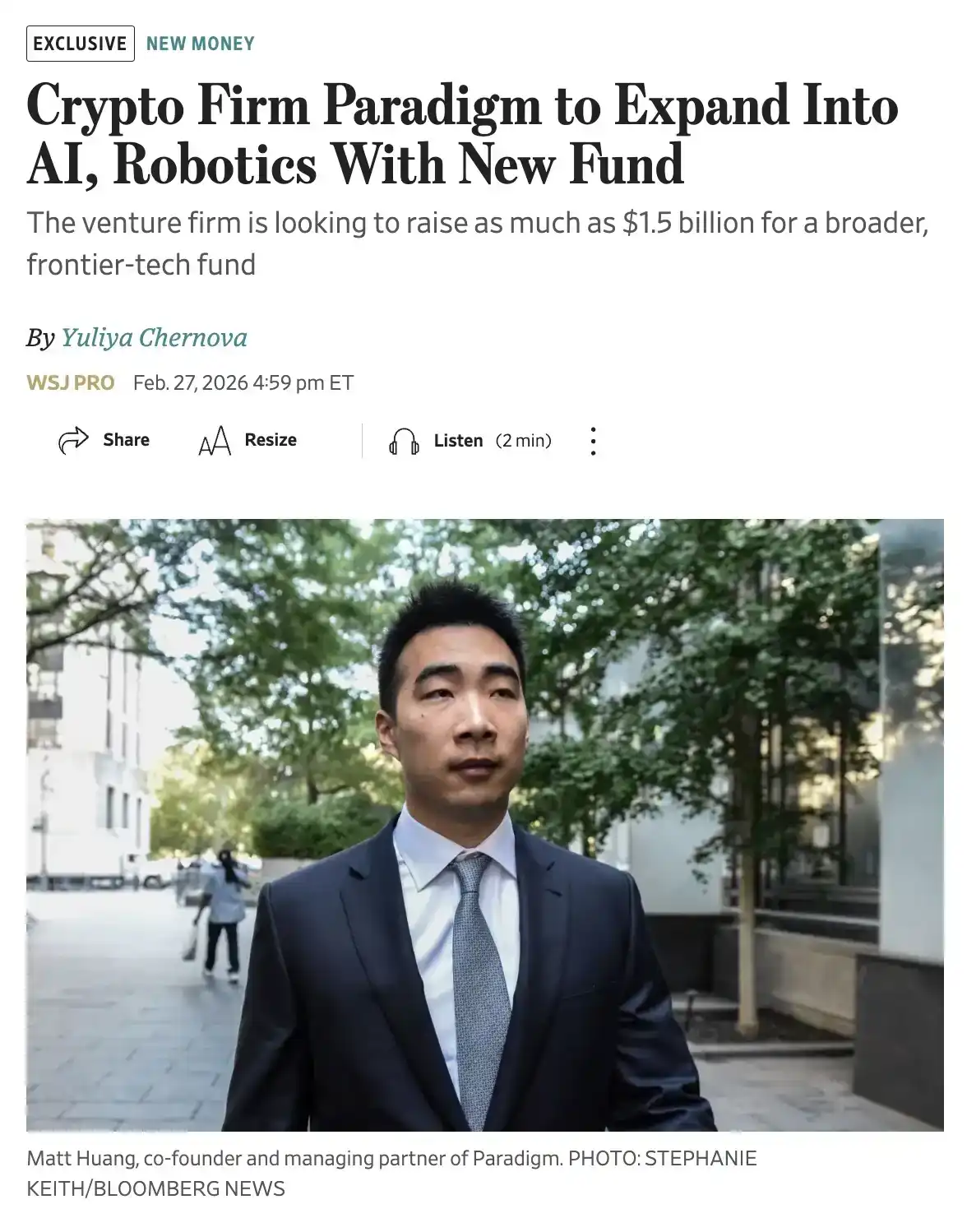
On February 28, 2026, The Wall Street Journal provided the answer: Cryptocurrency investment firm Paradigm is raising a new fund of up to $1.5 billion, expanding its investment focus to artificial intelligence, robotics, and other frontier technologies.
This is not a sudden decision. It's a math problem that started being calculated long ago, and the answer is only being announced today.

First, let's look at the numbers

In 2025, the total global VC investment in cryptocurrencies reached $49.8 billion. That sounds like good news. But if you only focus on that one number, you'll misjudge one thing.

In the same year, the number of crypto VC deals plummeted by about 60% year-over-year, from approximately 2,900 deals to 1,200 deals. Money is increasing, but the number of projects is decreasing. Funds flowing into the crypto space are increasingly concentrated in a few large deals rather than spread across hundreds of early-stage projects.

For the vast majority of small and medium-sized funds, this might not be a problem. But for Paradigm, this is a structural issue. Paradigm manages $12.7 billion in assets and is one of the world's largest crypto-dedicated VCs. Its problem isn't finding projects; it's finding enough large, early-stage projects to deploy this scale of capital while maintaining its expected returns.

In 2021, Paradigm raised the largest cryptocurrency fund in history, at $2.5 billion. In 2024, it announced its third fund, sized at $850 million—only one-third the size of the previous one.

This contraction is not a sign of weakness; it's an active adaptation to a narrower market. But it also illustrates one thing: relying solely on crypto, Paradigm is struggling to find an outlet for its scale.

After FTX, Paradigm started asking a question

To understand today's $1.5 billion, we must go back to November 2022.

That month, FTX collapsed. Sam Bankman-Fried's empire turned to ashes in a matter of days, burning the money of countless institutions along with it. Paradigm's paper investment in FTX was $278 million. Ultimately, it all went to zero.

For a top-tier firm known for being "research-driven" and priding itself on its technical vision, this wasn't just a bad debt. It was a public misjudgment that needed to be explained to LPs, to the market, and to itself.

What happened next seemed quite strange at the time. In 2023, people noticed that Paradigm's official website had quietly changed: all mentions of "crypto" and "Web3" were removed and replaced with the more neutral term "technology investment."

There was no official announcement about this change, but it was quickly discovered by the community and sparked intense discussion. The biggest doubt was: Is Paradigm running away?

Co-founder Matt Huang had to put out the fire. He tweeted that Paradigm had "never been more excited about crypto," while adding: "The developments in AI are too compelling to ignore. Framing AI and crypto as a zero-sum competition is a popular but mistaken narrative. We don't buy it. Both are interesting and will have significant overlap."
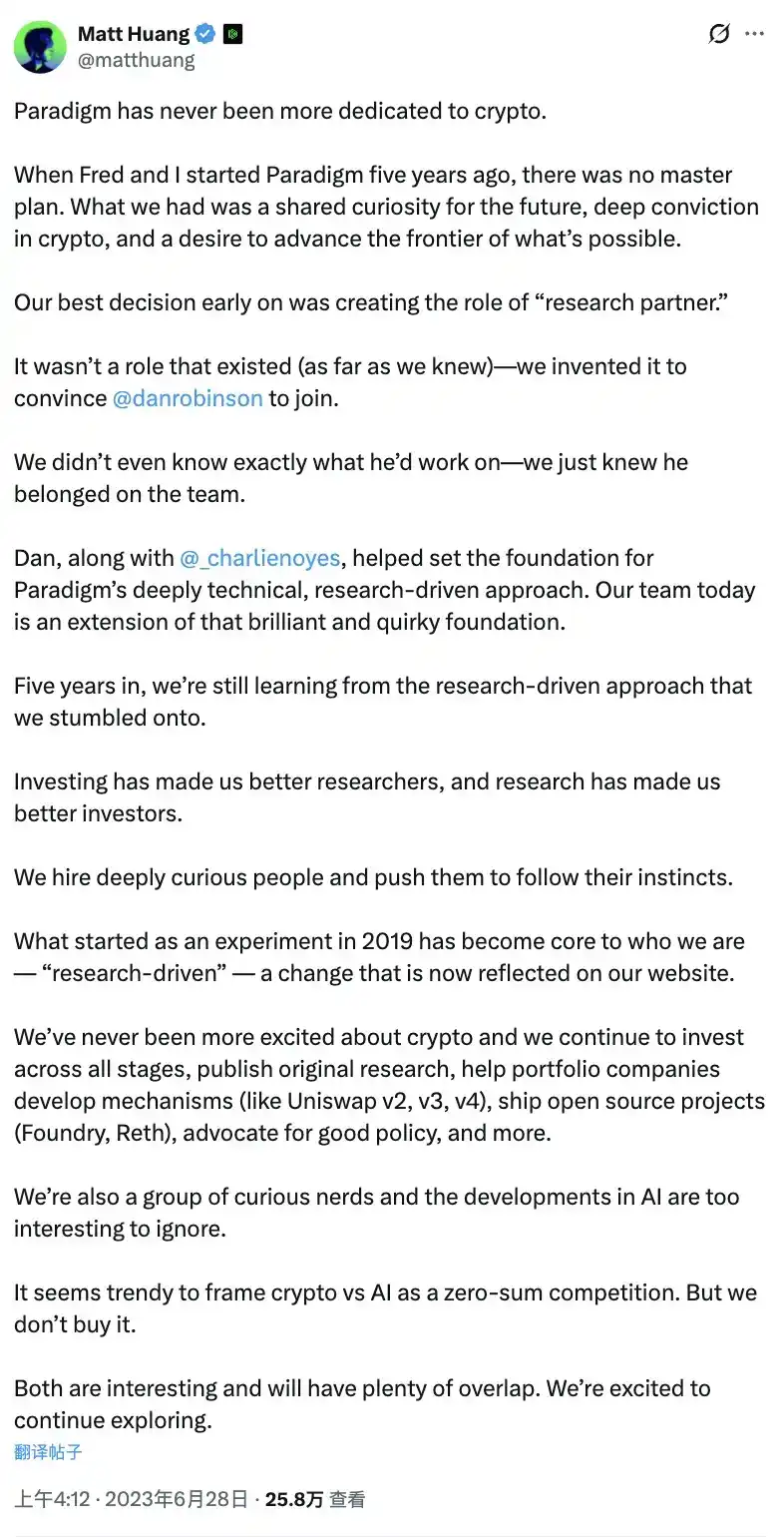
This was a PR-driven clarification, but it also revealed something real: Paradigm was already seriously considering AI internally.

After FTX, the question it was forced to answer was: What to bet on for the next decade?

Matt Huang has already been working on the answer

If you only look at Paradigm's official announcements, the company's pivot seems to have started today. But if you look at Matt Huang's actual actions over the past two years, you'll find he has long been more than just a crypto investor.

In 2024, Paradigm invested $50 million in Nous Research. Nous Research is an AI infrastructure company focused on the research and development of open-source large language models. This wasn't an "exploratory" small test; $50 million is a serious bet at Paradigm's scale.

In February of this year, Paradigm also jointly released EVMbench with OpenAI, a benchmark tool to evaluate the ability of different AI models to detect and fix security vulnerabilities in smart contracts. The core infrastructure of cryptocurrency met AI capability assessment—two things were placed on the same table.

At the same time, Matt Huang is building another company: Tempo. This is a stablecoin payment infrastructure company; Matt Huang is a co-founder, and his role on Stripe's board is highly aligned with this direction. Stripe established a strategic partnership with Paradigm in 2025, and Stripe also launched its stablecoin payment product that year.

Looking at these together, Matt Huang isn't "going to invest in AI"; he has been living at the intersection of AI and crypto for at least two years.

He's not betting on AI alone, nor on crypto alone, but on the moment these two things collide. And when AI agents need to execute transactions on-chain, when robots need a programmable monetary system, that collision point is Paradigm's next main battlefield.

Why AI×Crypto, not a pivot to AI

Paradigm's move into AI doesn't mean it's competing with a16z or Sequoia for the same batch of projects.

There's a narrative mistake that's easy to make: interpreting Paradigm's new fund as "just another VC pivoting to AI." But if that were the case, it would have no advantage; the general AI track is already crowded with traditional VC giants with deeper backgrounds and stronger resources.

Paradigm's real logic is: it doesn't intend to fight for a piece of the general AI pie; it wants to bet on the intersection that others haven't yet clearly seen.

AI agents are one of the hottest concepts right now. These intelligent agents, capable of autonomously performing tasks, have already started replacing human labor in various scenarios: search, writing code, analyzing data, managing workflows. But there's one thing they haven't solved yet: money.

When an AI agent needs to pay, receive payments, or transfer funds between different services, what does it use? PayPal? Bank accounts? These systems are designed for humans, requiring identity verification, manual authorization, and are incompatible with the logic of autonomous machine execution.

But stablecoins can. Smart contracts can. Programmable money can.

This is why Matt Huang is simultaneously working on Tempo (stablecoin payments) and investing in Nous Research (AI infrastructure): he believes these two lines will eventually merge, and Paradigm can place bets on both sides, capturing the maximum return at the moment of merger.

This isn't a pivot; it's an expansion. An expansion into a place he believes others haven't fully figured out yet.

LPs need a new story

There's also a practical level that must be made clear.

Paradigm's LPs, the institutions and individuals who entrusted their money to it, saw the ambition of a $2.5 billion raise in 2021 and the restraint of a contraction to $850 million in 2024.

Such a vast difference in the size of two consecutive funds requires an explanation. Even more, it requires a persuasive narrative for the next fund.

"Continue investing in early-stage crypto projects"—this story was already difficult to support a $1.5 billion fundraising target in 2024. But "leveraging crypto's technical advantages to切入 (cut into) frontier tech at the hottest time for AI and robotics"—that can.

In 2025, 61% of global VC funding flowed into the AI sector, totaling approximately $258.7 billion. This is the largest pool in the venture capital field today. The $1.5 billion Paradigm is raising now is to draw water from this pool, not to continue guarding a shrinking lake. For LPs, this is a bigger story and a more credible growth logic.

Now we can go back to 2023. That year, when Matt Huang was forced to clarify the website revision incident, he said this: "AI and crypto are not a zero-sum competition."

At the time, this statement seemed more like a defense.安抚 (Reassuring) the community, preventing LP panic, while leaving room for itself to explore AI. But if you reread it in today's context, it sounds more like a预告 (preview/advance notice).

Paradigm took three years to walk out of the ruins of FTX. It didn't choose the simplest path of scaling down, focusing solely on crypto, waiting for the next bull market. It chose a harder path with greater想象空间 (imaginative space/potential): betting on the fusion of AI and crypto, establishing positions in both fields simultaneously, and then waiting for them to meet.

Today's $1.5 billion fund is a marker of this path at its current stage.

Matt Huang hasn't publicly responded to today's Wall Street Journal report yet. But his Tempo is still being built, Nous Research is still running, EVMbench has been released.

He doesn't need to explain anymore. Those actions have already spoken louder than any statement.

Пов'язані питання

QWhy is Paradigm, a major crypto-focused investment firm, expanding its investment focus to include AI and other frontier technologies?

AParadigm is expanding because the crypto market, while seeing large total investment, has experienced a sharp decline in the number of early-stage projects. This makes it structurally difficult for a large fund like Paradigm to deploy its massive $12.7 billion in assets and achieve its desired returns. AI represents a much larger capital pool and a new frontier for growth.

QWhat was the significance of the FTX collapse for Paradigm, and how did it influence their strategic thinking?

AThe FTX collapse resulted in a total loss of Paradigm's $278 million investment. This was not just a financial loss but a public judgment error that forced the firm to re-evaluate its strategy. It prompted the internal question of 'what to bet on for the next decade,' leading to a broader exploration beyond pure crypto, including AI.

QAccording to the article, what is Paradigm's specific investment thesis regarding the intersection of AI and Crypto?

AParadigm's thesis is not to compete in general AI but to invest at the intersection of AI and Crypto. They believe AI agents will eventually need programmable monetary systems for autonomous transactions (e.g., payments, transfers), which crypto infrastructure like stablecoins and smart contracts can provide. They are betting on the moment these two fields converge.

QWhat evidence does the article provide that Paradigm's move into AI was a long-planned strategy rather than a sudden shift?

AThe article cites several pre-2026 actions: a 2023 website change removing 'crypto' and 'Web3' wording, a $50 million investment in AI infrastructure firm Nous Research in 2024, the co-development of the EVMbench AI evaluation tool with OpenAI, and Matt Huang's work on Tempo, a stablecoin payment infrastructure company.

QWhy does a $15 billion fundraise require a new narrative for Paradigm's Limited Partners (LPs)?

AAfter their fund size shrunk from $2.5 billion to $850 million, LPs needed a convincing story to justify a return to a larger $1.5 billion fund. The narrative focused solely on early-stage crypto investing was insufficient. The new narrative of leveraging crypto's technical advantages to invest in the massive, booming AI sector ($258.7 billion in VC funding in 2025) provides a more credible growth logic for LPs.

Пов'язані матеріали

North Korean Hackers Loot $500 Million in a Single Month, Becoming the Top Threat to Crypto Security

North Korean hackers, particularly the notorious Lazarus Group and its subgroup TraderTraitor, have stolen over $500 million from cryptocurrency DeFi platforms in less than three weeks, bringing their total theft for the year to over $700 million. Recent major attacks on Drift Protocol and KelpDAO, resulting in losses of approximately $286 million and $290 million respectively, highlight a strategic shift: instead of targeting core smart contracts, attackers are now exploiting vulnerabilities in peripheral infrastructure. For instance, the KelpDAO attack involved compromising downstream RPC infrastructure used by LayerZero's decentralized validation network (DVN), allowing manipulation without breaching core cryptography. This sophisticated approach mirrors advanced corporate cyber-espionage. Additionally, North Korea has systematically infiltrated the global crypto workforce, with an estimated 100 operatives using fake identities to gain employment at blockchain companies, enabling long-term access to sensitive systems and facilitating large-scale thefts. According to Chainalysis, North Korean-linked hackers stole a record $2 billion in 2025, accounting for 60% of all global crypto theft that year. Their total historical crypto theft has reached $6.75 billion. Post-theft, they employ specialized money laundering methods, heavily relying on Chinese OTC brokers and cross-chain mixing services rather than standard decentralized exchanges. Security experts, while acknowledging the increased sophistication, emphasize that many attacks still exploit fundamental weaknesses like poor access controls and centralized operational risks. Strengthening private key management, limiting privileged access, and enhancing coordination among exchanges, analysts, and law enforcement immediately after an attack are critical to improving defense and fund recovery chances. The industry's challenge now extends beyond secure smart contracts to safeguarding operational security at the infrastructure level.

marsbit52 хв тому

North Korean Hackers Loot $500 Million in a Single Month, Becoming the Top Threat to Crypto Security

marsbit52 хв тому

Circle CEO's Seoul Visit: No Korean Won Stablecoin Issuance, But Met All Major Korean Banks

Circle CEO Jeremy Allaire's recent activities in Seoul indicate a strategic shift for the company, moving away from issuing a Korean won-backed stablecoin and instead focusing on embedding itself as a key infrastructure provider within Korea’s financial and crypto ecosystem. Despite Korea accounting for nearly 30% of global crypto trading volume—with a market characterized by high retail participation and altcoin dominance—Circle has chosen not to compete for the role of stablecoin issuer. Instead, Allaire met with major Korean banks (including Shinhan, KB, and Woori), financial groups, leading exchanges (Upbit, Bithumb, Coinone), and tech firms like Kakao. This approach reflects a broader industry transition: the core of stablecoin competition is shifting from issuance rights to systemic positioning. With Korean regulators still debating whether banks or tech companies should issue stablecoins, Circle is avoiding regulatory uncertainty by strengthening its role as a service and technology partner. The company is deepening integration with trading platforms, building connections, and promoting stablecoin infrastructure. This positions Circle to benefit regardless of which entity eventually issues a won stablecoin. Allaire also noted the potential for a Chinese yuan stablecoin in the next 3–5 years, underscoring a regional trend of stablecoins becoming more regulated and integrated with traditional finance. Ultimately, Circle’s strategy highlights that future influence in the stablecoin market will belong not necessarily to the issuers, but to the foundational infrastructure layers that enable cross-system transactions.

marsbit1 год тому

Circle CEO's Seoul Visit: No Korean Won Stablecoin Issuance, But Met All Major Korean Banks

marsbit1 год тому

SpaceX Ties Up with Cursor: A High-Stakes AI Gambit of 'Lock First, Acquire Later'

SpaceX has secured an option to acquire AI programming company Cursor for $60 billion, with an alternative clause requiring a $10 billion collaboration fee if the acquisition does not proceed. This structure is not merely a potential acquisition but a strategic move to control core access points in the AI era. The deal is designed as a flexible, dual-path arrangement, allowing SpaceX to either fully acquire Cursor or maintain a binding partnership through high-cost collaboration. This "option-style" approach minimizes immediate regulatory and integration risks while ensuring long-term alignment between the two companies. At its core, the transaction exchanges critical AI-era resources: SpaceX provides its Colossus supercomputing cluster—one of the world’s most powerful AI training infrastructures—while Cursor contributes its AI-native developer environment and strong product adoption. This synergy connects compute power, models, and application layers, forming a closed-loop AI capability stack. Cursor, founded in 2022, has achieved rapid growth with over $1 billion in annual revenue and widespread enterprise adoption. Its value lies in transforming software development through AI agents capable of coding, debugging, and system design—positioning it as a gateway to future software production. For SpaceX, this move is part of a broader strategy to evolve from a aerospace company into an AI infrastructure empire, integrating xAI, supercomputing, and chip manufacturing. Controlling Cursor fills a gap in its developer tooling layer, strengthening its AI narrative ahead of a potential IPO. The deal reflects a shift in AI competition from model superiority to ecosystem and entry-point control. With programming tools as a key battleground, securing developer loyalty becomes crucial for dominating the software production landscape. Risks include questions around Cursor’s valuation, technical integration challenges, and potential regulatory scrutiny. Nevertheless, the deal underscores a strategic bet: controlling both compute and software development access may redefine power dynamics in the AI-driven future.

marsbit2 год тому

SpaceX Ties Up with Cursor: A High-Stakes AI Gambit of 'Lock First, Acquire Later'

marsbit2 год тому

Торгівля

Спот
Ф'ючерси
活动图片