Pacific 'Fever': How Extreme Weather Becomes Wall Street's ATM?

链捕手Опубліковано о 2026-07-08Востаннє оновлено о 2026-07-08

Анотація

"Pacific 'Fever': How Extreme Weather Becomes Wall Street's Piggy Bank" The article examines how the 2026-2027 El Niño, potentially the strongest since 1950, is not only disrupting global weather but also creating major financial opportunities. It links recent extreme events in China and worldwide to this climate phenomenon, which alters atmospheric patterns, increasing risks of floods, droughts, and heatwaves. The core narrative explores how financial markets capitalize on these disruptions. A hedge fund is raising $500 million specifically to bet on El Niño-affected crops like South African corn and Malaysian palm oil. Historically, such strategies have yielded massive profits. Examples include Richard Dennis ("Turtle Trader") making his first fortune in the 1970s soy boom triggered by El Niño's impact on Peruvian anchovies (a key fishmeal source), and Anthony Ward's cocoa empire built on superior weather intelligence. The 2024 cocoa price surge, driven by West African drought, enriched quantitative trend-following funds. Currently, markets are preemptively bidding up palm oil, rubber, and sugar futures based on anticipated future supply shocks, despite high current inventories. The article details El Niño's asymmetric global impacts: causing drought in Southeast Asia (hurting palm oil/rubber) and India (affecting sugar/cotton), but bringing beneficial rains to South American soy and sugarcane. Key metrics to watch include the Niño3.4 index, Indian monsoon data, and Mal...

Author: Jia Liu, Zhangsheng Beatz

It rained heavily and unexpectedly for several days in Tianjin. You'd leave home in sunshine only to get soaked halfway. A friend's flight to Shenzhen in the evening was canceled due to a typhoon, and all high-speed train tickets to Zhejiang direction were suspended.

Checking the news on the phone: rainfall exceeded 329 mm in just a few hours in Fushun, Liaoning. Residents in Fangchenggang, Guangxi, said it was the most severe flood in 20 years. Daily precipitation records were broken at seven national meteorological stations. The largest high-temperature warning in northern China was issued, with ground temperatures approaching 50°C in some places. In the first week of July, two to three typhoons were queuing up to form in the Western Pacific, with super typhoon 'Bavi' approaching the southeast coast.

Since the start of summer in 2026, the weather in China has clearly become more restless.

And it's not just us. Sea temperatures off the coast of Peru remain persistently warm, limiting anchovy catches, with fishmeal prices rising about 80% over the past year. As Southeast Asia enters the dry season, drought signals are strengthening, putting palm oil producing regions in Malaysia and Indonesia on edge. The crucial window for the Indian monsoon hasn't arrived yet, but markets are already betting it will be weak. Analysts have flagged Australian wheat planting area as potentially shrinking significantly.

These extreme weather changes are scattered across different continents, seemingly unrelated. But in fact, beyond the direct trigger mechanisms like monsoon moisture, tropical storm peripheral circulation, location, and topography, they most likely have all been influenced by the same storm:

ENSO, El Niño.

El Niño: The Pacific is Running a Fever

ENSO, translated in Chinese as El Niño–Southern Oscillation, is the largest interannual signal in Earth's climate system. Simply put, it describes the periodic changes between Pacific sea temperatures and atmospheric circulation.

Under normal conditions, the eastern equatorial Pacific is relatively cool, and the western part is relatively warm. Trade winds push warm water toward the western Pacific. But if the trade winds weaken, warm water flows back eastward, abnormally raising sea temperatures in the central and eastern Pacific, resulting in an El Niño.

Meteorological agencies judge whether an El Niño is occurring mainly by looking at a key region: the Niño3.4 region (a critical area in the equatorial central Pacific, understood as the "thermometer" for judging El Niño strength). If this region's temperature remains 0.5°C above the normal for several consecutive months, it's considered an El Niño state; if it's 2°C above, it's a super-strong level. 1997 and 2015 were two typical super-strong El Niño events.

This year's El Niño could become the strongest one since 1950.

On June 11, the U.S. National Oceanic and Atmospheric Administration (NOAA) officially issued an El Niño watch, confirming that El Niño conditions have emerged and are expected to strengthen through late 2026 to early 2027. They estimate a 63% probability of a super-strong El Niño occurring from November this year to January next year. The judgment from the Chinese Academy of Sciences' Institute of Atmospheric Physics is slightly more conservative, with a probability of over 70% for a moderate event and about 10% for a super-strong one.
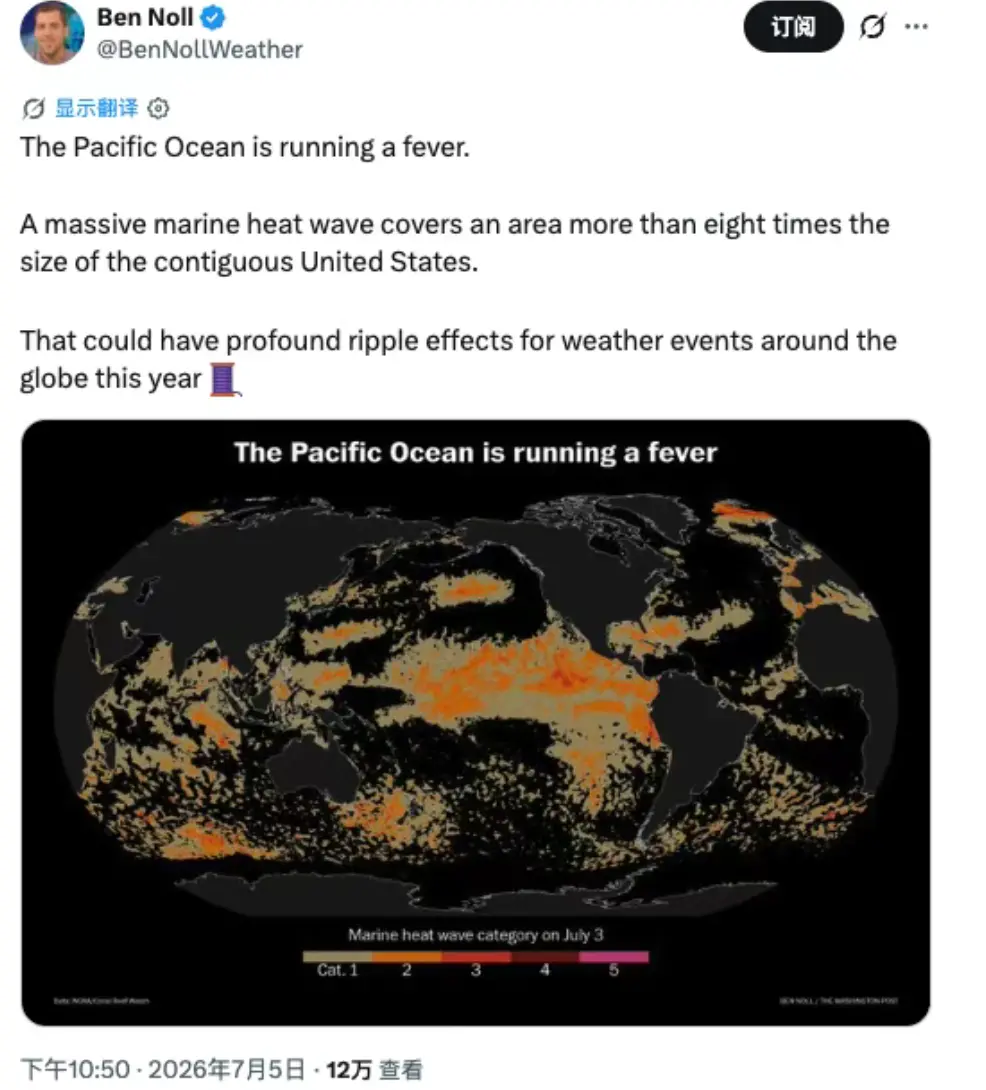
Meteorologist Ben Noll posted a Pacific sea temperature map on X with the caption "Pacific fever." Deep orange and red cover most of the Pacific on the map, showing the area of this marine heatwave exceeds 8 times the size of the contiguous United States.

For us, its impact is not "directly creating a specific rainstorm," but rather altering the underlying tone of atmospheric circulation. It influences the position of the Western Pacific Subtropical High, changes the path of water vapor transported by the East Asian Summer Monsoon, making rain belts more likely to deviate from their normal positions, and increasing the risk of high temperatures, droughts, and severe convection.

Compounded with global warming, for every 1°C increase in atmospheric temperature, its capacity to hold water vapor increases by about 7%. So today's El Niño isn't happening in a normal climate but against a backdrop that is already hotter, wetter, and more prone to extremes.

Here we have monsoons and typhoons, but over there in financial markets, some have already caught the scent, and funds are stirring.

On June 24, Bloomberg reported that hedge fund Moreton Capital Partners is raising $500 million for a dedicated vehicle. The assets targeted are agricultural products affected by El Niño, such as South African corn, Malaysian palm oil, and Australian wheat. Co-founder Les Finemore's rationale was simply: the market is vastly underestimating the risks brought by this year's El Niño.

Weather is no longer just background noise in a commodity portfolio; to some extent, it can stand alone as a separate theme for capital raising.

How can Finemore raise $500 million? Because profiting from extreme weather like El Niño isn't theoretical; people have been making big money from it for decades.

The First Fortune of the 'Turtle Trading' Founder

In 1972, the anchovies off the coast of Peru suddenly disappeared.

This tiny fish, about a dozen centimeters long, is something most people in the world will never eat, but when ground into fishmeal, it's one of the most important protein sources in global animal feed.

The disappearance of the anchovies was precisely because the equatorial Pacific waters suddenly warmed up. Cold water no longer upwelled, breaking the plankton chain. Meteorologists later named this phenomenon: El Niño.

With no fishmeal, feed manufacturers had to find substitutes, pushing up the price of soybean meal, which in turn drove up the price of soybeans.

At the Chicago Mercantile Exchange, a young trader not yet 26, Richard Dennis, saw prices hitting new highs and kept buying soybeans. In 1974, he made about $500,000 on soybeans and became a millionaire by year-end.

Richard Dennis in his youth

And this young trader, Richard Dennis, who made his first fortune, would later become the famous founder of the "Turtle Traders," his name enshrined as one of the patriarchs of trend trading.

Another classic story is that of Anthony Ward, nicknamed Chocfinger. He founded Armajaro in London in 1998, specializing in cocoa and coffee. What set this company apart was not its trading desk but its meteorology department: a proprietary weather station network, employing full-time meteorologists, and a research team of over 20 people in West African producing regions.

His logic: small weather changes could cause crop yields to fluctuate by 10%; whoever knows the weather first knows the price first. In 2002, he took three-quarters of the London exchange's cocoa delivery for the month, with a pre-tax profit of £10.4 million. On July 17, 2010, he received 240,100 tonnes of physical cocoa in one go, valued at £658 million, about 7% of global annual production, essentially all visible inventory in Europe at the time, pushing cocoa prices to their highest since 1977.

Let's look at some more recent examples.

In 2024, cocoa was the craziest commodity globally. West Africa's Côte d'Ivoire and Ghana, producers of 70% of the world's cocoa, suffered from abnormally high temperatures and dry Harmattan winds (a dry, hot wind blowing from the Sahara to the West African coast). Cocoa pods rotted on a large scale, compounded by disease, old trees, and low inventories. Cocoa futures rose over 400% in two years, briefly surpassing $10,000 per tonne.

Those who captured the bulk of this move weren't just cocoa industry players, but a group of quantitative trend funds. Razvan Remsing of Aspect Capital said it was their best first quarter in 25 years. AQR's managed futures strategy rose about 17.4% in Q1. Capital Fund Management's trend fund rose about 17.5%. Aspect's flagship fund was up 21.4% by late April. Winton, founded by David Harding, saw its diversified macro fund rise about 13% in Q1.

During the same period, besides making significant money on cocoa, Winton also made a lot on another front: El Niño typically brings warmer winters to parts of the U.S. A less cold winter means weaker heating demand for natural gas, inventories build up, and the U.S. natural gas benchmark price, Henry Hub (equivalent to Brent in the oil market), fell to near 30-year lows.

Bottom-Fishing Cocoa, or Sugar?

Back to 2026. This round of El Niño hasn't peaked yet, but the market has already front-run one wave.

Palm oil futures surged from 9400 yuan in late April to 9993 yuan before retreating. Rubber rose from its April low, briefly breaking 18300 yuan in mid-May. Sugar fluctuated repeatedly between 5200 and 5450 yuan. Peanuts rallied for seven consecutive sessions, supported by drought conditions and cost factors.

The strange thing is, the actual fundamentals of these commodities don't support the rise. Malaysian palm oil inventories were still increasing month-on-month by the end of May. Domestic sugar inventories in China were 1.83 million tonnes higher year-on-year. Domestic palm oil inventories were up 25.68% year-on-year. Production hasn't started falling yet, but prices rose first. The only reason for the rise is the anticipation of reduced yields 6 to 12 months later due to El Niño.

Over the past fifty years, every round of moderate or stronger El Niño has left its mark on commodity markets. In the 1982 round, palm oil rose 169%. From 2009 to 2010, Indonesian rubber production fell 11.3%, and spot prices rose 157.79% over two years. From 2015 to 2016, sugar rose 65%.
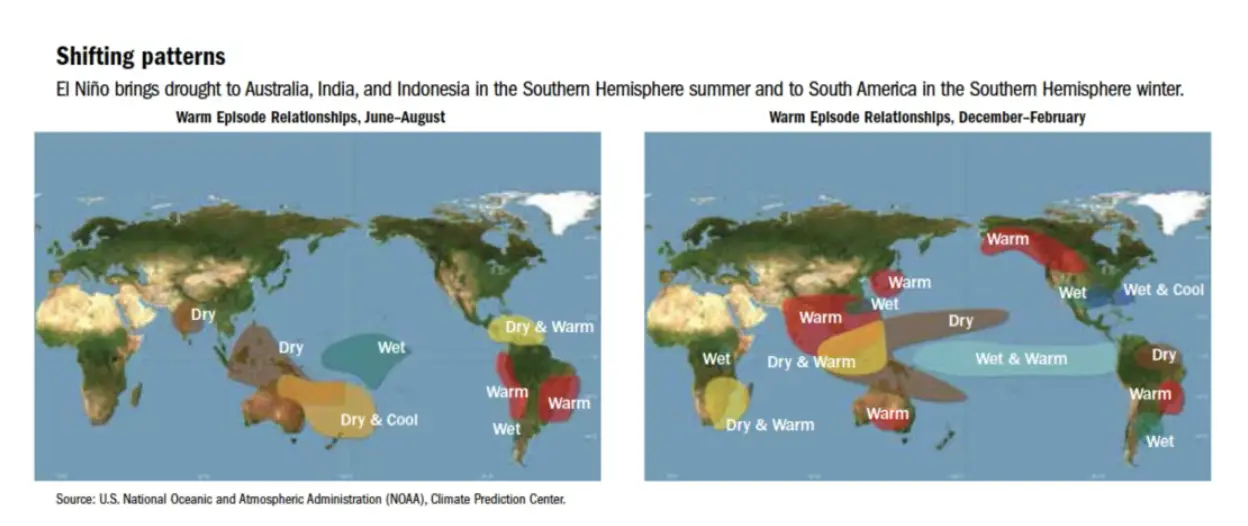
In Southeast Asia, it brings drought, suppressing palm oil and rubber yields. In India, it weakens the monsoon, affecting sugar and cotton. In Peru, it makes anchovies disappear, pushing up fishmeal prices. But at the other end of South America, it brings more rain, potentially improving soybean and sugarcane conditions in Brazil and Argentina. In the mining regions of Chile and Peru, heavy rainfall impacts not farmland but copper mines. In the U.S., a warm winter suppresses natural gas demand.

Overseas community discussions about this El Niño are still fermenting.
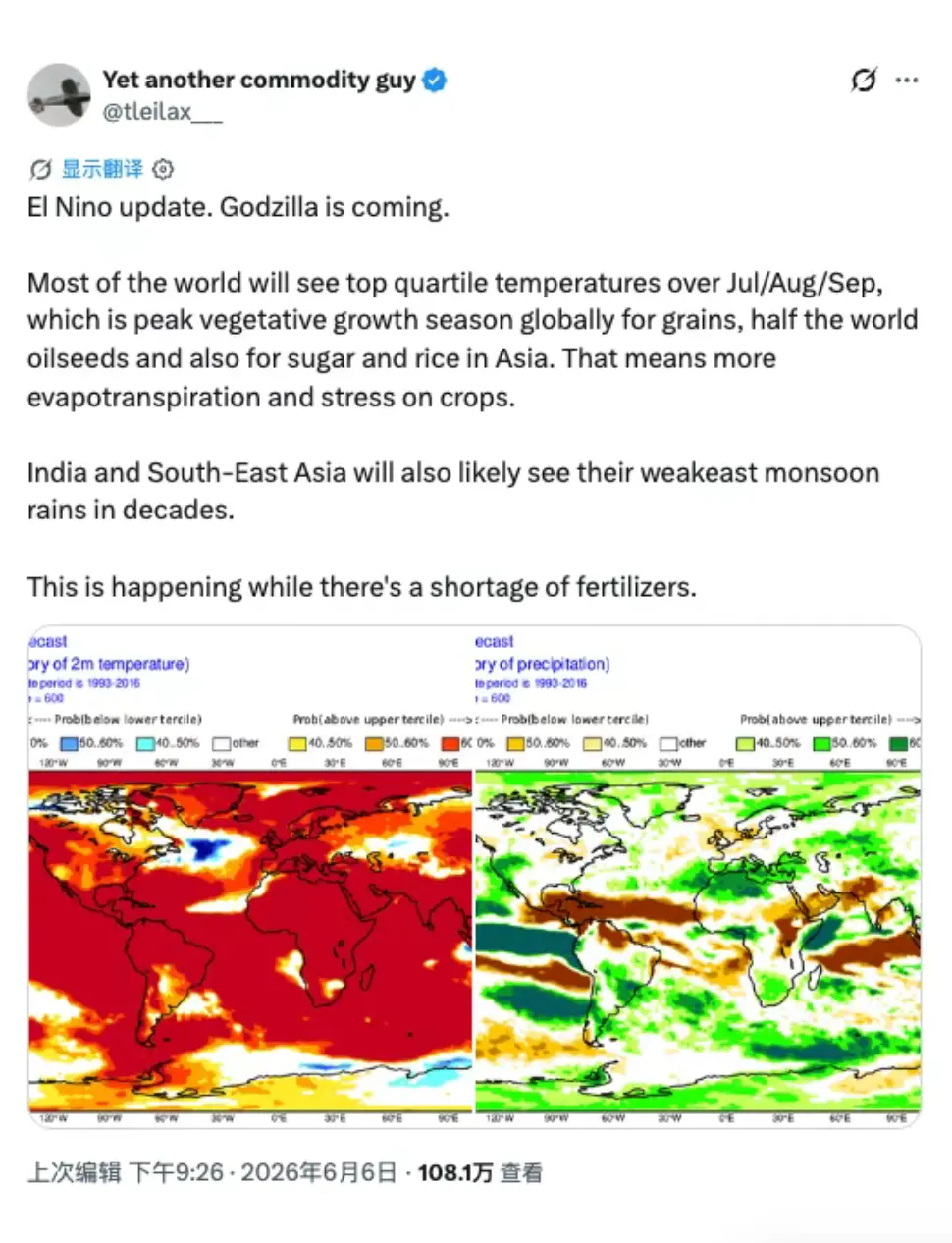
Commodities blogger @tleilax__ posted with two forecast maps. One map shows how much higher global temperatures from July to September this year are expected to be compared to the same period in previous years. The map is almost entirely red, and this timeframe coincides with the crucial growing period for grains, oilseeds, Asian rice, and sugar.

The other map shows whether rainfall will be higher or lower than the historical average for the same period. It shows large swathes of India and Southeast Asia as drier than usual, precisely matching the market's biggest fear: a weak monsoon.

His conclusion: India and Southeast Asia could experience the weakest monsoon rainfall in decades, and this is happening against a backdrop of a global fertilizer shortage. This post has garnered over 1.08 million views so far.

A commodities column on Substack listed palm oil, cotton, and cocoa as the cluster with the clearest risk-reward profile for the next 6 to 12 months. The Singapore investment community is scrutinizing Malaysian plantation stocks one by one, concluding that pure upstream planters capture the full elasticity, while companies like Wilmar International, focused on midstream and downstream processing, get their margins squeezed by rising palm oil prices. The U.S. stock community is circulating an even more nuanced argument: Adecoagro, an agricultural company in Brazil and Argentina, is a "weather hedge for tech-heavy portfolios" because El Niño brings rain, not drought, to South America; its output expands while Asia's production declines, pushing up prices.

The script for this round's market move is still largely unwritten, so it's not necessarily better to buy earlier. There aren't many hard indicators that can change position direction, but each is crucial:

  • Whether the Niño3.4 index breaks above 2.0°C in autumn/winter. This is the dividing line between moderate and super-strong, and the switch for overall agricultural volatility to step up.

  • Indian monsoon rainfall data from June to September. The steering wheel for the sugar, cotton, and rice group of commodities.

  • Monthly inventory reports from the Malaysian Palm Oil Board. The speed at which high inventories are drawn down determines when the expected market move connects with the actual market move.

  • Rainfall in Guangxi, China, in July and the consecutive days of high temperatures in North China. The former governs sugar, the latter electricity.

  • The subsequent fundraising scale of weather-focused funds like Moreton. The volume of institutional capital determines whether weather trading is a short-lived pulse or a year-long theme.

The experiences of 1972 and 2024 point to the same time lag: the real price effects of El Niño mostly occur after the event's peak. Dennis made his money two years after the anchovy collapse. Cocoa truly exploded after ENSO turned neutral. In the second half of 2026, the market is trading on expectations; in 2027, it will trade on the actual production shortfall itself.

At First, No One Cared About This Storm

Beyond these trading opportunities, what's more thought-provoking are two highly shared posts on X by finance blogger @FinanceLancelot.
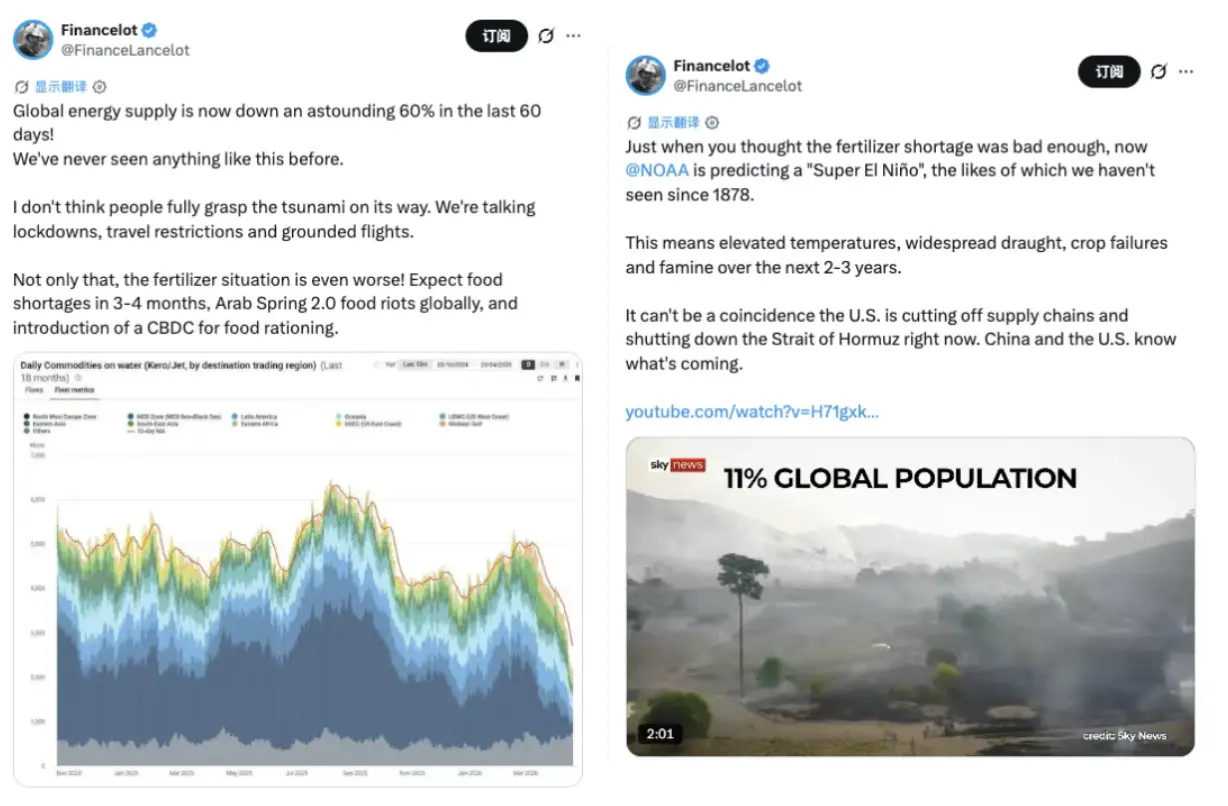
One said NOAA (the U.S. National Oceanic and Atmospheric Administration, one of the world's most frequently cited climate monitoring agencies) is predicting a "super El Niño" unseen since 1878, implying warming, widespread drought, crop failures, and famine risks over the next two to three years. It was accompanied by a Sky News video titled "11% of the global population."

Another post expressed a similar view: global energy and maritime supply has fallen 60% in the past 60 days, accompanied by a shipping oil product flow chart showing a cliff-like drop from the start of the year. His conclusion: fertilizer shortages coupled with El Niño could lead to food shortages globally within 3 to 4 months.

The wording of these posts carries obvious doomsday overtones and shouldn't be taken at face value.

But they reflect one thing: a group of people in the market are already weaving a narrative connecting El Niño, energy supply disruptions, fertilizer shortages, and tensions in the Strait of Hormuz. And this narrative is gaining traction and attention.

More importantly, this narrative points not just to gains and losses in futures accounts, but to potential impacts on the lives of ordinary people, adding to everyone's cost of living.

At first, no one cared about this storm. It was just a typhoon, a downpour, a slight rise in sea temperature.

But the storm doesn't stop just because no one cares. The heavy rains around the world, the canceled flights, the disappearing anchovies in Peru, the rotting cocoa pods in Ghana, the sugar shortages—these are already part of the storm, destined to land in the lives of different people.


Трендові криптовалюти

Пов'язані питання

QWhat is ENSO (El Niño-Southern Oscillation) and how does it act as a 'fever' for the Pacific, according to the article?

AENSO describes the periodic variation in sea surface temperatures and atmospheric circulation in the Pacific Ocean. During an El Niño event, weakened trade winds allow warm water to flow back east, causing abnormally high sea temperatures in the central-eastern Pacific. The article metaphorically calls this a 'fever' for the Pacific, referencing a scientist's post showing a vast area of deep orange and red on a sea temperature map, indicating a massive oceanic heatwave.

QWho was Richard Dennis and how did his first major profit relate to an El Niño event?

ARichard Dennis was a young trader who later became famous as a founder of the 'Turtle Traders.' His first major profit came in the 1970s by trading soybeans. The price surge was indirectly caused by an El Niño event off Peru, which devastated the anchovy population. As fishmeal (made from anchovies) became scarce and expensive, feed manufacturers switched to soybean meal, driving up soybean prices. Dennis capitalized on this trend, making around $500,000 and becoming a millionaire by the end of 1974.

QWhat are some of the key financial indicators or data points that traders are watching to gauge the impact of the 2026 El Niño on commodity markets?

ATraders are monitoring several key indicators: 1) Whether the Niño3.4 index exceeds 2.0°C in autumn/winter, marking a shift to a strong El Niño. 2) India's monsoon rainfall data from June to September, crucial for sugar, cotton, and rice. 3) Monthly stock reports from the Malaysian Palm Oil Board to see if high inventories are decreasing. 4) Rainfall in Guangxi, China, and the duration of heatwaves in North China, affecting sugar and electricity demand. 5) The fundraising scale of weather-focused funds like Moreton Capital Partners, indicating institutional interest.

QHow does the article illustrate the time lag between an El Niño event and its full impact on commodity prices?

AThe article highlights that the most significant price effects often occur after the El Niño peaks, not during its initial development. For example, Richard Dennis profited from the 1972-73 El Niño's impact on soybeans in 1974. Similarly, the 2024 cocoa price explosion happened after the ENSO cycle had turned neutral. The article suggests that for the 2026 event, the market in late 2026 is trading on anticipation, while 2027 will likely trade on the actual supply shortages and减产 (yield reduction) itself.

QBeyond specific trades, what broader, more alarming narrative is emerging in some financial communities regarding the 2026 El Niño, according to the article's conclusion?

AA broader, more alarming narrative is forming that connects several crises: the potential 'super El Niño,' a reported 60% drop in global energy and maritime shipping supplies, fertilizer shortages, and geopolitical tensions like those around the Strait of Hormuz. This narrative, promoted by some financial commentators, warns of widespread drought, crop failures, and the risk of global food shortages impacting '11% of the global population' within a few months, ultimately affecting the cost of living for ordinary people worldwide.

Пов'язані матеріали

Bitcoin’s path to $80K may hinge on THIS hidden trend

Bitcoin's potential path toward $80,000 is influenced by conflicting market signals. Data shows the Coinbase Bitcoin Premium Index has recorded its longest-ever streak of consecutive negative premiums, indicating muted institutional demand or net selling from U.S. institutions. While such a trend often signals short-term weakness, it doesn't necessarily forecast a long-term bear market. Additionally, a bearish crossover occurred in Bitcoin's Net Unrealized Profit/Loss (NUPL), with its short-term average falling below the longer-term average, suggesting declining investor profitability and waning market momentum. Historically, major bear market bottoms saw the 100-day NUPL drop below zero, but this cycle it remains positive, implying either an unprecedented bottom or a further decline is needed. Currently trading around $63,148, Bitcoin has seen weekly gains but remains below its May peak. Technical indicators present a mixed picture: the MACD shows bullish momentum, while the RSI signals bearish pressure. A positive development is the return of inflows to Bitcoin ETFs after eight weeks of outflows. Analysts hold divergent views; some highlight a key liquidity zone between $48,000-$50,000 where a market bottom could form, while others maintain a more optimistic long-term outlook. Ultimately, while some bullish signs exist, a strong push from institutional investors appears crucial for Bitcoin to challenge the $80,000 level.

ambcrypto14 хв тому

Bitcoin’s path to $80K may hinge on THIS hidden trend

ambcrypto14 хв тому

Unexpected Weak Non-Farm Payrolls Data Pushes BTC to Rebound 11%, FOMC Minutes to Test the Narrative of This Rally

Bitcoin has rebounded 11% from its 21-month low, but the sustainability of this rally hinges entirely on the Federal Reserve's release of the June FOMC meeting minutes. The bounce was triggered by a weaker-than-expected US jobs report, which showed only 57,000 jobs added in June—about half of economists' forecasts. This data prompted traders to scale back bets on further Fed rate hikes, fueling a rally in Bitcoin alongside gold and stocks. The upcoming minutes are critical. They will reveal whether Fed officials, in their mid-June meeting, were already expressing concerns about a weakening labor market, tight credit conditions, or the risks of overtightening—factors that would support the market's recent dovish shift. Conversely, if the discussion focused on persistent inflation and the conditions for more rate hikes, the rally's foundational narrative would crumble. Market indicators show the rebound's fragility. While US spot Bitcoin ETFs saw a significant single-day inflow, it followed a prolonged period of outflows. On-chain data indicates a substantial increase in Bitcoin being moved to exchanges, creating potential sell pressure. Options market positioning suggests key price levels around $60,000 and $62,000 that could either stabilize or accelerate price movement. In essence, Bitcoin's 11% gain is built on speculation about the Fed's private deliberations three weeks ago. The FOMC minutes will replace that speculation with concrete details, and the discrepancy between market expectations and the actual record will determine whether Bitcoin holds above $64,000 or falls back toward $58,000.

marsbit24 хв тому

Unexpected Weak Non-Farm Payrolls Data Pushes BTC to Rebound 11%, FOMC Minutes to Test the Narrative of This Rally

marsbit24 хв тому

Just Now, The World's First Ultra-High-Frame World Model Was Born, Nvidia Content 0, Racing to 50 FPS

Just Now, Global First Ultra-High-Frame World Model Born, 0% NVIDIA, Speeds to 50 FPS A Chinese team has developed MoWorld, the world's first Flash World Model, achieving real-time interactive inference exceeding 50 FPS. Crucially, it is entirely built on domestic NPUs (National Processing Units), bypassing NVIDIA GPUs. Developed by Moxin Technology in collaboration with Zhejiang University's Pan Yunhe academician team, MoWorld represents a complete, closed-loop system from training and distillation to deployment on domestic computing power. The model tackles the critical industry bottleneck of real-time performance, essential for applications like robotics, gaming, and digital worlds. MoWorld achieves this through a full-stack redesign for NPUs, including a proprietary 3D-annotated data pipeline, system-level optimizations for long-sequence training (up to 2000 frames), and inference optimizations like dynamic mixed-precision quantization. On a Huawei Ascend 910C platform, a 14B MoE parameter model achieves over 50 FPS, reducing typical inference costs by 70% compared to equivalent GPU solutions. This breakthrough lowers the deployment barrier, potentially accelerating the industrialization of world models. Key application areas include gaming/entertainment (offering 6-DoF camera control for immersive exploration), embodied AI/autonomous driving (providing a high-fidelity digital training ground), film pre-visualization, and 3D reconstruction/digital twins due to its strong geometric consistency. MoWorld demonstrates that a full-stack domestic compute ecosystem can support cutting-edge, real-time world models, positioning China at a competitive starting line in defining next-generation spatial intelligence standards. The project underscores a shift in competition from model scale to real-world usability and cost-effective deployment.

marsbit1 год тому

Just Now, The World's First Ultra-High-Frame World Model Was Born, Nvidia Content 0, Racing to 50 FPS

marsbit1 год тому

Pacific 'Fever': How Extreme Weather Becomes Wall Street's Cash Machine?

"Pacific Fever": How Extreme Weather Becomes Wall Street's ATM? The summer of 2026 sees unusually fierce weather across China and globally. The common driver behind this global pattern is a powerful El Niño event, potentially the strongest since 1950, as declared by NOAA. This phenomenon, characterized by warming central/eastern Pacific waters, disrupts global atmospheric circulation, raising risks of floods, droughts, and heatwaves, further intensified by climate change. For financial markets, especially commodities, El Niño is not just weather but a major trading theme. History shows its price impact is profound. In the 1970s, El Niño-driven anchovy collapse in Peru fueled a soybean boom, giving Richard Dennis his first million. Anthony Ward's cocoa empire was built on superior weather intelligence. Most recently in 2024, West African droughts caused cocoa prices to soar over 400%, delivering huge gains for trend-following hedge funds. In 2026, markets are again pricing in future El Niño-induced supply shocks. Despite high current inventories, prices for palm oil, rubber, and sugar have rallied on anticipation of upcoming Southeast Asian droughts and weak Indian monsoons. Analysts identify key indicators to watch: the Niño3.4 index, Indian monsoon rainfall, Malaysian palm oil stocks, and the fundraising scale of specialized weather funds like Moreton Capital. Beyond trading opportunities, a concerning narrative is gaining traction online, linking El Niño with fertilizer shortages and energy supply disruptions to warn of potential global food crises within months. While alarmist, it highlights a deeper truth: the cascading effects of climate-driven weather extremes ultimately translate into higher costs of living for everyone, far beyond the trading floor.

marsbit1 год тому

Pacific 'Fever': How Extreme Weather Becomes Wall Street's Cash Machine?

marsbit1 год тому

Just Now, OpenAI's Chief Futurist Departed, Once Called a Jackass by Musk

Just now, OpenAI's Chief Futurist, Joshua Achiam, announced his departure from the company via X. Having joined as a 25-year-old intern in 2017, he spent nine years at OpenAI, evolving from an AI safety research scientist to leading the Mission Alignment team. Earlier this year, that team was dissolved, and Achiam transitioned to the newly created role of Chief Futurist, positioned at the intersection of AI safety and policy to study AGI's long-term risks and opportunities. In his departure statement, Achiam called his time a "graduation," reflecting on the immense progress from AI that couldn't converse to systems solving scientific problems. He expressed optimism about a future of peace, prosperity, and possibility, closing with "To safe AGI." His tenure was notably marked by a 2018 incident where he publicly challenged Elon Musk—then still with OpenAI—on safety compromises if Musk pursued AGI at Tesla, leading Musk to call him a "jackass." This became an internal legend, with colleagues later giving him a trophy inscribed, "To safety, never stop being that jackass." Achiam's exit follows a pattern of prominent safety and alignment experts leaving OpenAI, including Jan Leike and others who joined rivals like Anthropic or started non-profits. His departure coincides with OpenAI's internal efforts to more tightly integrate its research and policy teams, and the recent hiring of former White House AI advisor Dean Ball. Achiam did not cite a specific reason for leaving but indicated it was a long-considered decision, stating the mission to ensure AGI benefits humanity can now be advanced beyond the "frontier lab's" walls.

marsbit1 год тому

Just Now, OpenAI's Chief Futurist Departed, Once Called a Jackass by Musk

marsbit1 год тому

Торгівля

Спот

Популярні статті

Що таке $S$

Розуміння SPERO: Комплексний огляд Вступ до SPERO Оскільки ландшафт інновацій продовжує еволюціонувати, виникнення технологій web3 та криптовалютних проектів відіграє ключову роль у формуванні цифрового майбутнього. Один з проектів, який привернув увагу в цій динамічній сфері, — це SPERO, позначений як SPERO,$$s$. Ця стаття має на меті зібрати та представити детальну інформацію про SPERO, щоб допомогти ентузіастам та інвесторам зрозуміти його основи, цілі та інновації в рамках web3 та крипто-сектору. Що таке SPERO,$$s$? SPERO,$$s$ — це унікальний проект у криптопросторі, який прагне використати принципи децентралізації та технології блокчейн для створення екосистеми, що сприяє залученню, корисності та фінансовій інклюзії. Проект розроблений для полегшення взаємодії між користувачами новими способами, надаючи їм інноваційні фінансові рішення та послуги. У своїй основі SPERO,$$s$ прагне надати можливості індивідам, забезпечуючи інструменти та платформи, які покращують користувацький досвід у криптовалютному просторі. Це включає в себе можливість більш гнучких методів транзакцій, сприяння ініціативам, що підтримуються спільнотою, та створення шляхів для фінансових можливостей через децентралізовані додатки (dApps). Основна концепція SPERO,$$s$ обертається навколо інклюзивності, прагнучи зменшити розриви в традиційній фінансовій системі, використовуючи переваги технології блокчейн. Хто є творцем SPERO,$$s$? Особистість творця SPERO,$$s$ залишається дещо невідомою, оскільки є обмежені публічно доступні ресурси, що надають детальну інформацію про його засновників. Ця відсутність прозорості може бути наслідком зобов'язання проекту до децентралізації — етики, яку багато проектів web3 поділяють, ставлячи колективні внески вище за індивідуальне визнання. Зосереджуючи обговорення навколо спільноти та її колективних цілей, SPERO,$$s$ втілює суть наділення без виділення конкретних осіб. Таким чином, розуміння етики та місії SPERO є більш важливим, ніж ідентифікація єдиного творця. Хто є інвесторами SPERO,$$s$? SPERO,$$s$ підтримується різноманітними інвесторами, починаючи від венчурних капіталістів до ангельських інвесторів, які прагнуть сприяти інноваціям у крипто-секторі. Зосередження цих інвесторів зазвичай узгоджується з місією SPERO — пріоритет надається проектам, які обіцяють технологічний прогрес у суспільстві, фінансову інклюзію та децентралізоване управління. Ці інвесторські фонди зазвичай зацікавлені в проектах, які не лише пропонують інноваційні продукти, але й позитивно впливають на спільноту блокчейн та її екосистеми. Підтримка з боку цих інвесторів підкріплює SPERO,$$s$ як значного конкурента в швидко змінюваній сфері крипто-проектів. Як працює SPERO,$$s$? SPERO,$$s$ використовує багатогранну структуру, яка відрізняє його від традиційних криптовалютних проектів. Ось деякі ключові особливості, які підкреслюють його унікальність та інноваційність: Децентралізоване управління: SPERO,$$s$ інтегрує моделі децентралізованого управління, надаючи користувачам можливість активно брати участь у процесах прийняття рішень щодо майбутнього проекту. Цей підхід сприяє відчуттю власності та відповідальності серед членів спільноти. Корисність токена: SPERO,$$s$ використовує свій власний криптовалютний токен, розроблений для виконання різних функцій в екосистемі. Ці токени дозволяють здійснювати транзакції, отримувати винагороди та полегшувати послуги, що пропонуються на платформі, підвищуючи загальну залученість та корисність. Шарова архітектура: Технічна архітектура SPERO,$$s$ підтримує модульність та масштабованість, що дозволяє безперешкодно інтегрувати додаткові функції та додатки в міру розвитку проекту. Ця адаптивність є надзвичайно важливою для збереження актуальності в постійно змінюваному крипто-ландшафті. Залучення спільноти: Проект підкреслює ініціативи, що підтримуються спільнотою, використовуючи механізми, які стимулюють співпрацю та зворотний зв'язок. Підтримуючи сильну спільноту, SPERO,$$s$ може краще задовольняти потреби користувачів та адаптуватися до ринкових тенденцій. Фокус на інклюзію: Пропонуючи низькі комісії за транзакції та зручні інтерфейси, SPERO,$$s$ прагне залучити різноманітну базу користувачів, включаючи осіб, які раніше не брали участі в крипто-просторі. Це зобов'язання до інклюзії узгоджується з його загальною місією наділення через доступність. Хронологія SPERO,$$s$ Розуміння історії проекту надає важливі уявлення про його розвиток та етапи. Нижче наведено пропоновану хронологію, що відображає значні події в еволюції SPERO,$$s$: Етап концептуалізації та ідеації: Початкові ідеї, що стали основою SPERO,$$s$, були сформовані, тісно пов'язані з принципами децентралізації та фокусом на спільноті в індустрії блокчейн. Запуск білого паперу проекту: Після концептуального етапу був випущений комплексний білий папір, що детально описує бачення, цілі та технологічну інфраструктуру SPERO,$$s$, щоб залучити інтерес та зворотний зв'язок від спільноти. Створення спільноти та ранні залучення: Активні зусилля були спрямовані на створення спільноти ранніх прихильників та потенційних інвесторів, що полегшило обговорення цілей проекту та отримання підтримки. Подія генерації токенів: SPERO,$$s$ провів подію генерації токенів (TGE) для розподілу своїх рідних токенів серед ранніх прихильників та встановлення початкової ліквідності в екосистемі. Запуск початкового dApp: Перший децентралізований додаток (dApp), пов'язаний з SPERO,$$s$, став доступним, дозволяючи користувачам взаємодіяти з основними функціями платформи. Постійний розвиток та партнерства: Безперервні оновлення та вдосконалення пропозицій проекту, включаючи стратегічні партнерства з іншими учасниками блокчейн-простору, сформували SPERO,$$s$ у конкурентоспроможного та еволюціонуючого гравця на крипто-ринку. Висновок SPERO,$$s$ є свідченням потенціалу web3 та криптовалют для революціонізації фінансових систем та наділення індивідів. Завдяки зобов'язанню до децентралізованого управління, залучення спільноти та інноваційно спроектованих функцій, він прокладає шлях до більш інклюзивного фінансового ландшафту. Як і з будь-якими інвестиціями в швидко змінюваному крипто-просторі, потенційним інвесторам та користувачам рекомендується ретельно досліджувати та обдумано взаємодіяти з поточними подіями в SPERO,$$s$. Проект демонструє інноваційний дух крипто-індустрії, запрошуючи до подальшого дослідження його численних можливостей. Хоча подорож SPERO,$$s$ ще триває, його основні принципи можуть справді вплинути на майбутнє того, як ми взаємодіємо з технологією, фінансами та один з одним у взаємопов'язаних цифрових екосистемах.

121 переглядів усьогоОпубліковано 2024.12.17Оновлено 2024.12.17

Що таке $S$

Що таке AGENT S

Агент S: Майбутнє автономної взаємодії в Web3 Вступ У постійно змінюваному ландшафті Web3 та криптовалюти інновації постійно переосмислюють, як люди взаємодіють з цифровими платформами. Один з таких новаторських проектів, Агент S, обіцяє революціонізувати взаємодію людини з комп'ютером через свою відкриту агентну структуру. Прокладаючи шлях для автономних взаємодій, Агент S прагне спростити складні завдання, пропонуючи трансформаційні застосування в штучному інтелекті (ШІ). Це детальне дослідження заглиблюється в складності проекту, його унікальні особливості та наслідки для сфери криптовалюти. Що таке Агент S? Агент S є революційною відкритою агентною структурою, спеціально розробленою для вирішення трьох основних викликів в автоматизації комп'ютерних завдань: Набуття специфічних знань у галузі: Структура інтелектуально навчається з різних зовнішніх джерел знань та внутрішнього досвіду. Цей подвійний підхід дозволяє їй створити багатий репозиторій специфічних знань у галузі, покращуючи її продуктивність у виконанні завдань. Планування на довгих горизонтах завдань: Агент S використовує планування з підкріпленням досвіду, стратегічний підхід, який полегшує ефективний розподіл та виконання складних завдань. Ця функція значно підвищує її здатність ефективно та результативно управляти кількома підзавданнями. Обробка динамічних, неоднорідних інтерфейсів: Проект представляє Інтерфейс Агент-Комп'ютер (ACI), інноваційне рішення, яке покращує взаємодію між агентами та користувачами. Використовуючи багатомодальні великі мовні моделі (MLLMs), Агент S може безперешкодно орієнтуватися та маніпулювати різноманітними графічними інтерфейсами користувача. Завдяки цим новаторським функціям Агент S надає надійну структуру, яка вирішує складнощі, пов'язані з автоматизацією людської взаємодії з машинами, прокладаючи шлях для численних застосувань у ШІ та за його межами. Хто є творцем Агент S? Хоча концепція Агент S є фундаментально новаторською, конкретна інформація про його творця залишається невідомою. Творець наразі невідомий, що підкреслює або початкову стадію проекту, або стратегічний вибір зберегти засновників у таємниці. Незважаючи на анонімність, акцент залишається на можливостях та потенціалі структури. Хто є інвесторами Агент S? Оскільки Агент S є відносно новим у криптографічній екосистемі, детальна інформація про його інвесторів та фінансових спонсорів не задокументована. Відсутність публічно доступних відомостей про інвестиційні фонди або організації, що підтримують проект, викликає питання щодо його фінансової структури та дорожньої карти розвитку. Розуміння підтримки є критично важливим для оцінки стійкості проекту та потенційного впливу на ринок. Як працює Агент S? В основі Агент S лежить передова технологія, яка дозволяє йому ефективно функціонувати в різних умовах. Його операційна модель побудована навколо кількох ключових функцій: Взаємодія з комп'ютером, подібна до людської: Структура пропонує розширене планування ШІ, прагнучи зробити взаємодії з комп'ютерами більш інтуїтивними. Імітуючи людську поведінку при виконанні завдань, вона обіцяє підвищити досвід користувачів. Наративна пам'ять: Використовується для використання високорівневого досвіду, Агент S використовує наративну пам'ять для відстеження історій завдань, тим самим покращуючи свої процеси прийняття рішень. Епізодична пам'ять: Ця функція надає користувачам покрокові інструкції, дозволяючи структурі пропонувати контекстуальну підтримку в міру виконання завдань. Підтримка OpenACI: Завдяки можливості працювати локально, Агент S дозволяє користувачам зберігати контроль над своїми взаємодіями та робочими процесами, узгоджуючи з децентралізованою етикою Web3. Легка інтеграція з зовнішніми API: Його універсальність і сумісність з різними платформами ШІ забезпечують те, що Агент S може безперешкодно вписатися в існуючі технологічні екосистеми, роблячи його привабливим вибором для розробників та організацій. Ці функціональні можливості колективно сприяють унікальному положенню Агент S у крипто-просторі, оскільки він автоматизує складні, багатоступеневі завдання з мінімальним втручанням людини. У міру розвитку проекту його потенційні застосування в Web3 можуть переосмислити, як відбуваються цифрові взаємодії. Хронологія Агент S Розробка та етапи Агент S можуть бути узагальнені в хронології, яка підкреслює його значні події: 27 вересня 2024 року: Концепція Агент S була представлена в комплексній науковій статті під назвою “Відкрита агентна структура, яка використовує комп'ютери як людина”, що демонструє основи проекту. 10 жовтня 2024 року: Наукова стаття була опублікована на arXiv, пропонуючи детальне дослідження структури та її оцінки продуктивності на основі бенчмарку OSWorld. 12 жовтня 2024 року: Було випущено відеопрезентацію, що надає візуальне уявлення про можливості та особливості Агент S, ще більше залучаючи потенційних користувачів та інвесторів. Ці маркери в хронології не лише ілюструють прогрес Агент S, але й вказують на його прихильність до прозорості та залучення громади. Ключові моменти про Агент S У міру розвитку структури Агент S кілька ключових характеристик виділяються, підкреслюючи її новаторський характер та потенціал: Інноваційна структура: Розроблена для забезпечення інтуїтивного використання комп'ютерів, подібного до людської взаємодії, Агент S пропонує новий підхід до автоматизації завдань. Автономна взаємодія: Здатність автономно взаємодіяти з комп'ютерами через GUI означає стрибок до більш інтелектуальних та ефективних обчислювальних рішень. Автоматизація складних завдань: Завдяки своїй надійній методології він може автоматизувати складні, багатоступеневі завдання, роблячи процеси швидшими та менш схильними до помилок. Безперервне вдосконалення: Механізми навчання дозволяють Агенту S покращуватися на основі минулого досвіду, постійно підвищуючи свою продуктивність та ефективність. Універсальність: Його адаптивність до різних операційних середовищ, таких як OSWorld та WindowsAgentArena, забезпечує його здатність служити широкому спектру застосувань. Оскільки Агент S займає своє місце в ландшафті Web3 та криптовалюти, його потенціал покращити можливості взаємодії та автоматизувати процеси означає значний прогрес у технологіях ШІ. Завдяки своїй інноваційній структурі Агент S є прикладом майбутнього цифрових взаємодій, обіцяючи більш безперешкодний та ефективний досвід для користувачів у різних галузях. Висновок Агент S представляє собою сміливий крок вперед у поєднанні ШІ та Web3, з можливістю переосмислити, як ми взаємодіємо з технологією. Хоча проект все ще на ранніх стадіях, можливості для його застосування є величезними та переконливими. Завдяки своїй комплексній структурі, що вирішує критичні виклики, Агент S прагне вивести автономні взаємодії на передній план цифрового досвіду. У міру того, як ми заглиблюємося в сфери криптовалюти та децентралізації, проекти, подібні до Агент S, безсумнівно, відіграватимуть ключову роль у формуванні майбутнього технологій та співпраці людини з комп'ютером.

748 переглядів усьогоОпубліковано 2025.01.14Оновлено 2025.01.14

Що таке AGENT S

Як купити S

Ласкаво просимо до HTX.com! Ми зробили покупку Sonic (S) простою та зручною. Дотримуйтесь нашої покрокової інструкції, щоб розпочати свою криптовалютну подорож.Крок 1: Створіть обліковий запис на HTXВикористовуйте свою електронну пошту або номер телефону, щоб зареєструвати обліковий запис на HTX безплатно. Пройдіть безпроблемну реєстрацію й отримайте доступ до всіх функцій.ЗареєструватисьКрок 2: Перейдіть до розділу Купити крипту і виберіть спосіб оплатиКредитна/дебетова картка: використовуйте вашу картку Visa або Mastercard, щоб миттєво купити Sonic (S).Баланс: використовуйте кошти з балансу вашого рахунку HTX для безперешкодної торгівлі.Треті особи: ми додали популярні способи оплати, такі як Google Pay та Apple Pay, щоб підвищити зручність.P2P: Торгуйте безпосередньо з іншими користувачами на HTX.Позабіржова торгівля (OTC): ми пропонуємо індивідуальні послуги та конкурентні обмінні курси для трейдерів.Крок 3: Зберігайте свої Sonic (S)Після придбання Sonic (S) збережіть його у своєму обліковому записі на HTX. Крім того, ви можете відправити його в інше місце за допомогою блокчейн-переказу або використовувати його для торгівлі іншими криптовалютами.Крок 4: Торгівля Sonic (S)Легко торгуйте Sonic (S) на спотовому ринку HTX. Просто увійдіть до свого облікового запису, виберіть торгову пару, укладайте угоди та спостерігайте за ними в режимі реального часу. Ми пропонуємо зручний досвід як для початківців, так і для досвідчених трейдерів.

1.6k переглядів усьогоОпубліковано 2025.01.15Оновлено 2026.06.02

Як купити S

Обговорення

Ласкаво просимо до спільноти HTX. Тут ви можете бути в курсі останніх подій розвитку платформи та отримати доступ до професійної ринкової інформації. Нижче представлені думки користувачів щодо ціни S (S).

活动图片