P2P team admits to betting on its own raise days after Polymarket tightened insider trading rules

ambcryptoОпубліковано о 2026-03-27Востаннє оновлено о 2026-03-27

Анотація

P2P, a crypto project, has admitted that its team placed bets on Polymarket regarding the outcome of its own $6 million fundraising campaign. The bets were made approximately 10 days before the raise concluded, using funds from the project's treasury. This activity, which generated around $23,000 in profit and loss, occurred just days after Polymarket updated its rules to explicitly prohibit insider trading, including by individuals who can influence an event's outcome. While P2P stated the bets were not based on guaranteed information and plans to return all proceeds, the case highlights the enforcement challenges decentralized prediction markets face in preventing manipulation and maintaining trust, especially from involved actors. The incident is a real-world test of how newly tightened market integrity rules are applied in practice.

A crypto project has disclosed that it placed bets on its own fundraising outcome on Polymarket, drawing attention to how newly tightened market integrity rules may apply in practice.

In a public statement, P2P.me confirmed that an account labeled “P2P Team” on-chain was controlled by its team. The account was used to bet on whether the project would reach a $6 million fundraising target.

The bets were placed roughly 10 days before the raise concluded, when the outcome had not yet been finalized.

The project stated that the capital used came from its foundation’s treasury and that all proceeds would be returned. It added that it plans to liquidate the positions and introduce internal policies governing prediction market activity.

Case emerges days after Polymarket tightened insider trading rules

The disclosure comes just days after Polymarket updated its rules on 23 March, introducing stricter definitions around insider trading and manipulation.

Among the changes, the platform explicitly prohibited trading by individuals who hold positions of influence over an outcome. That category includes participants directly involved in events tied to prediction markets.

While P2P said the bets were placed before the raise was completed and not based on guaranteed allocations, the timing of the disclosure places the case within a broader shift toward tighter oversight on prediction platforms.

On-chain activity shows active trading and profits

Data from the “P2P Team” account indicates the activity was not purely symbolic.

The account recorded roughly $149,000 in trading volume and around $23,000 in profit and loss. Individual positions generated gains of over $11,000. The figures suggest the trades were executed as active positions rather than passive signaling.
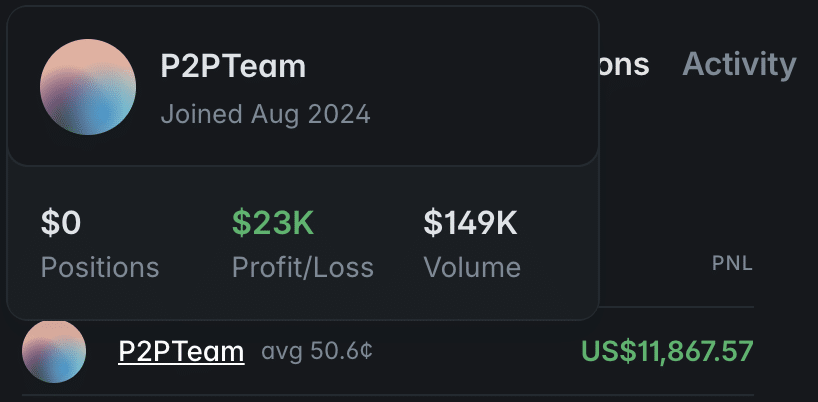
Source: Polymarket

P2P acknowledged that failing to disclose the activity at the time was a mistake. The team notes that trading on outcomes that a team can influence may erode trust, even if the result is not predetermined.

Incident highlights challenges in prediction market enforcement

The case underscores a broader challenge facing decentralized prediction markets: how to manage participation by individuals who may influence event outcomes.

Polymarket’s model relies on open participation and transparent on-chain activity. However, the presence of informed or involved actors can complicate enforcement, particularly when trades occur before outcomes are finalized.

As platforms move to formalize rules around insider activity, real-world cases like this may shape how those standards are interpreted and applied.


Final Summary

  • P2P disclosed betting on its own fundraise outcome, raising questions about insider participation in prediction markets.
  • The incident comes as platforms like Polymarket tighten rules, highlighting ongoing challenges in enforcing market integrity.

Пов'язані питання

QWhat did the P2P team admit to doing on Polymarket?

AThe P2P team admitted to placing bets on their own fundraising outcome, specifically on whether the project would reach its $6 million target.

QWhen did Polymarket update its rules regarding insider trading and manipulation?

APolymarket updated its rules, introducing stricter definitions around insider trading and manipulation, on March 23.

QWhat was the financial result of the 'P2P Team' account's trading activity?

AThe 'P2P Team' account recorded approximately $149,000 in trading volume and around $23,000 in profit and loss, with individual positions generating gains of over $11,000.

QAccording to the article, what is a key challenge for decentralized prediction markets highlighted by this incident?

AA key challenge is managing participation by individuals who may influence event outcomes, as the presence of informed or involved actors complicates enforcement, especially when trades occur before outcomes are finalized.

QWhat action did P2P say it would take following this disclosure?

AP2P stated it would liquidate the positions, return all proceeds to its foundation's treasury, and introduce internal policies governing prediction market activity.

Пов'язані матеріали

Understanding Hash in One Article: The "Browser Miner" on Ethereum

Hash is an Ethereum-based ERC-20 token described as a "browser-minable post-quantum token." Its key features include enabling browser-based GPU mining without specialized hardware, a fixed supply cap of 21 million tokens, immutable and permissionless smart contracts with no team allocation or pre-mining, and an emphasis on post-quantum security using Keccak256 hashing. The mining mechanism is a simplified on-chain proof-of-work where miners solve unique challenges tied to their wallet address. Key design elements prevent answer theft, with epochs resetting every 100 blocks (~20 minutes) and a per-block minting limit. Emission follows a Bitcoin-like halving schedule every 100,000 mints, starting at 100 tokens per mint. Projections suggest all tokens could be mined within approximately 294 days if a target rate of one mint per minute is sustained. Hash emphasizes "post-quantum" security by leveraging hash-based primitives like Keccak256, which are considered more resistant to quantum attacks compared to elliptic-curve cryptography. While not a fully post-quantum asset, it aligns with Ethereum's broader post-quantum research narrative. The project completed its Genesis sale at $0.03 and began trading on Uniswap, with its price reaching around $0.19. The initial circulating supply is small, with 5% sold in Genesis and 5% allocated to liquidity. The majority (47.6% of total supply) is allocated to early-stage mining, leading to a front-loaded emission schedule. This structure, combined with low initial liquidity, makes Hash a high-volatility, high-risk project dependent on sustained miner participation and market demand to absorb new supply.

marsbit12 хв тому

Understanding Hash in One Article: The "Browser Miner" on Ethereum

marsbit12 хв тому

OpenAI's Largest Internal Wealth Creation: 600 People Cash Out a Total of $6.6 Billion, 75 Take Home the Maximum $30 Million Each

A Wall Street Journal report reveals OpenAI's unprecedented pre-IPO wealth creation. In a single employee stock sale last October, over 600 current and former employees sold shares, collectively cashing out approximately $6.6 billion. Due to high investor demand, the company tripled the individual sale cap to $30 million, with about 75 employees selling the maximum amount. This event represents the largest such transaction in tech industry history for a private company. OpenAI's valuation was $500 billion for this tender offer. Employees with over two years of tenure were eligible, allowing many post-ChatGPT hires their first liquidity event. The company's stock has reportedly grown over 100-fold in seven years. Following a restructuring, employees collectively hold about 26% of OpenAI. The scale of executive wealth is also staggering. In court testimony related to Elon Musk's lawsuit, President and co-founder Greg Brockman confirmed his OpenAI stake is worth around $30 billion. Analysis indicates about 165 current and former employees hold a combined ~$164.9 billion in equity, averaging nearly $1 billion per person in paper wealth. OpenAI's per-employee stock-based compensation is estimated to be 34 times the average of major tech firms before their IPOs. OpenAI continues its rapid ascent, closing a $122 billion funding round at an $852 billion valuation in March. With monthly revenue hitting $2 billion, over 900 million weekly ChatGPT users, and plans for a potential trillion-dollar IPO in late 2026, this wealth-creation engine shows no signs of stopping.

链捕手35 хв тому

OpenAI's Largest Internal Wealth Creation: 600 People Cash Out a Total of $6.6 Billion, 75 Take Home the Maximum $30 Million Each

链捕手35 хв тому

Торгівля

Спот
Ф'ючерси
活动图片