‘Ownership must be tracked at creation’ – Can Camp Network solve it?

ambcryptoОпубліковано о 2026-03-23Востаннє оновлено о 2026-03-23

Анотація

Camp Network, a blockchain startup, proposes using crypto to address challenges in entertainment finance and digital ownership, particularly as AI accelerates content creation. It replaces traditional intermediaries with "on-chain vaults" for programmable ownership and automated revenue distribution, allowing communities to fund projects and share in IP success. The system emphasizes "proof of provenance" to track ownership at creation, ensuring proper attribution and royalties. While the model has attracted investment and industry interest, adoption remains cautious, with executives seeking solutions to real inefficiencies like rights tracking and payment delays rather than added complexity.

Camp Network, a blockchain startup focused on artificial intelligence [AI] and intellectual property [IP], is pitching crypto as a fix for growing problems in entertainment finance and digital ownership.

The pitch comes as AI speeds up content creation, while funding and rights systems lag.

Creators often face unclear ownership and complex financing. Camp Network’s approach, using blockchain-based “on-chain vaults”, tries to replace intermediaries with programmable ownership and automated revenue flows.

Funding without middlemen

In an interview with AltcoinDesk, Co-Founder Nirav Murthy said entertainment financing remains slow and controlled by a few players. Creators often give up equity and pay high legal costs to secure funding.

Camp’s model allows communities to fund projects directly. Fans can share in the upside of the IP they support. A recent example included a $200,000 vault used for film post-production and marketing.

Murthy said this model builds stronger audiences. Supporters become more engaged when they have economic exposure.

Tokenizing entertainment flows collapses the distance between creators, capital, and audiences.

The company said 53 global music festivals have joined the network, including Clockenflap and S2O Festival.

Industry response remains cautious. In an interview with IBM, a New York City-based record label said,

Royalty payments are often three to six months delayed. What happens if a song blows up and when the stats come in, not everyone was credited? At that point, changing the metadata is a pain and often swept under the rug.

Executives are open to blockchain only if it solves real inefficiencies such as cross-border payments, rights tracking and revenue distribution, rather than adding complexity.

AI exposes cracks in ownership

The pressure comes from AI’s rapid growth. Content is being created faster than ownership systems can track.

IP still gets priced after the fact... that model collapses once creation happens at AI speed.

Murthy said ownership must be tracked at the moment of creation. Delays can leave creators without payment or control.
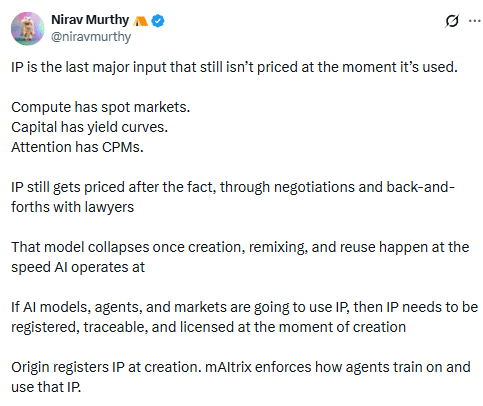
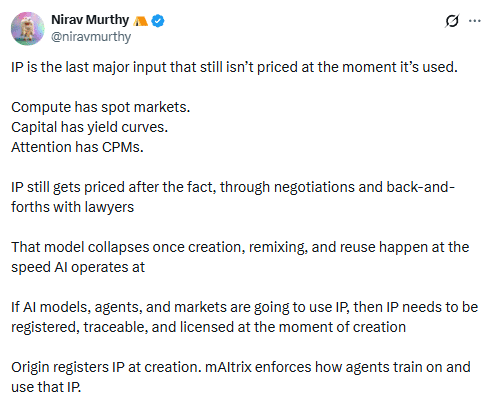
Source: Nirav Murthy/X

Camp Network’s system focuses on “proof of provenance,” which records who created content and how it is used. The goal is to allow creators to license work and receive royalties automatically.

The company describes this as building an “Autonomous IP Layer” for AI systems, where data used to train models is traceable and permissioned.

That approach aligns with broader industry concerns. According to a16z Crypto’s State of Crypto 2025 report, AI and blockchain are increasingly converging, with crypto infrastructure evolving into a core layer of the digital economy.

Capital flows into IP blockchains

Investors have backed this approach.

Camp Network has raised about $30 million across funding rounds. That includes a $25 million Series A led by 1kx and Blockchain Capital.

Murthy has also pointed to broader changes in the market, including how creators and platforms are reacting to AI.

If you’re a startup trying to train a voice model or a video model... you can’t do it anymore

At the same time, legal pressure is rising. Creators and publishers have filed lawsuits over AI training on copyrighted material.

Anyways, adoption remains uneven. Institutional investors still dominate early participation in tokenized assets. As AI creates more content, ownership may become harder to define.


Final Summary

  • Creators still face slow financing, high legal costs, and loss of equity under traditional systems.
  • Camp’s “on-chain vaults” enable direct funding from communities, allowing fans to share in IP revenue.


Трендові криптовалюти

Пов'язані питання

QWhat problem does Camp Network aim to solve in the entertainment and AI industries?

ACamp Network aims to solve problems related to unclear ownership, complex financing, and delayed royalty payments in entertainment and AI-driven content creation by using blockchain technology to provide programmable ownership and automated revenue flows.

QHow does Camp Network's 'on-chain vaults' model work for funding creative projects?

ACamp Network's 'on-chain vaults' allow communities to fund projects directly, enabling fans to share in the financial upside of the intellectual property they support. This model replaces intermediaries and reduces legal costs while building stronger audience engagement through economic exposure.

QWhy is tracking ownership at the moment of creation particularly important in the age of AI?

ATracking ownership at creation is crucial because AI accelerates content generation beyond the capacity of traditional ownership systems. Delays in establishing ownership can leave creators without payment or control, especially when content goes viral or is used in training AI models without proper attribution.

QWhat is Camp Network's approach to ensuring proof of provenance for digital content?

ACamp Network focuses on 'proof of provenance,' which records who created content and how it is used. This system allows creators to license their work and receive royalties automatically, ensuring traceable and permissioned use of data, particularly in AI training.

QHow much funding has Camp Network raised, and which firms led their Series A round?

ACamp Network has raised about $30 million across funding rounds, including a $25 million Series A led by 1kx and Blockchain Capital.

Пов'язані матеріали

Amidst Capital's Encirclement, Decentralization is the Sole Defense for Public Blockchains

In a landscape dominated by power and profit motives, the author argues that decentralization is not merely one desirable feature among many in blockchain design—it is the singular, non-negotiable defense against corporate and capital capture. The article adopts a Machiavellian, realist perspective on human institutions, positing that businesses will inevitably attempt to co-opt any valuable network to protect their profits and dominance. While external attacks like 51% forks are often discussed, the greater existential risk is internal capture—the gradual erosion of a protocol’s neutrality by vested interests, as seen historically with platforms like Visa and Google. The piece critiques permissioned chains, highly centralized “permissionless” layer-1s, and layer-2s without sufficient decentralization (e.g., single sequencers) as inherently vulnerable. These compromised systems, promoted by established financial players, are framed as delaying tactics to stifle truly open networks that threaten existing high-fee, inefficient business models. Real-world examples, such as closed enterprise consortiums that exclude competitors, illustrate how such systems cement oligopolies rather than foster innovation. The author concludes that while decentralized protocols like Ethereum are imperfect and costly to operate, they represent the only viable long-term equilibrium. In a market where value naturally flows to the most secure and neutral settlement layer, only maximally decentralized public blockchains can resist being subsumed by capital and powerful incumbents.

Foresight News11 хв тому

Amidst Capital's Encirclement, Decentralization is the Sole Defense for Public Blockchains

Foresight News11 хв тому

Who Decides the Rules of Bitcoin? BIP-110 Ignites Governance Debate

Bitcoin's governance is once again at the center of a heated debate, this time ignited by BIP-110, the "Reduced Data Temporary Softfork." This proposal aims to curb non-monetary data (like inscriptions and Runes) by introducing seven new consensus-layer restrictions over a year, such as limiting new output scripts to 34 bytes and restoring the OP_RETURN cap to 83 bytes. The controversy stems from BIP-110's fundamental shift: it moves the battle against "spam" from node relay and miner policies to the consensus layer, rendering currently valid transactions invalid. Supporters, arguing that default policy governance has failed (highlighted by Bitcoin Core v30's relaxation of OP_RETURN limits), see this as necessary to protect node resources and Bitcoin's monetary focus. Opponents, led by figures like Michael Saylor and Adam Back, warn it dangerously centralizes governance. Saylor listed 110 reasons against it, criticizing its low 55% miner activation threshold and potential for chain splits. Back emphasized Bitcoin's "permissionless" ethos, arguing no single group should impose value judgments via consensus rules. Further complicating matters, technical critiques suggest BIP-110 may be technically circumventable, and a "BlockSlop" vulnerability in its upgrade path poses a consensus risk. The debate has drawn in diverse stakeholders: miners (with pools like Ocean signaling support and Foundry polling clients), node operators (like Bitcoin Knots), and new players like corporate treasury holder MicroStrategy (Saylor), whose market influence adds a novel dimension. Ultimately, BIP-110 acts as a governance stress test, exposing the unresolved question: who decides Bitcoin's rules? It pits the authority of miners, node operators, developers, and capital holders against each other, with each side claiming to defend Bitcoin's core principles of neutrality and security.

marsbit28 хв тому

Who Decides the Rules of Bitcoin? BIP-110 Ignites Governance Debate

marsbit28 хв тому

Who Decides Bitcoin's Rules? BIP-110 Ignites Governance Debate

Title: Who Decides Bitcoin's Rules? BIP-110 Ignites Governance Debate A new technical proposal, BIP-110 (Reduced Data Temporary Softfork), has sparked a fundamental governance debate within the Bitcoin community. It aims to impose new consensus rules for one year to limit non-financial data (like inscriptions and Runes) on-chain, moving beyond simple node and miner policy filters to invalidate currently valid transactions. Supporters argue that default policies have failed due to workarounds, necessitating consensus-layer changes to protect Bitcoin's core monetary function from data spam. Critics, including Michael Saylor and Adam Back, contend this dangerously centralizes judgment, undermines permissionlessness, and sets a risky governance precedent. They advocate for market-based solutions like fees or Layer 2s instead. The debate exposes deeper tensions: miners are divided on activation; node operators assert their sovereignty; Bitcoin Core developers influence defaults without direct accountability; and large corporate holders like MicroStrategy now wield narrative influence. Technically, BIP-110 may not fully block data and carries a disclosed consensus bug risk. Ultimately, BIP-110 acts as a stress test, forcing the community to confront the unresolved question: who legitimately decides what Bitcoin is and how it evolves, amidst competing claims from miners, nodes, developers, and capital holders.

链捕手40 хв тому

Who Decides Bitcoin's Rules? BIP-110 Ignites Governance Debate

链捕手40 хв тому

Zcash's New Node Zakura Goes Live: Privacy Payments Can Reach 50,000 TPS, Aiming to Rival Visa and Mastercard

Zcash, a privacy-focused cryptocurrency, has launched a new full node software called Zakura version 1.0.0. Developed by Zcash co-founder Sean Bowe and Dev Ojha, with private ZEC donations, its goal is to enable Zcash to process over 50,000 transactions per second (TPS)—matching the scale of Visa and Mastercard—while maintaining full transaction privacy and verifiability. This addresses a key bottleneck, as Zcash currently handles only about 1 private transaction per second. Zakura is a fork of the Zcash Foundation's Zebra node. It features chain pruning and snapshots, reducing disk usage and allowing new nodes to sync in under two minutes. It also offers compatibility with the legacy `zcashd` client interface. The scalability challenge stems from the large data size of privacy proofs. Bowe's Tachyon project aims to use recursive proofs to reduce consensus-layer data needs from ~500 MB/s to ~100 MB/s. For wallet scalability, Valar Group is researching Private Information Retrieval (PIR) tech to allow wallets to fetch their data privately. Zakura supports fast block propagation and the upcoming "Ironwood" network upgrade (NU6.3), scheduled for activation around July 28th. Ironwood was created to contain a critical inflation bug discovered in the Orchard shielded pool in May 2024. The fix uses "turnstiles" to trap any counterfeit ZEC created during the vulnerability period within the shielded pool, preventing it from entering circulation and restoring supply integrity.

marsbit54 хв тому

Zcash's New Node Zakura Goes Live: Privacy Payments Can Reach 50,000 TPS, Aiming to Rival Visa and Mastercard

marsbit54 хв тому

Торгівля

Спот

Популярні статті

Як купити CAMP

Ласкаво просимо до HTX.com! Ми зробили покупку Camp Network (CAMP) простою та зручною. Дотримуйтесь нашої покрокової інструкції, щоб розпочати свою криптовалютну подорож.Крок 1: Створіть обліковий запис на HTXВикористовуйте свою електронну пошту або номер телефону, щоб зареєструвати обліковий запис на HTX безплатно. Пройдіть безпроблемну реєстрацію й отримайте доступ до всіх функцій.ЗареєструватисьКрок 2: Перейдіть до розділу Купити крипту і виберіть спосіб оплатиКредитна/дебетова картка: використовуйте вашу картку Visa або Mastercard, щоб миттєво купити Camp Network (CAMP).Баланс: використовуйте кошти з балансу вашого рахунку HTX для безперешкодної торгівлі.Треті особи: ми додали популярні способи оплати, такі як Google Pay та Apple Pay, щоб підвищити зручність.P2P: Торгуйте безпосередньо з іншими користувачами на HTX.Позабіржова торгівля (OTC): ми пропонуємо індивідуальні послуги та конкурентні обмінні курси для трейдерів.Крок 3: Зберігайте свої Camp Network (CAMP)Після придбання Camp Network (CAMP) збережіть його у своєму обліковому записі на HTX. Крім того, ви можете відправити його в інше місце за допомогою блокчейн-переказу або використовувати його для торгівлі іншими криптовалютами.Крок 4: Торгівля Camp Network (CAMP)Легко торгуйте Camp Network (CAMP) на спотовому ринку HTX. Просто увійдіть до свого облікового запису, виберіть торгову пару, укладайте угоди та спостерігайте за ними в режимі реального часу. Ми пропонуємо зручний досвід як для початківців, так і для досвідчених трейдерів.

438 переглядів усьогоОпубліковано 2025.08.27Оновлено 2026.06.02

Як купити CAMP

Обговорення

Ласкаво просимо до спільноти HTX. Тут ви можете бути в курсі останніх подій розвитку платформи та отримати доступ до професійної ринкової інформації. Нижче представлені думки користувачів щодо ціни CAMP (CAMP).

活动图片