1. What does Nebius (NBIS) do?
Emerging AI cloud infrastructure provider.
Nebius Group NV (NASDAQ: NBIS), headquartered in Amsterdam, Netherlands, is an AI cloud company restructured and established in July 2024 following the separation of Yandex's Russian business. The company's main business is providing full-stack AI cloud infrastructure, covering large-scale GPU clusters, cloud computing platforms, model training, and inference services. It also designs its own servers, racks, and data center architecture. It is a "Preferred" level cloud service provider within the NVIDIA Partner Network (NPN) and one of the NVIDIA Exemplar Clouds. The company has data center locations in Europe (Finland, the UK, France, Iceland) and the US (New Jersey, Missouri).
2. Heated market reaction after earnings release: Stock price surges 34.14% in a single day
Nebius announced its Q2 2026 fiscal year earnings (for the period ending June 30th) before the US market opened on August 12th. The stock price gapped up significantly in pre-market trading and closed up 34.14% for the day.
The background of the heated market reaction is not only due to the earnings themselves beating expectations but also related to the better-than-expected earnings report from peer CoreWeave on the previous trading day (8/11), which drove the stock prices of the peer group higher. Additionally, positive comments from Goldman Sachs analysts before the earnings report were a factor. Furthermore, about 24% of Nebius's free float was shorted, with the short squeeze effect amplifying the stock price gain.
3. Revenue hits record high, AI cloud business contributes nearly all revenue
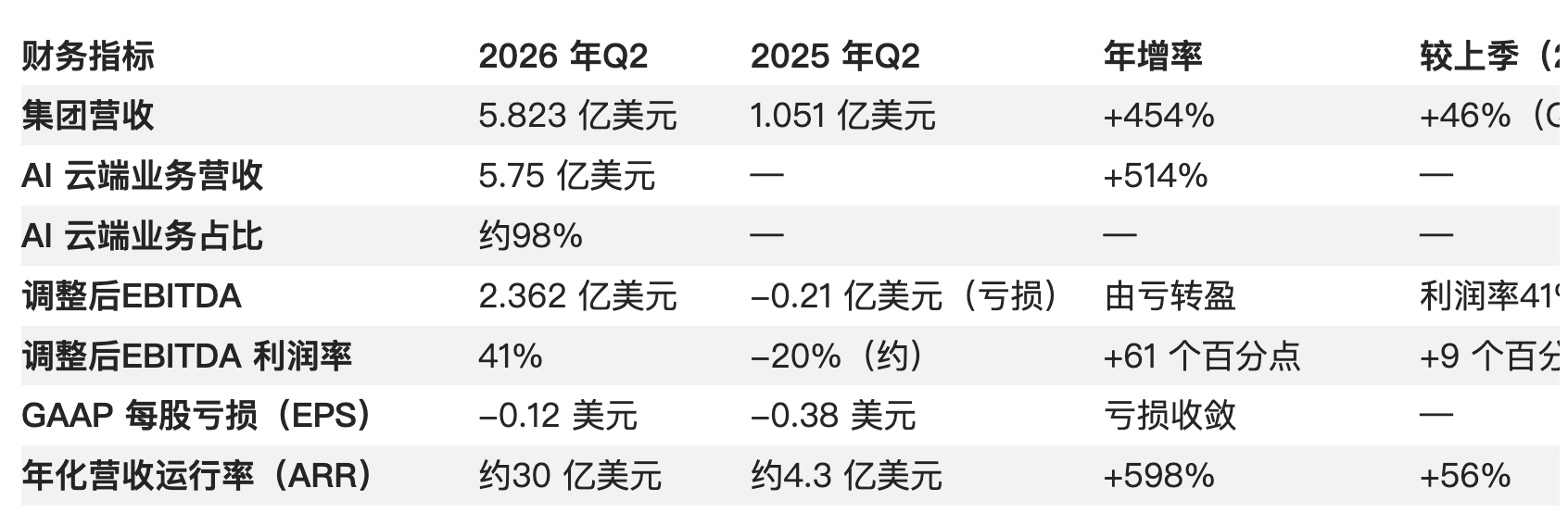
Q2 revenue was $582.3 million, representing sequential growth of approximately 46% and year-over-year growth of 454%, beating the market expectation range (approximately $576M to $583M).
Revenue from the Nebius AI cloud business grew 514% year-over-year, accounting for approximately 98% of the group's total revenue. Regarding profitability, Adjusted EBITDA turned profitable, with a margin of 41%, a significant improvement from the previous quarter's 32%. GAAP loss per share was $0.12, better than the market's estimated loss range of $0.69 to $0.82.
The GAAP income statement was affected by a significant increase in depreciation and amortization, stock-based compensation expenses, and interest expenses. GAAP net income after tax turned from a profit of $502.5 million in the same period last year (including one-time investment revaluation gains) to a loss of $190.4 million this quarter. However, on a half-year basis, net income still increased 8% year-over-year to $430.8 million.
4. Capacity and Customer Expansion: Meta's large order, NVIDIA ramps up investment
Capacity Expansion: The company raised its target for signed power capacity by the end of 2026 from the original 4GW to 5GW and plans to add over 1GW of capacity annually starting in 2027.
Large Customer Contract: The company signed a five-year compute capacity supply agreement with Meta Platforms with a total value of up to $27 billion (including a $12 billion commitment for dedicated infrastructure, with an option to purchase up to an additional $15 billion in capacity). This is the company's first large-scale deployment case adopting NVIDIA's next-generation Vera Rubin chips.
Strategic Investor: NVIDIA previously announced a $2 billion investment in Nebius to help accelerate its next-generation cloud computing deployments, praising its "unique engineering depth across the entire AI technology stack."
Customer Prioritization: Management stated that when allocating capacity, factors such as customer type, pricing, payment structure, contract duration, and deal size are comprehensively considered, with priority given to existing customers.
5. Q3 and Full-Year Outlook: Reiterating guidance, excluding contributions from newly signed capacity
Full-Year Revenue Outlook: The company reiterated its fiscal 2026 revenue guidance range of $3.0 billion to $3.4 billion, annualized revenue run-rate of $7.0 billion to $9.0 billion, adjusted EBITDA margin of approximately 40%, and capital expenditure guidance of $20 billion to $25 billion.
Management explained that capacity contracts newly signed at the end of Q2 are expected to begin contributing to revenue later in 2026, thus having a limited impact on the current year's guidance; the main impact will be reflected in 2027 and beyond. Formal guidance for 2027 will be provided later.
6. Financial Health: Strong cash position, capital expenditure increases significantly
. Cash Position: Cash and cash equivalents at period-end amounted to $8.0 billion.
. Operating Cash Flow: Q2 operating cash flow reached $2.3 billion; however, the company noted that this was primarily from changes in working capital such as accounts receivable and deferred revenue, rather than contributions from GAAP profit, and such items can fluctuate across periods.
. Capital Expenditure: Q2 capital expenditure (primarily for GPU purchases and data center expansion) reached $5.66 billion, an increase of over tenfold compared to the same period last year; capital expenditure for the first half of the year exceeded $8.1 billion.
. Financing Instruments: The company finances its substantial capital expenditure needs through customer prepayments, a $775 million asset-backed debt financing facility, and a light-asset infrastructure partner collaboration model (where partners fund, build, and own the data centers and hardware, while Nebius provides architectural design, supply chain resources, and platform software).
7. Growth Potential and Potential Risk Assessment
Regarding growth momentum, Nebius benefits from the continued expansion of global AI training and inference demand, coupled with NVIDIA's strategic investment and the endorsement of the Meta large contract. The market remains optimistic about its medium-to-long-term growth momentum (analysts' average price target is approximately $241).
Potential risks include:
. High capital expenditure and cash consumption: The company is still in a heavy capital investment phase, with GAAP financials still in a loss position. If revenue growth falls short of expectations, it could delay the path to profitability.
. Infrastructure execution risk: The company acknowledges that data center site selection, power availability, equipment, and supply chain resources coming online as planned are key risks for capacity to be delivered on time and at a reasonable cost.
. Elevated valuation: The current Price-to-Sales (P/S) ratio is approximately 65.5x, significantly higher than the company's historical median of about 6.8x, indicating the market has priced in a considerable degree of future growth, warranting attention to volatility risk.
. Customer concentration: Although signing large contracts with companies like Meta helps diversify the customer base, overall revenue remains highly dependent on a small number of large cloud/AI customers.
8. Outlook
Nebius's Q2 earnings report demonstrated the continued strong trend in demand for AI cloud infrastructure: revenue grew 454% year-over-year, adjusted EBITDA turned profitable with the margin improving to 41%, coupled with the large long-term contract signed with Meta and NVIDIA's strategic investment, all strengthening market confidence in the company's medium-to-long-term growth, driving the stock price to surge over 10% in a single day.
However, the company's current GAAP financials remain in a loss position, capital expenditure is large and continues to climb, and the current valuation already reflects highly optimistic expectations. Investors must still pay attention to risks such as its capacity execution progress, financing structure robustness, and customer concentration, and carefully assess the valuation level before making investment decisions aligned with their own goals.