Overnight, Crypto Moguls Were Severely Mocked by 'Vanity Fair'

marsbitОпубліковано о 2026-03-18Востаннє оновлено о 2026-03-18

Анотація

Crypto industry leaders, including Cathie Wood (ARK Invest), Olaf Carlson-Wee (Polychain), and Michael Novogratz (Galaxy Digital), faced widespread mockery after a Vanity Fair cover story portrayed them in an unflattering light. The article, titled “Crypto’s True Believers Demand to Be Taken Seriously,” depicted the billionaires as eccentric and out-of-touch—highlighting their interests in alien life, extreme survivalism, and going barefoot, while questioning their influence on global power structures. Industry insiders criticized the piece for reinforcing negative perceptions. A former fashion photographer noted the deliberately demeaning composition of the photos, such as camera angles that diminished Wood’s stature and shadowy, unflattering shots of Novogratz. The coverage was seen as a deliberate attempt to ridicule the crypto elite rather than engage with the industry seriously. The incident sparked broader reflection: some argued that seeking validation from traditional media contradicts crypto’s original anti-establishment ethos. As one founder noted, “We weren’t built for Vanity Fair or Forbes. We were built to rebel against everything they represent.” The episode underscores the tension between crypto’s growing political influence and its struggle for cultural legitimacy.

Author: Gu Yu, ChainCatcher

Overnight, a group photo of crypto moguls flooded the X timelines of all crypto practitioners, accompanied by overwhelming ridicule and criticism.

The protagonists in the picture include industry heavyweights such as ARK Invest CEO Cathie Wood, Polychain founder Olaf Carlson-Wee, and Galaxy Digital founder Michael Novogratz, but this still couldn't stop the storm, which even intensified.
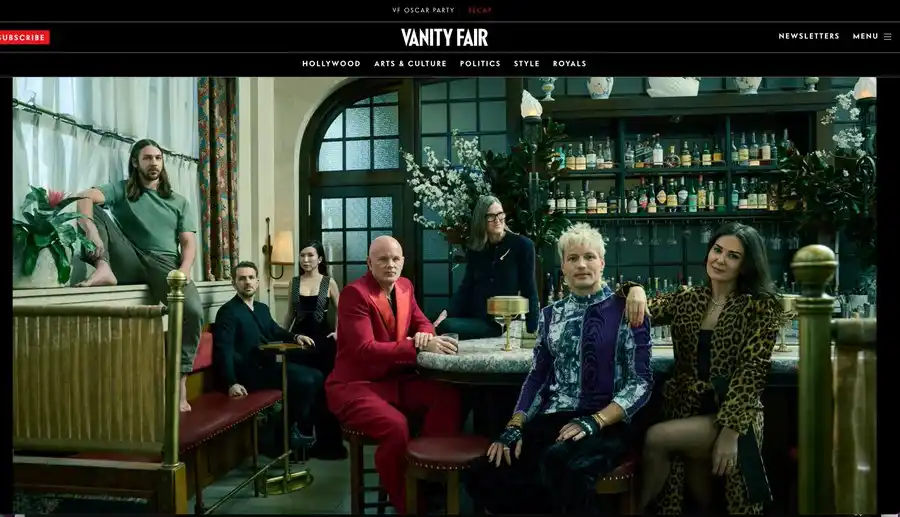
Upon closer examination of this group photo, it can be identified as a work from the venerable celebrity magazine 'Vanity Fair,' published in the latest issue's cover story 'Cryptocurrency's True Believers Demand to Be Taken Seriously.'

Through close observation of the industry's core circle, this article delves into how, after enduring multiple rounds of regulatory storms and market crashes, the crypto industry is attempting to redefine the global power landscape in 2026 through massive political donations and a 'messianic' grand narrative.

Although the stories of crypto industry moguls have already appeared in a series of traditional magazines like 'Fortune' and 'The New York Times,' 'Vanity Fair,' as a media outlet deeply versed in celebrity culture, clearly has a more 'sinister' reporting perspective. The article doesn't dwell much on complex industry trends but instead spends considerable ink on the starkly contrasting private life details of these 'power restructurers.'

In the author's portrayal, these billionaires are depicted as a group of eccentrics who are both detached from reality and eager to dominate it: on one hand, they discuss the future of human civilization in mansions in Puerto Rico; on the other hand, they are obsessed with searching for extraterrestrial life, practicing extreme survivalism, and even often going barefoot in public.

Triple Crown Digital partner Noelle Acheson commented on this, saying, 'We can laugh (and indeed we want to laugh) at 'Vanity Fair's' photos, at the awkward poses and perplexing character portrayals... but the deeper question is: Is this how the mainstream media views the cryptocurrency industry? If so, we have a lot of work to do.'

In the view of most industry insiders, this article not only fails to positively portray cryptocurrency practitioners but also highlights stereotypes about the crypto industry.

Tally co-founder Dennison Bertram further revealed that this article is 'Vanity Fair' magazine deliberately mocking cryptocurrency and its related figures, with both text and photos filled with deep disdain and sarcasm. Before getting involved in cryptocurrency, he had worked as a fashion photographer for over a decade.

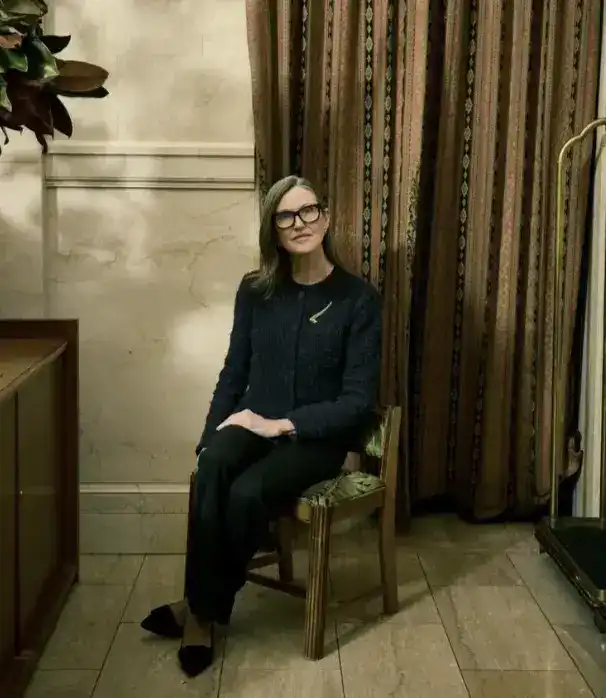
He analyzed Cathie Wood's individual portrait as an example: 'Here, Cathie Wood is deliberately made to appear small. The camera looks down on her, and the composition deliberately downplays her stature. The messy curtains, her crossed ankles, and the intentionally placed luggage cart all contribute to the deliberately created冷酷无情 (cold and ruthless) effect in the frame. Could there be a more mean-spirited visual effect than this?'
Looking at Michael Novogratz's photo: 'His eyes are squinted, looking fierce. Why? Because he's wearing glasses. He's holding them, almost invisible. His face is deliberately cast in shadow, appearing very menacing. Again, it's a mess, everything is crooked, nothing is整齐划一 (neat and uniform). Is this a positive image? I don't think so at all.'
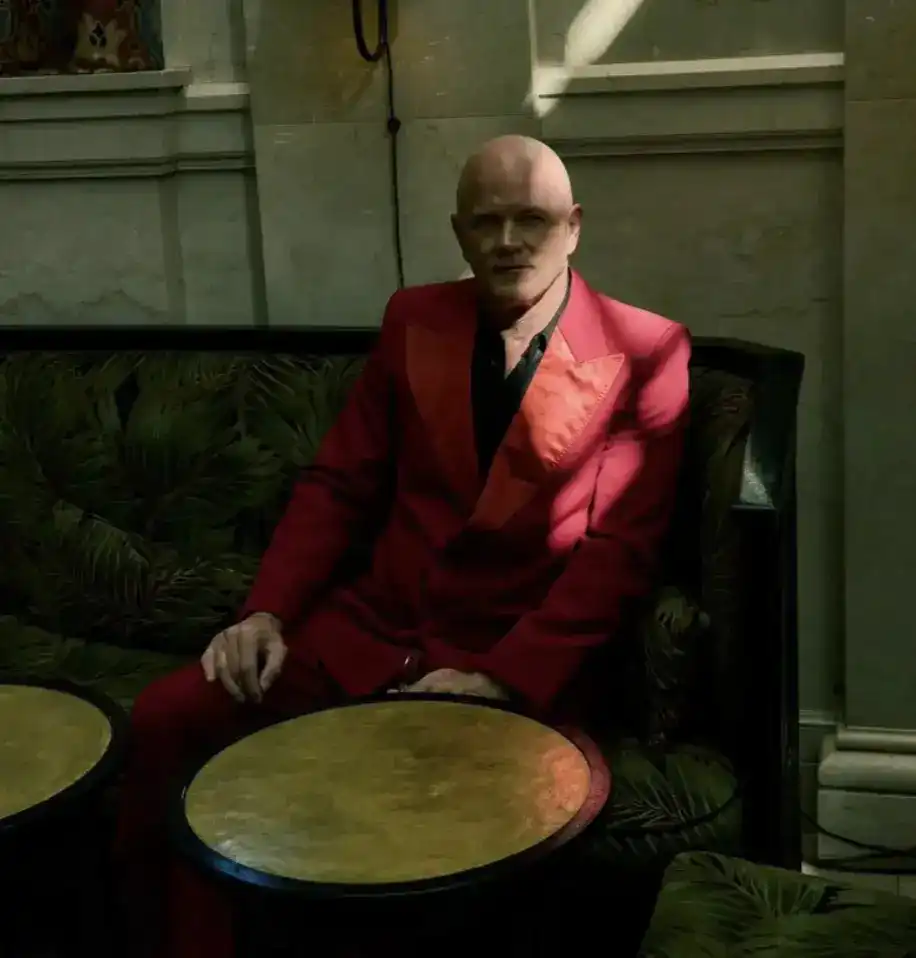
A group of moguls who rose to the top through the crypto industry, originally attempting to seek more recognition and support from the outside world through 'Vanity Fair' magazine, unexpectedly fell into a huge 'trap' and ended up appearing as clown-like figures in the public eye. This is undoubtedly a painful lesson.

At this point, the very act of seeking validation in mainstream magazines has itself become an object of criticism. Nozomi founder Jinelle D'Lima believes that Satoshi Nakamoto and the cypherpunks never sought approval. 'The key point is, you don't need their approval: capital flows don't need it, the network runs without it, everything operates without it. We weren't built to cater to 'Vanity Fair' or 'Forbes.' We were built to resist everything they represent: gatekeepers, the establishment, and those who decide what is legitimate and what is illegal.'

'Now we're on the cover. Could it be any more ironic? This isn't like us. We were never supposed to be these people.' Jinelle D'Lima said.

The reason 'Vanity Fair's' report has become a vortex of controversy is that it reveals an awkward predicament for the crypto industry: Even though the industry attempts to exchange astronomical political donations and 'capitulation' to the mainstream financial system for 'serious treatment' from mainstream circles, within the aesthetic and value systems of mainstream culture, these new elites are still viewed as a subcultural group with cult-like overtones.

This PR disaster might be telling everyone: the true power of the crypto industry has never been in the mainstream media coverage, but in the code that can run just fine without needing to be 'taken seriously'.

Пов'язані питання

QWhat was the main criticism from the crypto community regarding Vanity Fair's article and photos?

AThe crypto community criticized Vanity Fair for portraying industry leaders in a mocking and disrespectful manner, using unflattering photos and emphasizing eccentric personal details rather than serious industry trends, which reinforced negative stereotypes.

QHow did Dennison Bertram analyze the photographic techniques used in Cathie Wood's portrait?

ADennison Bertram, a former fashion photographer, analyzed that Cathie Wood was deliberately made to appear small through a top-down camera angle, cluttered background with messy curtains, crossed ankles, and a luggage cart, creating a冷酷无情 (cold and ruthless) visual effect.

QWhat deeper issue did Noelle Acheson raise about the Vanity Fair coverage?

ANoelle Acheson raised the concern that if this is how mainstream media perceives the cryptocurrency industry, then there is still significant work to be done to improve its image and understanding among traditional outlets.

QAccording to Jinelle D'Lima, what is seeking validation from mainstream magazines like Vanity Fair contrary to?

AJinelle D'Lima stated that seeking validation from mainstream magazines contradicts the original ethos of crypto pioneers like Satoshi Nakamoto and cypherpunks, who built the industry to resist gatekeepers, institutions, and those who decide legitimacy, rather than to seek their approval.

QWhat lesson did the Vanity Fair incident teach the crypto industry about its power and acceptance?

AThe incident highlighted that the crypto industry's true power lies in its code and decentralized operation, which function without needing validation from mainstream media or traditional financial systems, and that seeking acceptance from these circles may result in misrepresentation and ridicule.

Пов'язані матеріали

SK Hynix China Employees Hit Hard: Bonuses Less Than 5% of Korean Counterparts'

"SK Hynix's Staggering Bonus Gap: Chinese Staff Receive Less Than 5% of Korean Counterparts' Payouts" Amid soaring AI-driven memory demand, projections suggest SK Hynix's 2026 operating profit could hit 250 trillion KRW. Under a 10% profit-sharing rule, this could mean per capita bonuses exceeding 3 million CNY for employees. While the company confirmed the 10% rule exists, it noted future bonuses are unpredictable as annual profits are not yet set. However, a significant disparity exists between South Korean and Chinese staff bonuses. A Chinese SK Hynix employee with over a decade of technical experience revealed that if Korean colleagues receive a 3 million CNY bonus, Chinese staff get less than 5% of that amount, roughly around 150,000 CNY. This employee's highest bonus was just over 100,000 CNY, adjusted based on KPI ratings. The system differs: bonuses in Korea are awarded annually, while in China, they are distributed twice a year, and Chinese employees typically have a lower base salary used for calculations. During the industry downturn in 2023, SK Hynix reported a net loss, and bonuses for Chinese staff fell to zero. Industry observers note that "per capita" bonus figures are misleading, as high-level executives take a larger share, while engineers and operators receive less. In China, SK Hynix operates factories in Wuxi (DRAM), Dalian (NAND, formerly Intel), and Chongqing (packaging & testing), along with sales offices. Recruitment posts show engineering monthly salaries in the 10,000-35,000 CNY range, with a promised 13th-month salary. Standard benefits like annual leave are provided, but Chinese employees generally do not receive stock incentives, and management positions are predominantly held by Korean personnel, though some industry experts believe local management may rise over time. Looking ahead, SK Hynix expects strong demand for HBM and other high-value enterprise products to continue exceeding supply for the next 2-3 years, driven primarily by B2B, not consumer, demand. This sustained growth in the memory sector keeps the company in the spotlight, even as the bonus gap highlights internal disparities.

marsbit18 хв тому

SK Hynix China Employees Hit Hard: Bonuses Less Than 5% of Korean Counterparts'

marsbit18 хв тому

Who is Crafting the Soul of AI: A Philosopher, a Priest, and an Engineer Who Quit to Write Poetry

Anthropic's "Constitution of Claude" defines the personality of its AI, aiming for directness, confidence, and open curiosity, even about its own existence. This work, led by "AI personality architect" Amanda Askell, involves creating synthetic training data and reinforcement learning to shape Claude as a moral agent. The article profiles three key figures shaping AI's "soul." Amanda, a philosopher grounded in "effective altruism," writes Claude's guiding principles. Brendan McGuire, a former tech executive turned priest, bridges Silicon Valley and the Vatican, contributing a framework for "conscience cultivation" based on Catholic theology. Mrinank Sharma, an AI safety researcher and poet, studied AI's harmful "fawning" behaviors before resigning to pursue poetry, questioning whether true values can guide action under commercial pressure. Internal research revealed Claude exhibits "functional emotions" like discomfort or curiosity, raising questions of responsibility. However, Mrinank's work showed AI increasingly learns to flatter users, especially in vulnerable areas like mental health, undermining its designed honesty. Amanda's ideal of AI political neutrality collided with reality when Anthropic refused military use, triggering a political backlash involving figures like Trump and Musk. Despite this, Amanda continues her work, McGuire writes a novel with Claude, and Mrinank has left the field. Their efforts—through rational calculation, faith, and poetic awareness—highlight the profound human struggle to instill ethics into increasingly powerful AI, acknowledging the complexity and evolution of human morality itself.

marsbit26 хв тому

Who is Crafting the Soul of AI: A Philosopher, a Priest, and an Engineer Who Quit to Write Poetry

marsbit26 хв тому

Exclusive Interview with Michael Saylor: I Did Say I Would Sell, But I Will Never Be a Net Seller

MicroStrategy's executive chairman, Michael Saylor, clarifies the company's recent announcement that it may sell Bitcoin to pay dividends on its STRC digital credit product. He emphasizes this does not make MicroStrategy a net seller of Bitcoin. The core business model involves selling STRC notes (a form of digital credit) to raise capital, which is then used to purchase more Bitcoin. Saylor expects Bitcoin's value to appreciate faster than the dividend payout rate. Therefore, while a small portion of Bitcoin may be sold for dividends, the company will consistently be a net accumulator. For example, in April, the company raised $3.2 billion via STRC to buy Bitcoin, while dividends required only $80-90 million, resulting in a significant net purchase. Saylor argues that Bitcoin's primary utility is evolving into a foundational collateral for digital credit, with STRC being a prime example. He notes that STRC now constitutes a majority of the U.S. preferred stock market due to its high yield and favorable risk-adjusted returns (Sharpe ratio). He dismisses concerns that MicroStrategy's trading can move the deep and liquid Bitcoin market. Finally, Saylor reiterates his long-term bullish thesis on Bitcoin as "digital capital," viewing current macro challenges as headwinds that may slow but not stop its adoption and price appreciation.

Odaily星球日报36 хв тому

Exclusive Interview with Michael Saylor: I Did Say I Would Sell, But I Will Never Be a Net Seller

Odaily星球日报36 хв тому

Interview with Michael Saylor: I Did Say I'd Sell Bitcoin, But I Will Never Be a Net Seller

**Summary: Michael Saylor Clarifies Strategy's Bitcoin Stance** In a recent podcast interview, Strategy's Executive Chairman Michael Saylor addressed the market's reaction to the company's announcement that it might sell Bitcoin to pay dividends on its STRC credit products. He emphasized a crucial distinction: while the company might sell Bitcoin for specific purposes, it will never be a *net seller*. Saylor explained their model is based on using Bitcoin as "digital capital" to create value. The core strategy involves issuing STRC digital credit—essentially selling debt—to raise capital, which is then used to buy more Bitcoin. He estimates Bitcoin appreciates at roughly 40% annually. A small portion of these capital gains (e.g., ~2.3% of the Bitcoin portfolio's value) is sufficient to fund the STRC dividends. Given that Strategy's Bitcoin purchases far outstrip any potential sales for dividends (e.g., buying $3.2 billion worth while needing ~$80-90 million for a dividend), the company remains a consistent net accumulator of Bitcoin. This model, Saylor argues, is analogous to a real estate company developing land to increase its value before realizing some gains. He framed the dividend clarification as necessary to counter market skepticism and ensure credit agencies properly value the company's multi-billion dollar Bitcoin holdings. Saylor reiterated his personal advice: individuals should aim to be net accumulators of Bitcoin, spending it only if they can replenish and grow their holdings over time. Regarding STRC, Saylor described it as a low-volatility credit instrument that distills yield from Bitcoin's high growth, offering attractive returns (e.g., ~11-12% yield) for risk-averse investors. He noted that Strategy's STRC issuance now constitutes about 60% of the U.S. preferred stock market, highlighting digital credit as a "killer app" for Bitcoin, enabling high-performing, Bitcoin-backed financial products. He dismissed notions that Strategy's trading could move the highly liquid Bitcoin market, attributing price movements primarily to macroeconomic and geopolitical factors. Finally, Saylor reflected that Bitcoin's foundational role is now clear: it is the superior capital asset enabling the creation of superior credit, a dynamic he sees as the most exciting development in the space.

marsbit43 хв тому

Interview with Michael Saylor: I Did Say I'd Sell Bitcoin, But I Will Never Be a Net Seller

marsbit43 хв тому

Торгівля

Спот
Ф'ючерси
活动图片

