Over 1 in 20 emails are malicious, warns internet giant Cloudflare

cointelegraphОпубліковано о 2025-12-16Востаннє оновлено о 2025-12-16

Анотація

More than 5% of all emails sent contain malicious content, with that figure surging to nearly 10% in November, according to Cloudflare's 2025 year-in-review report. Malicious emails are defined as those capable of causing harm, such as stealing credentials, data, or money. These threats are particularly relevant to crypto investors, as phishing attacks have increased in complexity and can result in irreversible losses. Deceptive links were the most common threat category, making up 52% of malicious emails. Identity deception followed at 38%, where attackers impersonate trusted individuals using spoofed domains. The most abused top-level domain was “.christmas,” with 92.7% of emails from it being malicious. Additional research from Barracuda found that one in four emails were unwanted spam, a quarter of all HTML attachments were malicious, and 12% of malicious PDF attachments were Bitcoin scams. Hornet Security also reported a 131% year-over-year increase in malware-laden emails, confirming email as a consistent vector for cyberattacks.

More than 5% of all emails sent worldwide contain malicious content, according to internet infrastructure giant Cloudflare.

The web security giant revealed that an aggregate of 5.6% of global email traffic analyzed by the firm over the past year was found to be malicious. This equates to more than one in every twenty emails containing harmful content.

In November, that figure surged to almost one in 10, nearly double the average for the year, it found.

Malicious emails include those that can cause harm, such as the theft of credentials, data, or money, Cloudflare explained in its 2025 year-in-review report.

The findings are particularly relevant to crypto investors, as phishing attacks targeting crypto traders, investors, and executives have increased in complexity and surged in recent months.

Crypto phishing links can be especially damaging. Once a victim falls for one of these malicious links or sends cryptocurrency to a scammer, there’s usually no way back.
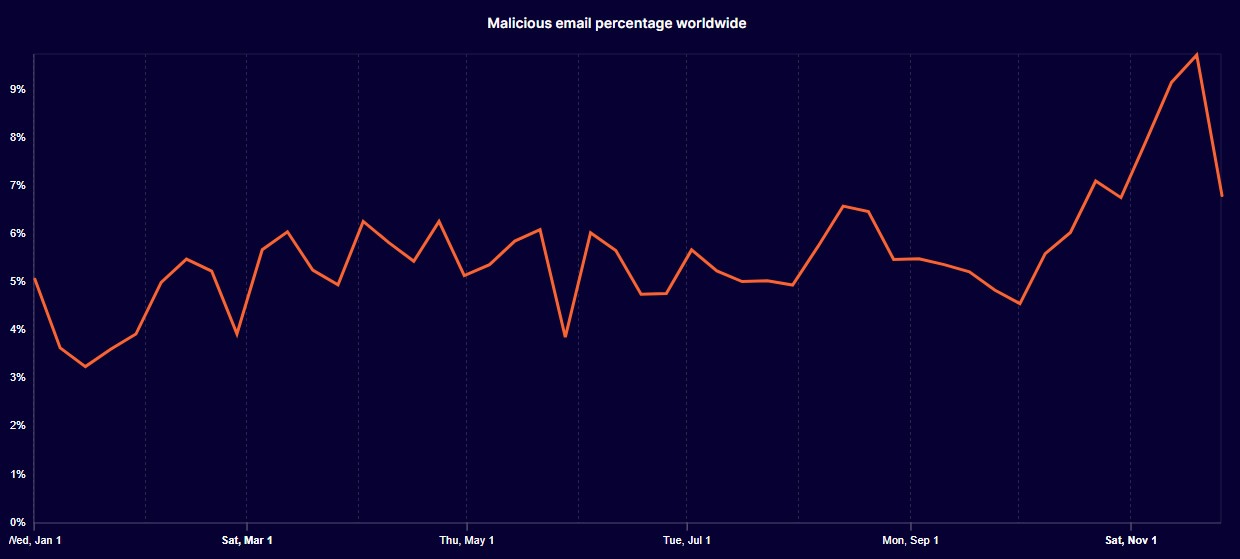
Malicious emails surged to 9.7% in November. Source: Cloudflare

Deceptive links dominate threat categories

More than half of these malicious emails, or 52%, contained a deceptive link, which was the highest threat category, it reported.

Identity deception was the second-highest at 38%, up from 35% in 2024, as attackers impersonated trusted individuals using spoofed domains, similar-looking domains, or display name tricks.

Related: Email auto-reply vulnerability allows hackers to mine cryptocurrency

Cloudflare also revealed that the most abused top-level domain (TLD) extension was “.christmas,” with 92.7% malicious emails and 7.1% spam originating from this domain type.

Other highly abused domain names included “.lol,” “.forum,” “.help,” “.best” and “.click.”
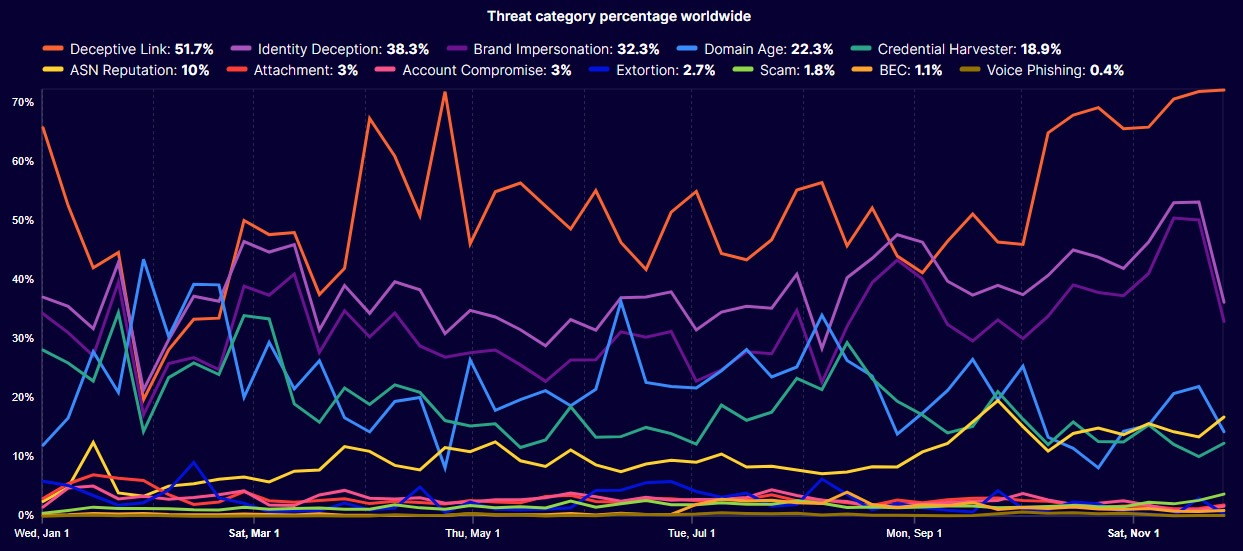
Deceptive links were the highest threat category among malicious emails. Source: Cloudflare

A quarter of HTML attachments are malicious

Earlier this year, researchers at cybersecurity company Barracuda analyzed 670 million emails that were malicious or unwanted spam.

They discovered that email remains the most common attack vector for cyber threats, with malicious attachments and links being used to distribute malware, launch phishing campaigns, and exploit vulnerabilities.

As many as one in four emails were unwanted spam, a quarter of all HTML attachments were malicious, and 12% of malicious PDF attachments were Bitcoin scams, they reported.

In November, Hornet Security reported that email was a “consistent delivery vector” for cyberattacks in 2025, with malware-laden emails surging by 131% year-over-year.

Magazine: Do Kwon sentenced to 15 years, Bitcoin’s ‘choppy dance’: Hodler’s Digest

Пов'язані матеріали

This Week's Key Events Preview | U.S. to Release April CPI Data; U.S. Senate Banking Committee to Review "Digital Asset Market Structure Act of 2025"

Weekly News Preview: Key events for May 12-16 include major economic and crypto industry developments. On Tuesday, May 12, the U.S. will release its April CPI data. Additionally, the gaming blockchain Ronin will begin a 10-hour migration to an Ethereum Layer 2, built on OP Stack with EigenDA for data availability. This aims to leverage Ethereum's security and settle RON's annual inflation below 1%. Base's first independent network upgrade, "Base Azul," is scheduled for mainnet activation on Wednesday, May 13, focusing on security, performance, and developer experience enhancements. Thursday, May 14, sees the U.S. Senate Banking Committee voting on the "Digital Asset Market Structure Act of 2025." In other news, Solana DeFi protocol Carrot will shut down, setting a final withdrawal deadline due to impacts from the Drift exploit. The Moscow Exchange will launch futures trading for Solana, Ripple, and Tron indices (RUB-settled) for qualified investors. Multiple service closures are scheduled for Friday, May 15. Dmail Network will begin winding down due to unsustainable infrastructure costs and failed commercialization. Users must export data before this date. Separately, the Cosmos-based lending blockchain UX Chain will fully shut down. Finally, on Saturday, May 16, gaming infrastructure provider Lattice will wind down operations, with its Redstone Layer 2 network ceasing. Users are urged to withdraw assets, especially from contracts like Uniswap pools, before the shutdown.

链捕手1 год тому

This Week's Key Events Preview | U.S. to Release April CPI Data; U.S. Senate Banking Committee to Review "Digital Asset Market Structure Act of 2025"

链捕手1 год тому

Morning Post | Trump Media Group Releases Q1 Financial Report; Top Three DeFi Applications Return Nearly $100 Million in Revenue to Token Holders in 30 Days; Michael Saylor Shares Bitcoin Tracker Info Again

**Title: Daily Briefing | Trump Media Group Releases Q1 Report; Top 3 DeFi Apps Return Nearly $100M to Token Holders; Michael Saylor Signals Potential Bitcoin Buy** **Summary:** Key developments in the past 24 hours include: * **Economic Outlook:** Goldman Sachs has pushed back its forecast for the next two Federal Reserve interest rate cuts to December 2026 and March 2027, citing persistent inflationary pressures from energy costs. This delayed timeline is expected to tighten liquidity flow into risk assets, including cryptocurrencies. * **DeFi & Revenue:** Data from DefiLlama shows that three leading DeFi applications—Hyperliquid, Pump.fun, and EdgeX—collectively distributed $96.3 million in revenue to their token holders over the last 30 days. This trend highlights a shift in the crypto community's focus towards real protocol earnings and sustainable economic models. * **Corporate Bitcoin Moves:** Michael Saylor, founder of MicroStrategy (note: referred to as 'Strategy' in the text, likely a typographical error), has signaled potential upcoming Bitcoin purchases by posting a "Bitcoin Tracker" update, following a pattern that typically precedes the company's official disclosure of new acquisitions. * **Market Integrity:** Prediction market platform Polymarket announced updates to address platform issues, including identifying and banning clusters of accounts involved in "ghost-fill" activities and implementing measures to prevent bulk account creation. * **Regulation:** The Bank of England Governor warned that stablecoin regulation could lead to tensions between US and international regulators. In South Korea, the National Tax Service has launched a pilot program to entrust seized virtual assets to private custody firms for management. * **Meme Token Trends:** GMGN data lists the top trending meme tokens on Ethereum (e.g., HEX, SHIB), Solana (e.g., FWOG, TROLL), and Base (e.g., SKITTEN, PEPE) over the past day. **Financial Note:** Trump Media & Technology Group reported a Q1 loss of approximately $4 billion, primarily attributed to unrealized losses on its Bitcoin and other digital asset holdings.

链捕手1 год тому

Morning Post | Trump Media Group Releases Q1 Financial Report; Top Three DeFi Applications Return Nearly $100 Million in Revenue to Token Holders in 30 Days; Michael Saylor Shares Bitcoin Tracker Info Again

链捕手1 год тому

Telegram Takes Direct Control of TON, Social Traffic Rewrites the Public Chain Narrative

Telegram founder Pavel Durov announced that Telegram will replace the TON Foundation as the core driver and largest validator of The Open Network (TON). Key initiatives include a sixfold reduction in transaction fees, performance upgrades, and improved developer tools within the next few weeks. This marks a strategic shift from Telegram merely providing user access to deeply integrating TON into its platform's core infrastructure. The goal is to transform Telegram's massive social traffic into sustainable on-chain activity. While viral mini-apps like Notcoin have demonstrated Telegram's ability to drive user adoption, TON aims to support frequent, low-value transactions inherent to social platforms—such as tipping, in-app payments, and game rewards. Ultra-low fees and sub-second finality (0.6 seconds) are crucial to making blockchain interactions seamless and nearly invisible within the Telegram user experience. However, Telegram's increased central role raises questions about network decentralization. Durov argues that Telegram's participation will attract more large validators, thereby enhancing decentralization. TON also offers high annual staking rewards (18.8%), aiming to retain capital within its ecosystem. The fundamental challenge for TON is no longer leveraging Telegram's user base, but becoming an indispensable, seamless infrastructure layer for Telegram's everyday applications—moving from an adjacent chain to an embedded utility.

marsbit1 год тому

Telegram Takes Direct Control of TON, Social Traffic Rewrites the Public Chain Narrative

marsbit1 год тому

Торгівля

Спот
Ф'ючерси

Популярні статті

Як купити T

Ласкаво просимо до HTX.com! Ми зробили покупку Threshold Network Token (T) простою та зручною. Дотримуйтесь нашої покрокової інструкції, щоб розпочати свою криптовалютну подорож.Крок 1: Створіть обліковий запис на HTXВикористовуйте свою електронну пошту або номер телефону, щоб зареєструвати обліковий запис на HTX безплатно. Пройдіть безпроблемну реєстрацію й отримайте доступ до всіх функцій.ЗареєструватисьКрок 2: Перейдіть до розділу Купити крипту і виберіть спосіб оплатиКредитна/дебетова картка: використовуйте вашу картку Visa або Mastercard, щоб миттєво купити Threshold Network Token (T).Баланс: використовуйте кошти з балансу вашого рахунку HTX для безперешкодної торгівлі.Треті особи: ми додали популярні способи оплати, такі як Google Pay та Apple Pay, щоб підвищити зручність.P2P: Торгуйте безпосередньо з іншими користувачами на HTX.Позабіржова торгівля (OTC): ми пропонуємо індивідуальні послуги та конкурентні обмінні курси для трейдерів.Крок 3: Зберігайте свої Threshold Network Token (T)Після придбання Threshold Network Token (T) збережіть його у своєму обліковому записі на HTX. Крім того, ви можете відправити його в інше місце за допомогою блокчейн-переказу або використовувати його для торгівлі іншими криптовалютами.Крок 4: Торгівля Threshold Network Token (T)Легко торгуйте Threshold Network Token (T) на спотовому ринку HTX. Просто увійдіть до свого облікового запису, виберіть торгову пару, укладайте угоди та спостерігайте за ними в режимі реального часу. Ми пропонуємо зручний досвід як для початківців, так і для досвідчених трейдерів.

409 переглядів усьогоОпубліковано 2024.12.10Оновлено 2025.03.21

Як купити T

Обговорення

Ласкаво просимо до спільноти HTX. Тут ви можете бути в курсі останніх подій розвитку платформи та отримати доступ до професійної ринкової інформації. Нижче представлені думки користувачів щодо ціни T (T).

活动图片













