Over $1 Billion in Cryptocurrencies Forced to Liquidate, Bitcoin Plunges 6% Below $67,000

华尔街日报Опубліковано о 2026-06-02Востаннє оновлено о 2026-06-02

Анотація

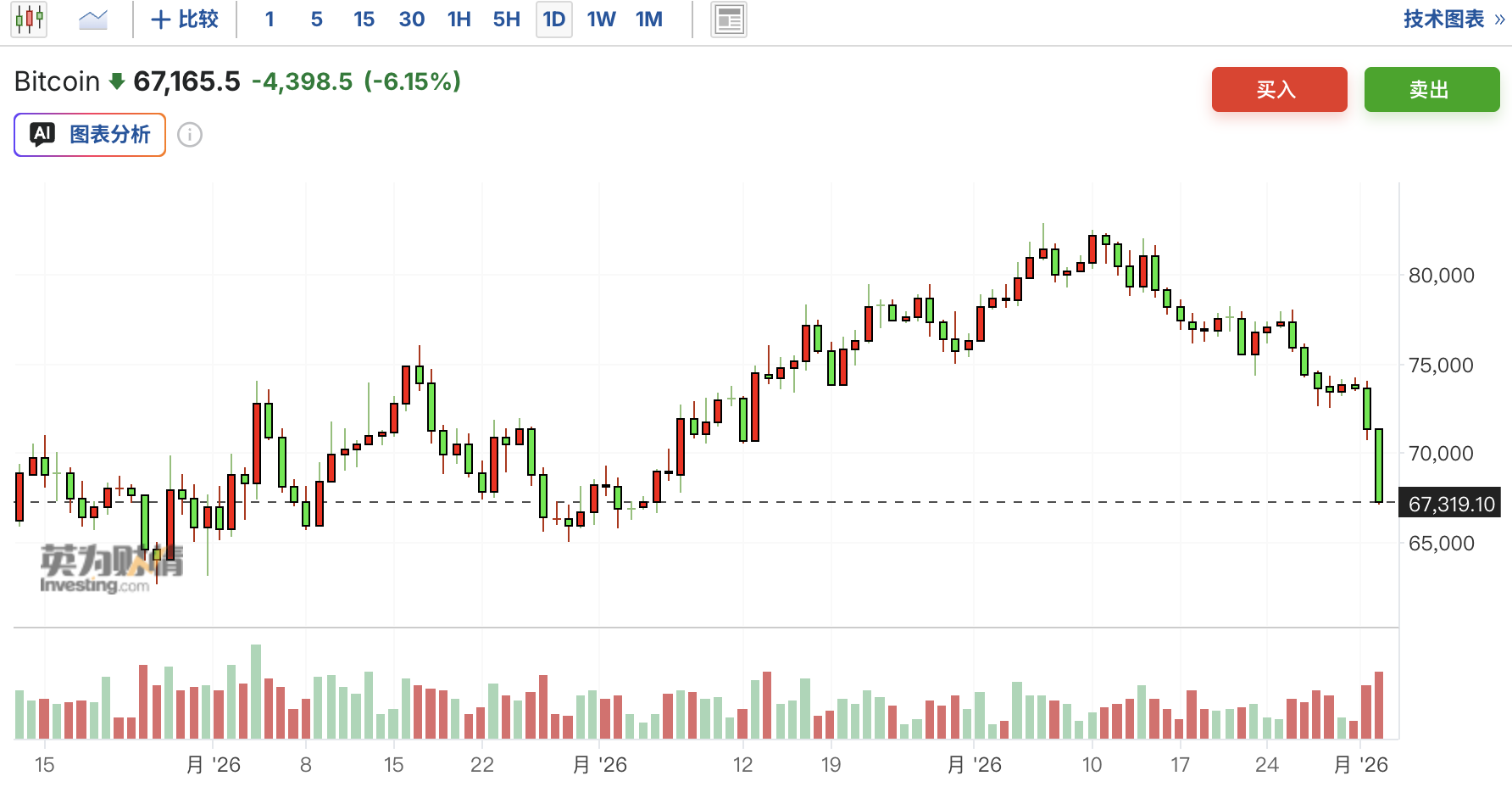
Bitcoin plunged over 6%, breaching the $67,000 mark for the first time since April 5, triggering more than $1 billion in cryptocurrency liquidations—the highest level since February. The sell-off was driven by deteriorating market sentiment amid heightened geopolitical risks from the Iran situation and a symbolic shift in strategy from a major holder. In a significant psychological blow to the market, MicroStrategy disclosed the sale of approximately 32 bitcoins, marking its first divestment since late 2022 and breaking its long-standing "buy-only" stance. Concurrently, U.S. spot Bitcoin ETFs have seen net outflows for a record 11 consecutive days, with approximately $3.5 billion withdrawn, removing a key traditional price support. Analysts note that positive catalysts from U.S. crypto regulatory progress have been completely offset by prevailing risk-off sentiment. Bitcoin is now down nearly 50% from its all-time high of around $126,000 set in October last year, starkly underperforming the rising Wall Street equity markets.

Bitcoin sentiment deteriorated sharply, triggering a wave of forced liquidations exceeding $1 billion, the most severe market pressure in recent months.

Bitcoin fell as much as 6% on Tuesday, breaking below $67,000 for the first time since April 5th. Geopolitical risks from the ongoing situation in Iran, coupled with selling actions from major holder Strategy, jointly dampened investor risk appetite. According to CoinGlass data, the scale of forced liquidations in this round reached its highest level since February this year.

Simultaneously, the two major traditional sources of demand that have historically supported Bitcoin's price—spot ETFs and Strategy—are concurrently turning into drags on the price, further intensifying market pressure.
Strategy's Selling Triggers Sentiment Turning Point

Strategy disclosed on Monday that the company sold approximately 32 bitcoins, raising about $2.5 million, marking its first reduction in holdings since late 2022. Compared to its total Bitcoin position of about $59 billion, the scale of this sale is minuscule. However, it broke the company's long-standing "only buy, never sell" minimalist strategy at a sensitive moment for the market.

Jasper De Maere, an over-the-counter trader at market maker Wintermute, stated:

"This selling wave appears to have been triggered by Strategy's disclosure of selling 32 bitcoins. But the reality is that even without this news, market momentum was already waning, and institutional participation on OTC desks had also receded to low levels."

Sustained ETF Net Outflows Heighten Price Fragility

According to data compiled by Bloomberg, U.S. spot Bitcoin ETFs have recorded net outflows for 11 consecutive trading days, setting a record for the longest consecutive outflow streak. During this period, investors redeemed a total of approximately $3.5 billion.

James Butterfill, Head of Research at CoinShares, pointed out that the price cushioning effect brought by the advancement of U.S. crypto regulatory legislation has been "completely offset" by safe-haven sentiment triggered by the situation in Iran.

Bitcoin is now down nearly 50% from its all-time high of approximately $126,000, which was set in October last year. Meanwhile, Wall Street stocks continue to rise amid a resurgence in AI trading and expectations of a ceasefire agreement, forming a stark contrast with the crypto market.


Пов'язані питання

QWhat event triggered over $1 billion in cryptocurrency liquidations according to the article?

AA sharp deterioration in Bitcoin sentiment, triggered by a combination of geopolitical risks from the Iran situation and the symbolic selling of 32 bitcoins by MicroStrategy.

QHow much did Bitcoin's price fall on Tuesday, and what key level did it break?

ABitcoin fell 6% and broke below the $67,000 level for the first time since April 5.

QWhat was significant about MicroStrategy's recent sale of 32 bitcoins, as described in the article?

AIt marked the company's first sale since late 2022 and broke its long-standing 'buy and hold only' minimalist strategy, acting as a negative sentiment trigger in a sensitive market.

QWhat is the current state of U.S. spot Bitcoin ETFs, and what record was mentioned?

AU.S. spot Bitcoin ETFs have experienced 11 consecutive days of net outflows, which is a record-long streak, with investors redeeming approximately $3.5 billion during this period.

QWhat two major traditional sources of Bitcoin demand have turned into a drag on its price?

ASpot Bitcoin ETFs (due to sustained net outflows) and MicroStrategy (due to its symbolic sell-off), both of which are now contributing to market pressure.

Пов'язані матеріали

In Jinjiang, Fujian, a Storage Super Unicorn Lies Quiet

In Fujian's Jinjiang, a city known for sportswear, lies a quiet semiconductor giant: Fujian Jinhua Integrated Circuit Co. (JHICC). Once a promising domestic DRAM manufacturer alongside Yangtze Memory and ChangXin Memory Technologies (CXMT), its journey was derailed in 2018 when the U.S. placed it on an Entity List and filed criminal charges for alleged trade secret theft. This halted production for years. A turning point came in February 2024 when a U.S. federal court found JHICC not guilty. However, it had lost crucial time. While CXMT soared to become a top-valued A-share company in 2024, JHICC, with an estimated valuation of 80 billion RMB, was just restarting. Its current output is primarily customized DDR4 chips, not the advanced DDR5/HBM demanded for AI, but it still benefits from the broader memory chip upcycle. JHICC's story is tied to Chen Zhengkun, a veteran engineer who left Micron to lead the venture. Founded in 2016 with state-backed funding, JHICC partnered with Taiwan's UMC to develop DRAM technology. Rapid progress was cut short by the U.S. actions, which Micron initiated, partly due to its heavy reliance on the Chinese market. Post-sanctions, Chen's team worked to rebuild the production line with reduced reliance on U.S. technology. According to its records, JHICC achieved small-scale production and revenue growth under immense pressure. It now focuses on the stable "niche" DRAM market (e.g., TVs, routers) with a monthly capacity of ~40,000 wafers, aiming for 60,000 by 2026. It holds over 1,000 patents but remains on the Entity List. For Jinjiang, investing in JHICC was a bold industrial leap. The local government provided unwavering financial and logistical support during the crisis, helping the company survive. JHICC has become the anchor for a growing local semiconductor cluster. Though its scale lags behind domestic peers, JHICC's persistence symbolizes a hard-won foothold in a global market long dominated by Samsung, SK Hynix, and Micron. Having missed one boom, it seeks a place in the new AI-driven memory supercycle.

marsbit1 год тому

In Jinjiang, Fujian, a Storage Super Unicorn Lies Quiet

marsbit1 год тому

Торгівля

Спот
活动图片




