Optimism Proposes Using 50% of Superchain Revenue for OP Token Buybacks

TheNewsCryptoОпубліковано о 2026-01-09Востаннє оновлено о 2026-01-09

Анотація

Optimism has proposed a major shift in its tokenomics by allocating 50% of Superchain revenue to monthly OP token buybacks, pending community approval. If passed, the program will begin in February 2026, using sequencer fees to purchase OP tokens via an OTC provider. The purchased tokens will be returned to the treasury, not immediately burned or sold, with future governance deciding their use. This initiative aims to tie OP’s value directly to ecosystem usage and economic activity, reflecting Optimism’s significant role in the L2 space, where it holds 61.4% of the fee market share. The proposal has sparked debate over combining buybacks and expanded treasury discretion in a single vote. A governance call is scheduled for January 12, with a formal vote on January 22.

Optimism has proposed a major change to how its ecosystem uses its revenue. The plan is to buy back the OP tokens every month by using 50% of its Superchain revenue. If the Community approves this plan, Optimism is planned to start in February 2026. This makes a major shift in OP’s Role from being just a governance token to a token that is directly tied to the usage and revenue of the Ecosystem.
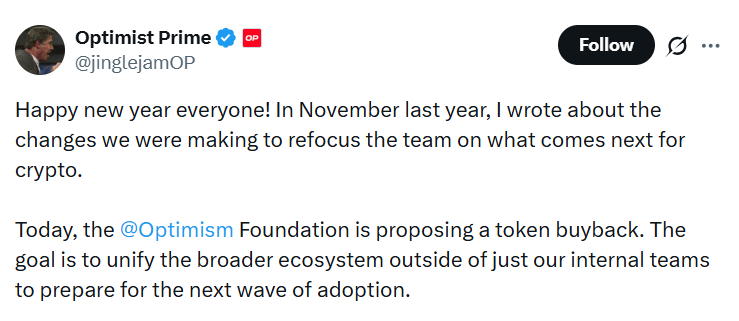
How Optimism Plans to Turn Superchain Fees Into OP Token Demand

The Buyback will happen from the revenue earned by the Superchain from the Sequencer fees. Over the past years, these chains have generated over 5,800 ETH in revenue. So under the proposal, 50% of the revenue will be used to buy OP tokens. Purchases will be made monthly through the OTC Provider. The bought OP tokens will be sent back to the treasury. This will be paused if monthly revenue drops below $200,000. These treasury tokens would not be burned or sold immediately. The Governance would later decide whether to burn or use them for staking and ecosystem incentives.

The reason for this new plan is to make the OP’s value reflect its real economic activity instead of revenue sitting unused in the treasury. Optimism and Superchain agave become dominant players in layer-2. 61.4% of the L2 fee market share and 13% of all on-chain transactions are where the most L2 economic activity is happening.

The Foundation will have the limited discretion to manage remaining ETH. They can use it to generate yield and support ecosystem development. This reduces slow governance overhead while keeping spending within set rules. The Staking partnerships have already generated yield and aim to strengthen OP mainnet’s institutional appeal.

There has been some debate going on for the community members because the proposal combines OP buybacks and expanded treasury discretion in one vote. The Critics argue that these should be voted on separately to avoid bias from the price expectations. The community discussion is going on, a governance call is scheduled for Jan 12, and a formal vote happens on Jan 22. Once it is approved, the buyback will begin in February and the program will run for 12 months.

Highlighted Crypto News:

A Bearish Wall Looms Over BONK: Fade Lower or Fight Back for Gains?

TagsOptimismsuperchain

Пов'язані питання

QWhat is the main change proposed by Optimism regarding its Superchain revenue?

AOptimism has proposed using 50% of its Superchain revenue to buy back OP tokens every month.

QWhen is the proposed buyback program planned to begin if approved by the community?

AThe buyback program is planned to start in February 2026 if the community approves the proposal.

QWhat is the source of the revenue that will be used for the OP token buybacks?

AThe buybacks will be funded from the revenue earned by the Superchain from sequencer fees.

QWhat will happen to the purchased OP tokens after they are bought back?

AThe purchased OP tokens will be sent back to the treasury, and governance will later decide whether to burn them or use them for staking and ecosystem incentives.

QWhat is the minimum revenue threshold that would pause the monthly buyback program?

AThe monthly buyback program will be paused if the monthly revenue drops below $200,000.

Пов'язані матеріали

Within Strategy's Framework, STRC's Dividend Yield Remains at 12% as Share Price Stays Below Par Value

Michael Saylor, Executive Chairman of Strategy (MSTR), confirmed that the dividend rate for its STRC perpetual preferred shares will remain at 12.00% through August 2026. The rate has increased from 9% at its July 2025 launch to the current high via a "ratchet" mechanism, which permanently raises the rate by 0.5% whenever the share price falls below $95. This mechanism is intended to push the price back toward its $100 par value and support Strategy's "at-the-market" (ATM) program for issuing new shares to fund Bitcoin purchases. However, the mechanism has not worked as intended. STRC shares closed at $89.46 on July 31, remaining about 10-11% below par value despite the record-high dividend. Competition from rival Strive's higher-yielding SATA securities has pressured demand. The persistent discount has forced Strategy to suspend new STRC issuances via its ATM program, limiting this funding channel for Bitcoin acquisitions. STRC's struggles reflect Bitcoin's own volatility, as the preferred shares historically move in tandem. Analysts have warned the ratchet structure carries long-term, one-way risk. A law firm is investigating Strategy's ability to maintain dividend payments if Bitcoin's price stays low. Retail investors own roughly 83% of outstanding STRC shares, a group seen as prone to panic selling during downturns. In response, Strategy has established financial reserves, including a liquidity cushion covering about 26 months of dividend/interest obligations, and a $2 billion share buyback program alongside a Bitcoin monetization framework, though the company emphasized it is not obligated to sell any Bitcoin.

cryptonews.ru30 хв тому

Within Strategy's Framework, STRC's Dividend Yield Remains at 12% as Share Price Stays Below Par Value

cryptonews.ru30 хв тому

Analyst: Bitcoin's Price Will Drop to $60k in August, Then Rebound to $70k

Financial analyst Andrey Poroshin has provided a new forecast for Bitcoin's price dynamics in August. Poroshin, an analyst at the Bitbanker exchange, expects the cryptocurrency market to experience a downturn this month, with prices retesting the $60,000 level due to a lack of supportive macroeconomic catalysts. He noted that the recent US Federal Reserve decision to hold interest rates did not significantly impact the market, while inflation remains above the 2% target. Poroshin stated that Bitcoin is ending July under pressure from moderate volatility and a lack of new macroeconomic stimuli, leading to continued market caution. According to his base scenario, Bitcoin will drop to a range of $60,000 to $62,000 before recovering to $70,000. He pointed out that even $70,000 remains below the cost of mining in the US, which has prompted some miners to shift towards AI data center operations. Poroshin cited the winding down of BitMEX's operations as a potential catalyst for a price rebound, suggesting the exit of weaker players often coincides with market reversals and reduced short-term selling pressure. He believes Bitcoin is currently less susceptible to geopolitical shocks, such as the Iran-US conflict, and does not expect significant market changes in August related to the pending CLARITY Act. Looking ahead, Poroshin forecasts that September will bring more active price fluctuations driven by potential Fed rate decisions and possible discussions or approval of the CLARITY Act.

cryptonews.ru31 хв тому

Analyst: Bitcoin's Price Will Drop to $60k in August, Then Rebound to $70k

cryptonews.ru31 хв тому

Торгівля

Спот
活动图片





