Opinion Almost Entirely Flipped, Airdrop Value Less Than Platform Fee Revenue?

Odaily星球日报Опубліковано о 2026-03-05Востаннє оновлено о 2026-03-05

Анотація

Opinion, a prediction market platform once hailed as one of the most anticipated airdrops of 2026, has sparked significant community backlash following its Token Generation Event (TGE). Despite raising over $25 million from top VCs and being deeply integrated with the Binance ecosystem, the project repeatedly delayed its TGE, causing its points' OTC value to drop from a peak of $45 to around $6. The controversy intensified when the tokenomics were revealed: only 3.5% of the airdropped tokens (23.5% of total supply) were unlocked at TGE, with the rest vested over 7 months. In contrast, the marketing allocation saw 7.7% unlocked immediately. This, combined with large allocations to investors, team, and advisors (totaling over 54%), angered early users who had paid high transaction fees to earn points. Many users reported losses, with one notable example being an investment of $200,000 yielding only around $1,000 worth of tokens at launch. Ironically, the platform’s cumulative fee revenue exceeded $17 million, surpassing the initial airdrop’s value. As a result, user activity and TVL plummeted, raising questions about the future of prediction markets on BNB Chain.

Original | Odaily Planet Daily (@OdailyChina)

Author | Asher(@Asher_ 0210)

TGE Repeatedly Delayed, Leading to a Continuous Drop in OTC Points Price

Another $20 Million Funding Round in February Made Opinion One of the Most Anticipated Airdrops of 2026

The rising narrative around prediction markets garnered significant attention for Opinion even before its TGE. Combined with top-tier VC backing and deep integration with the Binance ecosystem, the market once regarded it as one of the most anticipated airdrop projects of 2026.

In terms of funding, Opinion completed two rounds, raising over $25 million in total. In March 2024, the project was selected for the 7th season of Yzi Labs' MVB accelerator program, becoming one of 13 early-stage projects. In March 2025, Opinion completed a $5 million seed round led by Yzi Labs, with participation from Echo, Animoca Ventures, Manifold Trading, Amber Group, and others. By February 2026, Opinion announced another $20 million Pre-Series A funding round, co-led by Hack VC and Jump Crypto, with participation from Primitive Ventures, Decasonic, Continue Fund, and others.

Continuous support from several leading institutions led to higher market expectations for the airdrop scale and potential valuation.

TGE Was Originally Scheduled Before Chinese New Year But Repeatedly Postponed Due to Market Conditions

In December 2025, Opinion founder Forrest stated in the official Discord that the project's TGE was expected before the Chinese New Year. This quickly ignited community sentiment, with many users starting to "work overtime" to farm points and frequently participate in various prediction events to boost trading volume. As point farming became more competitive, some users' farming costs even exceeded $20 per point, all to accumulate more points before the TGE, hoping to snag the first "big airdrop" of 2026.
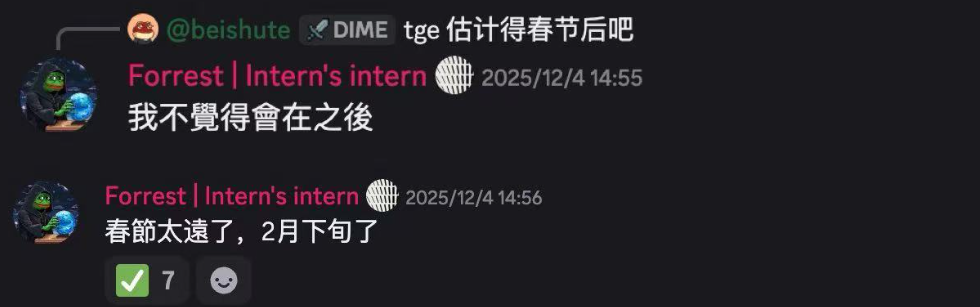
Opinion founder previously stated TGE would occur before Chinese New Year

However, entering February, the overall crypto market experienced a significant correction, and Opinion's TGE timeline became uncertain. The TGE, originally anticipated before the New Year, had no news, causing market expectations for the points to cool. Although Binance launched the Opinion-related Binance Wallet Booster and Alpha airdrop activities on February 4th, the official team still did not announce a clear TGE schedule. As expectations gradually cooled, the OTC price of Opinion points also fell from a high of about $45 per point to around $20 per point.

As the TGE was repeatedly delayed, community sentiment gradually turned negative. Some users began questioning the project's progress in community groups, but in the official Discord, any obvious negative comments often led to the swift removal of the involved members. Some dissatisfied users even went to other prediction market project communities, such as predict.fun, to continue venting their frustrations about Opinion's various issues.
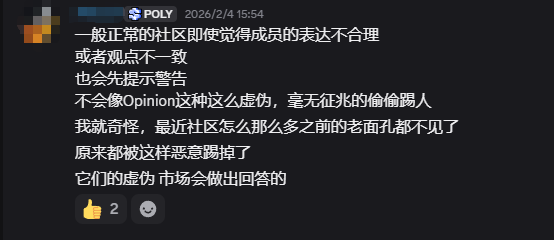
Opinion community members complaining in other prediction market project communities

Repeated TGE delays, continuous point dilution, and arbitrary kicking of members from the official community led to accumulating dissatisfaction within the Opinion community. Points kept increasing, fees kept being paid, but the answers to when the project would TGE and what it would ultimately be worth became increasingly elusive.

Airdrop Allocation Sparks Controversy: Only 3.5% of TGE Airdrop Unlocked, Marketing Allocation Unlocks a High 7.7%

After Tokenomics Revealed, Point Price Plunged to $6

On the evening of March 2nd, the Opinion Foundation officially announced the tokenomics of its native token OPN. The total supply of OPN is 1 billion tokens, with the airdrop accounting for 23.5% (235 million tokens). At first glance, this proportion is not low compared to current crypto projects.

However, the actual unlock ratio at TGE sparked controversy. Of the total airdrop allocation, only 3.5% (35 million tokens) were released on TGE day, with the remaining portion to be linearly released over 7 months. This means that for the vast majority of users who farmed points for the airdrop, the number of tokens actually received on TGE day was far lower than previous market expectations.

What further displeased the community was the unlock ratio of other allocation parts. According to the official token distribution, the Marketing portion accounts for 8.9%, but 7.7% is released at TGE, significantly higher than the airdrop release ratio. In comparison, users who participated in early interactions and contributed trading volume only received 3.5% at TGE.

This comparison quickly sparked controversy within the community—early interactive users contributing trading volume received a minimal share at TGE, while the related marketing share received a higher proportion of unlocks at launch. Simultaneously, Binance Launchpool directly received 2% of the token supply, further intensifying community dissatisfaction.

At the same time, the internal holding比例 further exacerbated community discontent. According to the token distribution, investors account for 23%, the team and advisors account for 19.5%, and the foundation accounts for 12%, totaling over 54%.
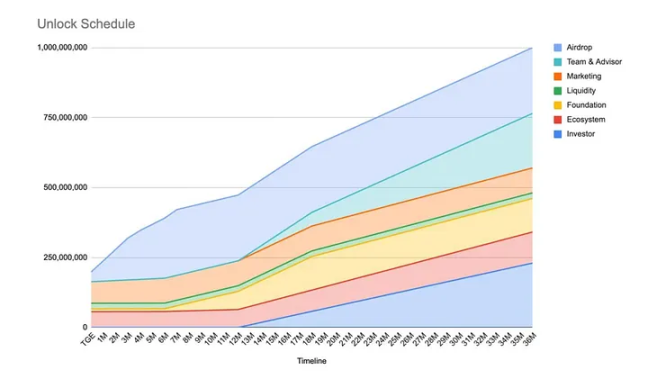
OPN Token Unlock Schedule

After the tokenomics were announced, market expectations quickly changed. Prior to this, OPN points were once quoted at $45 per point on the secondary market. With only 3.5% being airdropped at TGE, the OTC price of Opinion points plummeted, with pre-market quotes quickly falling to $6 per point.

Furthermore, many "airdrop farming whales" spent real money on fees to farm points, only to be flagged as Sybils. According to feedback data from community members, 1 point ultimately corresponded to $6, but many users with high point rankings received an airdrop value even lower than this. KOL Daidaidai Bitcoin posted his loss details on platform X: invested $200,000 to farm points,最终 received 2000 OPN, worth about $1000 at current prices. "200k USD for 2000 tokens. Yes, you read that right." This phrase quickly went viral in the Chinese crypto community.

What the community found even more ironic was that according to Dune data, Opinion's cumulative revenue from trading fees over the past months has exceeded $17 million. Calculated at current market prices, the TGE airdrop value is even lower than this figure.
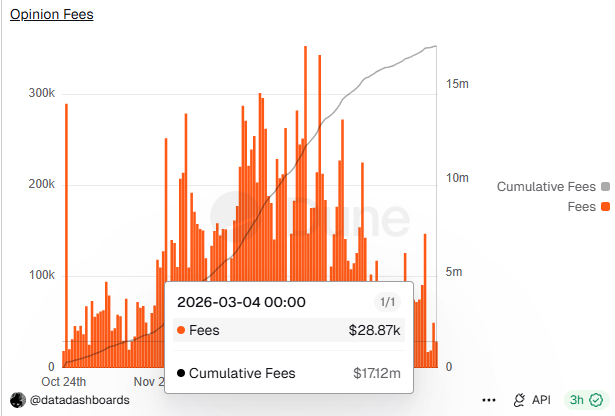
Opinion's cumulative fee revenue exceeds $17 million

Summary

From "the most anticipated airdrop of 2026" to being joked about by the community as "almost entirely flipped," Opinion's plot twist took only a few months. Although Opinion founder Forrest recently stated that more emphasis would be placed on Season 2 rewards, for many early participants, the Season 1 airdrop result has severely透支 trust.
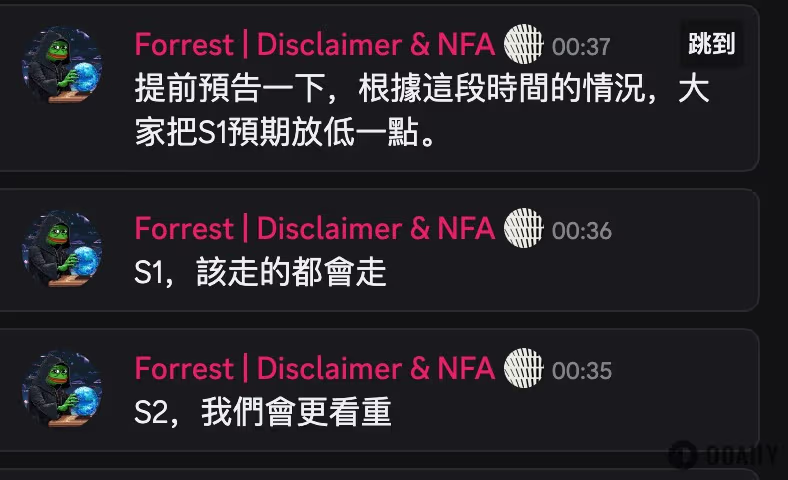
Opinion founder emphasizes greater focus on S2 rewards

This sentiment was quickly reflected in user behavior. More and more participants chose to reduce or even stop trading on the platform, and on-chain data showed a significant subsequent decline. Platform TVL plummeted from about $150 million to $36 million, and trading volume dropped from $150 million to about $15 million, indicating a clear cooling off in user activity.

Against this backdrop, the controversy surrounding Opinion is more than just an airdrop incident. As one of the most watched prediction market projects in the BNB Chain ecosystem, this event has also had a significant impact on the entire sector.

After this storm, can the BNB Chain ecosystem still produce new prediction market platforms?

Пов'язані питання

QWhat was the main reason for the community's disappointment with Opinion's airdrop?

AThe main reason was the extremely low initial unlock of the airdrop allocation. Only 3.5% of the total airdropped tokens (23.5% of total supply) were distributed at TGE, while a much higher percentage (7.7%) of the marketing allocation was unlocked immediately.

QHow did the delay of the TGE (Token Generation Event) impact the perceived value of Opinion's points?

AThe repeated delays of the TGE caused the OTC (Over-The-Counter) price of Opinion points to plummet, falling from a high of approximately $45 per point to around $6 per point after the tokenomics were revealed.

QAccording to the article, what was the total amount of fees that the Opinion platform generated from user transactions?

AAccording to Dune data cited in the article, the Opinion platform accumulated over $17 million in revenue from transaction fees.

QWhat drastic change in user activity did Opinion experience following the airdrop controversy?

AUser activity dropped significantly. The platform's TVL (Total Value Locked) plummeted from about $150 million to $36 million, and its trading volume fell from $150 million to approximately $15 million.

QWhat was the total supply of OPN tokens and what percentage was allocated to the airdrop?

AThe total supply of OPN tokens was 1 billion. The airdrop allocation was 23.5% of the total supply, which equals 235 million tokens.

Пов'язані матеріали

STAR 50 Soars 10.73%, Why Did A-Shares Stage a "V-Shaped Reversal"?

After a prolonged decline, the Chinese A-share market staged a strong rally on July 21. The STAR 50 index surged 10.73%, its largest single-day gain in nearly a year, leading a broad-based "V-shaped" reversal. The Shanghai Composite Index rose 1.79%, the Shenzhen Component Index gained 4.81%, and the ChiNext Index jumped 7.05%. Total market turnover reached 2.97 trillion yuan, an increase of 256.1 billion yuan from the previous session, with over 3,100 stocks advancing. The semiconductor sector spearheaded the rebound, with related ETFs posting significant gains. Analysts attribute the surge to three converging factors. First, coordinated capital inflows from "national team" institutions, insurance funds, listed company buybacks, and fund house self-purchases have bolstered market liquidity and confidence. Second, supportive policy signals, including commitments from regulators to ensure stable market operations, provided a favorable backdrop. Third, a stabilization and recovery in overseas markets, notably South Korea, created a positive external environment. Institutions suggest the most severe panic selling phase for the tech sector has likely passed, following a significant digestion of crowded positions and leveraged funds. While short-term volatility may persist, the medium to long-term outlook remains underpinned by enduring trends like AI computing demand expansion and semiconductor localization. The market's focus now shifts to the sustainability of supportive fund flows, earnings reports, and upcoming catalysts from the global AI industry chain.

marsbit9 хв тому

STAR 50 Soars 10.73%, Why Did A-Shares Stage a "V-Shaped Reversal"?

marsbit9 хв тому

U.S. Tech Momentum Stocks Post Largest Single-Day Gain Ever, But Is the Plunge Over?

US tech momentum stocks staged a sharp rebound on Tuesday (July 21st). Morgan Stanley's TMT Momentum Factor surged over 12%, marking its largest single-day gain on record, exceeding even peaks from the 2000 dot-com bubble. Key momentum indices from Goldman Sachs also posted their strongest daily performances in years. The rally was led by semiconductors, with the Philadelphia Semiconductor Index jumping 4.6%. This rebound followed three consecutive down days and a cumulative 33% plunge in momentum stocks, one of the steepest drawdowns since the dot-com era. Analysts attribute the surge largely to a short squeeze. Heavy selling had pushed high-beta momentum stocks into deeply oversold territory, forcing many short sellers, particularly in Asia, to cover their positions, creating a self-reinforcing buying spiral. However, the rebound's internals appear weak. Trading volume was notably low, and advancing stocks still lagged decliners on the S&P 500, indicating a narrow, concentrated rally rather than broad market participation. Diverging views emerge on the outlook. BTIG warns the bounce has hit key resistance and recommends selling into strength, citing extreme volatility and historical parallels to past market tops. Conversely, Goldman Sachs and UBS believe the momentum unwind is nearing its end, suggesting it may be time to gradually add exposure, as positioning has been significantly reduced. They caution, however, that high volatility warrants a measured approach, potentially using defined-risk strategies. The upcoming earnings season, particularly reports from major tech firms like Alphabet, is seen as a critical test for the rally's sustainability. Simultaneously, bond markets flashed a warning, with yields rising partly due to spiking oil prices. Analysts note that if long-term Treasury yields break decisively higher, it could pose a significant headwind for equities, especially growth stocks.

marsbit16 хв тому

U.S. Tech Momentum Stocks Post Largest Single-Day Gain Ever, But Is the Plunge Over?

marsbit16 хв тому

U.S. Tech Momentum Stocks Record Largest Single-Day Gain Ever, but Has the Rout Ended?

U.S. tech momentum stocks staged a dramatic rebound on Tuesday, July 21st. Key momentum indices like the Morgan Stanley TMT Momentum Factor and Goldman Sachs' High Beta Momentum Long Index posted historic or near-historic single-day gains, fueled largely by semiconductor stocks. This sharp rally followed a severe three-day sell-off that saw momentum stocks plunge 33%, marking one of the steepest pullbacks since the dot-com bubble. Analysts attribute the bounce primarily to a short squeeze, as forced covering from over-leveraged traders, particularly in Asia, created a buying spiral. However, the rally's health is questioned due to weak market breadth—overall trading volume was low, and decliners outnumbered advancers in the S&P 500 despite the index's gain—suggesting a narrow, concentrated surge rather than broad recovery. Opinions on the sustainability diverge. BTIG strategists warn the rebound has hit key resistance levels, citing extreme volatility and historic stock dispersion as signs of an ongoing broader correction, and recommend selling into strength. Conversely, Goldman Sachs and UBS view the aggressive momentum unwinding as nearing its end, noting reduced positioning and a lack of new fundamental catalysts. They suggest the sell-off presents a selective opportunity to add exposure, albeit cautiously and gradually using defined-risk strategies. The immediate trajectory hinges on the ongoing earnings season, with market focus on Alphabet's capital expenditure guidance for AI investment clarity. Meanwhile, bond markets present a risk, with rising Treasury yields—potentially heading toward 5.5%—and widening credit spreads for mega-cap tech companies posing a threat to equity valuations. The combination of technical factors, earnings results, and macro conditions leaves the durability of the rebound in doubt.

链捕手19 хв тому

U.S. Tech Momentum Stocks Record Largest Single-Day Gain Ever, but Has the Rout Ended?

链捕手19 хв тому

Long-Divided Must Unite, Long-United Must Divide: When L1 Becomes Its Own Rollup, What Is Ethereum's Endgame?

"The Inevitable Cycle: When L1 Becomes Its Own Rollup – What is Ethereum's Endgame?" For years, the Ethereum community grappled with concerns that L2s were fragmenting the ecosystem and eroding L1's value. While L2s provided cheaper execution, they also splintered liquidity and the unified user experience of a single chain. This has prompted a fundamental reassessment of the relationship between L1 and L2. Ethereum's roadmap is evolving. The "Scale" initiative merges L1 and L2 expansion into a holistic framework. L1 itself is advancing with higher gas limits, statelessness, and zkEVM verification, no longer content to be just a low-throughput settlement layer. Consequently, the primary value proposition of L2s is shifting from merely providing cheap blockspace to offering L1 cannot easily provide: application-specific optimizations, privacy features, and flexible governance models. L2s are becoming a spectrum of execution environments with varying degrees of security inheritance from Ethereum. A critical challenge in this multi-chain future is interoperability. The vision is to make Ethereum "feel like one chain again." This relies on advancements in native account abstraction (like EIP-7702) and intent-based architectures (Open Intents Framework), where users declare desired outcomes, and solvers handle the complex cross-chain execution. Furthermore, shortening Ethereum's finality time from minutes to seconds is crucial, as it underpins trust between chains for bridges, stablecoins, and cross-chain applications. Perhaps the most provocative idea is that Ethereum L1 itself could become a form of "its own Rollup." As zkEVM and proof systems mature, high-performance nodes could execute transactions and generate validity proofs. Regular validators would then verify these proofs instead of re-executing all transactions. This blurs the traditional L1/L2 hierarchy, making "Rollup" more of a general execution-verification architecture. Native Rollup aims to integrate L2 validation more directly into the Ethereum protocol, allowing L2s to inherit L1's security more fully and move away from reliance on security councils. In the end, L2s are not destined to replace L1 or be made obsolete by it. The likely future is a unified system where diverse execution environments—each optimized for specific use cases like DeFi, gaming, or privacy—coexist. They will share a common foundation of security, liquidity, and verifiable state, seamlessly connected to restore a cohesive user experience. The next phase for Ethereum is not just about scaling through separation, but about intelligently reintegrating what was separated back into a coherent whole.

链捕手35 хв тому

Long-Divided Must Unite, Long-United Must Divide: When L1 Becomes Its Own Rollup, What Is Ethereum's Endgame?

链捕手35 хв тому

Торгівля

Спот
活动图片





