OpenMind, the Leader in the Robotics Track, is About to TGE: Is the $400 Million Valuation New Token Sale Worth Participating In?

Odaily星球日报Опубліковано о 2026-01-25Востаннє оновлено о 2026-01-25

Анотація

OpenMind, a leading robotics company, is set to conduct a Token Generation Event (TGE) for its native token ROBO on the Kaito platform. With a fully diluted valuation (FDV) of $400 million, the token sale aims to raise $2 million, representing 0.5% of the total token supply. The public sale begins on January 26 at 8 PM Beijing Time, with a per-address investment limit of $1,000 to $250,000 and tokens fully unlocked at TGE. Founded by Stanford professor Jan Liphardt, OpenMind is developing a universal operating system and decentralized network for intelligent machines, enabling global collaboration between robots. It has received backing from major investors like Pantera Capital, Coinbase Ventures, and DCG, and was recognized among the top 100 robotics startups of 2025. Notably, NVIDIA's Robotics division has shared OpenMind's content, indicating close ties. The project operates alongside the Fabric Foundation, an independent entity managing the protocol’s governance and ecosystem. The ROBO token sale includes a 40% priority allocation for partner communities, with the remaining 60% open to the general public. However, the $400 million FDV is considered high compared to similar AI and robotics projects like Virtuals ($540M), Sentient ($200M), and Grass ($127M). Concerns include unclear tokenomics and potential sell pressure from early investors if institutional tokens are unlocked at TGE, making the offering less attractive despite strong backing.

Original | Odaily Planet Daily (@OdailyChina)

Author | Asher (@Asher_ 0210)
On January 23, the official Foundation account of OpenMind, the leader in the robotics track, Fabric Foundation, posted on platform X that its native token ROBO will soon undergo a token sale on the Kaito platform.

Below, Odaily Planet Daily will take you through understanding the robotics track leader OpenMind, its relationship with the Fabric Foundation, and the details of the new token sale.

OpenMind: Building a Universal Operating System for Intelligent Machines and a Decentralized Collaboration Network

OpenMind was founded by Stanford University Professor Jan Liphardt. It is dedicated to building a universal operating system for intelligent machines and a decentralized collaboration network, enabling robots from different manufacturers and of different forms to securely trust each other, share information, and collaborate on a global scale. Furthermore, OpenMind was successfully selected as one of the Top 100 Global Robotics Startups in 2025.

It is worth mentioning that NVIDIA Robotics' official account reposted a robot testing video from OpenMind, and the two parties have close business dealings.
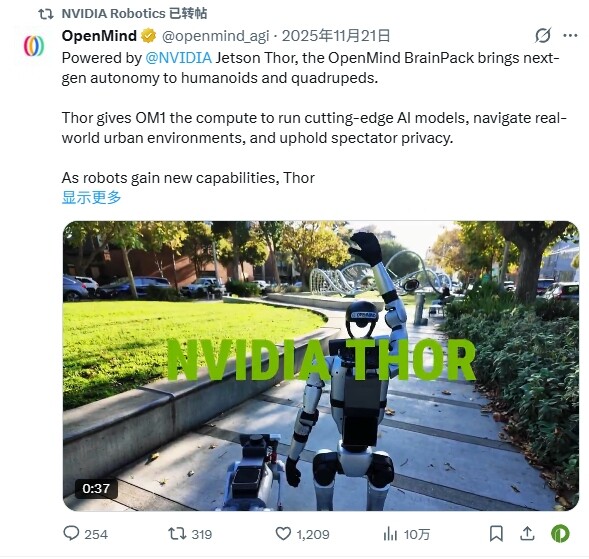
NVIDIA Robotics official account reposts OpenMind's tweet

In early August this year, OpenMind announced the completion of a $20 million funding round, led by Pantera Capital, with participation from Ribbit, Sequoia, Coinbase Ventures, DCG, Lightspeed Faction, Anagram, Pi Network Ventures, Topology, Primitive Ventures, Amber Group, and several other institutions and renowned angel investors.

The Relationship Between OpenMind and Fabric

OpenMind is the founding team and core developer of the Fabric protocol, and also a core contributor and initiator of the Fabric Foundation. Fabric was initially designed and developed by the OpenMind team, responsible for the core technical architecture and early implementation of the protocol.

As the project developed, to prevent the protocol from being controlled by a single company and to achieve a more open and neutral governance structure, OpenMind spun off the governance, economic model, and community coordination functions of Fabric to establish an independent non-profit organization, the Fabric Foundation. This foundation is responsible for the long-term maintenance, standard setting, ecosystem incentives, and global coordination of the protocol, promoting the sustainable development of Fabric.

Currently, OpenMind continues to participate in the construction of the Fabric protocol as a core contributor. Its official introduction also clearly states "We’re a core contributor of @FabricFND". Meanwhile, the community branding has been unified towards Fabric, including the renaming of Discord and the unified narrative of the protocol and the ROBO token, further strengthening Fabric's position as the main brand.
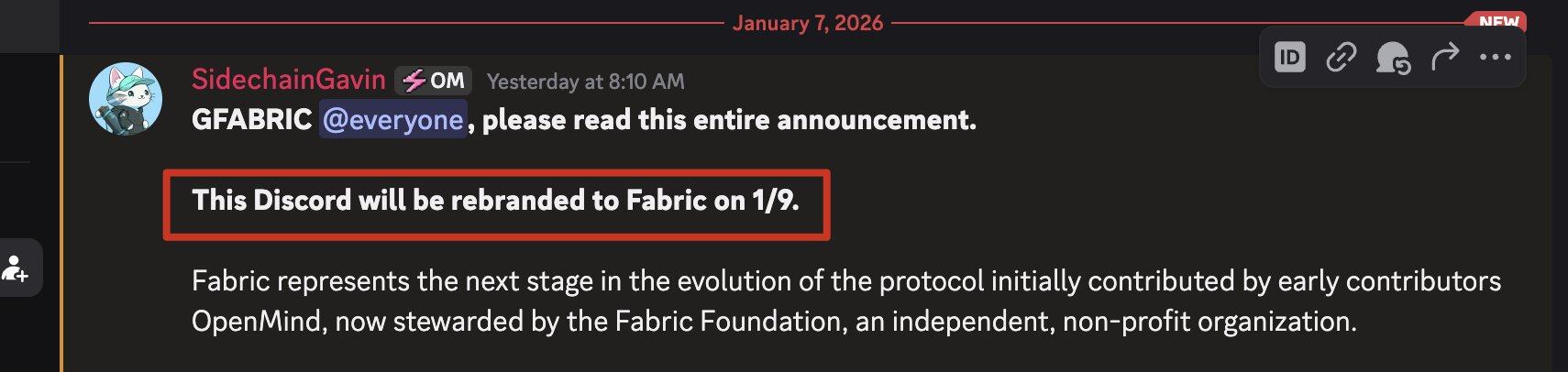
OpenMind's official Discord renamed to Fabric

Fabric New Token Sale Details

According to official information, the native token of the Fabric protocol, ROBO, will undergo a token sale on the Kaito platform. The specific details for participation are as follows:

  • Sale Start Time: January 26th, 8:00 PM Beijing Time;
  • Valuation: $400 million FDV;
  • Fundraising Target: $2 million;
  • Sale Proportion: 0.5% of the total supply of ROBO tokens;
  • Unlock Situation: 100% unlocked at TGE;
  • Single Address Subscription Limit: Minimum $1,000, Maximum $250,000;
  • Expected TGE Time: Q1 2026 (specific date not announced).

Additionally, 40% of the total public sale allocation on the Kaito platform is Priority Allocation, dedicated to partner communities:

  • Fabric Foundation community (based on past participation, holders of Platinum/Emerald/Diamond tier, OG, Developer, Backpack, Researcher badges, etc.): 15%;
  • Kaito AI community (sKAITO holders, etc.): 10%;
  • Virtuals community (holders of >100 veVIRTUAL): 5%;
  • Surf AI community (Pro/Max annual subscribers or NFT Pass holders): 5%;
  • Other Kaito referral programs: 5%.

The remaining 60% of the new token sale allocation is the public portion (for general eligible users).

The $400 Million Valuation for the New Sale Offers Less Than Ideal Value

From a valuation comparison perspective, OpenMind's token ROBO is priced at a $400 million FDV, significantly higher than the reasonable range for comparable projects in the same track that have already issued tokens. For reference, among related projects in the AI robotics sector, Virtuals currently has a market cap of approximately $540 million, Sentient around $200 million, and Grass around $127 million. ROBO's starting valuation is already on the high side.

Although OpenMind has backing from top-tier investment firms like Pantera Capital, Coinbase Ventures, and DCG, providing some endorsement for the project, the detailed token economics for ROBO have not yet been released. Particularly, the unlock ratio for institutional investors at TGE remains unclear.

If institutions have liquid supply at TGE, combined with the 100% unlock of the public sale portion, it could create significant dual selling pressure, putting pressure on the early price trend. Given this uncertainty, the pricing of the new sale at a $400 million FDV offers less than ideal overall value.

Пов'язані питання

QWhat is OpenMind and what does it aim to build?

AOpenMind is a leader in the robotics sector, founded by Stanford Professor Jan Liphardt. It aims to build a universal operating system and a decentralized collaboration network for intelligent machines, enabling robots from different manufacturers to securely share information and work together globally.

QWhat is the relationship between OpenMind and the Fabric Foundation?

AOpenMind is the founding team and core developer of the Fabric protocol. To avoid centralized control and promote open governance, OpenMind spun off the protocol's governance and economic model to form the independent, non-profit Fabric Foundation. OpenMind remains a core contributor to the ongoing development of the Fabric protocol.

QWhat are the key details of the ROBO token sale on the Kaito platform?

AThe ROBO token sale on Kaito has a fully diluted valuation (FDV) of $400 million. It aims to raise $2 million, representing 0.5% of the total token supply. The sale begins on January 26th at 8 PM Beijing Time. Tokens are 100% unlocked at TGE, with a per-address purchase limit of $1,000 to $250,000. The TGE is expected in Q1 2026.

QWhy does the article suggest the $400 million FDV valuation offers suboptimal value for participants?

AThe article suggests the $400 million FDV is suboptimal because it is significantly higher than the current market capitalizations of comparable projects in the AI and robotics sector, such as Virtuals ($540M), Sentient (~$200M), and Grass (~$127M). Furthermore, the lack of transparency regarding the tokenomics and the potential for early selling pressure from both the publicly sold tokens (100% unlocked) and possibly institutional investors could negatively impact the token's early price action.

QWhich major investors participated in OpenMind's funding round?

AOpenMind raised $20 million in a funding round led by Pantera Capital. Other participants included Ribbit, Sequoia Capital, Coinbase Ventures, DCG, Lightspeed Faction, Anagram, Pi Network Ventures, Topology, Primitive Ventures, and Amber Group.

Пов'язані матеріали

$30 Billion DeFi Capital Exodus: LayerZero Stumbles, Chainlink Feasts

Following the major DeFi security incident involving Kelp DAO, a significant migration of funds is underway from the cross-chain protocol LayerZero to Chainlink's CCIP (Cross-Chain Interoperability Protocol). Over $30 billion in Total Value Locked (TVL) from protocols like Kelp DAO, Solv Protocol, Re, and Tydro has moved to Chainlink in the past week, driven by security concerns. LayerZero is facing a severe trust crisis after the attack. Initially denying responsibility, LayerZero Labs has now issued a public apology, acknowledging management oversights. These include a vulnerable "1/1" single-node configuration for its Decentralized Verification Network (DVN) and past misuse of a multi-signature wallet by a team member. The protocol's weekly bridge volume has slumped to near-historic lows of around $470 million. In contrast, Chainlink is experiencing a surge in adoption and activity. Its independent active addresses recently hit multi-month highs, and whales have been accumulating LINK tokens. Beyond DeFi, Chainlink is securing partnerships with traditional finance giants like DTCC, European stock exchange operator SIX Group, and asset manager Amundi. While LayerZero has announced security upgrades—such as migrating to stronger multi-signature configurations and developing a second DVN client—and contributed to a rescue fund, the event underscores that security is becoming a decisive competitive factor as DeFi matures.

marsbit34 хв тому

$30 Billion DeFi Capital Exodus: LayerZero Stumbles, Chainlink Feasts

marsbit34 хв тому

The $13 Trillion Repo Market Is Quietly Being Rewritten by Blockchain

The $13 trillion repurchase agreement (repo) market, a crucial artery for global short-term funding, is experiencing a significant transformation through blockchain technology. After years of limited impact in finance, blockchain is finding substantial adoption in repo transactions. Major institutions like JPMorgan Chase, HSBC, and Broadridge are deploying tokenized repo platforms, with daily volumes already reaching tens of billions of dollars. Traditional repo markets operate with fixed hours, rely on intermediaries, and involve manual, time-consuming processes. Tokenized repos, by contrast, use blockchain to create digital tokens representing cash and securities collateral. This enables near-instantaneous settlement, 24/7 trading, automated execution, and enhanced auditability. The key drivers for adoption include maturing technology, more receptive regulators, and growing client recognition of tangible benefits like reduced operational friction and capital efficiency. Analyses, such as one from Broadridge, indicate that moving a portion of repo activity onto blockchain can significantly reduce a bank's required liquidity buffers, potentially freeing up billions in capital. The infrastructure is also seen as foundational for a future of round-the-clock trading for traditional assets. Challenges remain, including the existence of fragmented blockchain networks, the need for stress testing under extreme market conditions, and the loss of operational flexibility compared to manual processes. However, the industry consensus is that these are implementation hurdles. Tokenized repo has moved beyond pilot stages to become one of blockchain's most concrete and impactful applications in traditional finance, marking a pivotal shift in how a core market functions.

marsbit34 хв тому

The $13 Trillion Repo Market Is Quietly Being Rewritten by Blockchain

marsbit34 хв тому

From Gas Limit to 'Keyed Nonces', How to Understand the Next Step in Ethereum Scalability?

Ethereum’s scalability efforts are shifting toward a user-centric approach—focusing not only on higher TPS, but on translating technical upgrades into lower costs, smoother operations, and better wallet experiences. Two recent developments highlight this direction: - **Raising the Gas Limit to 200 million**: Following the Fusaka upgrade that increased it to 60 million, a consensus has formed around a potential future increase to 200 million. This would boost Ethereum’s execution capacity, but it is planned alongside other upgrades—such as ePBS, Block-Level Access Lists (BAL), and EIP-8037—to manage state growth and keep node operation viable for average participants. - **Keyed Nonces (EIP-8250)**: This proposal aims to improve how transactions are queued. Instead of a single linear nonce per account, it introduces multiple independent nonce domains. This prevents different types of transactions—such as private payments, session keys, or batch operations—from blocking each other. Vitalik Buterin views this as a foundational step toward better privacy support and more flexible state scalability. Together, these upgrades are part of a broader move to push complexity from wallets, DApps, and relays back into the protocol layer. For everyday users, this means future Ethereum interactions could become less congested, more intuitive, and safer—especially as core improvements in account abstraction, cross-L2 interoperability, and node decentralization continue to progress. Ultimately, Ethereum is evolving to handle not just more transactions, but more varied and complex on-chain use cases while preserving its decentralized foundation.

marsbit57 хв тому

From Gas Limit to 'Keyed Nonces', How to Understand the Next Step in Ethereum Scalability?

marsbit57 хв тому

Торгівля

Спот
Ф'ючерси
活动图片

