OpenMind, the Leader in the Robotics Track, is About to TGE: Is the $400 Million Valuation New Token Sale Worth Participating In?

Odaily星球日报Опубліковано о 2026-01-25Востаннє оновлено о 2026-01-25

Анотація

OpenMind, a leading robotics company, is set to conduct a Token Generation Event (TGE) for its native token ROBO on the Kaito platform. With a fully diluted valuation (FDV) of $400 million, the token sale aims to raise $2 million, representing 0.5% of the total token supply. The public sale begins on January 26 at 8 PM Beijing Time, with a per-address investment limit of $1,000 to $250,000 and tokens fully unlocked at TGE. Founded by Stanford professor Jan Liphardt, OpenMind is developing a universal operating system and decentralized network for intelligent machines, enabling global collaboration between robots. It has received backing from major investors like Pantera Capital, Coinbase Ventures, and DCG, and was recognized among the top 100 robotics startups of 2025. Notably, NVIDIA's Robotics division has shared OpenMind's content, indicating close ties. The project operates alongside the Fabric Foundation, an independent entity managing the protocol’s governance and ecosystem. The ROBO token sale includes a 40% priority allocation for partner communities, with the remaining 60% open to the general public. However, the $400 million FDV is considered high compared to similar AI and robotics projects like Virtuals ($540M), Sentient ($200M), and Grass ($127M). Concerns include unclear tokenomics and potential sell pressure from early investors if institutional tokens are unlocked at TGE, making the offering less attractive despite strong backing.

Original | Odaily Planet Daily (@OdailyChina)

Author | Asher (@Asher_ 0210)
On January 23, the official Foundation account of OpenMind, the leader in the robotics track, Fabric Foundation, posted on platform X that its native token ROBO will soon undergo a token sale on the Kaito platform.

Below, Odaily Planet Daily will take you through understanding the robotics track leader OpenMind, its relationship with the Fabric Foundation, and the details of the new token sale.

OpenMind: Building a Universal Operating System for Intelligent Machines and a Decentralized Collaboration Network

OpenMind was founded by Stanford University Professor Jan Liphardt. It is dedicated to building a universal operating system for intelligent machines and a decentralized collaboration network, enabling robots from different manufacturers and of different forms to securely trust each other, share information, and collaborate on a global scale. Furthermore, OpenMind was successfully selected as one of the Top 100 Global Robotics Startups in 2025.

It is worth mentioning that NVIDIA Robotics' official account reposted a robot testing video from OpenMind, and the two parties have close business dealings.
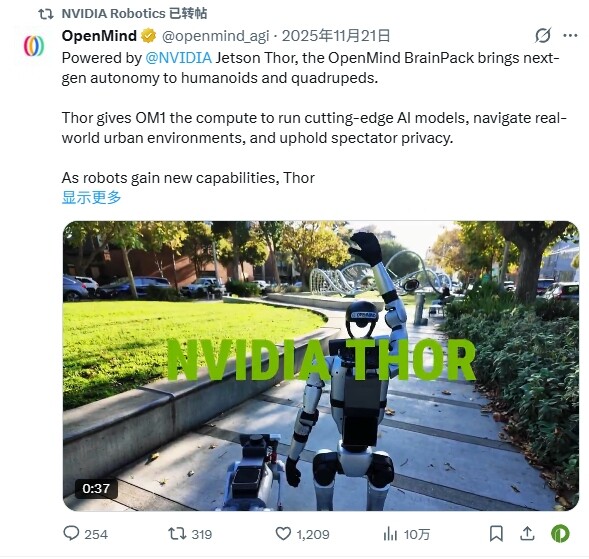
NVIDIA Robotics official account reposts OpenMind's tweet

In early August this year, OpenMind announced the completion of a $20 million funding round, led by Pantera Capital, with participation from Ribbit, Sequoia, Coinbase Ventures, DCG, Lightspeed Faction, Anagram, Pi Network Ventures, Topology, Primitive Ventures, Amber Group, and several other institutions and renowned angel investors.

The Relationship Between OpenMind and Fabric

OpenMind is the founding team and core developer of the Fabric protocol, and also a core contributor and initiator of the Fabric Foundation. Fabric was initially designed and developed by the OpenMind team, responsible for the core technical architecture and early implementation of the protocol.

As the project developed, to prevent the protocol from being controlled by a single company and to achieve a more open and neutral governance structure, OpenMind spun off the governance, economic model, and community coordination functions of Fabric to establish an independent non-profit organization, the Fabric Foundation. This foundation is responsible for the long-term maintenance, standard setting, ecosystem incentives, and global coordination of the protocol, promoting the sustainable development of Fabric.

Currently, OpenMind continues to participate in the construction of the Fabric protocol as a core contributor. Its official introduction also clearly states "We’re a core contributor of @FabricFND". Meanwhile, the community branding has been unified towards Fabric, including the renaming of Discord and the unified narrative of the protocol and the ROBO token, further strengthening Fabric's position as the main brand.
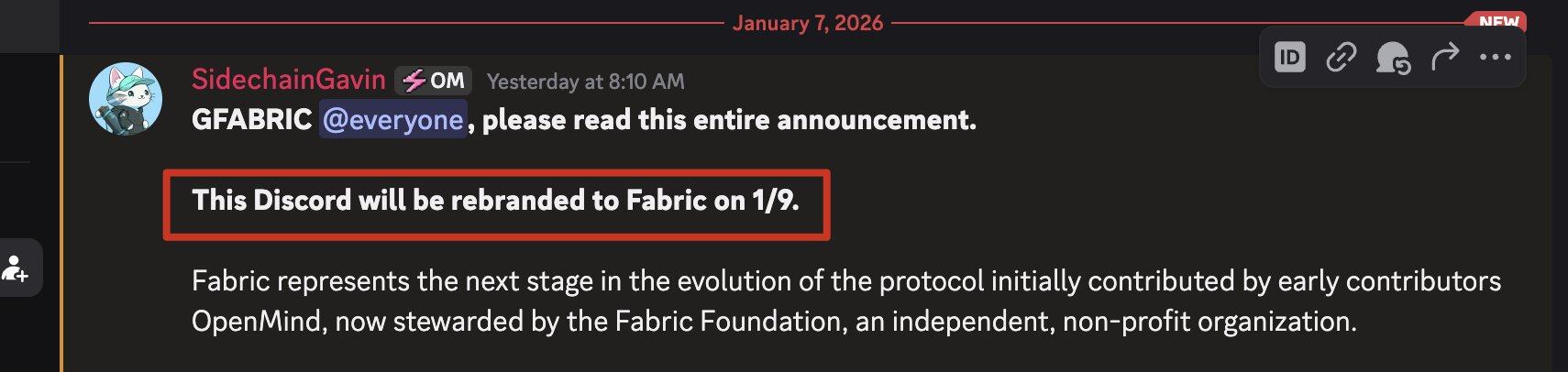
OpenMind's official Discord renamed to Fabric

Fabric New Token Sale Details

According to official information, the native token of the Fabric protocol, ROBO, will undergo a token sale on the Kaito platform. The specific details for participation are as follows:

  • Sale Start Time: January 26th, 8:00 PM Beijing Time;
  • Valuation: $400 million FDV;
  • Fundraising Target: $2 million;
  • Sale Proportion: 0.5% of the total supply of ROBO tokens;
  • Unlock Situation: 100% unlocked at TGE;
  • Single Address Subscription Limit: Minimum $1,000, Maximum $250,000;
  • Expected TGE Time: Q1 2026 (specific date not announced).

Additionally, 40% of the total public sale allocation on the Kaito platform is Priority Allocation, dedicated to partner communities:

  • Fabric Foundation community (based on past participation, holders of Platinum/Emerald/Diamond tier, OG, Developer, Backpack, Researcher badges, etc.): 15%;
  • Kaito AI community (sKAITO holders, etc.): 10%;
  • Virtuals community (holders of >100 veVIRTUAL): 5%;
  • Surf AI community (Pro/Max annual subscribers or NFT Pass holders): 5%;
  • Other Kaito referral programs: 5%.

The remaining 60% of the new token sale allocation is the public portion (for general eligible users).

The $400 Million Valuation for the New Sale Offers Less Than Ideal Value

From a valuation comparison perspective, OpenMind's token ROBO is priced at a $400 million FDV, significantly higher than the reasonable range for comparable projects in the same track that have already issued tokens. For reference, among related projects in the AI robotics sector, Virtuals currently has a market cap of approximately $540 million, Sentient around $200 million, and Grass around $127 million. ROBO's starting valuation is already on the high side.

Although OpenMind has backing from top-tier investment firms like Pantera Capital, Coinbase Ventures, and DCG, providing some endorsement for the project, the detailed token economics for ROBO have not yet been released. Particularly, the unlock ratio for institutional investors at TGE remains unclear.

If institutions have liquid supply at TGE, combined with the 100% unlock of the public sale portion, it could create significant dual selling pressure, putting pressure on the early price trend. Given this uncertainty, the pricing of the new sale at a $400 million FDV offers less than ideal overall value.


Пов'язані питання

QWhat is OpenMind and what does it aim to build?

AOpenMind is a leader in the robotics sector, founded by Stanford Professor Jan Liphardt. It aims to build a universal operating system and a decentralized collaboration network for intelligent machines, enabling robots from different manufacturers to securely share information and work together globally.

QWhat is the relationship between OpenMind and the Fabric Foundation?

AOpenMind is the founding team and core developer of the Fabric protocol. To avoid centralized control and promote open governance, OpenMind spun off the protocol's governance and economic model to form the independent, non-profit Fabric Foundation. OpenMind remains a core contributor to the ongoing development of the Fabric protocol.

QWhat are the key details of the ROBO token sale on the Kaito platform?

AThe ROBO token sale on Kaito has a fully diluted valuation (FDV) of $400 million. It aims to raise $2 million, representing 0.5% of the total token supply. The sale begins on January 26th at 8 PM Beijing Time. Tokens are 100% unlocked at TGE, with a per-address purchase limit of $1,000 to $250,000. The TGE is expected in Q1 2026.

QWhy does the article suggest the $400 million FDV valuation offers suboptimal value for participants?

AThe article suggests the $400 million FDV is suboptimal because it is significantly higher than the current market capitalizations of comparable projects in the AI and robotics sector, such as Virtuals ($540M), Sentient (~$200M), and Grass (~$127M). Furthermore, the lack of transparency regarding the tokenomics and the potential for early selling pressure from both the publicly sold tokens (100% unlocked) and possibly institutional investors could negatively impact the token's early price action.

QWhich major investors participated in OpenMind's funding round?

AOpenMind raised $20 million in a funding round led by Pantera Capital. Other participants included Ribbit, Sequoia Capital, Coinbase Ventures, DCG, Lightspeed Faction, Anagram, Pi Network Ventures, Topology, Primitive Ventures, and Amber Group.

Пов'язані матеріали

Who Will Define the Rules of the AI Era? Anthropic Discusses the 2028 US-China AI Landscape

This article, based on Anthropic's analysis, outlines the intensifying systemic competition between the U.S./allies and China for AI leadership by 2028. It argues that access to advanced computing power ("compute") is the critical bottleneck, where the U.S. currently holds a significant advantage through chip export controls and allied innovation. However, China's AI labs remain competitive by exploiting policy loopholes—via chip smuggling, overseas data center access, and "model distillation" attacks to copy U.S. model capabilities—keeping them close to the frontier. The piece presents two contrasting scenarios for 2028. In the first, decisive U.S. action to tighten compute controls and curb distillation locks in a 12-24 month AI capability lead, cementing democratic influence over global AI norms, security, and economic infrastructure. In the second, policy inaction allows China to achieve near-parity through continued access to U.S. technology, enabling Beijing to promote its AI stack globally and integrate advanced AI into its military and governance systems, altering the strategic balance. Anthropic contends that maintaining a decisive U.S. lead is essential for shaping safe AI development and governance. The core recommendation is for U.S. policymakers to urgently close compute and model access loopholes while promoting global adoption of the U.S. AI technology stack to secure a lasting strategic advantage.

marsbit1 год тому

Who Will Define the Rules of the AI Era? Anthropic Discusses the 2028 US-China AI Landscape

marsbit1 год тому

“Why Didn’t You Buy 2x Long SK Hynix?”

The article discusses the immense popularity of the "2x Long SK Hynix ETF" (07709.HK) in Hong Kong, which became the world's largest single-stock leveraged ETF by May 2026. Launched in October 2025, the ETF's net value soared over 1000% in seven months, significantly outperforming the 324% gain of SK Hynix's underlying stock, driven by the AI boom and a critical shift in industry demand from computing power to memory. It highlights the mechanics and risks of daily-rebalanced leveraged ETFs. In a smooth bullish market, they generate amplified returns, but during volatile periods—exemplified by market swings during geopolitical tensions in the Strait of Hormuz in March-April 2026—they suffer severe "volatility decay," where choppy price action can cause losses far exceeding twice the drop of the underlying asset. The piece frames SK Hynix, as NVIDIA's primary HBM supplier, within the classic cycle of the memory chip industry—a commoditized sector prone to boom-and-bust cycles of shortage, price hikes, overcapacity, and crashes. While current AI-driven demand and high margins (Q1 2026毛利率~79%) create a "super cycle," the article questions its sustainability. It warns that extreme profits will inevitably tempt competitors like Samsung and Micron to ramp up HBM production, potentially eroding scarcity. Furthermore, the entire narrative remains tethered to the massive AI capital expenditure of tech giants. In conclusion, the ETF's trajectory symbolizes the accelerated, all-in nature of the current AI revolution, where timeframes are compressed and market moves are extreme. However, it also underscores that while industry trends define ultimate returns, macro-geopolitical risks dictate the volatile and uncertain path to get there.

marsbit1 год тому

“Why Didn’t You Buy 2x Long SK Hynix?”

marsbit1 год тому

a16z Crypto: A Guide to the CLARITY Act for Crypto Entrepreneurs

The CLARITY Act, a bipartisan crypto market structure bill, has advanced through the Senate Banking Committee, marking a potential historic shift in U.S. digital asset regulation. For years, a lack of clear rules has stifled innovation, pushed development overseas, and exposed consumers to risk. This bill aims to establish a comprehensive framework, providing long-needed regulatory clarity for blockchain networks and digital assets. It builds upon previous legislative efforts like FIT21 and the House version of CLARITY, which gained strong bipartisan support. CLARITY is crucial because it recognizes that blockchain networks are fundamentally different from traditional companies. Networks operate through decentralized, shared rules rather than centralized control. Applying corporate legal frameworks to networks forces them into a centralized model, concentrating power and value. In contrast, decentralized blockchain networks can function as user-owned public infrastructure, distributing value more equitably among participants. The bill seeks to enable the safe launch of networks in the U.S., clarify regulatory jurisdiction between the SEC and CFTC, oversee crypto exchanges, and enhance consumer protections. Its passage would align U.S. law with the nature of decentralized technology, allowing builders to operate transparently and fund projects domestically without structural compromises due to regulatory uncertainty. Similar to the positive impact seen after the stablecoin-focused GENIUS Act, CLARITY could unlock a new wave of innovation, helping the U.S. reclaim leadership in the crypto space while combating fraud and abuse.

链捕手1 год тому

a16z Crypto: A Guide to the CLARITY Act for Crypto Entrepreneurs

链捕手1 год тому

Торгівля

Спот
Ф'ючерси
活动图片




