OpenAI's Largest Internal Wealth Creation: 600 Individuals Cash Out $6.6 Billion Combined, 75 Take the Full $30 Million Cap

marsbitОпубліковано о 2026-05-11Востаннє оновлено о 2026-05-11

Анотація

OpenAI conducted its largest-ever internal stock sale in October, allowing over 600 current and former employees to collectively cash out approximately $6.6 billion. About 75 individuals sold the maximum allowed amount of $30 million per person, a limit tripled from $10 million due to high investor demand. The tender offer was based on a $500 billion company valuation. President Greg Brockman confirmed in court that his OpenAI stake is worth around $30 billion. Employees collectively own about 26% of the company, with average paper wealth per employee around $1 billion, far exceeding pre-IPO norms at other major tech firms. Following a recent funding round at an $852 billion valuation and with monthly revenue reaching $2 billion, OpenAI is reportedly preparing for a potential trillion-dollar IPO in late 2026.

Author: Claude, Shenchao TechFlow

Synopsis: The Wall Street Journal revealed the scale of wealth creation within OpenAI. In a staff stock sale last October, the company raised the personal cash-out limit from $10 million to $30 million. Over 600 current and former employees participated, cashing out a combined $6.6 billion, with approximately 75 individuals taking the full maximum amount. President Brockman confirmed in court this week that his stake is worth about $30 billion. Silicon Valley has never seen such a concentration of millionaires created by a private company before its IPO.

Image source: Wall Street Journal

In the past Silicon Valley, the typical path for ordinary employees to strike it rich was one: wait for the company to go public. OpenAI is rewriting that rule.

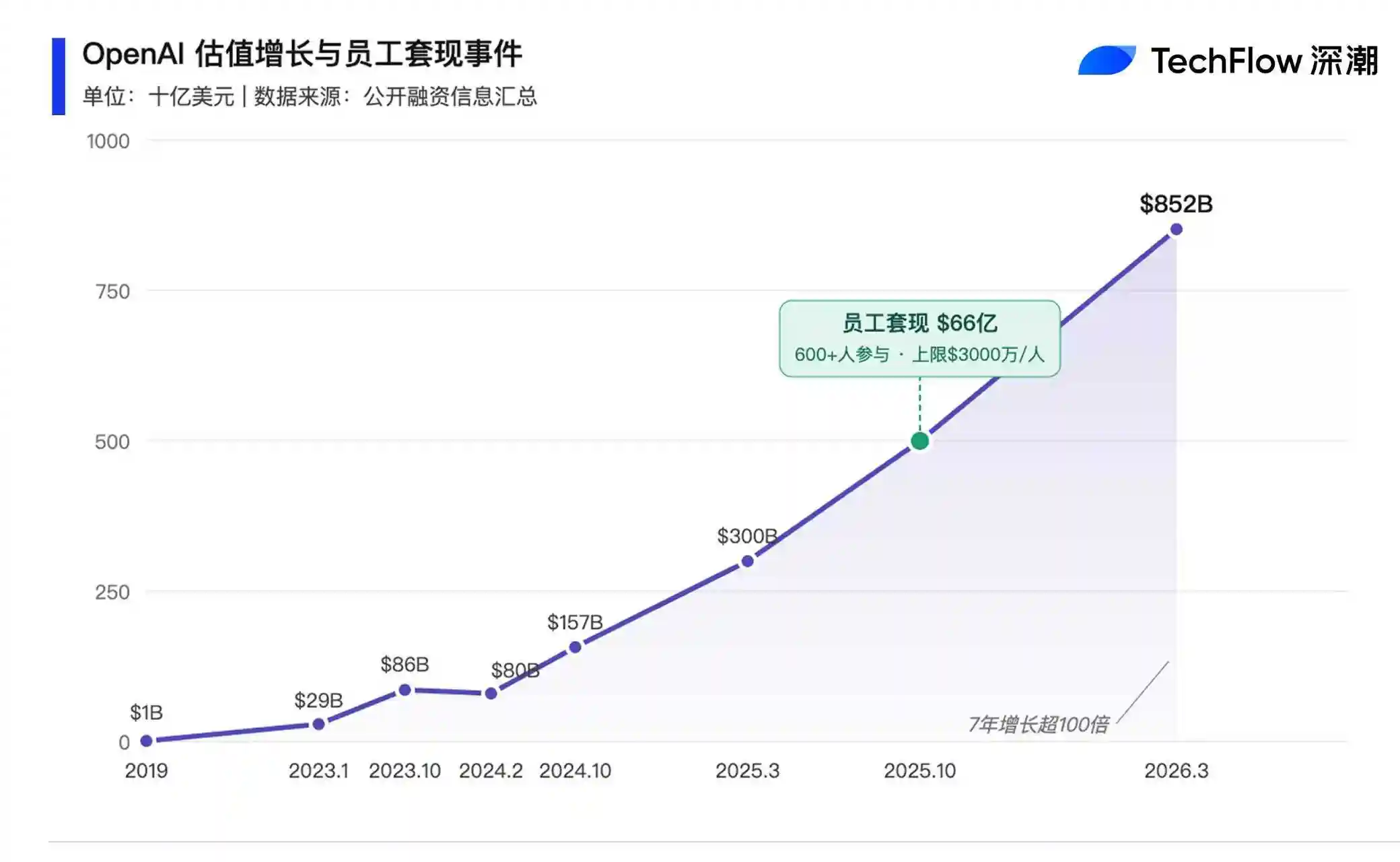
According to The Wall Street Journal, in an internal stock transaction completed last October, OpenAI allowed employees to sell up to $30 million in shares each. Over 600 current and former employees participated, cashing out approximately $6.6 billion in total. Informed sources revealed that about 75 of them took the full $30 million cap. This is the largest single employee stock sale event in the tech industry to date.

Cash-Out Cap Tripled, Driven by External Investor Demand

OpenAI originally set a single cash-out limit of $10 million for employees. However, due to external investor demand far exceeding expectations, the company tripled the cap to $30 million last fall.

The transaction was completed at a $500 billion valuation, with investors including Thrive Capital, SoftBank, Dragoneer Investment Group, Abu Dhabi's MGX, and T. Rowe Price. As previously reported by CNBC, OpenAI initially planned a sale of about $6 billion, later expanded to $10.3 billion, but the actual transaction ended up being around $6.6 billion. Internally, the lower participation rate was interpreted as a vote of confidence in the long-term prospects by employees.

According to OpenAI's rules, employees can sell shares after two years of service. This means many employees who joined after ChatGPT's launch at the end of 2022 had their first opportunity to cash in options in this transaction. The value of OpenAI's stock has increased over 100-fold in the past seven years.
Brockman Confirms $30 Billion Stake in Court, Musk's Lawyer Presses Relentlessly

The scale of wealth held by executives is even more staggering. According to NBC, OpenAI President and Co-founder Greg Brockman confirmed during testimony on May 4th that his current OpenAI equity is worth approximately $30 billion.

This figure was disclosed on the fourth day of the trial in Elon Musk's lawsuit against OpenAI. Musk's lawyer, Steven Molo, repeatedly referenced this number during over two hours of questioning, pressing Brockman on why he hadn't fulfilled a promised $100,000 donation while amassing a $30 billion fortune. According to CNBC, Brockman admitted, "It is true I ultimately did not make the donation."

As reported by Fortune, Musk's legal team also revealed multi-layered financial ties between Brockman and CEO Sam Altman: Altman provided Brockman with about $10 million in equity from his family office as early as 2017; Brockman also holds stakes in AI chip startup Cerebras and nuclear fusion company Helion Energy. OpenAI had previously discussed acquiring Cerebras, and Altman has invested hundreds of millions in Helion. Musk's side argues these cross-holdings compromised Brockman's independence as a fiduciary.

Employees Hold 26% Stake, Average Paper Wealth Exceeds Returns of Most VC Funds

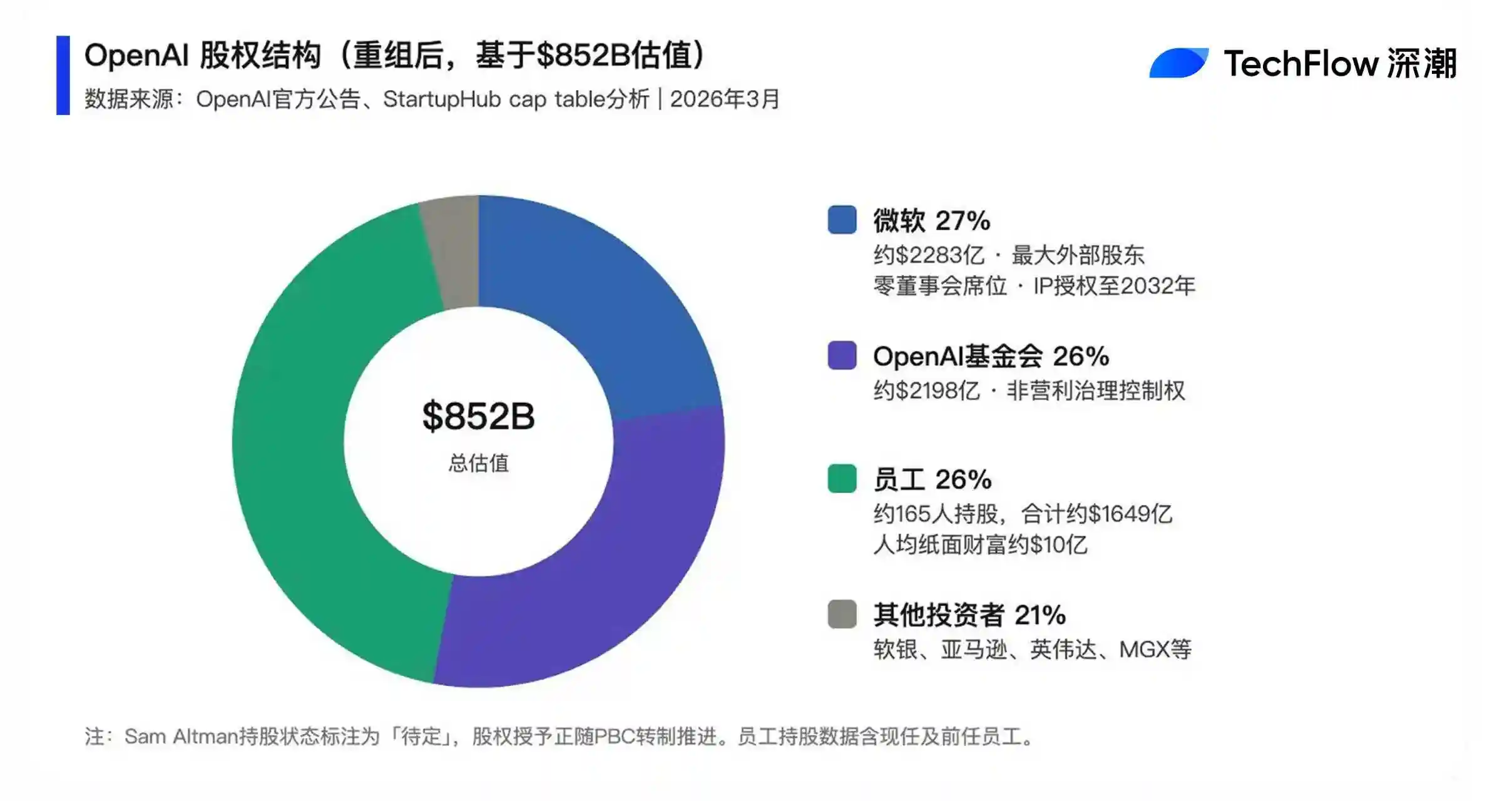
Following the company restructuring completed last October, OpenAI employees collectively hold about 26% of the company's equity.

According to an analysis by StartupHub, approximately 165 current and former employees collectively hold equity worth about $164.9 billion, averaging nearly $1 billion in paper wealth per person. This exceeds the total lifetime returns of most venture capital funds.

According to an analysis by The Wall Street Journal and data firm Equilar, OpenAI's per capita stock-based compensation in 2025 is about $1.5 million. This is over 7 times the figure for Google before its 2004 IPO, and 34 times the average for 18 large tech companies in the year before their IPOs over the past 25 years.

The company's equity-based compensation expense constitutes nearly half of its projected revenue, far surpassing peers like Palantir, Meta, and Salesforce.

$852 Billion Valuation, Trillion-Dollar IPO on Horizon, Wealth Creation Far From Over

OpenAI completed a $122 billion financing round on March 31st this year at an $852 billion valuation, setting a new record for the largest single private funding round in Silicon Valley history. Amazon led the investment with $50 billion, while Nvidia and SoftBank each invested $30 billion. The company's current monthly revenue is $2 billion, with over 900 million weekly active ChatGPT users and more than 50 million paid subscribers.
According to multiple media reports, OpenAI is preparing for an IPO in the fourth quarter of 2026, with a target valuation potentially reaching $1 trillion. If successful, this would become one of the largest tech IPOs in history. CFO Sarah Friar previously stated at Davos that the company plans to allocate a portion of the IPO shares to retail investors.


Пов'язані питання

QAccording to the article, how many OpenAI employees participated in the internal stock sale and what was the total amount cashed out?

AOver 600 current and former employees participated, cashing out a total of approximately $6.6 billion.

QWhat was the new individual cash-out limit set for the October stock sale, and how did it compare to the previous limit?

AThe new individual cash-out limit was set at $30 million. It was a threefold increase from the previous limit of $10 million.

QWhat did OpenAI president Greg Brockman reportedly confirm about his stake in the company during the Musk vs. OpenAI trial?

AHe confirmed that his current OpenAI equity is worth approximately $30 billion.

QWhat percentage of OpenAI is owned by employees, and what is the approximate average paper wealth per employee as cited by StartupHub?

AEmployees collectively own about 26% of OpenAI. According to StartupHub, around 165 employees hold a total of approximately $164.9 billion in equity, averaging about $1 billion in paper wealth per person.

QWhat is OpenAI's reported monthly revenue, and when is its IPO potentially scheduled to launch according to the article?

AOpenAI's monthly revenue is reported to be $2 billion. Its IPO is potentially scheduled to launch in the fourth quarter of 2026.

Пов'язані матеріали

Can DeepSeek Save China One Trillion Dollars?

"DeepSeek and the $1 Trillion Infrastructure Question" The article examines whether DeepSeek's AI optimization breakthroughs could potentially save China $1 trillion in future AI infrastructure costs. The analysis begins with Nvidia's upcoming Vera Rubin AI platform, costing ~$7.8 million, where memory (HBM4/LPDDR5X) constitutes $2 million—a 435% cost increase in one year, highlighting how AI hardware spending is shifting toward expensive memory components. DeepSeek's approach works in the opposite direction. Through three key technical innovations showcased in DeepSeek V4, the company dramatically improves hardware efficiency: 1. **Memory Compression (MLA)**: Re-engineers the attention mechanism to compress long-context memory (KV Cache) by over 90%, drastically reducing expensive HBM usage. 2. **Selective Activation (MoE)**: Employs Mixture-of-Experts architecture where only a small fraction of parameters (e.g., 49B out of 1.6T in V4-Pro) are activated per token, allowing most parameters to reside in cheaper memory/SSD. 3. **Computation Caching**: Reuses previously computed results via cache hits, replacing expensive GPU computations with cheap memory reads. Combined, these optimizations allow the same hardware to produce approximately 4x more tokens, effectively reducing required hardware investment by 75%. DeepSeek's pricing reflects this: a 10-billion token workload costs ~$522 monthly versus ~$9,000-$10,000 for competitors. The $1 trillion savings projection stems from McKinsey's estimate that global AI infrastructure will require ~$5.2 trillion investment by 2030. As China's daily token consumption grows toward quadrillions, even marginal efficiency gains scale massively. With a conservative 4x throughput improvement, China could avoid building tens of thousands of AI data centers equivalent to ~7 trillion RMB ($1 trillion) in saved investment. Critically, this strategy shifts dependency from scarce, expensive GPU/HBM—where China lags—toward more accessible storage, caching, and systems engineering where domestic suppliers like CXMT are gaining strength. Rather than "replacing Nvidia," DeepSeek rebalances AI's value chain away from monolithic hardware dependency. Ultimately, DeepSeek's technical breakthroughs could lower the barrier to AI adoption across Chinese industries by making advanced capabilities affordable at scale—transforming who can access next-generation AI.

marsbit46 хв тому

Can DeepSeek Save China One Trillion Dollars?

marsbit46 хв тому

Overturning the Mainstream Approach to Hallucinations: Metacognition is the New Solution for Large Models to Break the Hallucination Barrier

This paper, "Hallucinations Undermine Trust; Metacognition is a Way Forward," proposes a paradigm shift in combating AI hallucination. It argues that the current mainstream approaches—striving for omniscience by scaling data/models or having AI abstain from uncertain answers—are fundamentally flawed. The former has inevitable knowledge gaps, while the latter imposes a crippling "utility tax," requiring the rejection of many correct answers to achieve high accuracy, due to models' poor "discrimination" (the ability to distinguish correct from incorrect answers internally). The core contribution is redefining hallucination not as "being wrong," but as "expressing false information with unwarranted certainty." The proposed solution is **Faithful Uncertainty** or **Metacognition**: enabling AI to accurately perceive its internal uncertainty and honestly express it in its language (e.g., using hedging phrases when unsure). This creates a more reliable assistant that provides useful information while signaling its confidence, minimizing harm from errors. The paper emphasizes that metacognition is critical for the era of AI Agents. Without it, Agents cannot intelligently decide when to use tools like search engines, leading to inefficiency and misuse. Key implementation challenges are highlighted: the "bootstrapping paradox" of training with static uncertainty data, the "alignment distortion signal" where human preference training suppresses internal uncertainty cues, and the difficulty of causally evaluating true metacognition vs. its superficial imitation. The paper concludes that the goal should not be an infallible AI, but one that is honest about the limits of its knowledge, thereby building user trust through transparent communication of its certainty.

marsbit51 хв тому

Overturning the Mainstream Approach to Hallucinations: Metacognition is the New Solution for Large Models to Break the Hallucination Barrier

marsbit51 хв тому

Hedge by Buying Gold and Oil, Chase Soaring Returns with AI. ‘Dated’ Bitcoin Enters a Bear Market

Bitcoin has recently declined, hitting a two-month low near $66,123, while Ethereum fell to a three-month low around $1,837. Analysts suggest the drop is not merely due to factors like ETF outflows or MicroStrategy's selling but reflects a deeper issue: Bitcoin is losing a broader asset competition. In a near-zero interest rate environment, Bitcoin previously thrived as an outlet for investor dissatisfaction with inflation and limited options. However, the market landscape has shifted. Bitcoin now occupies an "awkward middle ground," facing competition on three fronts. For inflation hedging, investors prefer gold, energy stocks, and commodity producers—assets with tangible backing and clearer pricing power. For growth exposure, AI-related companies with actual revenues and profits are more attractive. Even within crypto, investors can choose stablecoins, exchanges, or infrastructure firms tied directly to adoption, offering clearer business models and leverage. Thus, Bitcoin is no longer the top choice for hedging, growth, or crypto exposure. This shift is evident in market reactions: despite recent warnings about persistent inflation from a Fed official, Bitcoin did not rally as it might have in the past. Instead, capital flowed to assets with direct commodity or energy exposure. The recent ETF outflows and MicroStrategy sales are symptoms, not causes, of this new reality. Investors are becoming more selective, demanding clearer value propositions beyond mere scarcity. The emerging bear case for Bitcoin is not about it being a bubble or failed technology, but that scarcity alone is no longer sufficient.

华尔街日报54 хв тому

Hedge by Buying Gold and Oil, Chase Soaring Returns with AI. ‘Dated’ Bitcoin Enters a Bear Market

华尔街日报54 хв тому

Торгівля

Спот
Ф'ючерси
活动图片




