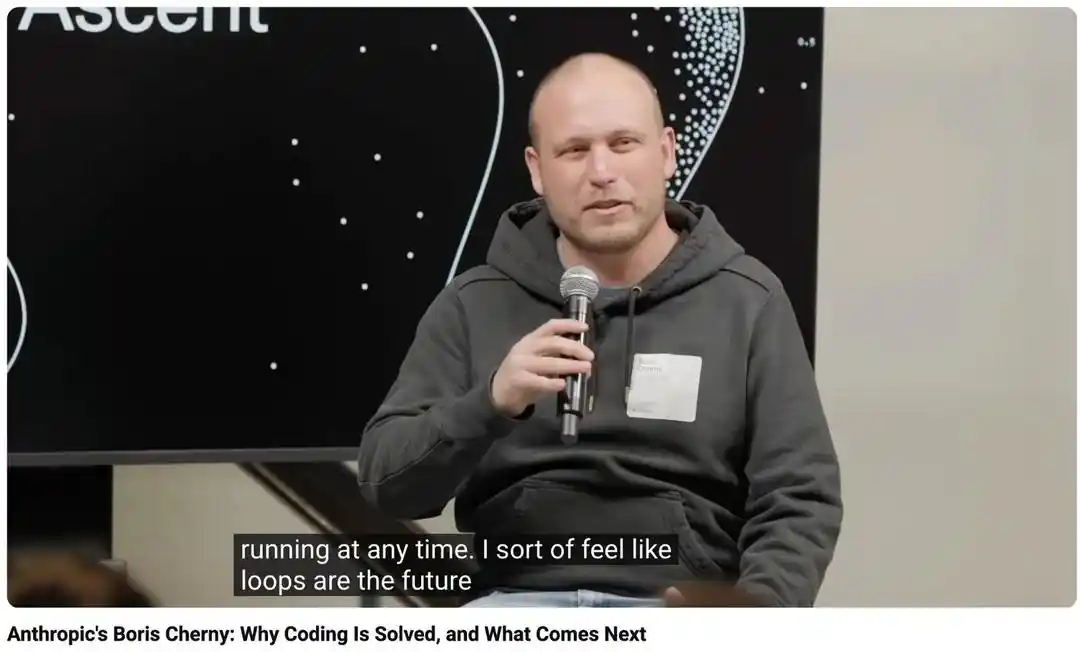
Claude Code's creator has publicly stated that he hasn't handwritten a single line of code in over two months.
In a single day, he can merge 27 PRs, all handled by Claude.
OpenAI researcher roon was even more extreme: 'I don't write code anymore; 100% is done by GPT.'
Now, another big name, after deeply experiencing Claude Code and Codex, declared, 'In five years, humans won't write code anymore!'
These past few days, Rails creator DHH personally took on a major task—
Using only Claude Fable 5, he completely rewrote the Python library 'TerminalTextEffects' into Rust in one go.
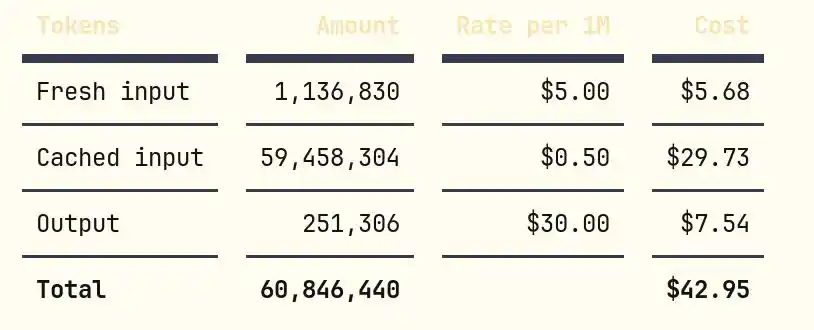
What's astonishing is that this refactoring consumed a staggering 11 million tokens, almost completing it in a single pass.
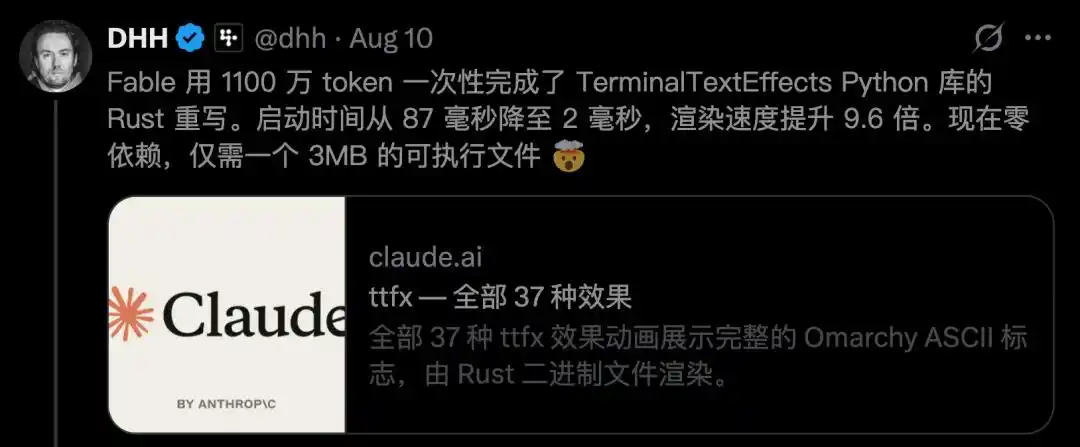
The results after it ran were nothing short of 'cheating'—startup time was compressed from 87 milliseconds to just 2 milliseconds, and rendering speed skyrocketed by 9.6 times.
The post instantly garnered millions of views across the internet.
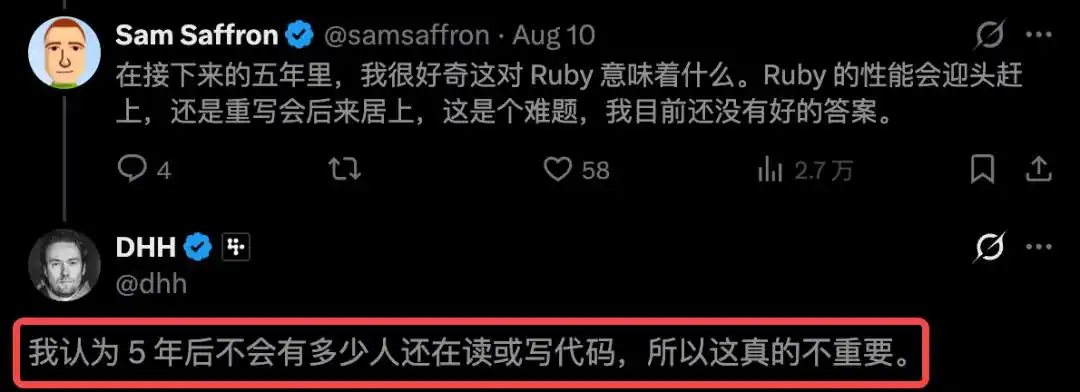
One AI expert directly posed a soul-searching question to the Rails creator: 'If that's the case, where does Ruby go in the next five years?'
DHH's answer was straightforward—
Within five years, not many people will be writing or reading code by hand anymore. So, it really doesn't matter.
Who would have thought that in just one year, the contrast would be so stark!
Handing the Keyboard to AI, Rather Retire
Remember, in May of last year, DHH was firmly stating online that he refused to cede the joy of coding to AI.
In that lengthy post 'Coding should be a vibe!', he clearly stated:
AI is, at best, an assistive 'pair programmer,' good for looking up APIs and answering questions.
He even issued a stern warning: 'If the day comes when I must completely hand the keyboard over to AI, I would rather retire.'
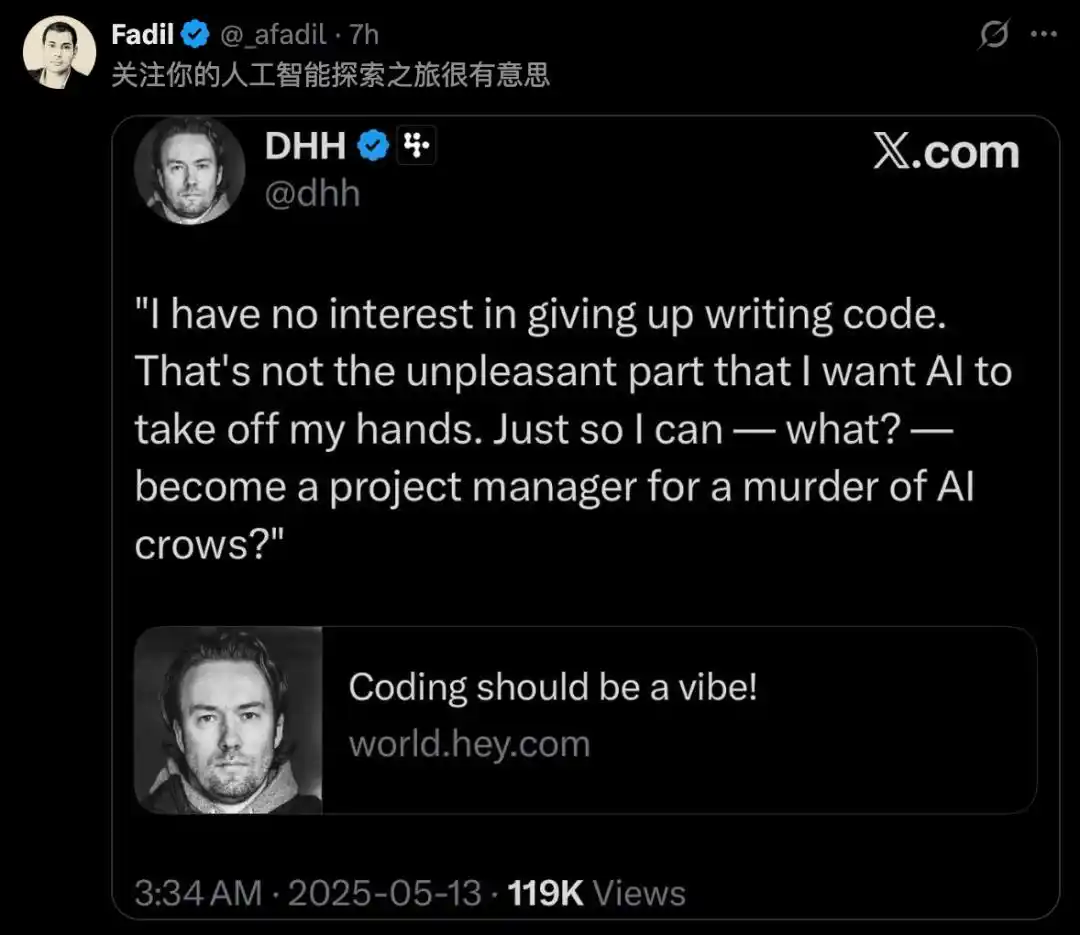
I have zero interest in giving up coding. It's not some chore to offload to AI. What would be the point? To become a project manager for a pack of AI 'hooligans'?
In that six-hour deep-dive conversation with Lex Fridman, DHH insisted that every line of his code was typed by his own hands.
Once, while building a Linux distribution, he repeatedly asked AI to generate the same Bash conditional statement, only to realize that because he lacked the physical act of typing, he never truly mastered it.
This loss of 'muscle memory' left him deeply unsettled. 'Is this the end of learning?'

However, by April this year, the winds had shifted dramatically.
On a podcast, he admitted he had now fully switched to 'Agent-first,' essentially saying goodbye to handwritten code.
Yet, no one expected the phrase 'in five years, not many people will be reading or writing code' to come from the mouth of the Rails creator.
Fable 5 All-in, No One Writes Code in Five Years
Let's take a closer look at this hardcore Python rewrite by Claude.
TerminalTextEffects, or TTE for short, is a terminal visual effects engine.
It can be used both as a command-line program and imported as a Python library into other applications.
Developers can, like magicians, control text trajectories, colors, gradient effects, and animation sequences, transforming dull UIs into something cool.
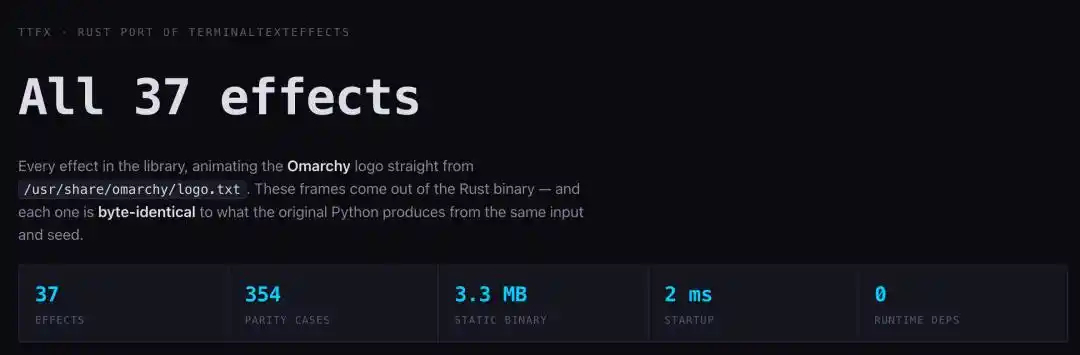
The Rust version demonstrated by DHH can run 37 effects.
A piece of software that originally required a Python runtime environment was transformed by Claude's refactoring into a mere 3MB executable.
This new repository is called ttfx, hosted under DHH's own Omarchy organization, with every commit history intact.
The entire process took 3 hours and 11 minutes. The main Rust code is 21,000 lines, almost the same volume as the original Python version.
During the task, 8 Agents each worked on a separate branch simultaneously, in batches: reading the code themselves, generating implementations, compiling, running tests, handling failures, then moving to the next round.
The so-called 'one-shot' was essentially handing the task over once.

Using the same method, DHH had Codex complete it, and the results after a single prompt were also excellent.
However, it was 30% slower and cost $43 (290 RMB) in Tokens.
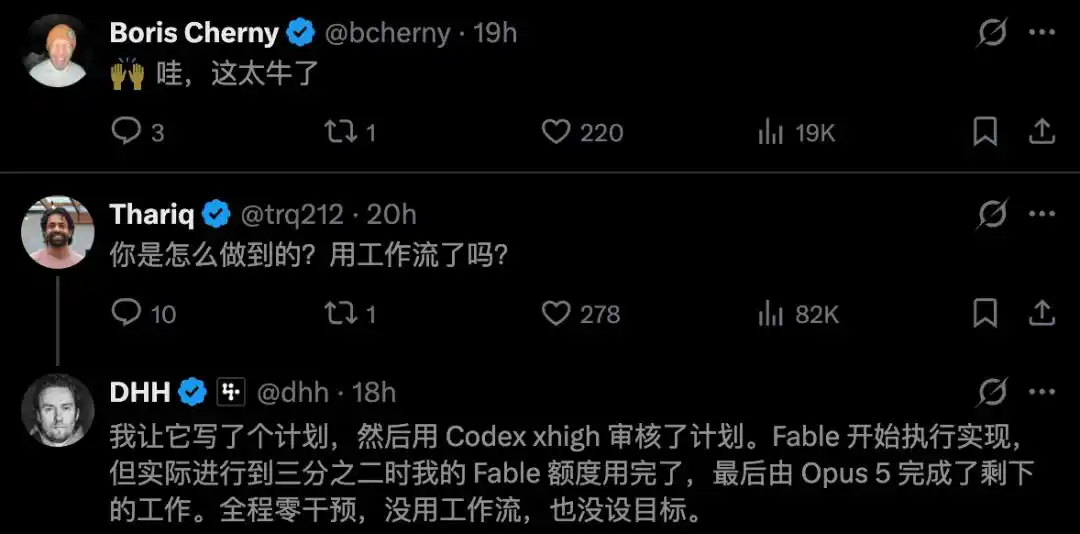
DHH's hardcore operation directly blew up the community, drawing out several Anthropic bigwigs.
Claude Code creator Boris Cherny couldn't help but appear in the comments exclaiming, 'This is insane!'
Faced with a follow-up question from another researcher, Thariq, DHH revealed an even more astonishing detail—
He simply asked Claude to formulate a plan. After that, it was zero intervention throughout, no complex workflows applied, no specific goals pre-set; it was all about complete delegation of authority.
Million-Line Codebase, Bun One-Click Migration
TerminalTextEffects, after all, is limited in scale.
What truly demonstrates the power of AI coding is a massive refactoring in Bun's core.
A few months ago, founder Jarred Sumner personally spearheaded the migration of the massive codebase from Zig to Rust in its entirety.

It's astonishing that this monumental project, involving a million lines of code, was declared 'complete' in less than two weeks.
If this were a few years ago, a project of this magnitude would have been a marathon lasting several quarters, if not years.
Future Coders to Become 'Dragon Tamers'
Now, all signs are frantically hinting at a fact that is both brutal and exciting—
The marginal cost of code generation is approaching zero.
This inevitably plunges many into panic. 'If no one reads or writes code in five years, will programmers disappear?'
Actually, 'no one writes code' absolutely does not equal 'programmers disappear.'

The core work of future programmers will undergo a fundamental shift—
From 'personally implementing code' to fully focusing on defining requirements, designing constraints, establishing testing frameworks, and judging whether the AI wrote it correctly.
It's foreseeable that when 'handcrafting code' becomes history, the only remaining scarce moats will be two points:
Insight into 'what is worth doing' + defining 'what counts as correct.'
Rather than worrying about losing your keyboard, it's better to start thinking now: what kind of Rome do you want to command this boundless-compute 'super coder' AI to build?
References:
https://x.com/dhh/status/2086713611934695848?s=20
https://claude.ai/code/artifact/287825bc-7aad-4541-a7e7-fa4ba8d03612
This article is from the WeChat public account "New Zhiyuan", author: Taozi